
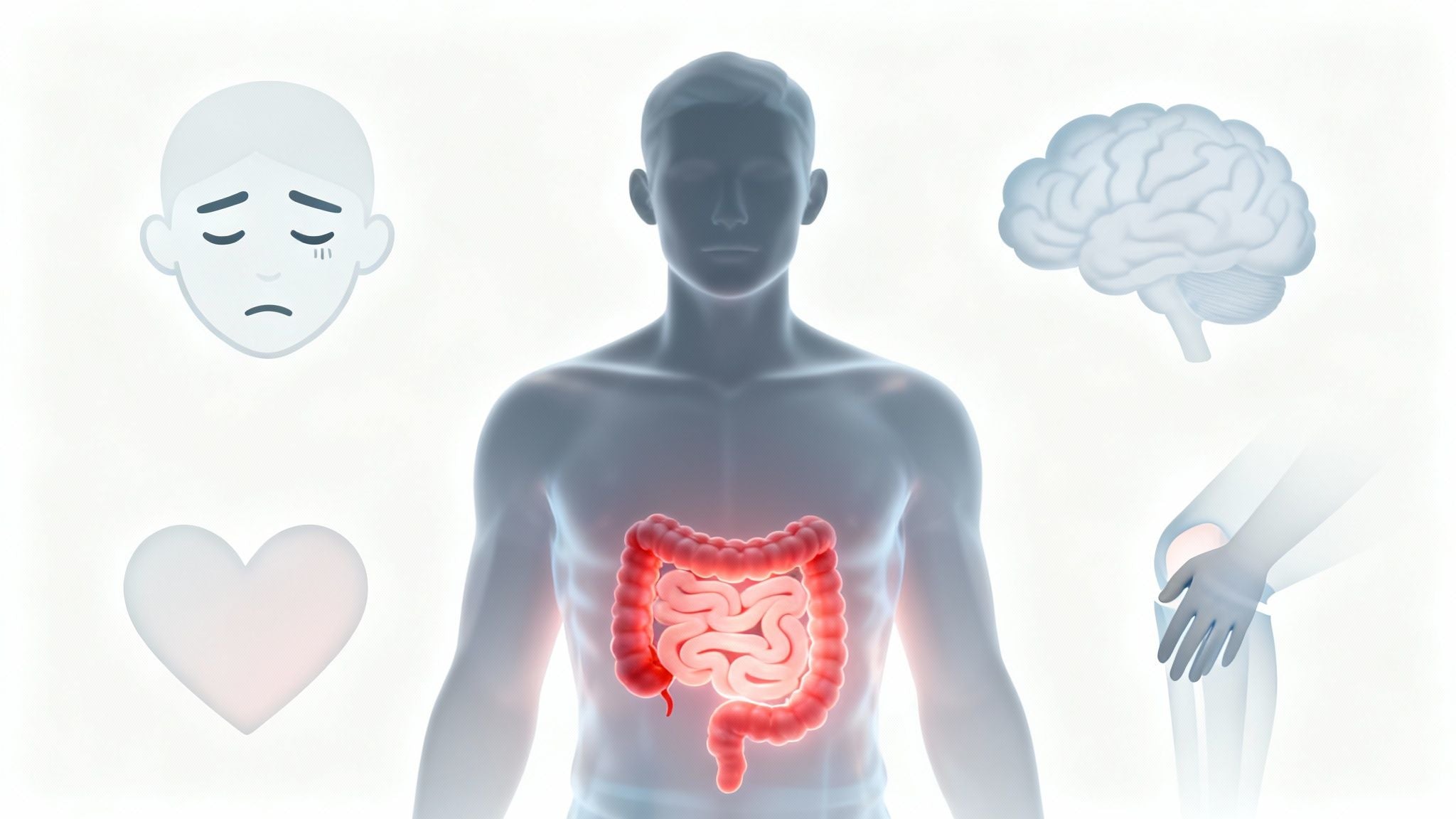
Celiac Disease: How to Properly Interpret the Symptoms in Adults
Do you often feel sluggish, have difficulty concentrating, or experience symptoms that no doctor can properly explain? They could be symptoms of celiac disease in adults. It is a complex autoimmune disease that often hides behind everyday complaints and affects far more than just the intestines.
Why Celiac Disease Is Often a Chameleon in Adults
When people think of celiac disease, they usually have the classic gastrointestinal problems in mind. Yet especially in adulthood, the condition often looks completely different. Imagine your body as a finely tuned orchestra: in celiac disease, gluten acts like a loud disruptive noise that not only throws a single group of instruments—your intestines—out of rhythm, but disrupts the entire interplay.
The result is chronic inflammation of the small intestinal lining, which severely limits your ability to absorb nutrients. This deficiency in vitamins and minerals can then make itself felt in many different areas of your body—often long before the typical digestive problems even appear.
Understanding the Hidden Epidemic
The figures speak for themselves. According to the German Celiac Disease Society (DZG), around one in 100 people in Germany has celiac disease. What is interesting is that only around 10 to 20% of those affected show the classic full picture with abdominal pain and diarrhea.
The vast majority—around 80 to 90%—experience mild, atypical symptoms or initially have no symptoms at all, which naturally makes diagnosis more difficult. You can also read more about this in the AOK information on celiac disease in adults.
This wide range of possible signs makes celiac disease a true chameleon among illnesses. Many people affected have endured years of going from doctor to doctor without receiving a clear answer. Symptoms such as chronic fatigue, iron deficiency, or joint pain are often mistakenly dismissed as stress, signs of aging, or separate conditions.
Celiac disease is not merely a digestive disorder. It is a systemic autoimmune disease that can affect your entire body—from your skin and joints to your brain.
More Than Just an Intolerance
It is crucial to understand that celiac disease is far more than a simple gluten intolerance. While an intolerance simply means your body has difficulty digesting gluten, in celiac disease it triggers an aggressive immune response.
This reaction leads to the destruction of the small intestinal villi—the tiny, finger-shaped projections responsible for absorbing nutrients. Learn more about the differences in our article on the various forms of gluten intolerance.
This guide is intended to help shed light on the situation. We will show you which typical and, above all, atypical symptoms to look out for so that you can better understand your body's signals.
Understanding classic digestive symptoms
Although celiac disease often disguises itself well, classic gastrointestinal symptoms are a central piece of the puzzle for many adults. Imagine the inner wall of your small intestine as a fluffy carpet with countless fine fringes. These fringes, known as intestinal villi, greatly increase the surface area and ensure that nutrients from your food can optimally enter your bloodstream.
In celiac disease, gluten triggers a severe immune reaction that attacks this exact carpet. The villi become inflamed, progressively shorter, and eventually flatten completely. As a result, the surface area of your intestine shrinks dramatically—a condition doctors call villous atrophy. The logical consequence: Your body can no longer properly absorb vitamins, minerals, and other vital nutrients.
This state of inadequate absorption is called malabsorption. It is the key mechanism responsible not only for intestinal problems but also for many symptoms throughout the body.
From diarrhea to bloating
Impaired digestion and chronic inflammation in the intestine lead to a range of typical symptoms. It is important to note that not everyone experiences all of them. The severity can vary dramatically from person to person.
The most common classic digestive symptoms in adults include:
- Chronic diarrhea: Often watery, voluminous, and foul-smelling. It occurs because the damaged intestine can no longer properly absorb water and fats.
- Bloating and abdominal distension: Undigested food particles move into lower sections of the intestine. There, bacteria break them down and produce gas, leading to a painfully bloated abdomen.
- Abdominal pain and cramps: They are usually caused by gas and the constant irritation of the inflamed intestinal lining.
- Nausea and vomiting: Although less common, this can occur—especially after a meal containing gluten.
- Unexplained weight loss: When your body does not get enough nutrients despite a normal diet, it draws on its own reserves. This can lead to unintended weight loss.
What is important to understand is: These symptoms are direct consequences of the inflammation and the resulting malabsorption. They are your gut’s distress signal that something is fundamentally wrong.
When constipation becomes a symptom
It may sound paradoxical at first, but constipation can also be a sign of celiac disease. While diarrhea is much more common, some adults instead suffer from sluggish digestion. The exact mechanisms behind this are complex, but it is thought that the inflammatory processes disrupt normal intestinal movement (peristalsis) and slow everything down.
This very variety of symptoms makes it so difficult to distinguish celiac disease from other conditions such as irritable bowel syndrome (IBS). Many complaints, especially bloating and abdominal pain, overlap. The crucial difference, however, is that celiac disease is an organic autoimmune disorder with detectable intestinal damage. Irritable bowel syndrome, on the other hand, is considered a functional disorder without visible inflammation. Thorough medical evaluation is therefore absolutely essential to establish the correct diagnosis and finally begin the appropriate treatment.
Atypical symptoms: When celiac disease manifests outside the gut
When the classic digestive problems are absent, many adults begin a years-long, often frustrating odyssey from doctor to doctor. Celiac disease is a true master of disguise, and its symptoms in adults often appear in places that you would not initially associate with the gut at all. In fact, these so-called extraintestinal signs are now the most common reason why the disease is diagnosed only at a late stage.
Imagine the inflammation in your small intestine as a smoldering fire. At first, you may notice only the smoke spreading throughout the house—that is, nonspecific symptoms—but not the fire itself. This “smoke” spreads throughout the body via the bloodstream and can cause problems in all sorts of places. The cause is a mix of the aforementioned malabsorption (impaired nutrient absorption) and a systemic immune response. So your body is not fighting only locally in the gut, but throughout the entire system.
When the energy has simply disappeared
One of the most common and at the same time most misunderstood symptoms is chronic, leaden fatigue and exhaustion, also known as fatigue. This is not the normal tiredness after a demanding day. It is a deep, debilitating feeling of having no energy that does not go away even after getting enough sleep and is often mistakenly dismissed as burnout or the result of stress.
However, this fatigue has tangible physical causes that can be directly attributed to celiac disease:
- Iron-deficiency anemia: Your body needs iron to transport oxygen through the blood. If the intestinal lining is damaged, it cannot absorb enough of it. The result is anemia, which causes paleness, shortness of breath, and this severe exhaustion. A typical sign is that iron tablets have little or no effect—because the iron simply does not reach where it is needed.
- Vitamin B deficiency: In particular, a vitamin B12 deficiency can cause fatigue and even neurological disorders. Since this important vitamin is also absorbed in the small intestine, a deficiency is almost inevitable in undiagnosed celiac disease. If you want to learn more, read our article to better recognize the signs of a vitamin B12 deficiency.
- Chronic inflammation: Imagine your immune system running at full speed 24/7 to fight gluten. This constant state of alarm costs your body an incredible amount of energy—and you feel it every day.
The figures confirm this trend: The prevalence of celiac disease among adults in Germany has risen sharply over the past few decades. A 2020 meta-analysis shows that the incidence increases by an average of 7,5 % increased. While the average age at diagnosis was around 30 before 1981, people affected today are often between 40 and 45 years old. This means that more and more adults are only showing symptoms such as fatigue, anemia, or even osteoporosis in middle age.
When the mind and psyche suffer
The connection between our gut and our brain—the so-called gut-brain axis—is a fascinating field of research. In celiac disease, this communication becomes severely disrupted, which can manifest in a wide range of neurological and psychological symptoms.
Many people describe a condition known as “brain fog”. They feel unfocused and forgetful, and feel as though they can no longer form clear thoughts. This is not imagined, but a real consequence of the inflammatory processes and nutrient deficiencies that directly affect the brain.
Other possible symptoms in this area include:
- Headaches and migraines: Celiac disease can be a trigger for recurring, severe headaches. Many people report that the attacks become significantly less frequent and less intense on a gluten-free diet.
- Depression and anxiety: Chronic inflammation can disrupt the production of important chemical messengers in the brain, such as the “happiness hormone” serotonin. This is compounded by the enormous psychological burden of years of unexplained symptoms.
Remember: If you suffer from psychological or neurological symptoms that no one can explain, taking a closer look at your intestines and undergoing diagnostic testing for possible celiac disease could be the decisive step.
Skin, joints, and liver as silent warning signs
The systemic nature of celiac disease is also evident in organs that, at first glance, you would not associate with the intestines at all. The immune response and nutrient deficiencies leave their mark throughout the body.
One very specific skin condition closely associated with celiac disease is dermatitis herpetiformis Duhring. It is an extremely itchy rash with small blisters that often appears on the elbows, knees, or buttocks. It is also known as the “skin manifestation” of celiac disease.
Joint and muscle pain can also be a warning sign. Chronic inflammation in the body can cause nonspecific pain that is sometimes mistakenly interpreted as rheumatism.
Finally, elevated liver enzymes may also show up during a routine blood test, without any other apparent cause such as alcohol or an infection. As a central metabolic organ, the liver reacts very sensitively to inflammatory processes. In many cases, these levels normalize on their own with a strictly gluten-free diet. This diversity makes it clear how important it is to think outside the box when symptoms are unclear—and to keep celiac disease in mind.
The path to a reliable diagnosis
Do you recognize some of the symptoms described in yourself and wonder whether celiac disease might be behind them? Then the next step is crucial: You need certainty. But how can such a complex condition actually be diagnosed reliably? The path to diagnosis is a clearly structured process consisting of several stages and must be supervised by a doctor.
One thing is especially important: You must continue eating gluten-containing foods as usual during this process. That may sound strange, but it is absolutely crucial. Think of it this way: If you want to catch a burglar in the act, there is no point in locking the door beforehand. Gluten works the same way. If you eliminate it before the tests, your immune system reduces its response. The telltale traces in your blood and intestines become invisible—and the results would be distorted. A reliable diagnosis would then be impossible.
Step 1: The blood test as the first indication
It almost always starts with a blood test, also called serology in technical terms. The lab does not look for gluten itself, but for the traces your immune system leaves behind while fighting it—that is, very specific antibodies.
Your doctor will primarily look at these values:
- Transglutaminase IgA antibodies (tTG-IgA): This is the most important and informative marker. In celiac disease, the immune system mistakenly classifies the tissue transglutaminase enzyme as an enemy and attacks it. Elevated tTG-IgA levels are a very strong indication of active celiac disease.
- Endomysial IgA antibodies (EmA-IgA): This test is extremely specific and is often used for confirmation when the tTG-IgA test is positive.
- Total IgA: This value is checked in parallel to rule out a rare IgA deficiency. If someone had this deficiency, the IgA antibody tests would be falsely negative. In such a case, your doctor would switch to other testing methods based on IgG.
A positive antibody test is not yet a definitive diagnosis, but it is the crucial spark that strengthens the suspicion and initiates the next steps. If you are unsure which tests are suitable for you, our article about the celiac disease test offers a good starting point.
Step 2: Genetic analysis to rule it out
Sometimes a genetic test also makes sense. It looks for the genetic markers HLA-DQ2 and HLA-DQ8 in a blood or saliva sample. What you need to know: Around 30% of the population in Germany carries these genes, but only a tiny fraction of them ever actually develop celiac disease.
So, a positive genetic test does not mean that you have celiac disease. It only indicates that you carry the genetic predisposition for it.
The real benefit of the test lies in the opposite scenario: If neither HLA-DQ2 nor HLA-DQ8 is found in the genetic material, celiac disease can be ruled out with over 99% certainty. This makes it a valuable tool for finally providing clarity in cases of unclear findings or for family members of affected individuals.
The following infographic summarizes the typical path to diagnosis once again.
This clearly shows how the individual examinations fit together to ultimately arrive at a truly reliable diagnosis.
Step 3: The small-intestinal biopsy as the gold standard
The final and decisive step in definitively confirming the diagnosis is the small intestine biopsy. Although the thought of it may cause some discomfort, the examination itself is generally straightforward and is the only way to see the extent of the intestinal damage with your own eyes.
The biopsy is performed as part of an upper endoscopy (gastroscopy). A specialist (gastroenterologist) guides a thin, flexible tube with a camera through your mouth and esophagus into the first section of the small intestine. The entire procedure often takes only 10–15 minutes and can be performed with mild sedation or during a brief twilight sleep if desired. You will not notice anything.
During the endoscopy, the doctor takes tiny tissue samples (usually 4–6 samples) from the lining of the small intestine. A pathologist then examines these samples under a microscope, specifically looking for the typical changes caused by celiac disease:
- Villous atrophy: The intestinal villi are flattened or even completely absent.
- Crypt hyperplasia: The indentations between the villi are enlarged.
- Intraepithelial lymphocytes: An unusually large number of certain immune cells are present in the intestinal lining.
Only when the antibodies in the blood are positive and the biopsy confirms the characteristic damage to the intestinal villi is the diagnosis of celiac disease completely certain. This clear, multistep process is essential because the consequence—a lifelong, strictly gluten-free diet—is a major intervention that should only be undertaken on an absolutely certain basis.
Long-term risks of undiagnosed celiac disease
Celiac disease that goes unnoticed for years is far more than just a digestive problem. It is a ticking time bomb for your health. Imagine that your body is permanently engaged in a silent defensive battle. Chronic inflammation in the intestine and inadequate nutrient absorption leave their mark—and throughout the entire body.
These effects usually develop gradually. You do not feel them from one day to the next. That is precisely why it is so important to know the potential complications. This knowledge is not meant to frighten you. Rather, it should encourage you to act quickly if you suspect symptoms of celiac disease in adults and seek clarity.
The domino effect of nutrient deficiencies
The intestinal lining damaged by celiac disease is like a sieve full of holes. Essential building blocks for your body—vitamins, minerals, and trace elements—simply get lost instead of reaching where they are needed. Sooner or later, this leads to serious deficiencies.
Two of the most common and consequential deficiencies are:
- Iron deficiency and anemia: When your body can no longer absorb iron, you develop anemia. As a result, you feel constantly exhausted, look pale, and have very little physical stamina. Persistent anemia that does not respond even to iron tablets is an absolute warning sign of undiagnosed celiac disease. Find out more about this topic in our article about the importance of ferritin levels.
- Osteoporosis caused by calcium and vitamin D deficiency: Strong bones need calcium and vitamin D. If these are poorly absorbed over many years, bone density declines. This dramatically increases the risk of fractures in old age.
Undiagnosed celiac disease quietly but steadily deprives your body of its most important resources. Its effects often do not become apparent until years later, when serious damage has already occurred.
The increased risk of other autoimmune diseases
Celiac disease is an autoimmune disease—and unfortunately, it rarely occurs alone. An immune system that has become misguided once tends to attack other structures in the body as well. These are known as associated autoimmune diseases.
People with untreated celiac disease have a significantly increased risk of developing another autoimmune disease. The most common include:
- Hashimoto's thyroiditis: A chronic inflammation of the thyroid gland that leads to an underactive thyroid.
- Type 1 diabetes: A disease in which the immune system destroys the insulin-producing cells of the pancreas.
Early diagnosis and consistently switching to a gluten-free diet can help calm the immune system and demonstrably reduce this risk. It is a crucial step toward regaining control of your health.
Effects on fertility and pregnancy
Undiagnosed celiac disease can also significantly disrupt family planning—for both women and men. Chronic inflammation and nutrient deficiencies throw the delicate hormonal balance out of equilibrium.
In women, this can lead to menstrual irregularities, difficulty becoming pregnant, and an increased risk of miscarriage. Men can also experience reduced fertility. The good news: After diagnosis and the start of a strictly gluten-free diet, these problems completely resolve in the vast majority of cases.
These examples make it clear: taking the symptoms of celiac disease in adults seriously and having them evaluated is one of the most important preventive measures for your long-term health.
Why so many adults are unknowingly affected
Are you also wondering how such a serious disease as celiac disease can fly under the radar for countless people? The answer is actually quite simple: Celiac disease is a master of disguise. The symptoms in adults are often so nonspecific and gradual that they are misinterpreted for years or simply accepted.
The old image of the typical celiac patient—underweight, pale, and plagued by abdominal cramps—is long outdated. Today, this stereotype applies to only a small minority. Instead, many people complain of vague symptoms such as crushing fatigue, constant headaches, or unexplained joint pain. In everyday life, such symptoms are quickly attributed to stress, lack of sleep, or simply getting older.
Honestly, who would immediately suspect a serious intestinal disease because of persistent fatigue? This very misjudgment leads to a huge number of unreported cases. Celiac disease often smolders unnoticed for years while your intestine is already quietly suffering damage.
The deceptive silence in the abdomen
A key reason for the often-late diagnosis is the absence of classic gastrointestinal problems. When the stomach does not hurt and digestion seems normal, neither those affected nor their doctors think of the intestine as the source of the problem.
In reality, the diversity of atypical symptoms is what makes it so difficult. Persistent iron deficiency is treated with iron tablets, depressive moods with psychotherapy, and painful joints with painkillers. Often, only the symptom is treated, while the actual cause—the autoimmune reaction to gluten—remains undetected.
Many people still believe that celiac disease cannot exist without diarrhea or abdominal pain. This is a widespread misconception. Especially in adults, entirely different symptoms often take center stage, obscuring what is actually happening in the intestine.
This situation is supported by an impressive statistic: Estimates suggest that 80 to 90% of adults with celiac disease in Germany have no clear symptoms or only very mild ones. This means that the overwhelming majority have no idea they have the condition. The textbook symptoms, such as diarrhea or weight loss, occur in only about 10 to 20% of those affected. You can read more about this astonishing number of unreported cases in this article about celiac disease symptoms.
Understanding “silent celiac disease”
There is even a form known as silent celiac disease (or asymptomatic celiac disease). Those affected subjectively experience few or no symptoms. Nevertheless, their immune system is fully active, and the same destruction of the intestinal villi occurs in the small intestine.
This form of celiac disease is often discovered only by chance—for example, during a gastroscopy for an entirely different reason or when a family member of someone with celiac disease is examined. Even if you feel completely healthy, the intestinal damage and associated long-term risks are just as real. The absence of symptoms is therefore not an all-clear. Medical evaluation of chronic, unexplained symptoms is always a sensible step to protect your long-term health.
Celiac disease symptoms: Your most frequently asked questions, answered briefly
Do you still have unanswered questions or are you unsure how to interpret certain signs? Here you will find clear, easy-to-understand answers to the most important questions about the symptoms of celiac disease in adults.
Can celiac disease first develop in adulthood?
Yes, absolutely. Many people affected are not diagnosed until they are between 40 and 60 years old. You carry the genetic predisposition throughout your life, but it often takes a trigger to “awaken” the disease. This could be severe stress, a serious infection, or even surgery.
Do the symptoms disappear immediately when I stop eating gluten?
Unfortunately, not always. Some symptoms, such as bloating or diarrhea, may improve after just a few weeks. With other symptoms, such as iron deficiency, chronic fatigue, or neurological problems, it may take months before you notice a significant change. Regenerating your intestinal lining is a process that takes time.
Patience is truly essential here. Your body needs to heal the damage caused by chronic inflammation and slowly replenish its depleted nutrient stores.
Should I simply stop eating gluten if I suspect I have it?
Absolutely not—this is a misconception that can make diagnosis much more difficult. Starting a gluten-free diet on your own can distort the results of blood tests and a small-intestinal biopsy. A subsequent confirmed diagnosis can become almost impossible as a result. Always speak to a doctor first before changing your diet.
Which doctor should I see?
Your first step should ideally be to see your family doctor. They can order the initial blood tests (serology). If the suspicion is confirmed, a gastroenterologist is the right specialist to consult. They specialize in further diagnostics, particularly gastroscopy with a biopsy.
Would you like to proactively learn more about your body and uncover potential nutrient deficiencies or intolerances? mybody-x.com offers scientifically based at-home self-tests. Use our analyses to find out what your body really needs and take control of your health. Discover the right tests now at https://mybody-x.com.



Share now:
Big Belly from Helicobacter: When a Bacterium Bloats the Abdomen
Rebuilding gut flora after antibiotics: what is supported by evidence and what is not