
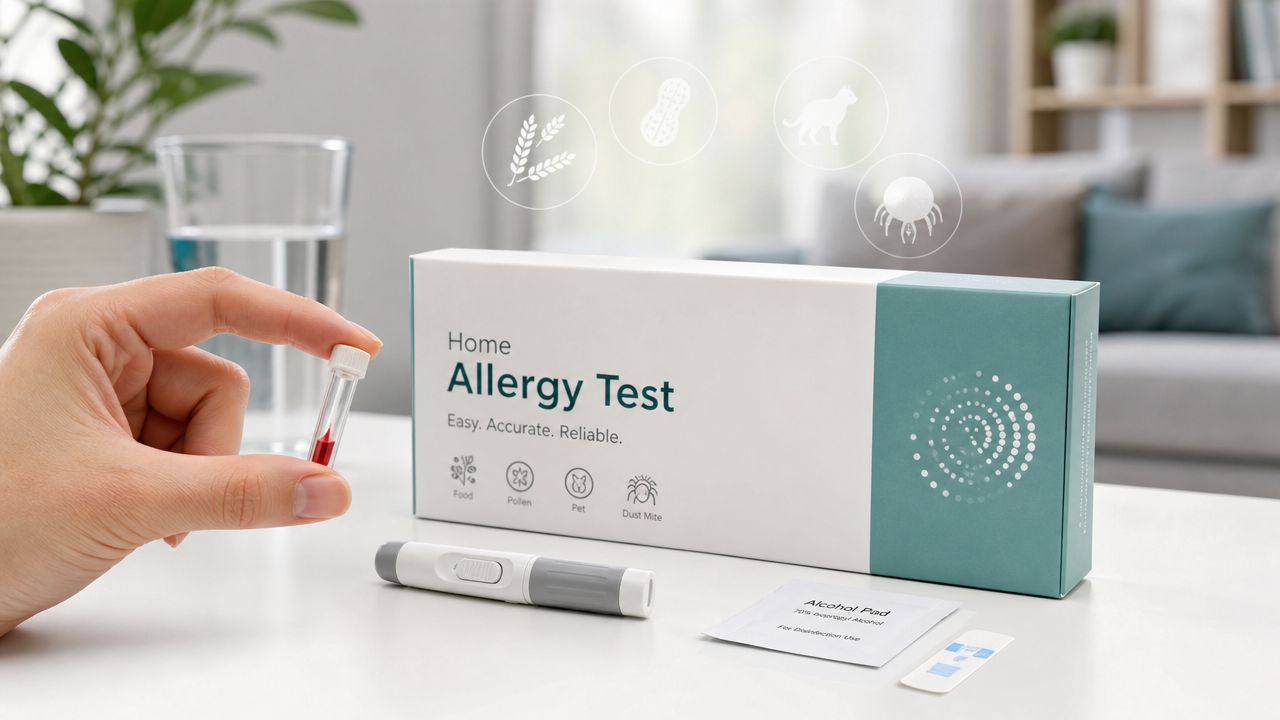
Allergy test: Allergy test 2026
You may be in exactly such a situation right now. Your nose is running, but you don’t have a cold. Your skin suddenly itches after eating a particular food. When visiting friends with a cat, your eyes water, and you wonder whether it is a coincidence or a clear pattern after all.
Then the usual guesswork often begins. You Google symptoms, eliminate foods, try home remedies, and observe your body almost every day. That is understandable. But it costs time, energy, and often quality of life as well.
If you are looking for a clear, scientifically sound next step, you are on the right track. Especially when it comes to allergy testing, the goal is not to keep guessing, but to find out specifically whether your immune system reacts to certain substances.
Put an end to constant guesswork about symptoms
Many people are familiar with the vague feeling that “something” is wrong. Sneezing in the morning without having a cold. A tingling sensation in the mouth after eating. Coughing in the bedroom at night. Such symptoms often seem harmless at first, but they can make everyday life quite difficult.

In Germany, around 20 to 25% of the population suffer from an allergic disease. This shows how common the issue is and why the cause of symptoms often remains unclear for a long time, as explained in the overview of allergy prevalence in Germany.
Why so many people misinterpret their symptoms
The problem is rarely a lack of attention. Quite the opposite. People with symptoms often observe themselves very closely, but they also quickly draw premature conclusions from individual situations.
Typical thoughts include:
- “I felt ill after eating strawberries”. Maybe that was the reason. Maybe it wasn’t.
- “I’m always tired in spring”. This could be related to pollen, but it doesn’t have to be.
- “Something sometimes happens around dogs”. Sometimes that is too vague for a clear assessment.
That is precisely why it helps to clearly distinguish between an allergy and an intolerance. If you want to understand this difference better, you can find a helpful explanation in the article on the difference between allergies and intolerances.
Many symptoms look similar. But the underlying cause can be completely different.
Clarity beats trial and error
Self-observation is useful. However, it does not replace targeted diagnostic testing. If you avoid foods, pets, or constantly adjust your surroundings based on suspicion without knowing the cause, you often end up going in circles.
A structured test can take you much further. Not as a panic reaction, but as a logical step. You do not have to figure everything out on your own. Your body provides clues, and a blood test can make these clues more tangible.
What an allergy really is and what types there are
Put simply, an allergy is an overreaction of the immune system. Your body classifies a substance that is actually harmless as a threat and reacts to it as though it had to defend itself.
A simple image can help. Imagine your immune system as a bouncer. Normally, it recognizes what is harmless and decides whom to let in. With an allergy, this bouncer gets it wrong. It considers pollen, animal proteins, or certain food components dangerous and triggers an alarm.

Common types of allergies in everyday life
To better classify your symptoms, it helps to look at typical groups.
-
Respiratory allergies
These include reactions to pollen, dust mites, or animal dander. Typical symptoms include sneezing, a runny nose, watery eyes, or coughing. -
Food allergies
Here, the body reacts to certain proteins in foods, such as those found in nuts, milk, or wheat. Some people experience itching in the mouth, while others have gastrointestinal symptoms or skin reactions. -
Contact allergies
These often appear directly on the skin. Jewelry, fragrances, or certain ingredients in cosmetics can be triggers. -
Insect venom allergies
Reactions after bee or wasp stings can be significantly more severe than normal local swelling. -
Drug allergies
Some people react to certain active ingredients, for example with a rash or other symptoms.
Why identifying the cause is often difficult
Symptoms do not always follow a clear pattern. A pollen allergy can feel like a constant cold. A food allergy is sometimes mistaken for an intolerance. Skin reactions can come from within or from external factors.
Remember: Not every symptom after contact with a substance is automatically an allergy. But recurring patterns deserve careful clarification.
If you want to get an overview of typical triggers, the article what allergies are there can also help.
Why the term “allergy test” is searched for so often
People searching for “allergy test” usually do not want theory. They want to know: Which option is right for me? That is exactly why understanding the types of allergies is so important. Only once you can roughly determine whether your symptoms are more likely related to the respiratory tract, skin, food, or contact with animals can the search for the cause become more precise.
An overview of classic allergy tests
When an allergy is suspected, there are several diagnostic approaches. Each serves a different purpose. Not every test answers every question equally well.
Skin tests and their role
The prick test is familiar to many people. Small amounts of potential allergens are applied to the skin and introduced superficially. This makes it possible to observe whether a local reaction occurs. It is often used when respiratory allergies or certain food allergies are suspected.
The patch test works differently. It is mainly used when contact allergies are suspected. Test substances remain on the skin for an extended period so that delayed reactions can become visible.
Both procedures can be useful. However, they usually require preparation, and the skin itself is directly involved in the testing.
Blood test and challenge test
The blood test looks for specific IgE antibodies. In other words, it measures whether your immune system has reacted to certain allergens. A major advantage is the safety aspect, because you are not directly exposed to the allergen when the blood is drawn.
The oral food challenge holds a special position. It is considered the gold standard for confirming or ruling out a food allergy. According to the report on the oral food challenge as the gold standard, 86% of patients tested tolerated the suspected allergen in one study, while 14% showed reactions. This highlights how important a thorough assessment is before you unnecessarily restrict your diet.
| Feature | Prick test (skin) | Patch test (skin) | Blood test (e.g. mybody®x) |
|---|---|---|---|
| What is tested | Immediate reactions to selected allergens | Delayed skin reactions | Specific IgE antibodies in the blood |
| Typical areas of application | Pollen, animal hair, and sometimes foods | Contact allergies | Different allergic triggers depending on the test panel |
| Procedure | Reaction directly on the skin | Patch left on the skin for an extended period | Blood sample in the laboratory |
| Preparation | May require coordination with medication | Requires time and skin rest | Practical for everyday use, as there is no direct allergen exposure during blood collection |
| Exposure during the test | Skin reaction possible | Skin reaction possible | No direct allergen exposure |
| Significance | Helpful in the context of symptoms | Helpful for skin-contact triggers | Helpful for detecting sensitization |
No single test automatically replaces the interpretation of your symptoms. The most meaningful insight comes when the test result matches the progression of your symptoms.
The modern path to clarity: an at-home blood test
Allergy diagnostics have changed significantly. An important turning point was the introduction of specific IgE tests. They make it possible to use a single blood sample to detect sensitization to many allergens in the laboratory without directly exposing the person to the allergen, as described in the historical overview of the development of specific IgE tests.
Why this is so relevant to your everyday life
When you live with unclear symptoms, you usually no longer want endless cycles of observing, eliminating, and trying things again. You want a step that is more precise than guessing and simpler than complicated appointment processes.
An at-home blood test fills exactly this gap:
-
Private and discreet
You do not have to begin your first steps in a waiting room. -
Practical for everyday life
Sample collection can be integrated into your daily routine. -
Evidence-based
It focuses on measurable IgE values, not trends or gut feelings. -
Targeted guidance
The result can show you which allergens should be examined more closely.
Who an at-home test may be particularly useful for
An at-home test is often useful when you have recurring but still unclear symptoms. For example, with seasonal symptoms, noticeable reactions to contact with animals, or suspected reactions to certain foods.
Other people have long been optimizing their blood values, nutrients, or hormone markers to identify connections earlier. The same applies to allergy testing. A structured initial data set often saves you a lot of trial and error.
Anyone who wants to learn more about at-home use can find an overview of how to perform an allergy test yourself.
An objective option for getting started
An example of this approach is the mybody®x at-home allergy IgE blood test. It measures IgE antibodies from a blood sample, offering a convenient way to obtain initial indications of relevant allergens from home.
Practical rule: A home blood test is not a substitute for every medical evaluation. It is often the step that turns a vague suspicion into a clearer direction.
Your mybody®x allergy test—it’s this easy
Many people imagine collecting the sample to be more complicated than it is. In practice, it involves a clear process that you can carry out at home step by step.

This is how the test works
-
Order the test kit
You select the appropriate allergy test online. The kit will be sent to your home. -
Collect a blood sample
Using the included lancet, you collect a few drops of blood from your fingertip. The instructions guide you through the process. -
Send in your sample
You then package the sample as described and send it back to the laboratory. -
Wait for the analysis
In the laboratory, your sample is tested for the specified allergens. -
Access your results digitally
You receive your results online in an easy-to-understand format. -
Interpreting the indications
Your report helps you identify patterns more clearly and plan your next steps more effectively.
Why this process works so well for many people
The main advantage is its simplicity. You do not need the perfect timing, extensive preparation, or a sudden reorganization of your week.
For many people, this is exactly the point at which they finally take action. Not someday, but when symptoms have been raising questions for some time and clarity becomes useful.
Understand your results and take the right action
A test result is not a label, but a guide. This is especially important when it comes to IgE.
According to experts, a positive IgE finding initially means sensitization. In other words, it proves that your immune system has reacted to a substance. However, a clinical allergy diagnosis always requires a combination of test results, medical history, and actual symptoms, as explained in the expert assessment of the positive IgE test and its significance.
What you can infer from a positive result
The result can show you where it is worth taking a closer look. If an allergen stands out and your symptoms match it in terms of timing or situation, the picture becomes clearer.
So it is not about black or white, but about meaningful interpretation. That is precisely what makes a blood test valuable. It provides a data basis instead of assumptions.
A positive result is not a diagnosis. It is an indication that you should compare with your actual experience.
Good next steps after receiving the results
What makes sense next depends on your symptoms. These steps often help:
-
Keep a symptom diary
Note when symptoms occur and in what context. -
Check triggers systematically
Instead of eliminating many things indiscriminately, you observe specific suspected triggers. -
Discuss the results with a professional
With clear data, a conversation with your doctor, therapist, or nutrition professional becomes much more specific. -
Understand your values better
If you want to learn more about interpreting the results, the article on allergy levels in the blood can help.
The goal is not to create uncertainty. The goal is for you to understand your body more precisely and make smarter decisions based on that.
Frequently asked questions about allergy testing
Is a blood test for home use actually useful
Yes, it can be a very useful first structured step. Especially if you have recurring symptoms and want to move beyond guesswork. The main advantage is the convenient sample collection at home and laboratory-based analysis.
Is a positive result enough for a diagnosis
No. A positive IgE value indicates sensitization. Whether this develops into a clinically relevant allergy depends on whether your symptoms actually match it. That is precisely why combining the test, symptoms, and personal history is so important.
Why shouldn't I simply continue observing myself
Because self-observation only works to a limited extent. Many reactions seem obvious, but are not. Others are overlooked because they occur with a delay or disguise themselves as “normal” symptoms. A blood test makes your next step more precise and often saves you a lot of trial and error.
What is the most sensible next step now
If you have been uncertain for some time, waiting longer usually will not bring any additional clarity. You can only get a reliable answer through targeted diagnostics.
Get a reliable answer with blood tests and discover more options in the overview of intolerance and allergy tests.
If you no longer want to guess at your symptoms but instead assess them systematically, a mybody x blood test may be a sensible next step. You can test conveniently from home, receive laboratory-based results, and make your next decisions on a clearer basis.



Share now:
At-home allergy blood test: Your path to certainty
Your cortisol deficiency weight gain: Causes & test