
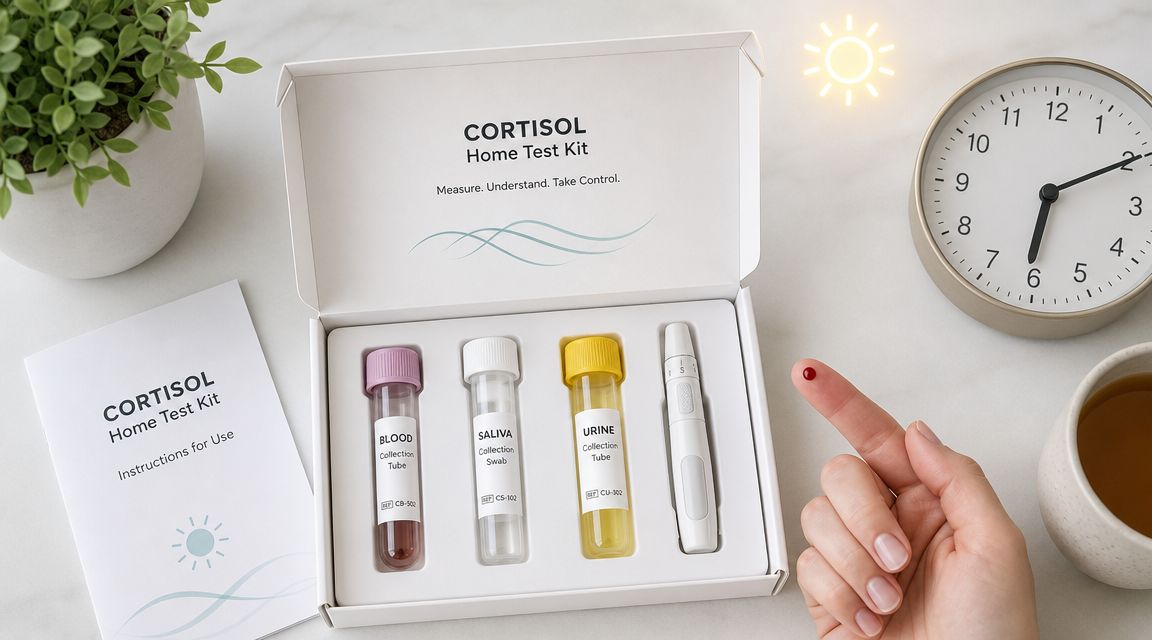
Cortisol Level Test: Understanding Stress & Fatigue 2026
You actually get enough sleep. Nevertheless, you wake up feeling run-down, take ages to get going, and then your mind suddenly starts racing in the evening. Or you function all day, feel internally tense, and wonder why your body never truly switches off.
If this sounds familiar, you're not alone. Many people realize that something is out of balance but can't quite pinpoint it. They blame it on stress, age, too much work, or a lack of discipline. However, it's often worth taking a closer look at a hormone that constantly plays a role in everyday life: cortisol.
A cortisol level test is not a sign of overreaction. It can be a sober, sensible step if you want to understand why energy, sleep, resilience, or inner peace don't fit into your daily life. And that's where it gets exciting. Not just whether you measure, but when and why you measure, determines whether a result truly helps you.
Constantly tired and stressed? Your cortisol level might be the answer
Many only consider cortisol after they've been experimenting for a while. More coffee. Less coffee. Sleeping earlier. Training harder. Supplements. Digital detox. Something works for a short time, then it reverts.
The problem isn't that you're not trying hard enough. Often, a biological classification is simply missing. If your body doesn't properly start in the morning, you fluctuate between exhaustion and tension during the day, or you can't switch off in the evening, it makes sense to include the cortisol rhythm in your considerations.
When your daily life seems contradictory
Typical thoughts sound like this:
- Flat in the morning: You can barely get out of bed, even though you slept long enough.
- Awake in the evening: You're tired during the day, but as soon as peace returns, you're suddenly wide awake.
- Constantly on edge: You appear capable on the outside, but you never truly feel relaxed inside.
- No clear cause: Blood count, sleep tracker, or routines don't provide a complete picture.
This mixture of fatigue and restlessness, in particular, confuses many. They expect exhaustion to always be associated with rest. In practice, an unbalanced daily life often feels much more contradictory.
You're on the right track if you want to understand patterns, not just endure symptoms.
A cortisol test is therefore primarily one thing: a tool for orientation. Not every burden is hormonally induced. But those who want to understand their body better often save themselves long trial and error. Others are already optimizing their blood values or symptoms more specifically. You don't have to guess when you can measure.
What is cortisol and why is it so important for you?
Cortisol is produced in the adrenal glands and is much more than just the well-known "stress hormone." A simple analogy helps: Imagine cortisol as your body's energy manager. It helps you start the day, respond to stress, and provide reserves when your body needs them.

Cortisol is not your enemy
Many hear "cortisol" and immediately think of something bad. That's too simplistic. You need cortisol every day. Without this hormone, your body would react much worse to demands.
Cortisol plays a role in these areas, among others:
- Energy in everyday life: It helps your body make energy available.
- Metabolism: It influences how your body handles blood sugar, fats, and protein.
- Immune system: It modulates immune responses and inflammation.
- Sleep-wake rhythm: It is one of the hormones that shape your daily rhythm.
Those who want to understand in more detail how cortisol works in the body can find a good introduction to cortisol and its function in the body at mybody®x.
Why stress is not just psychological
Stress is not just a feeling. Your body reacts biologically. This can be triggered by work pressure, lack of sleep, illness, intense exertion, or emotional tension. This is particularly evident in the healthcare sector. The article on causes of stress in nursing clearly shows how diverse stress can arise and why the body does not react neutrally to it.
Key takeaway: A healthy cortisol level does not mean "as little cortisol as possible," but a suitable rhythm at the right time.
This is precisely what makes the topic so difficult for many to grasp. It's not just about "high" or "low." It's about timing. A value can appear unremarkable or conspicuous depending on the time of day. Therefore, a test only provides real benefit if you consider it in the right context.
Signs of an imbalance – When is a cortisol test useful?
There are days when you're just tired. That's normal. A cortisol test becomes more interesting when symptoms recur, are difficult to explain, or don't match your lifestyle.

According to MedlinePlus on the cortisol test, a cortisol test is a standard procedure for clarifying adrenal gland dysfunction. Among other things, it is used to diagnose or rule out Cushing's syndrome, Addison's disease, and secondary adrenal insufficiency. Cortisol can be measured in blood, urine, or saliva.
What many think of first and what almost no one thinks of
Some symptoms are more consistent with an overactive system, others with a system that doesn't match the time of day or shows too little reserve. In everyday life, this feels like:
| Everyday situation | Why cortisol can be considered |
|---|---|
| You're barely responsive in the morning | The start of the day seems biologically "delayed" |
| You're tired in the evening, but not sleepy | Your body struggles to enter rest mode |
| You constantly feel rushed | Tension persists even without an acute trigger |
| You react sensitively to stress | Small triggers seem bigger than before |
A self-check helps, but only to a limited extent
A few questions for classification:
- Does your energy pattern not match your daily routine? Then not just fatigue is relevant, but the timing.
- Do you have contradictory symptoms? For example, exhausted and tense at the same time.
- Has this been going on for a while? Individual bad weeks are different from a recurring pattern.
- Have you tried many things already? Then measuring can be more efficient than further guesswork.
Those who recognize themselves in the described patterns will find an overview of symptoms of cortisol deficiency as a supplement.
Many complaints seem like "normal stress." But if they recur regularly, a sober look at the physical side is worthwhile.
The distinction is also important: a self-check does not replace a diagnosis. It only helps you realize whether the topic of cortisol testing might even be relevant for you. The reliable answer only comes from an accurate measurement and meaningful classification.
Blood, saliva, or urine – Which cortisol test is right for you?
The right test depends less on what's available and more on what question you want to answer. Cortisol changes significantly throughout the day. Therefore, the same person can appear unremarkable in the morning and still have a shifted rhythm in the evening. A single value without context is then only of limited help.

The blood test for a targeted snapshot
A blood test is suitable if you want to check a specific time point. It works like a photograph. You see where your cortisol level is at that exact time, but not how the day develops.
This can be useful, especially for symptoms with a clear time pattern. For example, if you feel foggy in the morning and want to know if your cortisol rises appropriately at the start of the day, a morning blood draw is often a good first step. UCSF Health on cortisol blood measurement mentions reference ranges for a measurement around 8 AM that clearly show how much the time of day influences the classification.
For people who want to measure a hormone level at home, a home test may also be an option. The mybody x blood test for home cortisol measurement is designed for this snapshot overview.
The saliva test for patterns throughout the day
A saliva test is often the better choice if your problem isn't a single point in time, but your daily rhythm. This is particularly helpful for questions like: Do I not get going in the morning even though I've had enough sleep? Or do I only truly wake up in the evening, even though my body should be winding down?
Multiple saliva samples throughout the day show whether your pattern is rather flat, delayed, or still unusually active in the evening. This is precisely what makes this method so useful for contradictory complaints. Those who are exhausted and at the same time internally tense often don't need another single value, but a picture of the entire rhythm.
In short: Blood tends to check the time. Saliva tends to check the course.
The urine test for the total amount in 24 hours
The urine test answers a different question. The 24-hour urine collection is less about morning or evening and more about the total amount of cortisol excreted throughout the day.
This can be useful if the overall production is more important. For people who primarily want to know if their cortisol rhythm matches their energy curve, this test is often less practical for everyday life. It requires careful collection over many hours. Small errors during collection can distort the result.
Which test type suits which symptom?
Here, the decision often becomes easier:
- You're hard to wake up in the morning and only feel halfway clear later: Morning blood test or a saliva test with the first sample taken immediately upon waking.
- You're functional during the day but wound up in the evening: Saliva test with multiple time points, especially in the evening.
- Your symptoms fluctuate greatly and you want to understand the rhythm rather than a single value: Saliva test.
- It's more about the total amount over the day than individual times: 24-hour urine.
- You want a clear starting point with little effort: Blood test.
The most important idea here is simple. Don't just collect values. Choose the method that suits your symptoms and the right time. Only then does a test become a useful guide.
The right preparation for an accurate test result
You wake up tired on a Saturday, but you don't take the test until after coffee, showering, and brushing your teeth. The result might seem precise, but it no longer accurately answers the question you actually wanted to clarify. For cortisol, preparation matters because this hormone reacts strongly to time of day, sleep, food, and acute stress.
This is precisely why preparation is more than a formality. It helps determine whether you're measuring your typical rhythm or just a distorted snapshot of it.
What you should consider before the test
The most important rule is: Align the test with your complaint and the test type.
If you're doing a saliva test immediately upon waking, the first sample should really be taken right after waking. Not after going to the bathroom or after the first sip of coffee. Those who primarily suffer from morning fatigue need precisely this early moment, because it shows how your body starts the day.
For evening restlessness or trouble falling asleep, something else is important. Then the sample must be taken exactly at the time specified by the test, often late in the evening. Even a significant shift can blur the pattern.
Especially for saliva tests, it's also important not to eat, drink, or brush your teeth shortly before taking the sample. The sample should reflect your cortisol level, not what's happening in your mouth.
How to prepare practically
A cortisol test works a bit like taking a photo in low light. If the moment isn't right, the picture will be blurry, even if the camera itself is good.
Therefore, a normal test day as possible is helpful:
- Don't choose an exceptional day. After a sleepless night, long-haul travel, infection, or a particularly stressful appointment, you're more likely to measure an unusual situation.
- Note wake-up time and sample time. For cortisol, the time is not a minor detail, but part of the result.
- Plan for rest before the sample. Haste, arguments, climbing stairs, or rushing just before can distort the value.
- Write down any special circumstances. Poor sleep, acute pain, illness, and medications belong as context.
- Read the instructions completely beforehand. This reduces the chance that you'll have to guess at the crucial moment.
A well-documented test is often more helpful than one done quickly.
Common mistakes that unnecessarily dilute the result
Many unclear findings do not originate in the lab, but in the minutes before. Typical mistakes include a sample taken at the wrong time, coffee or breakfast before the test, missing information about medications, or a test on a day that has little to do with your normal everyday life.
Even small shifts can be important. This is especially relevant if you don't want a general overview, but want to clarify a specific question. For example: Why don't I get going in the morning? Or why am I tired in the evening and at the same time internally awake?
Then a simple rule applies. The more precisely the preparation and timing match your symptom, the more useful the result will be. You then not only collect a value, but information that you can really work with.
Understanding your cortisol value – More than just a number
The result is in. Now begins the part that many find unsettling. Is the value good? Bad? Normal? And what does "normal" mean if you still don't feel well?

This is where most misinterpretations occur. Many guides explain the test types, but not the correct classification of the results. Expert sources emphasize that a single cortisol value without context to time of day, stress, and medication can quickly be misclassified. The Cleveland Clinic on the Cortisol Test specifically points out this clinical classification.
A reference range is not a judgment on your personality
A lab value is not a label. It doesn't say: "You are healthy" or "You are sick." Initially, it only tells you where your measured value stands in relation to a reference range. Nothing more.
Additionally, questions relevant to you include:
- At what time was the measurement taken?
- How did you sleep?
- Were you stressed, sick, or under the influence of medication?
- Do your symptoms match the measured pattern?
How to interpret the result more meaningfully
Instead of just looking at "within the normal range" or "outside the normal range," this perspective helps:
| Question | Why it's important |
|---|---|
| Was the test done at the right time? | Otherwise, the value is difficult to interpret |
| Is it a single value or a profile? | A single value shows something different from a daily curve |
| Does the value match your symptoms? | Numbers without symptom context are only of limited help |
| Is medical clarification needed? | Especially with significant deviations or severe symptoms |
A cortisol value is a starting point. It does not replace a diagnosis but can make the next sensible step much clearer.
When you shouldn't interpret alone
If symptoms are severe, worsen, or the result appears significantly abnormal, the interpretation belongs in medical hands. Especially when adrenal dysfunction is suspected, self-interpretation is not a good shortcut.
For most health-conscious people, however, a test is still valuable. Not as a self-diagnosis, but as a guide. You're not collecting a random number, but a piece of the puzzle. And this piece of the puzzle can help you look at sleep, recovery, stress, and daily life more targeted.
Your path to more balance – What you can do now
If you've read this far, you're probably not looking for a trendy solution. You want to understand what your body is showing you. That's a strong starting point.
A cortisol level test can help you make diffuse symptoms more tangible. Especially if you no longer just want to experiment but want to act more purposefully. This saves time, nerves, and often many unnecessary detours.
Sensible next steps in everyday life
Before you "optimize" anything, an honest look at the basics is worthwhile:
- Check sleep rhythm: Regular sleep and wake-up times help your body maintain a more stable daily rhythm.
- Manage stress more realistically: Not every phase needs more performance. Sometimes your system needs more reliable recovery.
- Observe caffeine and evening routine: If you can't wind down in the evening, it's worth looking at late activation.
- Note symptoms: Writing down energy, sleep, mood, and time of day together makes patterns visible.
If you want to work on everyday factors in parallel, mybody®x also provides an overview of how cortisol can be lowered naturally.
Why measuring is often more efficient than guessing
Self-observation is helpful. But it remains limited. You can perceive a lot, but you can't reliably distinguish everything. Fatigue, restlessness, sleep problems, or the feeling of constantly being "on" often have several possible causes.
Therefore, the clear answer is usually not another hack, but a clean test. Others are already optimizing their blood values or symptoms more targeted instead of staying in trial-and-error mode for months. Evidence-based is not trendy. It's simply efficient.
So you're not too late. You are exactly at the point where a quick blood test can make your path more precise.
If you want a reliable answer only with blood tests, you will find an option at mybody x Bluttest to address hormonal issues like cortisol in a structured way from home. This is useful if you want to understand your body better, save trial and error, and make decisions based on measurable data.
Share:
Allergy test: Allergy test 2026
Your Cortisol Deficiency Weight Gain: Causes & Test