

Recognizing and understanding the symptoms of hormonal imbalance
Do you feel constantly tired even though you have actually had enough sleep? Are you struggling with unexplained weight gain despite watching your diet, or do mood swings make you feel as though you are being controlled remotely? If you find yourself nodding internally at these questions, you are not alone. These and many other vague signs can be symptoms of a hormonal imbalance—a clear signal that your body's delicate messengers have fallen out of sync.
Learning to understand your body's secret language
Hormones are the unseen directors of your overall well-being. Think of them as a perfectly coordinated orchestra: if even one instrument is out of tune or comes in at the wrong time, the entire melody—your health—falls out of rhythm.
These tiny yet powerful messengers control practically every process in your body. They govern your energy, sleep, mood, metabolism, and even your libido. A hormonal imbalance is therefore no minor issue. It is a key warning signal from your body that deserves your full attention. The tricky part is that the symptoms are often so vague and seemingly unrelated that finding the true cause can become a real test of patience.
What hormones actually are
Put simply, hormones are chemical messengers. They are produced by various glands, such as the thyroid, adrenal glands, and ovaries, and released directly into your bloodstream. From there, they travel throughout your body to deliver highly specific instructions to particular target cells.
Think of hormones as keys that fit only very specific locks on cells. This lock-and-key principle ensures that the right message reaches the right place and triggers exactly the desired response—whether regulating your blood sugar or preparing your body for sleep.
However, this complex communication system is vulnerable to disruption. Even tiny shifts in hormone production can have far-reaching consequences and trigger an entire cascade of symptoms.
Why balance is so important
Your body naturally always strives for balance, a state also known as homeostasis. This balance is particularly delicate and crucial when it comes to hormones. A deficiency or excess of a single hormone can directly affect the action of many others and throw the entire system off balance.
A classic example is the delicate interplay between estrogen and progesterone in women:
- Estrogen has a stimulating effect and promotes the buildup of the uterine lining.
- Progesterone has a calming, balancing effect and stabilizes this lining.
When this ratio becomes unbalanced—a condition known as estrogen dominance—typical symptoms of a hormonal imbalance, such as PMS, menstrual irregularities, or mood swings, are almost inevitable. Similar, highly complex interactions occur between stress hormones such as cortisol, thyroid hormones, and many others.
The very first step toward improvement is finally recognizing and correctly interpreting these signals from your body. An at-home hormone test from mybody®x can help turn uncertainty into clarity. It provides precise data about your current hormone status, allowing you to take targeted action and finally regain control over your well-being.
Typical Symptoms of a Hormonal Imbalance
A hormonal imbalance rarely announces itself with a single, loud bang. Instead, it is often a gradual combination of many minor complaints that may not seem connected at first glance. Perhaps you have simply felt “not like yourself” for some time, are constantly exhausted, or your body is changing in a way you cannot explain.
That is exactly the challenge: understanding your body's language and correctly putting the individual pieces of the puzzle together. The following sections will help you identify the most common symptoms and associate them with the hormone systems that may have fallen out of sync.
When the Thyroid Sets the Pace
Your thyroid is the powerhouse of your metabolism. When it is not functioning properly, you feel it throughout your body—especially in your energy levels. The symptoms can develop in two completely opposite directions:
- With an underactive thyroid (hypothyroidism): Imagine your metabolism running on low power. You constantly feel tired and lacking in energy, get cold easily, and may struggle with unexplained weight gain, constipation, or hair loss.
- With an overactive thyroid (hyperthyroidism): Your system is running at full speed. Inner restlessness, a racing heart, nervousness, heavy sweating, and unexplained weight loss despite an increased appetite are all typical signs.
These opposing conditions in particular often make it so difficult to correctly interpret the symptoms.
A hormonal imbalance is like a domino effect in the body. A disruption in one area, such as the stress hormones, can quickly throw other systems, such as the sex hormones or thyroid function, out of balance as well. That is why taking a holistic view is so important.
The Rollercoaster of Sex Hormones
Estrogen, progesterone, and testosterone are not only responsible for reproduction. They also have a major impact on your mood, skin, and overall well-being. An imbalance in this area therefore often becomes very noticeable in everyday life.
In women, the signs are often closely linked to the menstrual cycle:
- Menstrual irregularities: Your period is irregular, unusually heavy, or even stops altogether.
- Premenstrual syndrome (PMS): In the days before your period, you experience severe mood swings, breast tenderness, water retention, or headaches.
- Loss of libido: Your desire for sex has noticeably decreased.
- Skin problems: Adult acne, especially around the chin and jawline, can be a clear sign.
Many women experience this hormonal roller coaster particularly intensely during menopause. In fact, around 9 million women in Germany are currently in this stage of life. Perimenopause often begins gradually with irregular cycles because estrogen and progesterone production fluctuates significantly. This leads to symptoms such as hot flashes, sleep disorders, and profound exhaustion, which can severely affect everyday life. You can read more about the connections during menopause on the German Health Portal.
In men, an imbalance in sex hormones, often a testosterone deficiency, usually manifests as:
- Fatigue and lack of motivation
- Loss of muscle mass accompanied by an increase in abdominal fat
- Mood swings and increased irritability
- Erectile dysfunction and reduced libido
This infographic clearly shows how essential hormones are to your energy, mood, and overall health.
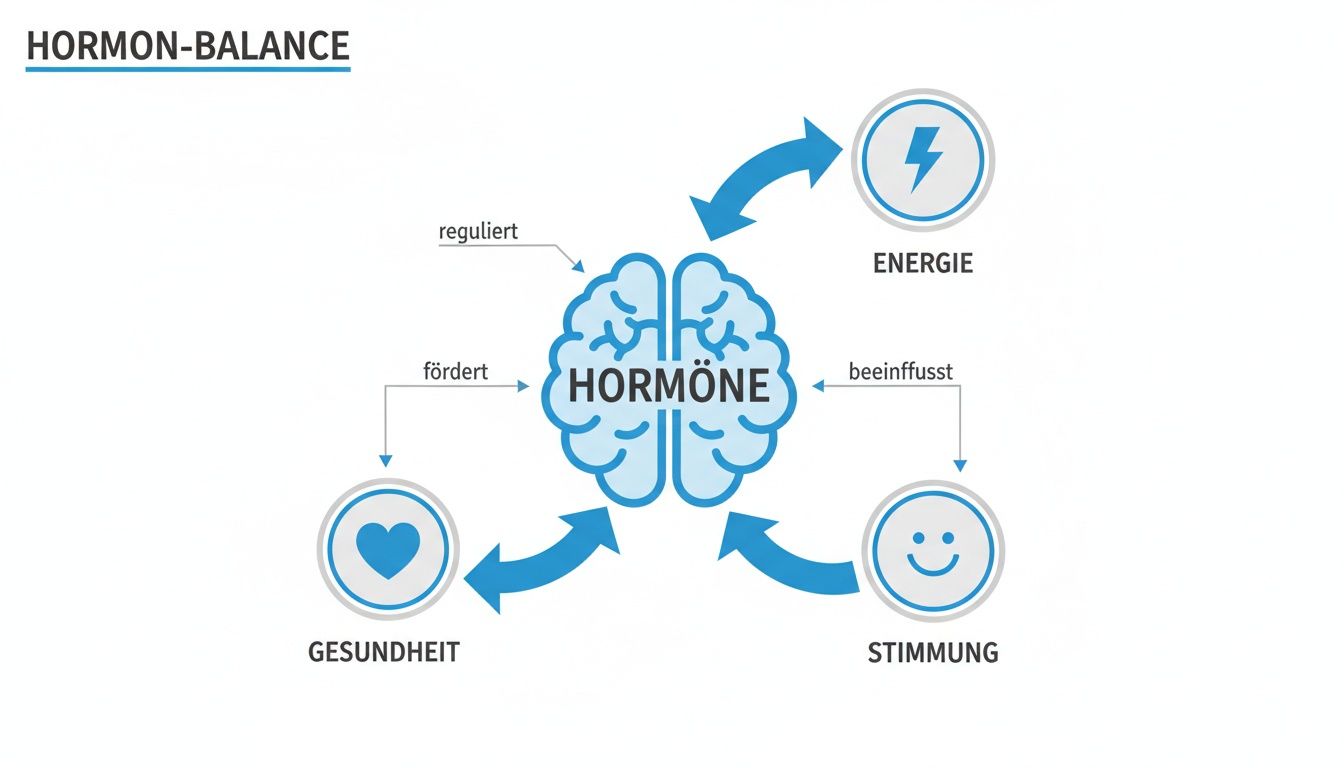
It is immediately clear: These three central areas of life depend directly on a balanced hormonal system.
When stress takes control
Your body responds to stress by releasing the hormone cortisol. In the short term, this is an absolutely vital response that helps you perform. However, chronic stress leads to permanently elevated cortisol levels—and this has far-reaching consequences.
You can recognize an imbalance in the stress hormone cortisol by these typical signs:
- Persistent exhaustion: You feel truly “burned out” and can barely get out of bed in the morning.
- Sleep disorders: You have trouble falling asleep, wake up frequently during the night, or feel completely exhausted in the morning.
- Food cravings: You have a strong, almost uncontrollable craving for sweet or salty foods.
- Weight gain: Persistent fat around the abdomen in particular is a classic sign of too much cortisol.
- Weakened immune system: You get sick much more often than before and are more susceptible to every infection going around.
The following table helps you better classify your symptoms and get a sense of which hormones may potentially play a role for you.
Symptoms and their possible hormonal causes
This table assigns common complaints to the hormones likely involved and helps you get an initial overview.
| Symptom | Possible hormonal imbalance | Hormones affected (examples) |
|---|---|---|
| Fatigue & exhaustion | Underactive thyroid, adrenal fatigue, testosterone deficiency | Thyroid hormones (TSH, fT3, fT4), cortisol, testosterone |
| Weight gain | Underactive thyroid, insulin resistance, elevated cortisol | Thyroid hormones, insulin, cortisol, estrogen |
| Sleep disorders | Elevated cortisol, progesterone deficiency, melatonin imbalance | Cortisol, progesterone, melatonin |
| Mood swings/PMS | Estrogen dominance, progesterone deficiency | Estrogen, progesterone, serotonin (indirectly) |
| Hair loss | Underactive thyroid, elevated androgens (in women) | Thyroid hormones, DHEA, testosterone |
| Skin problems (acne) | Elevated androgens, insulin resistance | Testosterone, DHEA-S, insulin |
| Loss of libido | Testosterone deficiency (both sexes), estrogen deficiency (women) | Testosterone, estrogen, prolactin |
This classification is naturally a simplification, because your hormonal system is a complex network. But it can be a valuable initial indication.
If you recognize several of these symptoms in yourself, a hormone test could be the first sensible step toward finally gaining clarity. A mybody®x hormone test for home use analyzes important levels such as cortisol, estrogen, and testosterone, giving you a scientifically sound basis for taking targeted action to support your balance.
Getting to the root of hormonal imbalance
Why does your finely tuned hormonal system get out of balance in the first place, even though it naturally always strives for balance? The answer usually lies not in a single cause, but in an interplay of various factors. Many of these are closely linked to our modern lives—and that is actually good news. Because it also means that you hold the key to change in your own hands.
The symptoms you feel are only the visible tip of the iceberg. To truly make a difference, we need to look deeper and understand what is happening beneath the surface. Often, it is everyday habits that disrupt the delicate balance over months or years.
Chronic stress: The modern hormone killer
One of the biggest adversaries of your hormonal balance is undoubtedly chronic stress. Your body does not distinguish whether the stress comes from an approaching deadline, financial worries, or an emotional conflict. The response is always the same: the release of the stress hormone cortisol.
Think of the building blocks for your hormones as a limited budget. During prolonged stress, cortisol production is given absolute priority so that you can get through this challenging phase. The problem is that cortisol and important sex hormones such as progesterone are produced from the same precursor molecule, pregnenolone. In stress mode, your body therefore chooses to spend the budget on “survival hormones.” The production of “feel-good and reproductive hormones” is left behind.
This mechanism, also known as “pregnenolone steal,” explains why chronic stress so often leads to menstrual irregularities, PMS, or a loss of libido. Your body is in permanent crisis mode and signals that now simply isn’t a good time for relaxation or reproduction.
Chronic stress disrupts hormonal balance for millions of people in Germany and leads to symptoms such as menstrual irregularities, profound fatigue, and a weakened immune system. The German Society for Endocrinology (DGE) warns that prolonged stress overloads the adrenal glands and that consistently high cortisol levels can block the effects of estrogen and testosterone. Up to 80% of women experience these effects through headaches, depressive moods, or a significant decline in performance. You can read more about the far-reaching effects of prolonged stress on hormonal balance here.
Diet and nutrient deficiencies as driving forces
Your hormones are made from what you eat. A diet rich in sugar, highly processed foods, and unhealthy fats can lead to chronic inflammation and blood sugar fluctuations—both of which are major disruptors of your hormonal system.
At the same time, very specific nutrient deficiencies can directly slow down hormone production:
- Magnesium: This “relaxation mineral” is involved in more than 300 metabolic processes and is absolutely essential for stress regulation and the production of progesterone.
- Vitamin D: Often referred to as the “sunshine hormone,” it is actually a hormone precursor that is essential for a properly functioning thyroid and the regulation of sex hormones.
- Omega-3 fatty acids: These healthy fats are not only the building blocks for many hormones but also have a powerful anti-inflammatory effect.
- B vitamins: They are crucial for breaking down used hormones in the liver and thus help prevent estrogen dominance.
When these important building blocks are missing, your body essentially has to work with the handbrake on.
Other important causes at a glance
In addition to stress and diet, there are other key disruptors that can throw your hormonal balance off track.
- Lack of sleep: Just one night of too little sleep can throw your cortisol and insulin levels out of balance the next day. In the long term, sleep deprivation disrupts the body’s entire hormonal rhythm.
- Environmental factors: So-called “xenoestrogens” from plastics (BPA), pesticides, or cosmetics can bind to your body’s hormone receptors and disrupt their function.
- Natural stages of life: Puberty, pregnancy, and menopause are periods of profound hormonal changes that naturally alter the balance.
- Specific conditions: Sometimes the cause is also an illness such as PCOS or thyroid problems, which are primarily based on a hormonal imbalance.
As you can see, the causes are varied. But you have control over many of them yourself. The first step is to understand where your personal vulnerabilities lie. A nutrient test or a hormone test from mybody®x can help you gain targeted insights and find out exactly where you can take action to restore your balance.
Specific hormonal disorders in detail
Sometimes the symptoms of a hormonal imbalance are more than just temporary quirks of your body. They may be part of a larger puzzle, a specific clinical condition. If you found yourself nodding repeatedly while reading the symptom lists, that could be an important clue.
To give you an idea of what may be behind this, let’s take a closer look at two of the most common hormonal disorders: polycystic ovary syndrome (PCOS) and thyroid dysfunction.

These two examples vividly demonstrate how multifaceted hormonal imbalance symptoms can be and why taking a closer look beneath the surface is so crucial.
PCOS: The complex imbalance of sex hormones
Polycystic ovary syndrome, or PCOS for short, is much more than just a “problem with the ovaries.” It is a complex metabolic disorder that affects the entire female body and unfortunately often goes undiagnosed.
At the heart of the problem is an imbalance in the sex hormones: Compared with female hormones, the body produces too many male hormones (androgens). This imbalance disrupts the finely tuned maturation process of the eggs and can completely prevent ovulation.
Typical symptoms that should put you on alert include:
- Irregular or absent periods: This is often the first and clearest warning sign.
- Skin problems: Persistent adult acne, especially along the chin and jawline, is widespread.
- Unwanted hair growth (hirsutism): Dark hair grows on the face, chest, or abdomen.
- Hair loss: Paradoxically, hair on the scalp may also become thinner.
- Weight gain: Many affected individuals struggle with persistent excess weight, often accompanied by insulin resistance.
In Germany alone, around 1 million women suffer from PCOS, making it one of the most common causes of menstrual irregularities and infertility. It is often caused by an imbalance in the regulatory hormones LH and FSH from the pituitary gland, which essentially overstimulates the ovaries.
The thyroid: The engine of your metabolism
Your thyroid is tiny, but its impact is enormous. It produces hormones that drive metabolism in every single cell of your body. When this “engine” stutters, you feel it everywhere.
Imagine your thyroid as the accelerator pedal of your car. With an underactive thyroid, you press the pedal, but hardly anything happens—everything runs on low power. With an overactive thyroid, the accelerator sticks and the engine revs uncontrollably high.
Underactive thyroid (hypothyroidism):
Here, the thyroid produces too few hormones. The entire metabolism shifts down a gear. Typical signs include unexplained weight gain, constant fatigue, extreme sensitivity to cold, dry skin, hair loss, and depressive moods.
Overactive thyroid (hyperthyroidism):
The exact opposite happens here: An excess of thyroid hormones drives the metabolism into the red zone. Those affected often suffer from inner restlessness, nervousness, a racing heart, heavy sweating, and unexplained weight loss despite constantly feeling hungry.
Do you recognize yourself in any of these patterns? Then it’s time to gain clarity. If you want to find out how to get to the bottom of your hormone status, read our detailed article on assessing hormone status. A hormone test can provide valuable initial indications of whether your symptoms point to one of these disorders and give you a solid basis for the next steps.
From suspicion to certainty: Your path to analysis
You recognized yourself in the symptoms and are asking: What now? That very thought is the first and most important step toward taking back control of your well-being. Many people live with vague symptoms for years simply because they don’t know where to start. But the journey from a quiet suspicion to clear certainty doesn’t have to be a marathon.
Uncertainty can be paralyzing. Knowledge, on the other hand, gives you the power to finally take action. Instead of continuing to feel your way around in the dark, you can find out specifically what is really going on in your body. This allows you to turn feelings of helplessness into a concrete, actionable plan.
When is seeing a doctor the right step?
Hormonal imbalance can cause an incredibly wide range of symptoms that sometimes overlap with other health problems. If your symptoms are very severe, suddenly get worse, or significantly restrict your daily life, seeing a doctor is essential. Likewise, if you suspect specific conditions such as PCOS or thyroid dysfunction, medical evaluation is the only right course of action.
Depending on your symptoms, different medical specialists may be the right people to contact:
- Endocrinologists: They are specialists in the entire hormonal system. For complex disorders affecting, for example, the thyroid, adrenal glands, or pituitary gland, they are the first point of contact.
- Gynecologists: As experts in female sex hormones, they are the right people to contact for menstrual irregularities, PMS, trying to conceive, or, of course, any symptoms related to menopause.
A well-prepared conversation is worth its weight in gold here. If you already bring specific data about your hormone status, your doctor can draw the right conclusions much more quickly and accurately.
The first step is in your hands
But you don’t have to passively wait for a doctor’s appointment to finally get clarity. The crucial first step is literally in your hands. A hormone test for home use is a simple, discreet, and scientifically sound way to get a well-founded initial overview of your hormonal status. It serves as your personal data base and makes you an informed discussion partner for any medical professional.
Imagine going to the doctor with a detailed map of your hormonal system instead of just a vague description of your symptoms. That’s exactly what an at-home test makes possible. It provides facts where there were previously only assumptions.
Sample collection is extremely simple and involves either a saliva sample or a tiny blood sample from your fingertip, depending on the test. Don't worry—these methods have been scientifically validated and provide precise measurement results.
Your sample will then be evaluated in a certified German specialist laboratory—the same laboratories trusted by countless medical practices. You will receive an easy-to-understand report showing at a glance where your levels fall compared with the normal range. With mybody®x, you can have key hormones such as cortisol, estrogen, progesterone, and testosterone analyzed, helping uncover the causes of your hormonal imbalance and its symptoms. This analysis provides the basis for your next targeted steps—whether that means talking to your doctor or directly adjusting your lifestyle.
What you can do right away for your hormonal balance
While you may still be waiting for your test results or are just beginning to understand your body's signals, you do not have to remain inactive. You can start supporting your body in a targeted way today. Think of this section as your personal first-aid kit for everyday life, filled with concrete and easy-to-implement measures to help alleviate the first symptoms of hormonal imbalance.

Each individual tip is designed to help you feel better quickly while also creating a solid foundation for your long-term hormonal health.
Building blocks for your hormones: the right diet
Your hormones are literally built from what you eat. A mindful diet is therefore probably the most powerful lever you can pull right away. The focus is on providing your body with the right building blocks and deliberately reducing disruptive factors.
These foods support you:
- Healthy fats: They are the absolute foundation for producing hormones such as estrogen and testosterone. Make a conscious effort to include avocados, nuts, seeds (especially flaxseeds, which are incredibly valuable here), and high-quality olive oil in your diet.
- Omega-3 fatty acids: Fatty fish such as salmon and mackerel are powerful anti-inflammatory foods and improve communication between cells—an essential prerequisite for hormonal balance.
- Cruciferous vegetables: Broccoli, cauliflower, and kale contain compounds that help your liver break down excess estrogen. This is particularly important for counteracting estrogen dominance.
A balanced diet plays a fundamental role in hormone production and regulation. So be mindful of your eating habits, including at work. Valuable tips for healthy eating at work show you how to do this.
You should avoid these foods:
- Sugar and refined carbohydrates: They send your blood sugar levels on a wild roller coaster ride. The result? Your body releases too much insulin and the stress hormone cortisol.
- Ultra-processed products: Ready-made meals often contain unhealthy fats, hidden sugar, and artificial additives that place unnecessary strain on your hormonal system.
Using exercise and relaxation strategically
Exercise is fantastic, but when it comes to hormonal imbalance, remember: Less is sometimes more. Excessive, high-intensity training can place additional stress on the body and drive cortisol levels even higher.
Instead, opt for moderate, balancing exercise:
- Yoga and Pilates: These forms of exercise combine strengthening exercises with conscious breathing and have been proven to promote relaxation.
- Brisk walks: Regular exercise in the fresh air, preferably in daylight, helps regulate cortisol levels and lifts your mood in the process.
- Moderate strength training: Targeted muscle development improves your body's response to insulin and supports a healthy metabolism.
Active stress management is just as important as exercise. Techniques such as deep abdominal breathing, a short meditation, or simply five minutes of mindful silence each day can calm your nervous system and reduce the production of stress hormones.
These measures are an excellent starting point. If you would like to explore the topic in greater depth, our guide contains 7 more effective tips for hormonal balance to help you specifically improve your well-being.
Frequently asked questions about hormonal imbalance
To wrap things up, we want to answer a few more questions that come up again and again when it comes to hormones. Think of it as a small but valuable knowledge session designed to give you even more confidence on your journey.
How quickly will I notice a change when I adjust my lifestyle?
This is one of the most common questions—and the honest answer is: It depends. Your body is not a complex system that works at the push of a button. Some people notice after just a few weeks that their sleep becomes deeper, their daytime energy returns, or their mood stabilizes.
However, if imbalances have persisted for a long time, your body simply needs more time. In this case, expect several months before you notice a truly noticeable and, above all, stable improvement. The most important things are patience with yourself and consistency. An at-home hormone test can help you establish a clear baseline and see your progress in black and white.
Are at-home hormone tests just as reliable as those performed by a doctor?
Yes, the tests available from mybody®x are absolutely reliable. Your sample—whether saliva or a tiny drop of blood from your fingertip—is analyzed in the same certified specialist laboratories in Germany that countless medical practices also work with. The methods have been scientifically tested and provide precise readings of your hormone status.
The key benefit for you? You can take the test conveniently and discreetly at home, without any waiting time. You receive reliable data that provides the perfect basis for targeted lifestyle changes or a well-prepared conversation with your doctor.
Can a hormonal imbalance also affect my digestion?
Absolutely! The hormonal system and your gut are closely connected. Hormones such as the stress hormone cortisol and thyroid hormones directly influence how quickly your gut works, how well you break down your food, and how healthy your intestinal lining is.
Persistent bloating, unexplained constipation, or sudden diarrhea can therefore certainly have their roots in a hormonal imbalance. A holistic approach that considers both hormones and gut health is often the key to success.
Do I always have to take medication if I have a hormonal imbalance?
Not necessarily. Many hormonal imbalances are caused by our modern lifestyle—too much stress, an unhealthy diet, or a lack of important nutrients. In these cases, targeted adjustments may be enough to restore balance.
For certain conditions, such as an underactive thyroid or PCOS, medical treatment with medication is often essential. Even then, the right lifestyle measures are worth their weight in gold: They can optimally support the treatment and significantly improve your overall well-being.
Are you ready to take the first step and finally gain clarity about your hormonal well-being? At mybody®x, you’ll find scientifically backed hormone and nutrient tests for home use that provide precise insights and help you regain control of your health. Discover the right health tests on mybody-x.com now.



Share now:
Get your thyroid tested: The guide for doing it at home
Understand concentration problems and find the true causes