
Understanding concentration problems and finding the true causes
Are you finding it increasingly difficult to stay focused? To form a clear thought? This is more than just a sign of tiredness. Concentration problems are often an important signal from your body that something has become unbalanced.
Why your concentration is declining and what is really behind it
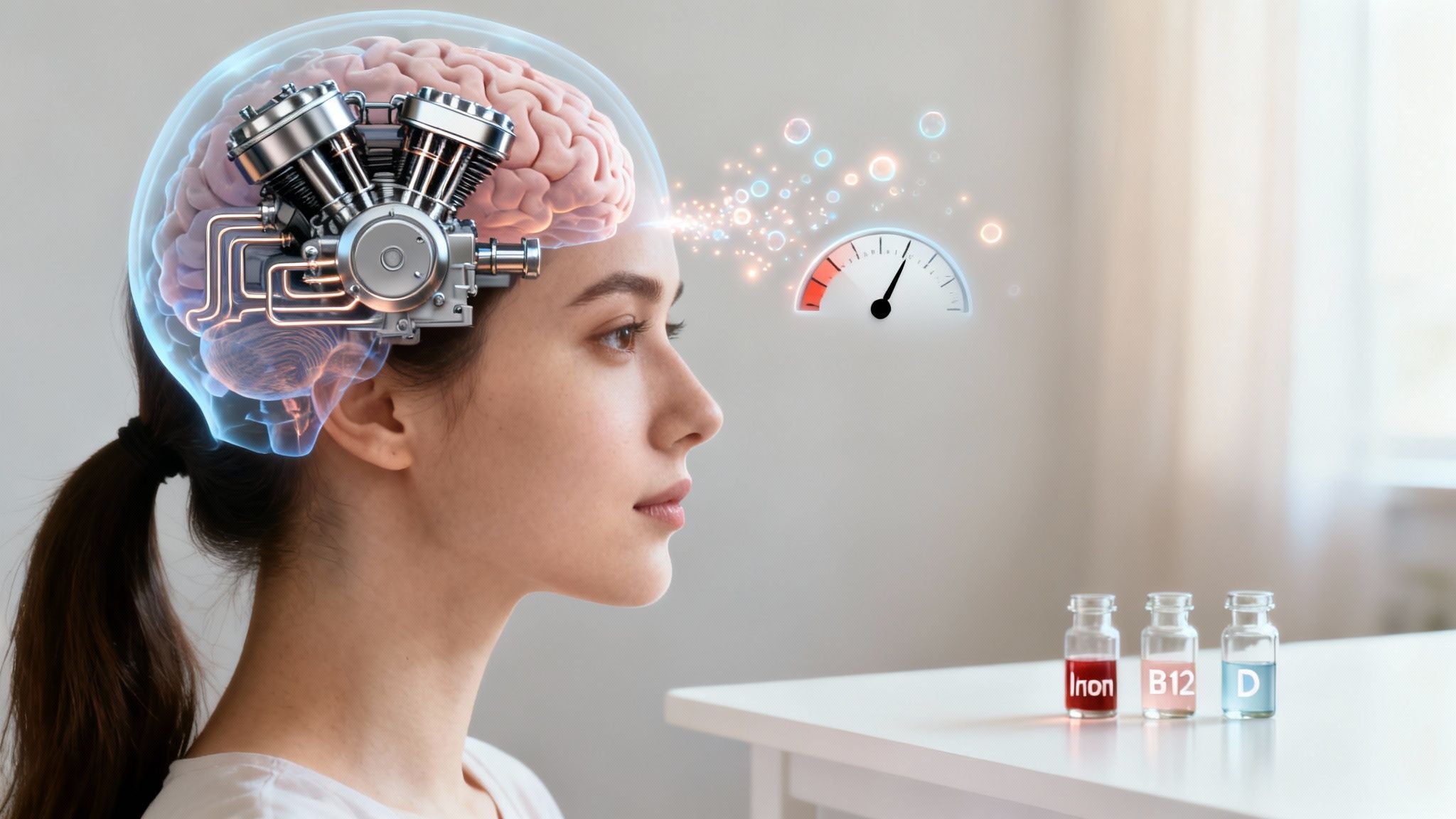
Imagine your brain as a high-performance engine. To run smoothly and allow you to concentrate fully, it needs the right fuel and the perfect operating temperature. But if it lacks important nutrients or your sensitive hormonal balance gets disrupted, the engine starts to sputter. Your mental performance noticeably declines.
This “fog in your head,” often also described as “Brain Fog,” is an all-too-familiar feeling for many women. The most important thing is: It is not a personal failure, but often a symptom of hidden physical causes that can be specifically identified.
What concentration problems can feel like
Difficulty concentrating is more than just feeling easily distracted. It creeps into everyday life in many ways and can severely affect your quality of life.
Maybe you recognize yourself in some of these situations:
- Forgetfulness: You are constantly forgetting appointments, names, or where you just put your keys.
- Word-finding difficulties: In the middle of a conversation, you suddenly cannot think of the simplest words.
- Feeling overwhelmed: Even small tasks suddenly feel like insurmountable hurdles.
- Inner restlessness: Your thoughts constantly wander, and you can barely focus on one thing.
- Mental exhaustion: You already feel completely drained after a short period of mental effort.
These symptoms are not imaginary. They are clear signs that your body wants to tell you something important. Often, measurable imbalances are behind them, undermining your mental clarity.
With mybody®, you gain deep insights into your women's health—from hormones and nutrients to your metabolism. This helps you understand what your body really needs to feel comfortable, balanced, and healthy in everyday life.
Instead of continuing to grope in the dark, you can take control and get to the bottom of the matter yourself. A simple at-home blood test can provide valuable clues as to whether a deficiency in iron, vitamin B12, or vitamin D is hindering your concentration. Your hormone status is equally important, including your thyroid levels and stress levels.
The Biochemical Roots of Concentration Problems
Your mental clarity depends directly on how well your body is supplied with nutrients. If your brain does not receive the right building blocks, it simply cannot operate at full capacity. So let’s take a closer look at the biochemical causes that may be behind concentration problems.
Imagine your brain as a vast, complex data network. For information to flow smoothly, it needs fuel and stable infrastructure. This is where nutrients and hormones come in—they are the silent architects of your mental power.
The Key Role of Nutrients
Certain vitamins and minerals are indispensable for your brain. When they are lacking, bottlenecks quickly arise, often making themselves felt as poor concentration or the dreaded “brain fog.”
- Iron: This trace element is the key to transporting oxygen in the blood. Your brain is a real oxygen junkie—which is why iron deficiency almost inevitably leads to mental exhaustion and concentration problems.
- Vitamin B12: You can think of it as a protective covering for the nerve pathways (myelin sheaths). A deficiency damages this insulation, slowing signal transmission in the brain and potentially manifesting as forgetfulness.
- Vitamin D: The well-known “sunshine vitamin” also plays a crucial role in cognitive function. Studies suggest that low vitamin D levels are often associated with poorer mental performance.
A deficiency in these important nutrients often develops unnoticed. If you would like to learn more about the various signals your body sends when you have a deficiency, you will find valuable information in our article about symptoms of nutrient deficiencies.
The following graphic clearly shows how “brain fog” is made up of various symptoms such as forgetfulness and a feeling of being overwhelmed.
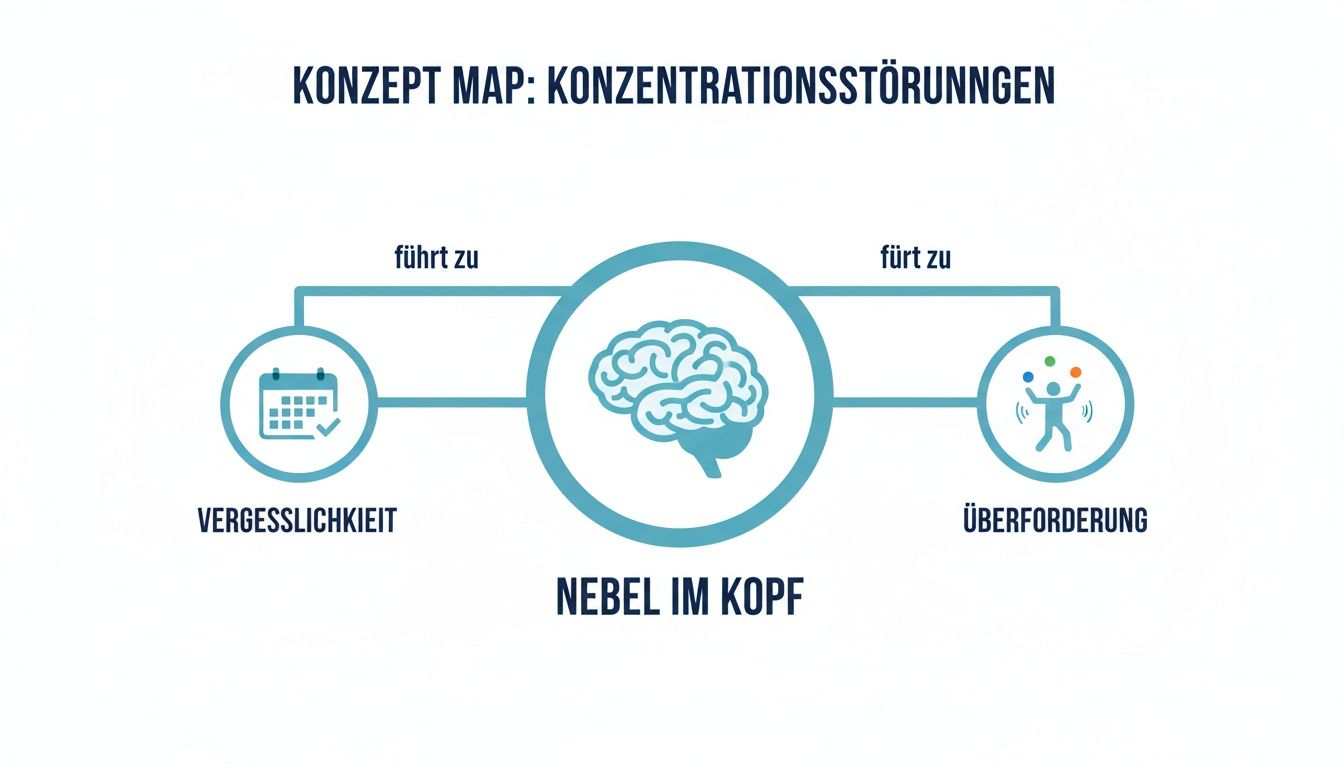
It is clear that concentration problems are rarely an isolated issue, but are often part of a bigger picture.
Important nutrients and hormones for your concentration
This table provides an overview of which biomarkers are essential for your mental performance and how a deficiency can affect you.
| Biomarker | Function for the brain | Possible symptoms of deficiency or imbalance |
|---|---|---|
| Iron (ferritin) | Important for oxygen transport and energy production in brain cells. | Fatigue, “brain fog,” poor concentration, paleness. |
| Vitamin B12 | Protects and regenerates nerve cells and supports the formation of red blood cells. | Forgetfulness, concentration problems, tingling, nervousness. |
| Vitamin D | Supports cognitive function and mood. | Memory problems, mood swings, lack of motivation. |
| Thyroid hormones (TSH) | Regulate the energy metabolism of the entire body, including the brain. | Sluggishness, poor concentration, weight gain, sensitivity to cold. |
| Cortisol | The “stress hormone” regulates the response to stress. | In cases of chronic excess: trouble focusing, inner restlessness, sleep disturbances. |
Looking at these levels can often provide the crucial clue as to what may be causing your concentration problems.
Hormonal balance is crucial
In addition to nutrients, your hormonal system is the central regulator of your mental energy. When it gets out of balance, your concentration suffers significantly.
You can think of the thyroid as the accelerator pedal of your metabolism. If it produces too few hormones (hypothyroidism), your entire body runs on low power. The result: lack of motivation, fatigue, and poor concentration.
At the same time, the stress hormone cortisol is an important counterforce. Chronic stress leads to persistently elevated cortisol levels. This not only sabotages your ability to focus but can even damage brain structure over time.
Concentration problems are not a fait accompli; they are often a solvable biochemical issue. By knowing your nutrient and hormone levels, you give yourself the tools to take targeted action.
And the problem is more widespread than you might think: In Germany, around 60 percent of schoolchildren in grades 5 and 6 struggle with concentration problems. A blood test can help uncover the causes, as vitamin B12 deficiency alone may account for up to 30% of concentration problems in children. A home test from mybody-x.com makes it easy to check nutrient levels and hormone status so that such deficiencies can be addressed specifically.
How modern stress affects your mental performance
Do you know the feeling of having to juggle countless balls in your mind at the same time—and then constantly having more added? Constant availability, the sheer flood of digital stimuli, and the pressure to always give 100% are pure poison for our focus. These external stressors interfere with the processes in your brain and body more directly than you might realize.
Our body is actually a master at dealing with short-term stress—the classic “fight-or-flight” mode. The problem is that our modern daily lives often fail to switch this mode off, putting us in a state of chronic stress. Your system is therefore constantly running at full speed, which leads to a permanently increased release of the stress hormone cortisol.
The vicious cycle of stress and exhaustion
Imagine constantly high cortisol levels as an annoying background noise that makes it impossible for your brain to focus on what matters. The result is mental exhaustion, inner restlessness, and the dreaded “brain fog”—that hazy state in which clear thoughts are simply no longer possible. Does that sound familiar? It’s no wonder that complex tasks then become a real challenge. If you want to learn more about how this hormone controls your body, take a look at our article “What Is Cortisol?”.
Chronic stress is not merely a feeling but a tangible biochemical state. Persistently elevated cortisol levels can seriously sabotage your cognitive performance and are a common cause of concentration problems.
But it’s not just digital stress or pressure to perform at work. Everyday factors such as too little sleep or an unbalanced diet are also major energy drains that directly sap your concentration. Your brain needs sleep to regenerate and the right nutrients to get going. Without either, it is left defenseless against the negative effects of stress.
How external and internal factors interact
These external stressors often affect an already weakened internal foundation. An unnoticed nutrient deficiency, such as low iron levels or insufficient B vitamins, acts like fuel on the fire for stress symptoms. Your body simply lacks the resources to withstand the strain—and your concentration problems become increasingly severe.
Constant digital distraction is a key factor here. One study suggests that as social media use increases, inattention among children could rise by 35 percent. If this sensory overload is compounded by a physical deficiency, such as iron deficiency, which can further reduce concentration by up to 20–40 %, it can quickly become a serious problem. You can read more here about the study results concerning concentration. This is precisely where mybody-x.com’s blood tests can provide clarity by uncovering such physical causes.
It is therefore crucial to identify and understand these energy drains in everyday life. Because only when you know how external influences interact with your internal physical condition can you take targeted action and sustainably strengthen your mental resilience.
The path to greater clarity: An at-home blood test
Constantly wondering why your concentration is fading simply doesn’t get you anywhere. To get to the root of the true causes of your “brain fog,” you need concrete data about your body. This is exactly where mybody-x.com’s at-home blood tests come in—simple, scientifically grounded, and available right in your own home.

The thought of having blood drawn may sound unpleasant to some people, but don’t worry: The process is genuinely straightforward and designed for maximum convenience. You don’t need to make appointments or spend hours sitting in a waiting room. Everything you need is delivered directly to your home.
How easy it is to take the test at home
The mybody-x.com test is designed so that you can perform it safely and easily yourself. The entire process is designed to give you precise insights without disrupting your daily routine.
- Easy sample collection: Use a small prick on your fingertip to collect a few drops of blood. Detailed, easy-to-understand instructions guide you through the process step by step.
- Free return shipping: Simply place your sample in the enclosed return envelope and send it free of charge to our partner laboratory.
- Analysis in a specialist laboratory: Your sample is analyzed in a German laboratory certified according to ISO standards. This allows us to guarantee the highest medical standards and absolutely reliable results.
With us, you don’t receive incomprehensible raw data, but a clear and easy-to-understand results report. We translate the “lab jargon” for you and show you exactly what your results mean for your concentration and well-being.
Which tests are relevant to you?
Depending on where you suspect the causes of your poor concentration lie, various analyses may be suitable. Each test gives you targeted insight into an important area of your health.
- Nutrient test: This test checks key biomarkers such as iron (ferritin), vitamin B12, and vitamin D. A deficiency in these nutrients is one of the most common – and easiest to remedy – causes of mental exhaustion.
- Hormone test: This analyzes your thyroid hormones or your stress level based on your cortisol levels. A hormonal imbalance can slow down your overall mental energy and should be addressed specifically.
These tests are specially tailored to women’s health needs. They provide you with the information you need to understand the biochemical roots of your concentration problems. If you’d like to learn more about how to perform a blood test yourself, you’ll find more details about the process in our guide.
Your personal results report is the key added value. It provides you with more than just numbers: it gives you specific, personalized recommendations for action. You’ll learn how to adjust your diet or optimize your lifestyle to compensate for deficiencies and sustainably improve your concentration. This puts you in control of your health – based on facts, not mere assumptions.
How to implement your test results in everyday life
You are holding your mybody-x.com test result in your hands – your very personal starting point for positive change. But the real work begins now, in your everyday life. Think of this section as your practical guide to truly and sustainably incorporating the valuable insights and recommendations from your report. It’s about turning knowledge into a genuine sense of well-being.
Your results report is more than just numbers; it’s essentially a personalized user manual for your body. It shows you exactly where you can take action. Now it’s about flipping the right switches to reclaim your concentration and reignite your mental energy.

From insight to implementation
The first and most important step is to break the recommendations down into small, manageable actions. For example, did your test reveal an iron deficiency? Then you don’t need to overhaul your entire meal plan right away. Start small and gradually incorporate iron-rich foods.
Here are a few simple tips to specifically improve your nutrient intake:
- Iron boosters: Consciously include foods such as lentils, chickpeas, pumpkin seeds, or occasionally a piece of lean red meat in your meals. A little pro tip: Always combine them with vitamin C (for example, from bell peppers or a glass of orange juice), as this greatly improves absorption.
- Vitamin B powerhouses: Nuts, oatmeal, eggs, and green leafy vegetables are true powerhouses for your nerves and concentration. They are packed with important B vitamins.
- Omega-3 fatty acids: You’ll find these “brain foods” mainly in fatty fish such as salmon and mackerel. Flaxseeds, chia seeds, and walnuts are also excellent plant-based sources.
If you want to delve deeper into the topic, take a look at our guide on how to optimize your diet after receiving your test results.
Reduce stress and optimize sleep
Your test result may also indicate a hormonal imbalance. This is often caused—or at least exacerbated—by chronic stress or poor sleep. Here, too, you can take targeted action.
Your body is an incredibly clever, interconnected system. Nutrient deficiencies and hormonal imbalances often go hand in hand with stress and lack of sleep. By adjusting just one factor, you can bring the entire system back into balance.
A study shows that 42 percent of children and adolescents in Germany frequently experience stress, which directly affects concentration. Stress stimulates the production of cortisol and can be exacerbated by nutrient deficiencies, such as a magnesium deficiency. A mybody-x.com test can uncover precisely these connections and help you take targeted measures to strengthen your resilience to stress.
Try incorporating simple but highly effective relaxation techniques into your day. Just 10 minutes of mindful breathing, a short walk in nature, or keeping a journal can demonstrably lower your cortisol levels. A consistent sleep routine is just as important to give your brain the rest it so urgently needs. Ultimately, it is about establishing sustainable habits that not only improve your concentration but also help you regain control over your well-being in the long term.
When you should see a doctor instead
Self-tests, such as those from mybody®x, are a fantastic tool for proactively doing something for your well-being. They provide valuable insights into your body and help you take targeted control of your nutrient intake or hormone balance. But one thing is clear: They never replace a medical diagnosis or treatment.
It is extremely important to know the difference between self-optimization and the need for professional medical help. Your health and safety always come first.
Signs that require medical evaluation
If you notice that your concentration problems go far beyond simply being “a little distracted” and are seriously disrupting your everyday life, it is time to see a doctor. Some symptoms may indicate more serious causes, such as ADHD, depression, burnout, or even neurological disorders.
Listen very carefully to what your body is telling you, especially when you notice these warning signs:
- You experience severe and persistent mood swings that have nothing to do with the normal cycle anymore.
- A deep sense of lack of motivation sets in, leaving you without the energy even for the smallest things.
- You feel that the problems are placing a massive strain on your work, relationships, or overall quality of life.
- Additional physical symptoms occur, such as severe dizziness, persistent headaches, or vision problems.
Your mybody-x.com test result can provide an excellent basis for discussion during your appointment with your doctor. You already bring objective data about your biomarkers, enabling an informed discussion about the next steps.
Do not hesitate to seek professional help. A doctor can provide a comprehensive diagnosis and initiate the therapy that is right for you. This will finally give you the clarity and security you need for your health.
Your questions, our answers
Here, we answer some of the most common questions we receive about concentration. This will help you better understand how to get to the root of the causes and regain your mental clarity.
Can my diet really affect my concentration?
Absolutely! Think of your brain as a high-performance engine that uses around 20% of your daily energy. This engine constantly needs the right fuel. If it lacks important building blocks such as B vitamins, iron, or omega-3 fatty acids, it sputters—and you experience this as “brain fog.” A balanced diet is therefore not a nice extra, but the absolute foundation of your mental fitness.
How quickly will I notice an improvement after a blood test?
This is highly individual and depends largely on the cause. If you have a clear nutrient deficiency and address it specifically with the right foods or supplements, you often notice more energy and sharper focus after just a few weeks.
If the cause is more related to hormones or chronic stress, it may take a little longer. Your body then needs time to regain its equilibrium and readjust.
The key is patience. Your body is not a computer that you can simply restart. Give it time to replenish its stores and find a new balance. It’s worth it!
Does a mybody-x.com test make sense during hormonal fluctuations?
Especially then, it’s incredibly valuable! Hormonal fluctuations—whether caused by your cycle, after pregnancy, or during menopause—can seriously disrupt your concentration and well-being. Many women know the feeling of simply not being themselves during certain phases.
A test that examines both your hormones and important nutrients gives you a clear picture of what is currently happening in your body. You understand the connections and can take targeted action to feel mentally strong and balanced again.
With mybody®x, you gain in-depth insights into your women’s health—from hormones and nutrients to your metabolism. This helps you understand what your body really needs to feel comfortable, balanced, and healthy in everyday life. Discover the right tests for your women’s health.



Share now:
Recognize and understand the symptoms of hormonal imbalance
Get clarity with an at-home vitamin and mineral test