

Thyroid testing at home: The guide
Do you often feel exhausted even though you’ve actually had enough sleep? Are you struggling with pounds that just won’t come off, or do you feel somehow disconnected from yourself? Such vague symptoms could point to a small but incredibly important organ: your thyroid. It may be time to have your thyroid tested to finally get some clarity.
Why it’s worth listening to your thyroid now
You can think of the thyroid as your body’s engine. This tiny, butterfly-shaped gland in your neck produces hormones that control almost everything—from your energy levels and metabolism to your mood and heartbeat. When this engine sputters, you feel it throughout your body.

Unfortunately, the signs of thyroid dysfunction are often overlooked or simply dismissed as stress or burnout. Yet the symptoms often have a very specific cause that you can actively address.
Typical signals your body sends you
Your body is pretty good at showing you when something isn’t right. With an underactive thyroid (hypothyroidism), your metabolism essentially runs on low power. And this can manifest in many different ways:
- Persistent fatigue that simply doesn’t go away, no matter how long you sleep.
- Unexplained weight gain, even though you haven’t changed your diet.
- Constantly feeling cold or extreme sensitivity to cold.
- Memory problems and the feeling of being wrapped in cotton wool (“brain fog”).
- Dry skin and hair that becomes brittle or falls out.
- Mood swings or depressive phases that seem to come out of nowhere.
These symptoms aren’t just annoying; they can severely limit your quality of life. Above all, the constant exhaustion often makes everyday life a real struggle. If you want to learn more about which blood values matter when you’re tired, you’ll find even more information in our guide.
“Fatigue is a message, not a diagnosis. It’s your body urging you to take a closer look—whether it’s your thyroid, your lifestyle, or both.”
A Problem You’re Not Alone With
You are far from alone in experiencing these symptoms. An underactive thyroid is a widespread condition in Germany. Approximately five out of every 100 people are affected, which amounts to more than four million people. One striking fact is that women suffer from it about five times more often than men. You can read more about the prevalence of thyroid disorders at vorsorge-online.de.
Instead of continuing to wonder why you don’t feel fit, you can take action yourself. A simple blood test for your thyroid levels gives you an important snapshot of your health. With an at-home hormone test from mybody®x, you can quickly and discreetly gain clarity—the first and most important step toward understanding the cause of your symptoms and taking targeted action against them.
The Key Thyroid Levels Explained Clearly
When you first hold a lab report with your thyroid levels in your hands, you may feel overwhelmed by all the abbreviations. TSH, fT3, fT4—what is it all supposed to mean? Don’t worry. Behind this “lab jargon” lies a logical system that reveals an incredible amount about your body. Understanding these values is the first step toward taking charge of your thyroid health.
Imagine your hormonal balance as a finely tuned orchestra. The thyroid plays one of the leading roles, but the actual conductor sits in the brain: the pituitary gland. It sets the pace and tells the thyroid how hard it should work. And this is precisely where the most important basic value comes in.
TSH – The Boss in the Ring
The TSH level (thyroid-stimulating hormone) is essentially the communicator between the brain and the thyroid. It is released by the pituitary gland and signals to the thyroid: “Hey, please produce more hormones!”
- A high TSH level means that the brain has to practically “shout” because the thyroid is responding sluggishly. This is a classic sign of an underactive thyroid.
- However, a low TSH level indicates that the thyroid is already producing far too many hormones. The brain then sharply reduces the TSH signal—a typical sign of an overactive thyroid.
Although the TSH level is the central control value, it tells only half the story. It shows us what the brain orders, but not necessarily what the thyroid actually does.
A TSH level on its own is like a weather forecast. It gives you a tendency, but only looking out the window—that is, at the free hormones—reveals what the weather is really like.
fT3 and fT4 – The active workers
And this is exactly where the free hormones come into play. Your thyroid mainly produces thyroxine (T4) and smaller amounts of triiodothyronine (T3). The key point is that the body converts T4 into the significantly more active T3 when needed. For measurement, however, only the “free” portions are decisive—namely fT4 and fT3. Only these circulate unbound in the blood and can perform their function directly in the cells.
- fT4 (free thyroxine) is the storage or reserve hormone. It shows how much potential the thyroid has available.
- fT3 (free triiodothyronine) is the active hormone. It is the actual engine that drives your metabolism and provides energy and well-being.
A typical pattern of an underactive thyroid is therefore low fT3 and fT4 levels combined with a high TSH. Conversely, high free hormone levels with low TSH often indicate an overactive thyroid. If you would like to explore the topic in more depth, you can find valuable information about TSH and normal thyroid levels in our article.
To make the connections even clearer, here is a brief overview of the most important values.
Overview of the most important thyroid values
This table explains the function of the key thyroid laboratory values and why they are important for a comprehensive analysis.
| Laboratory value | What it measures | Why it is important |
|---|---|---|
| TSH | The control signal from the brain (pituitary gland) to the thyroid. | Is the first value to show whether the system is out of balance (underactive or overactive). |
| fT4 | The “free,” unbound storage hormone produced by the thyroid. | Provides information about production capacity and available hormone reserves. |
| fT3 | The “free,” metabolically active hormone converted from T4. | Is directly responsible for your energy levels and well-being and shows how much “gas” the body is giving. |
| TPO antibodies | Antibodies against an enzyme that is important for hormone production. | An elevated level is a strong indication of an autoimmune disease such as Hashimoto’s thyroiditis. |
Only the combination of these values provides a truly meaningful picture and helps uncover the cause of symptoms.
Thyroid antibodies – The immune system’s detectives
Sometimes there is more behind a dysfunction than just a sluggish or overactive gland. In Hashimoto’s thyroiditis in particular, one of the most common autoimmune diseases, the immune system mistakenly attacks the thyroid tissue. To find this out, specific antibodies are sought in the blood.
The most important laboratory value for this is the TPO antibodies (thyroid peroxidase antibodies). Thyroid peroxidase is an enzyme that is absolutely essential for hormone production. If these antibodies are elevated, this is a strong indication of autoimmune inflammation, which can destroy thyroid tissue over the long term and lead to an underactive thyroid.
A comprehensive test that brings all these puzzle pieces – TSH, fT3, fT4, and TPO antibodies – together finally gives you a complete picture. The mybody®x thyroid hormone test analyzes exactly this combination, so you no longer have to grope in the dark but can gain a clear understanding of the connections in your body.
Testing your thyroid: doctor’s office or at-home test – which is better for you?
You’ve decided to have your thyroid levels checked – great! Now you’re faced with the next question: Do you take the traditional route to the doctor or try a modern at-home test? Both options have their merits, and the best choice depends entirely on your personal situation and needs. Let’s take a closer look.
Going to the doctor’s office is the approach most people are familiar with. You have a personal consultation, can describe your symptoms from A to Z, and the doctor then decides, based on their experience, which values are important. Later, you discuss the results together. Sounds good, right?
But honestly, who hasn’t experienced this: First you wait weeks for an appointment, then you sit in the waiting room forever, and somehow your whole day is already spoken for. It can be pretty frustrating, especially when all you want is quick reassurance.
The at-home test as a flexible alternative
This is exactly where mybody®x's at-home blood tests come in. The idea behind them is to give you back control. You order the kit online, collect the sample in the comfort of your own home, and then send it directly to a certified laboratory. No time pressure, no waiting – you decide when it works for you.
This method is not only discreet but also gives you a sense of personal responsibility. You do not have to convince anyone or defend your symptoms to be allowed to take a test. Instead, you receive your laboratory results directly on your phone or computer, presented in an easy-to-understand format and often even accompanied by initial recommendations. In our guide, we show you how to carry out a blood test at home and how straightforward the whole process is.
A home test enables you to take proactive action. Instead of being stuck waiting, you simply take the first step yourself and collect valuable data about your health.
The following overview shows which thyroid values are the focus—whether at the doctor’s office or with a comprehensive home test such as the one from mybody®x.
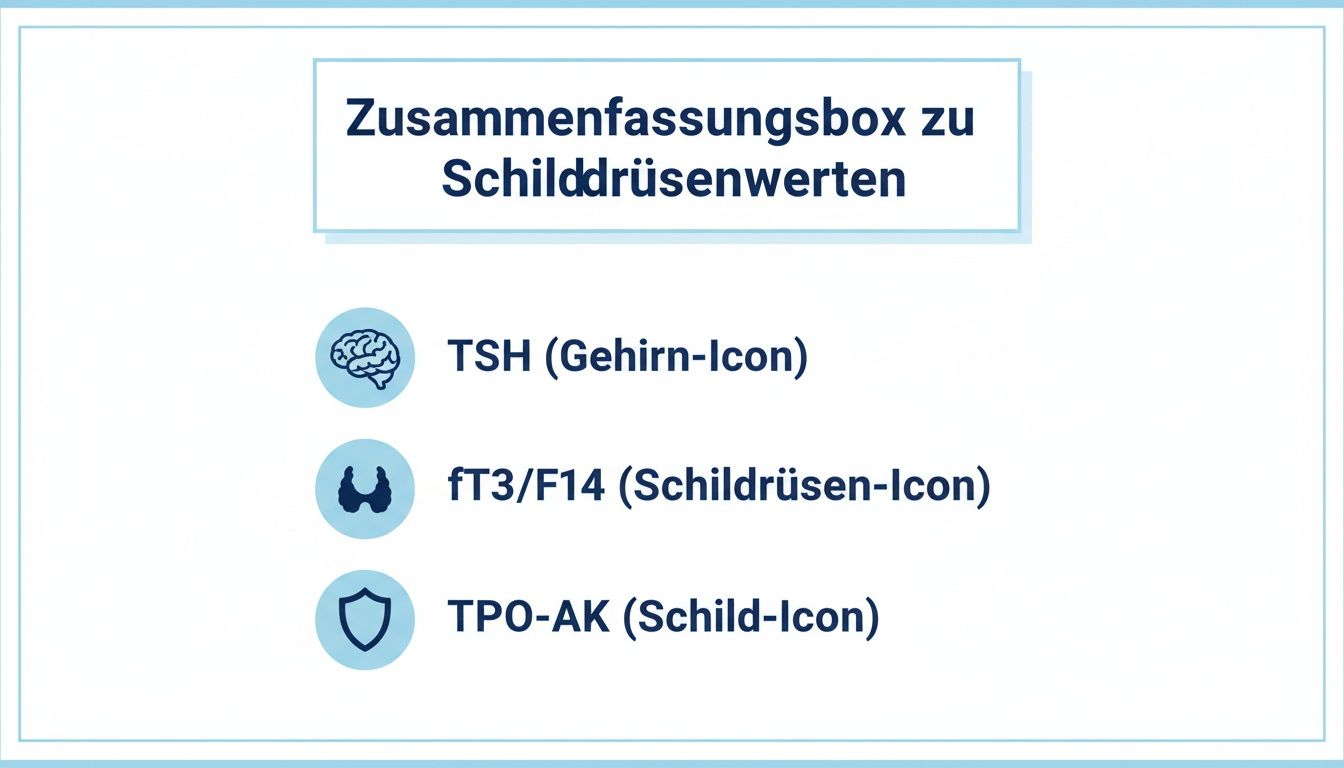
As you can see, it is about the interplay of control signals (TSH), active hormones (fT3/fT4), and possible autoimmune markers (TPO antibodies) to obtain a truly complete picture.
A look at the costs
One topic that naturally also plays a role is cost. If you have specific symptoms, health insurance generally covers an examination by a doctor without any issues. However, if you want to have your thyroid checked purely as a preventive measure, without acute symptoms, it can quickly become an Individual Health Service (IGeL) that you have to pay for yourself.
According to the German Medical Fee Schedule, such a blood test costs between €16.90 and €26.22 in Germany, although additional consultation fees may apply. What is particularly interesting is the assessment by the IGeL Monitor: Such screening examinations for people without symptoms are rated as “tendentially negative” because their benefits have not been clearly demonstrated. You can read more in the press release from the Federal Association of Statutory Health Insurance Funds’ Medical Service.
A home test from mybody®x offers the advantage here that the costs are clear from the outset. You know exactly what you are paying for a comprehensive results profile.
In the end, there is no right or wrong choice. Both paths lead to the same goal. The question is what matters more to you personally: direct advice at a doctor's office or a fast, flexible, self-directed analysis from home.
The mybody®x at-home thyroid test in practice
Don't feel like waiting weeks for a doctor's appointment? Do you simply want to know what's going on, discreetly and conveniently from home? That's exactly why we developed the mybody®x thyroid TSH self-test. Here, we'll show you in practical terms how straightforward the entire process is—from placing your order to receiving easy-to-understand results.
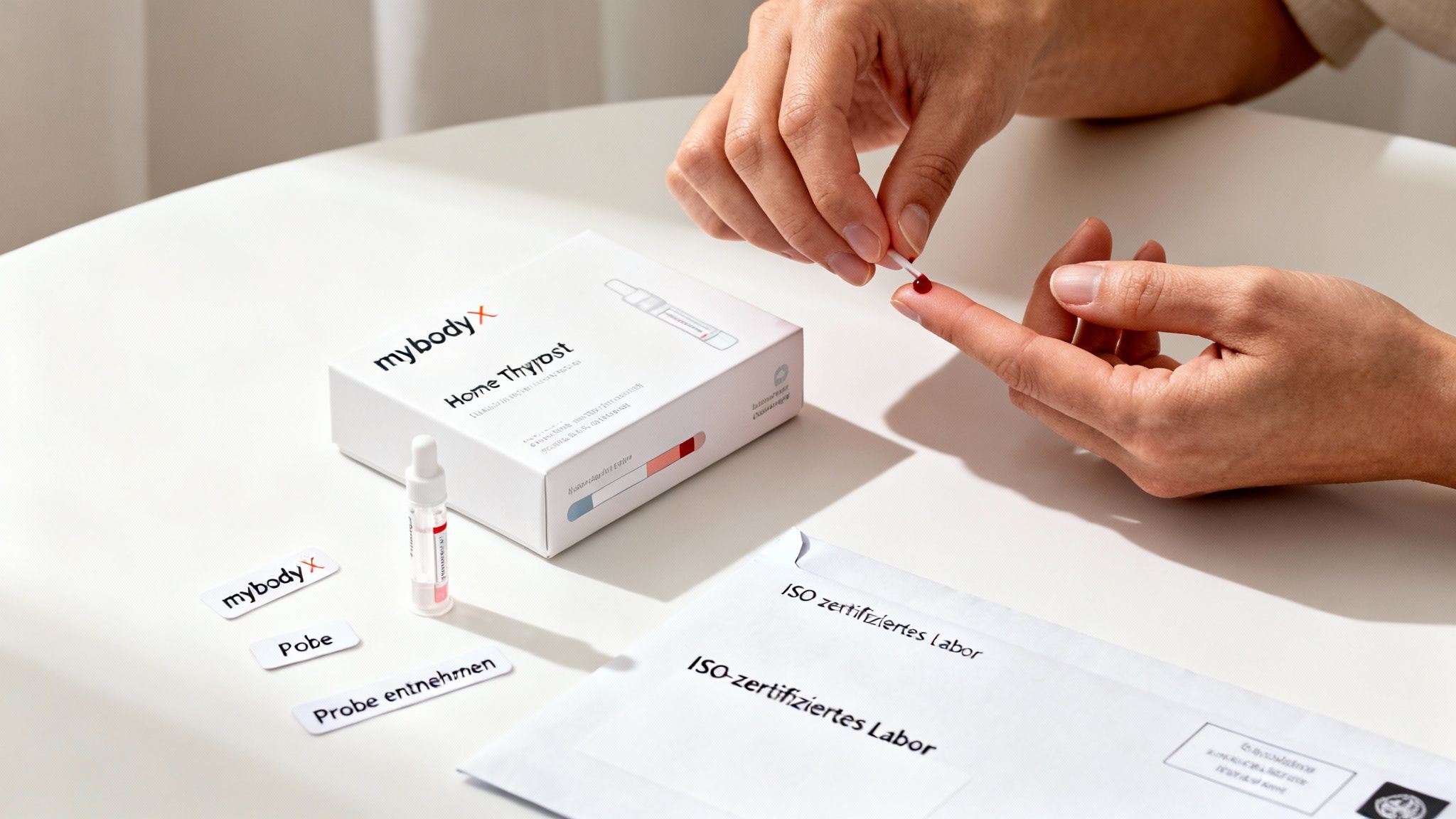
Our philosophy is simple: We give you a tool that enables you to take action yourself. You don't have to justify your symptoms at length or ask for a laboratory test first. Instead, you can establish the facts yourself whenever it fits your schedule.
Your path to clear results in just a few steps
It all starts with taking matters into your own hands. As soon as you order the test, we'll send you a small, discreet package. It contains everything you need—clearly explained and labelled.
The most important moment is, of course, collecting the blood. Many people feel quite apprehensive beforehand, but we can reassure you: it really is just a small prick in your fingertip. With the enclosed lancets, it's over in a flash and hardly hurts. Just a few drops of blood are enough.
Here are a few tried-and-tested tips from practice to help everything go smoothly:
- Warm your hands: Simply hold them under warm water for a moment or massage them a little. This stimulates circulation and helps the drops flow more easily.
- Use gravity: Let your arm hang loosely downward for a moment before pricking your finger. Simple but effective.
- Stay well hydrated: When you're well hydrated, your blood is more fluid too. That makes collecting the sample a breeze.
Once the sample is in the tube, pack it in the enclosed return envelope. It is already stamped, so all you have to do is drop it in the nearest mailbox. That's all there is to it—we'll take care of the rest.
What happens to your sample in the laboratory
As soon as your sample arrives with us, it goes straight to our ISO 15189-certified specialist laboratory in Germany. Absolute professionals work here according to the same high medical standards that apply to every analysis in a doctor's office.
Our mybody®x thyroid TSH self-test for home use examines the key value that serves as the first indication of a dysfunction:
- TSH (the control chief from the brain)
This value is the perfect first point of contact. It shows whether the control system between your brain and thyroid is in balance, providing a crucial indication of whether further, more comprehensive tests (such as fT3, fT4, and antibodies) would be useful.
Your data is absolutely secure with us. Data protection is not an empty promise, but an established practice. All processes are ISO 27001 certified and strictly comply with GDPR guidelines. Your results belong to you alone.
Your personal results report – Finally easy to understand
After a few business days, the time will have come. You will receive a notification and can access your personal report in our secure online portal. But do not worry—we will not leave you alone with a cryptic table full of numbers.
We present your value in a visually appealing way, so you can see at a glance where you stand. Your TSH level is explained clearly and understandably. What does it mean if your TSH is slightly elevated? We translate this “lab jargon” for you.
In addition, you will receive specific recommendations tailored to you. These are not generic phrases, but practical tips based on your value. This transforms the test from a simple measurement into a true compass for your well-being.
Interpreting your results correctly and planning the next steps
Finally, the time has come: You are holding your results report in your hands. This is a crucial moment on your journey toward greater clarity about your thyroid health. But what do you do now with all those numbers and graphs? The good news is: You do not have to be a medical professional to understand the story your value tells. We are here to help.
But first, the most important thing: A mybody®x test gives you an incredibly valuable and precise snapshot in time. It is a fantastic tool for gaining initial insights and uncovering connections. What it is not, however, is a medical diagnosis. Consider your result a well-founded, data-based basis that enables you to discuss the matter with your doctor on an equal footing if needed.
Typical value patterns – What’s behind them?
Your result shows where your TSH level lies compared with the reference range. That is the key to interpreting it. Let’s go through a few typical scenarios so you can better understand your own result.
Scenario 1: Suspected underactive thyroid (hypothyroidism)
Imagine that your report shows the following:
- TSH: Significantly elevated (e.g., above 4.5 mU/l)
This constellation is the classic sign of an underactive thyroid. Your brain (TSH) essentially has to “call” louder and louder because your thyroid is probably producing too few hormones. Symptoms such as constant fatigue, unexplained weight gain, and always feeling cold would fit the picture perfectly.
Scenario 2: Suspected thyroid overactivity (hyperthyroidism)
Here, the picture would be exactly the opposite:
- TSH: Very low or no longer measurable (e.g., below 0.4 mU/l)
In this case, your brain applies the TSH brakes fully because your thyroid is releasing far too many hormones on its own. Inner restlessness, a racing heart, or weight loss despite eating normally would be typical accompanying symptoms.
A laboratory result is not a definitive diagnosis, but an important guide. It shows you which direction to look in and gives you the data you need to ask the right questions.
Off to the doctor – When is the time right?
Your mybody®x test report is designed to provide you with clear, easy-to-understand recommendations. However, the rule of thumb is: Any significant deviation from the reference values should be discussed with a doctor, and doing so is the right and absolutely necessary next step.
Especially in the scenarios described above, only a medical professional can make a final diagnosis. Further tests are often necessary, such as a blood draw to determine free hormone levels (fT3, fT4) or an ultrasound of the thyroid. Your test result is the perfect basis for a discussion. Instead of coming to the doctor with vague suspicions, you can bring a concrete laboratory result.
First steps you can take right away
Regardless of whether your result is abnormal or not, you can always actively support your thyroid. Often, even small adjustments to your daily routine can make a huge difference.
- Nutrient check: Your thyroid depends on certain building blocks. Iodine, selenium, and zinc are particularly important. A few Brazil nuts a day are a great source of selenium, while fish and seaweed provide iodine.
- Stress management: Chronic stress is toxic to your hormonal system and can fuel inflammation in the body. Find out what helps you unwind—whether it is yoga, meditation, or simply a daily walk in nature.
- Keep an eye on your gut health: A healthy gut is essential for converting the storage hormone T4 into the active hormone T3. A diet rich in fiber and full of vegetables and fermented foods (such as yogurt or sauerkraut) is worth its weight in gold here.
These tips are of course no substitute for medical treatment, but they provide a healthy foundation on which everything else can build. They put you back in control, allowing you to take action yourself and improve your well-being while planning the next steps with your doctor.
Your questions about the at-home thyroid test
After all that information, you probably still have a few questions on your mind. That is completely normal—after all, this is about your health, and you want to know exactly what is going on. Here we have collected the answers to the most frequently asked questions about the mybody®x thyroid TSH self-test.
How reliable is a home test compared with a doctor’s test?
This is probably the most important question of all, and the answer is very simple: The laboratory analysis itself is just as reliable as at the doctor’s office. Your sample is sent to a German specialist laboratory certified to ISO 15189. These are exactly the same quality standards used to analyze samples from a doctor’s office.
The only difference is where the sample is collected—in your home rather than in the examination room. With our detailed instructions, we make sure you do everything correctly so that your result is precise and meaningful.
Does having blood drawn from the finger hurt a lot?
Most people are surprised by how quick and straightforward the whole process is. It really is just a small, quick prick in the fingertip. The lancets we include are specially designed to minimize the pain.
Honestly, it is just a tiny moment that can spare you weeks of wondering. The clarity you gain is absolutely worth that little prick.
What happens if my level is not normal?
If your result falls outside the normal range, there is no reason to panic. On the contrary: it is an important first indication that you can follow up on. Our results report explains everything clearly and gives you the clear recommendation to have the value assessed by a doctor.
The major advantage is that you go to the practice with concrete data rather than a vague suspicion. Based on this, your doctor can make a much more targeted final diagnosis, arrange further examinations such as measuring free hormones or an ultrasound if necessary, and find the right treatment for you. The home test is therefore your perfect preparation for a well-informed consultation with your doctor.
How quickly will I get my result?
We know how frustrating the wait can be. Once your sample arrives at our laboratory, the analysis usually takes only a few working days. You will then immediately receive an email informing you that your personal results report is available in your secure mybody®x account.
So you do not have to wait for weeks for the next available doctor's appointment or a call back from the practice to find out what is going on.
Do I have to fast for the test?
No, you do not necessarily have to fast for the pure thyroid value TSH. This value is fairly stable and is hardly affected by a meal.
However, there are still a few things you should bear in mind so that the result is not distorted:
- Take thyroid medication only afterward: Are you already taking L-thyroxine or other thyroid hormones? If so, please take your tablet on the day of the test only after the blood draw.
- Be careful with biotin: High-dose biotin (vitamin B7) in dietary supplements can interfere with laboratory results. It is best to stop taking such supplements a few days before the test.
- The early bird catches the worm: The best time to provide the sample is in the morning, as TSH levels naturally fluctuate throughout the day.
Is my data safe with you?
Absolutely. Protecting your health data is our highest priority. Only you can see your results—and exclusively in your password-protected online account.
All our processes are GDPR-compliant, and our information security system is ISO 27001 certified. You can therefore be 100% certain that your sensitive data is in the best hands with us and will never be shared with third parties. Your health is and remains your private matter.
Are you ready to take the first step and finally gain clarity about your thyroid? With a blood test from mybody®x, you take your well-being into your own hands—scientifically sound, discreet, and conveniently from the comfort of your home. Discover the possibilities now at https://mybody-x.com.



Share now:
Strengthen your immune system naturally: Your plan for strong defenses
Recognize and understand the symptoms of hormonal imbalance