

Understand health metrics and improve them strategically
TL;DR:
- More than 61% of men and 38% of women in Germany are overweight, often without knowing their blood values.
- Blood values such as cholesterol, blood sugar, and CRP are crucial for preventive healthcare and individual optimization.
- Combining BMI, body fat measurement, and basal metabolic rate provides a more comprehensive picture of physical health.
More than 61% of men and 38% of women in Germany are overweight, yet most do not know their own blood values, basal metabolic rate, or body fat percentage. These figures are precisely the key to managing nutrition, weight, and vitality in a targeted way. If you do not know where you stand, you are optimizing blindly. This article provides a systematic overview of the most important health metrics, explains their significance in everyday life, and shows how you can achieve concrete improvements using scientifically sound methods.
Table of contents
- Important health metrics and what they indicate
- BMI and body fat percentage: Opportunities and limitations of traditional indicators
- Basal Metabolic Rate and Calorie Needs: What Your Body Really Uses
- Nutrient profiles and a healthy diet: limits and optimization
- Why single measurements do not count and personalization will become standard in the future
- Test your health values easily and individually
- Frequently asked questions about health values
Key insights
| Point | Details |
|---|---|
| Blood values as a foundation | Important laboratory values provide early indications of health risks. |
| Putting BMI and body fat percentage into perspective | BMI only roughly indicates risk—body fat and its distribution are needed for a complete picture. |
| Measure individual calorie needs | Formulas help, but accurate measurements provide a better roadmap for nutrition and weight management. |
| Pay attention to the nutritional profile | Promoting fiber and limiting sugar, salt, and fat has been shown to improve these metrics. |
| Consistency over individual measurements | Regularly monitoring these metrics enables targeted, personalized optimization. |
Important health metrics and what they indicate
Blood is an information carrier. It reflects how well your body is functioning, whether inflammation is present, how your organs are working, and whether you are receiving sufficient nutrients. A complete blood count provides several important individual values.
The complete blood count includes, among other things, leukocytes (white blood cells, normal range 4.0 to 10.0 G/l), erythrocytes (red blood cells, 4.2 to 5.4 T/l in men), and hemoglobin (oxygen transport, 13.5 to 17.5 g/dl in men). Deviations may indicate infections, anemia, or chronic diseases. Reference ranges for key blood values vary depending on age, sex, and the laboratory method used, so comparisons should always be interpreted in the context of your own test report.
The following parameters are particularly informative for prevention:
- Total cholesterol: Should be below 200 mg/dl. LDL (“bad” cholesterol) below 130 mg/dl, HDL (“good” cholesterol) above 40 mg/dl in men.
- Fasting blood glucose: Normal range 70 to 100 mg/dl. Values above 126 mg/dl indicate diabetes.
- Liver values (AST, ALT, GGT): Elevated levels may indicate fatty liver, alcohol consumption, or medication side effects.
- Kidney values (creatinine, urea): Show how well the kidneys filter waste products.
- Ferritin: Iron stores, relevant to energy and performance.
An often underestimated marker is C-reactive protein (CRP). It is an inflammatory marker in the blood that rises in acute infections as well as in chronic low-grade inflammatory processes. C-reactive protein levels above 5 mg/l are considered elevated and should be medically evaluated. For heart health screening, high-sensitivity hsCRP is increasingly being used, as it detects even the smallest inflammatory reactions.
Important: Laboratory reference ranges are not rigid limits but statistical guidelines. A value just outside the normal range does not automatically indicate a disease. What matters is the trend over time and the overall picture of all parameters.
| Parameter | Normal range | Meaning |
|---|---|---|
| Leukocytes | 4.0 to 10.0 G/l | Immune defense |
| Hemoglobin (men) | 13.5 to 17.5 g/dl | Oxygen transport |
| LDL cholesterol | below 130 mg/dl | Heart risk |
| Fasting blood glucose | 70 to 100 mg/dl | Glucose metabolism |
| CRP | below 5 mg/l | Inflammation status |
BMI and body fat percentage: Opportunities and limitations of traditional indicators
Anyone who knows their blood values should also be able to assess their weight and body composition. Both aspects complement each other and together provide a more complete picture of health.

The Body Mass Index (BMI) is the best-known standard measure for assessing weight. It is calculated by dividing body weight in kilograms by the square of height in meters. The normal range is 18.5 to 24.9. Values between 25 and 29.9 are considered overweight, while values of 30 or higher indicate obesity. The fact that 61% of men and 38% of women in Germany are overweight shows how widespread the problem is.
However, BMI has clear weaknesses. It does not distinguish between muscle and fat tissue. A strength athlete with a high muscle mass can have a BMI of 27 and still be very healthy. Conversely, an older person with a normal BMI may have a dangerously high body fat percentage because muscle mass decreases with age. This phenomenon is called sarcopenic obesity and cannot be identified using BMI alone.
The following methods are suitable for a more accurate assessment:
- BIA (Bioelectrical Impedance Analysis): Measures body fat percentage through electrical resistance. Easy to use, but with a margin of error of ±3 to 5%.
- DEXA (Dual-Energy X-ray Absorptiometry): The gold standard for body composition, measuring fat, muscle, and bone density separately. Highly precise, but available only in medical facilities.
- Waist-to-hip ratio: A simple measurement that captures abdominal fat, which is particularly dangerous for the heart.
“BMI is a good starting point, but not the end point. Anyone who really wants to know how their body is composed needs more than one number.”
Pro tip: Always take BIA measurements at the same time of day, after waking up and before breakfast, to obtain comparable results. Hydration status, exercise the previous day, and meals significantly affect the result.
If you want to measure your body fat percentage and monitor it over the long term, combining regular BIA measurements with occasional DEXA scans is a sensible approach. This lets you identify trends before they become a problem.
| Method | Accuracy | Effort | Cost |
|---|---|---|---|
| BMI | Low | Very low | Free |
| BIA | Medium | Low | Low |
| DEXA | High | Medium | Medium to high |
| Skinfolds | Medium | Medium | Low |
Basal Metabolic Rate and Calorie Needs: What Your Body Really Uses
In addition to body composition, individual calorie expenditure also influences the assessment of all health metrics. If you don't know your basal metabolic rate, dietary changes can often feel like navigating in the dark.
Basal metabolic rate (BMR) describes the amount of energy the body uses at complete rest, including for heartbeat, breathing, body temperature, and cell renewal. For most people, it accounts for 60 to 75% of total calorie expenditure. Activity energy expenditure is added through physical activity, together making up total energy needs.
What many people don't know: Two people with the same weight and height can have basal metabolic rates that differ by up to 300 kilocalories per day. The reasons include differences in muscle mass, thyroid function, genetics, and hormone balance. This explains why standard formulas such as the Harris-Benedict equation or the Mifflin-St. Jeor equation are useful but often inaccurate.
This is how basal metabolic rate is determined:
- Formulas (e.g., Mifflin-St. Jeor): Quick and free, but based on average values. Suitable as a rough guide.
- BIA measurement: Estimates BMR based on body composition. More accurate than formulas, but still an estimate.
- Indirect calorimetry (spiroergometry): Measures actual oxygen consumption and CO2 output. The most accurate method for measuring BMR, but time-consuming and available only at specialized facilities.
- DNA analysis: Provides indications of genetically determined metabolic characteristics that formulas cannot capture.
Pro tip: If you have a specific weight goal, it is worth having your basal metabolic rate measured precisely. Many people fail on diets because they misjudge their needs and either eat too little (muscle loss) or too much (no progress). With a calorie needs calculator, you can calculate your individual needs as a starting point.
Basal metabolic rate becomes particularly relevant in the context of hormones. Thyroid hormones (T3, T4) directly regulate metabolism. A mildly underactive thyroid, even when its levels are still within the normal range, can nevertheless cause someone to lose hardly any weight despite a calorie deficit. This is not a willpower problem, but biology.
Nutrient profiles and a healthy diet: limits and optimization
In addition to individual figures, good health always requires the right diet. But what does “right” mean in concrete terms once you know your own values?
The EU and the German Federal Institute for Risk Assessment (BfR) have developed nutrient profiles that serve as a guide for making health-promoting food choices. These profiles define upper limits for fat, saturated fatty acids, sugar, and salt, as well as lower limits for fiber.
Practical daily reference values for adults:
- Total fat: Maximum 70 g (of which saturated fatty acids under 20 g)
- Sugar (free added): Under 50 g, ideally under 25 g according to WHO recommendations
- Salt: Under 6 g per day
- Fiber: At least 30 g; most Germans consume only around 18 g
- Protein: 0.8 g per kilogram of body weight as a minimum, with higher amounts for physical activity
These figures sound abstract until you start reading food labels. A standard breakfast cereal can already contain 20 g of sugar per serving—almost half the recommended daily maximum. Anyone who wants to improve their blood sugar or cholesterol levels should start right here.
Personalized nutrient profiles go even further. If you know that you are genetically predisposed to elevated triglycerides, a reduced-fat diet focused on omega-3 fatty acids makes more sense than a general low-carb diet. If your ferritin level is low, your body needs more iron-rich foods such as legumes, red meat, or fortified cereals combined with vitamin C.
The macronutrients and health markers directly influence one another. More fiber has been shown to lower LDL cholesterol and stabilize blood sugar. Less sugar reduces inflammatory markers such as CRP. A personalized diet deliberately uses these relationships instead of relying on general recommendations.
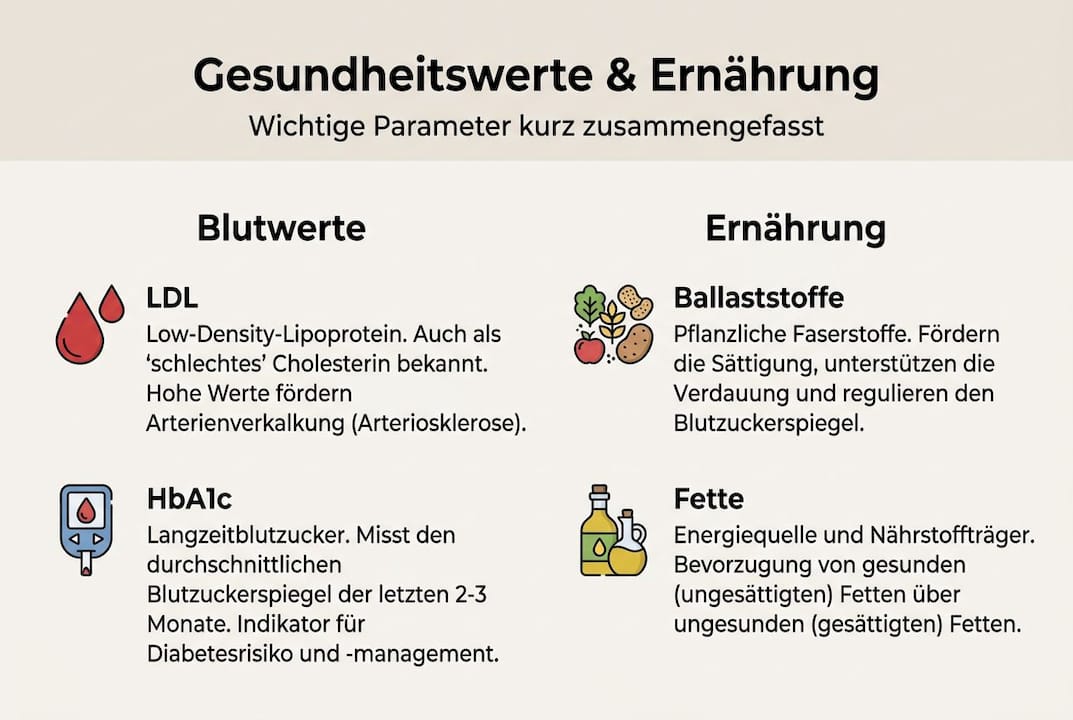
The BfR dietary guidelines also recommend making dietary changes gradually. People who try to change everything at once are more likely to fail. One strategy: Make one specific adjustment each week—for example, fewer sugary drinks in week one and more vegetables in week two.
Why single measurements do not count and personalization will become standard in the future
After years of working with health data, a clear pattern emerges: People who have their values measured once and then do nothing else benefit very little. The real value comes from repetition and comparison.
Reference ranges are a starting point, not a verdict. A CRP value of 4.8 mg/L is technically within the normal range, but if it was 1.2 mg/L three months ago, that is a signal. Laboratories are increasingly using trend analyses instead of interpreting individual values because the development reveals more than the value at a single point in time.
Parameters such as vitamin D, ferritin, hsCRP, and HbA1c value trends are becoming increasingly important because they provide early warning signals long before classic symptoms appear. Those who measure and digitally document these values regularly can adjust their nutrition, exercise, and sleep in a targeted way. This is no longer a vision of the future; modern at-home tests already make it possible today. Personalization is becoming the standard because average values are simply not sufficient for individual health.
Test your health values easily and individually
Those who know the theory can put it into practice. With mybody®, you can conveniently analyze the most important health values from home, without a doctor's appointment or long waits. The ISO-certified analyses cover blood values, DNA metabolism, micronutrients, hormones, and gut health. You receive a personalized report with specific nutrition recommendations, lifestyle tips, and a clear action plan. More than 11,300 customers, with an average rating of 4.77 stars, trust this approach. Start now with an individual health check and find out what your values really say about you.
Frequently asked questions about health values
Which blood values are particularly important for preventive healthcare?
For preventive care, cholesterol, blood sugar, liver and kidney values, as well as inflammatory markers such as CRP, are essential. The most important reference ranges help identify deviations early and take countermeasures.
How often should the most important health values be checked?
From age 40 onward, annual screening of key values such as HbA1c, vitamin D, and cholesterol is recommended. Younger people with risk factors or specific health goals should also test regularly.
Why is BMI not equally meaningful for everyone?
BMI does not take fat distribution or muscle mass into account, overestimates risks in athletes, and underestimates them with age. Additional measurements such as BIA or the waist-to-hip ratio provide a more accurate picture.
Which method is the most accurate for determining body fat percentage?
DEXA measurement is the most accurate. For everyday use, BIA scales are practical and useful for tracking trends, but they have an error margin of ±3 to 5% and should therefore always be used under the same conditions.



Share now:
Immediate help: What to do in case of an allergic reaction?
Hormone level test types: Which method is right for you?