

Complex B Vitamin Supplements: How to Dose Correctly
TL;DR:
- Many people take high-dose B vitamin supplements even though a needs-based dosage is usually sufficient.
- Overdosing, particularly on B6, can cause nerve damage and should be avoided.
Many people turn to complex B vitamin supplements convinced that more is better. That is not true, and with certain B vitamins, this assumption can cause real harm. B vitamins are water-soluble and essential, and must be supplied regularly through food or supplements. But whether you actually need them, what dosage is appropriate, and what you should look for when buying them depend heavily on your personal situation. This article gives you the knowledge you need to make informed decisions.
Table of contents
- Key findings
- The eight B vitamins and their functions
- Dosage, requirements, and risks
- Choosing the Right Supplement
- Incorporating a B-vitamin complex into everyday life
- My assessment of dosage and quality
- High-Quality B Vitamins at Mybody-x
- FAQ
Key findings
| Point | Details |
|---|---|
| Eight vitamins in one complex | A B vitamin complex contains B1 through B12 and supports energy, nerves, and blood formation simultaneously. |
| Dosage is individual | Pregnant women, vegans, and older people often have increased needs that should be met deliberately. |
| Overdosing is not a myth | Vitamin B6 in particular can cause nerve damage if taken in excess over a prolonged period, and this damage can be difficult to reverse. |
| Quality matters | Activated vitamin forms are better absorbed than inexpensive precursors without proven bioavailability. |
| Blood test before supplementation | A blood test shows whether a deficiency is present and prevents unnecessary or dangerous overdosing. |
The eight B vitamins and their functions
Vitamin B complex contains all eight essential B vitamins, which work together synergistically. This means they complement one another and have a stronger combined effect than they do individually. Those who supplement with only one B vitamin often overlook how closely the B vitamins are interconnected.
Here is an overview of all eight:
- Vitamin B1 (thiamine): Converts carbohydrates into energy and supports the nervous system. Deficiency often manifests as fatigue and difficulty concentrating.
- Vitamin B2 (riboflavin): Involved in generating energy from fats, proteins, and carbohydrates. Important for skin and eyes.
- Vitamin B3 (niacin): Supports more than 400 enzymatic reactions in the body, particularly those involved in cell repair and energy production.
- Vitamin B5 (pantothenic acid): Necessary for the synthesis of coenzyme A, which is central to fat metabolism.
- Vitamin B6 (pyridoxine): Involved in amino acid metabolism, neurotransmitter synthesis, and immune function. It is also the B vitamin with the highest risk of overdose.
- Vitamin B7 (biotin): Known for its role in skin, hair, and nails. Also important for glucose metabolism.
- Vitamin B9 (folate/folic acid): Essential for cell division and DNA synthesis. Particularly critical during pregnancy.
- Vitamin B12 (cobalamin): Essential for blood formation, nerve function, and the methylation of homocysteine. It is found almost exclusively in animal products.
All eight of these vitamins are water-soluble. This means that the body stores very little of them, with the exception of B12, which is stored in the liver. All the others must be consumed regularly, either through the diet or through targeted B-vitamin supplementation.
| Vitamin | Main function | Risk group for deficiency |
|---|---|---|
| B1 | Energy metabolism, nerves | People with alcohol dependence, malnourished people |
| B6 | Neurotransmitters, immune system | Older people, medication users |
| B9 | Cell division, DNA synthesis | Pregnant women, women of childbearing age |
| B12 | Blood formation, nerve function | Vegans, older people |
Dosage, requirements, and risks
Health benefits from B vitamins do not come from maximum doses, but from intake that meets requirements. This may sound obvious, but it is regularly ignored in practice.
The German Nutrition Society recommends the following reference values for healthy adults:
- Vitamin B12: 4 µg daily for adults, 4.5 µg during pregnancy, and 5.5 µg while breastfeeding. Vegans should take targeted supplements, as B12 is rarely found in plant-based foods.
- Vitamin B6: A maximum of 1.4 mg daily for adults from food. The German Federal Institute for Risk Assessment recommends a maximum of 0.9 mg per day from dietary supplements, well below international standards.
- Vitamin B9 (folate): 300 µg daily for adults, 550 µg during pregnancy. Women planning to conceive should start supplementing early.
- Vitamin B3 (niacin): 11 to 15 mg daily. Higher doses only under medical supervision, as nicotinic acid can cause skin flushing and liver damage.
- All other B vitamins: For most healthy adults, their needs can be adequately met through a balanced diet.
Certain groups have an increased need for B vitamins: vegans, pregnant and breastfeeding women, people over 65, and those taking metformin or proton pump inhibitors. People who regularly drink alcohol also have an increased risk of deficiencies, particularly in B1, B6, and folate.
The greatest risk involves vitamin B6. Chronic overdose starting at 20 mg per day can cause peripheral neuropathy. Those affected report numbness, tingling in the hands and feet, and coordination problems. This damage is often difficult to reverse. The insidious part is that many over-the-counter supplements contain far more than the recommended amount.

Pro tip: Have your B-vitamin status determined by a blood test before buying a supplement. This way, you know whether you actually have a deficiency and can tailor the dosage instead of taking high doses without confirmation.
Choosing the Right Supplement
The market for B-vitamin complexes is large and confusing. There are huge differences between inexpensive discount products and expensive branded supplements—not only in price but also in quality.
What to look for when buying:
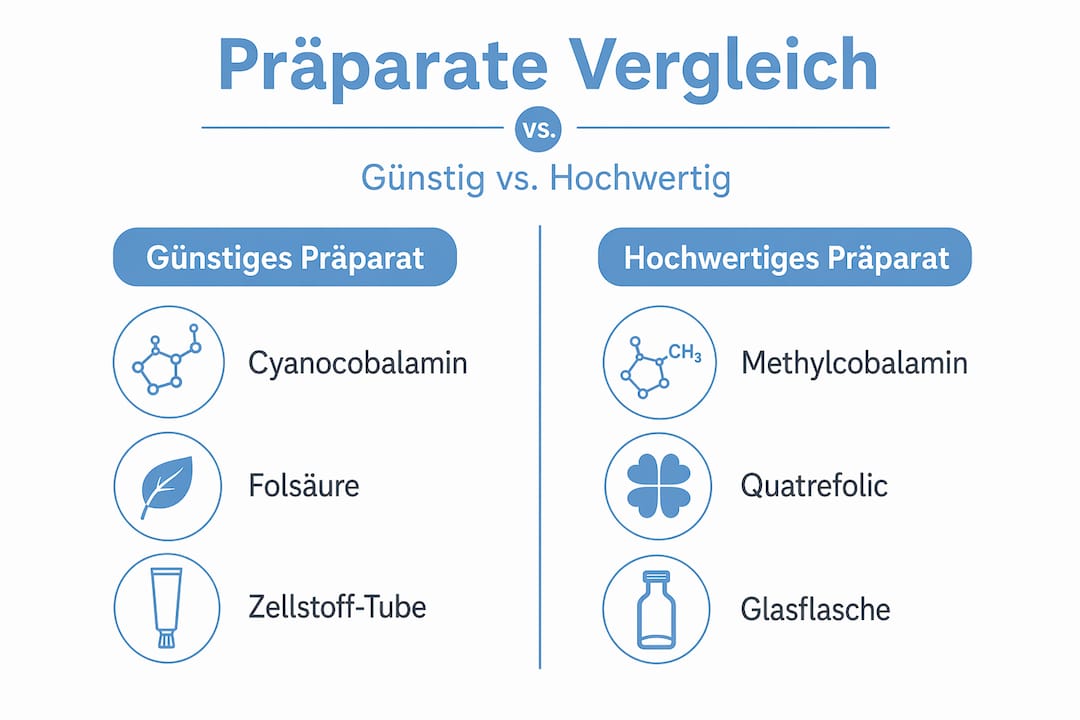
- Activated vitamin forms: High-quality B-complex supplements contain vitamins in their active, bioavailable form. Methylcobalamin instead of cyanocobalamin for B12, methylfolate instead of folic acid for B9, and pyridoxal 5-phosphate instead of pyridoxine for B6. The body does not need to convert these forms first, which is particularly relevant for people with MTHFR gene variants.
- Dosage within a reasonable range: Supplements containing 1,000 percent of the daily requirement for B6 are not a sign of quality. They are a warning sign. Look for products that cover 100 to 200 percent of the daily requirement.
- No unnecessary additives: Titanium dioxide, artificial colorants, or fillers such as magnesium stearate in large amounts have no place in a high-quality supplement.
- Third-party certifications: Seals such as ISO certification, GMP production, or independent laboratory testing provide indications of quality control.
- Complete composition: A true B-vitamin complex contains all eight B vitamins. Products containing only five or six are not a complete complex.
Pro tip: If you want to buy B vitamins affordably without compromising on quality, don't just compare the price per capsule—compare the price per daily dose in its active form. A seemingly inexpensive product with inactive vitamins is often more expensive than a high-quality supplement with genuine bioavailability.
| Criterion | Affordable supplement | High-quality supplement |
|---|---|---|
| Vitamin form | Cyanocobalamin, folic acid | Methylcobalamin, methylfolate |
| B6 dosage | Often 500 to 1,000% of the daily requirement | 100 to 150% of the daily requirement |
| Additives | Colorants, fillers | Minimal, without unnecessary additives |
| Certification | Not specified | GMP, ISO, or third-party laboratory |
| Completeness | 5 to 6 vitamins | All 8 B vitamins |
Interactions should also be taken into account. High doses of B9 can mask a B12 deficiency because they normalize blood formation while nerve damage progresses. Anyone taking folic acid should therefore always keep an eye on their B12 status as well. You can find an overview of nutrient deficiency symptoms at Mybody-x.
Incorporating a B-vitamin complex into everyday life
Knowledge about dosage and quality is of little use if taking the supplement does not work in everyday life. Here are concrete steps that really make a difference:
- Take in the morning with a meal: B vitamins are water-soluble and are best absorbed with some fat and protein. In addition, their stimulating effect on metabolism can disrupt sleep when taken in the evening.
- Consistency over quantity: Taking a moderate dose daily is more effective than taking high doses irregularly. The body quickly excretes excess amounts; high doses are usually unnecessary.
- Use diet as the foundation: Meat, fish, eggs, legumes, leafy green vegetables, and whole-grain products provide natural B vitamins. A supplement does not replace a balanced diet; it complements it where gaps exist.
- Take symptoms seriously: Persistent fatigue, tingling in the extremities, difficulty concentrating, or pale skin may indicate a deficiency. Anyone who recognizes B12 deficiency symptoms should not simply take high-dose supplements, but should first clarify the cause.
- Regular monitoring: Anyone who supplements on a long-term basis should have their blood levels checked at least once a year. This applies particularly to B12, which can accumulate in the body, but also to B6, where an overdose can develop gradually.
Seeing a doctor is advisable if you take medications that affect B vitamins, such as metformin, proton pump inhibitors, or antiepileptic drugs. These active ingredients can significantly interfere with the absorption or metabolism of B vitamins, creating a higher requirement that is difficult to assess without a blood test.
My assessment of dosage and quality
I see the same pattern again and again in practice: People buy B vitamin complexes because they feel tired or because a friend recommended them. No blood test, no diagnosis—just the highest dosage available at the drugstore.
What I learned from this: Blood tests should form the basis of every supplementation decision. Not gut feeling, advertising, or trends. The idea that water-soluble vitamins are automatically safe in any amount is false. With B6 in particular, I repeatedly see cases where well-intentioned self-treatment has led to real problems.
My honest advice: Quality and knowledge are worth more than an inexpensive high-dose supplement. Those who understand how B vitamins work, which forms are bioavailable, and what their body actually needs make better decisions. And that starts with a simple blood test.
— MYBODY
High-Quality B Vitamins at Mybody-x
Anyone who wants to truly know their B vitamin status before taking supplements has come to the right place at Mybody-x. At mybody-x.com, you will find not only information about high-quality supplements, but also scientifically validated blood tests that show you where your body actually stands. Instead of relying on guesswork, you receive concrete results and recommendations based on them. More than 11,300 satisfied customers trust Mybody-x’s ISO-certified laboratory. The first step toward targeted and safe B vitamin supplementation begins with the right knowledge about your own body.
FAQ
What does a B vitamin complex contain?
A complete B vitamin complex contains all eight essential B vitamins: B1, B2, B3, B5, B6, B7, B9, and B12. Together, they support energy production, the nervous system, and blood formation.
How do B vitamins work in the body?
B vitamins act as coenzymes in hundreds of metabolic processes. They are involved in energy production, cell division, neurotransmitter synthesis, and DNA repair.
Can B vitamins be overdosed?
Yes. Vitamin B6 in particular can cause peripheral neuropathy if permanently overdosed. The German Federal Institute for Risk Assessment recommends a maximum of 0.9 mg of B6 per day from dietary supplements.
Who needs a B vitamin supplement?
Vegans, pregnant women, older people, and individuals taking certain medications often have an increased need. A blood test clarifies whether supplementation is actually necessary.
Which form of B vitamin is the most bioavailable?
Activated forms such as methylcobalamin (B12), methylfolate (B9), and pyridoxal-5-phosphate (B6) are used directly by the body and should be preferred in high-quality supplements.



Share now:
Vitamin D3 Drops: Dosage, Effects, and Use
Vitamin B complex: effects, benefits, and safety