

Melatonin effects: facts and use explained scientifically
TL;DR:
- Melatonin signals nighttime and influences the sleep-wake cycle, but it does not act as a conventional sleeping pill. It is particularly useful for jet lag and shifting the sleep phase, but it should be dosed and timed correctly. Long-term use carries risks and side effects, so an individual assessment is advisable.
Melatonin is one of the most discussed molecules in the field of sleep and health, and at the same time one of the most frequently misunderstood. Many people turn to melatonin supplements expecting them to act as a powerful sleeping pill that will make them drowsy immediately. But this is precisely a misconception: Melatonin primarily acts as a biological signal for the circadian night and thereby influences the sleep-wake cycle, but it does not sedate you like a conventional sleeping pill. This article explains what melatonin really does, when it may be used appropriately, and what you should consider regarding dosage, timing, and side effects.
Table of contents
- What Is Melatonin and How Does It Work?
- Melatonin as a Sleep Aid: Evidence and Regulatory Framework
- Dosage, Timing, and Practical Use: What Do You Need to Know?
- Side effects, risks, and open questions about long-term use
- What Truth About Melatonin Do Most Guides Miss?
- Next Steps for Your Sleep Health
- Frequently asked questions about melatonin
Key findings
| Point | Details |
|---|---|
| Biological timekeeper | Melatonin regulates the sleep-wake cycle and is not a conventional sleeping pill. |
| Evidence-based use | Effectiveness and safety depend heavily on the correct dosage and timing of intake. |
| Risks and limitations | Side effects and uncertainties associated with long-term use should be taken seriously. |
| Regulatory considerations | In Germany, melatonin supplements are subject to clear regulations and approved uses. |
What Is Melatonin and How Does It Work?
Melatonin is a hormone produced by the body in the pineal gland (Latin: Glandula pinealis), a small structure in the brain. It is formed from the neurotransmitter serotonin and released mainly at night, when it is dark. During the day, bright light inhibits its production. This simple principle makes melatonin the most important time cue for our internal clock.
Endogenous versus exogenous melatonin are two fundamentally different concepts. Endogenous melatonin is what your body produces itself. Exogenous melatonin is what you supply from outside through a supplement. The key question is: What happens when you take exogenous melatonin? It binds to the same receptors as the body’s own hormone—namely the MT1 and MT2 receptors in the brain, particularly in the suprachiasmatic nucleus (SCN). The SCN is the body’s “master clock.” By binding to these receptors, the SCN receives the signal: “It is nighttime.” Sleep readiness increases, but sleep is not directly induced.
Important: Melatonin is not a sleeping pill in the traditional sense. It provides the body with a time cue but does not chemically induce sleep. Anyone who does not understand this will be disappointed by melatonin.
This explains why melatonin functions as a signal for the circadian night and influences the sleep-wake cycle without acting like a sedative. Its effect is subtle, time-dependent, and highly context-dependent. This fundamentally distinguishes melatonin from benzodiazepines or Z-drugs such as zolpidem.
The following factors particularly strongly influence endogenous melatonin production:
- Light exposure: Blue light from screens strongly suppresses melatonin release
- Age: As we age, the pineal gland produces less melatonin
- Chronotype: Night owls have a naturally later melatonin peak than early birds
- Shift work: Irregular sleep times significantly disrupt circadian rhythms
- Diet and micronutrients: Tryptophan, vitamin B6, and magnesium are precursors or cofactors in melatonin synthesis
If you want to learn more about the relationship between sleep and genes, you will find deeper insights there into how genetic factors control your internal clock. In fact, studies show that up to 40 percent of individual variability in sleep is genetically determined. Genetic causes of sleep problems also play an underestimated role, particularly in connection with caffeine metabolism and sleep architecture.
Melatonin as a Sleep Aid: Evidence and Regulatory Framework
Now that it is clear how melatonin works biologically, the question arises: What may officially be said about it, and when is its use meaningfully evidence-based?
In Germany, melatonin is available both as a food supplement and as a medication. The differences are considerable and often underestimated. In Germany, health claims for melatonin in food supplements are permitted only within a very narrow framework. Specifically, the European Food Safety Authority (EFSA) allows the following claims:
- Melatonin contributes to reducing the time it takes to fall asleep (with 1 mg of melatonin shortly before bedtime)
- Melatonin helps alleviate jet lag symptoms
That's all. Claims about improved sleep maintenance, dream quality, or overall sleep quality are not authorized for food supplements. This is important because many products on the market advertise with significantly broader claims that are not supported by regulations.
| Criterion | Food supplement | Medication |
|---|---|---|
| Typical dose | 0.5 to 1.9 mg | 2 to 10 mg (prolonged-release) |
| Approval | No medicinal product approval | Approved for specific indications |
| Approved claims | Falling asleep, jet lag | Broad, including sleep disorders |
| Prescription-only status | No | Partial (e.g., Circadin®) |
| Quality control | Food Supplements Regulation | Medicines Act |
| Target group | General population | Certain patient groups |
As a medicinal product, Circadin® (prolonged-release melatonin, 2 mg), for example, is approved for adults over 55 with primary sleep disorders. Prolonged-release means that the active ingredient is released slowly and gradually to better mimic the body's nighttime melatonin release. More specifically, Slenyto® (prolonged-release melatonin) is approved for certain sleep disorders in children and adolescents, particularly children with autism spectrum disorders and Smith-Magenis syndrome.
Melatonin may also be relevant for people with sleep disorders during menopause; however, the evidence here is less clear than for jet lag or treatment in children with specific diagnoses. The combination of hormonal changes and sleep-disrupting factors is particularly complex during this stage of life.
Pro tip: If you want to use melatonin to improve your sleep, first check whether healthy routines for better sleep may already achieve the desired effect. Sleep hygiene, regular sleep schedules, and reducing light in the evening have produced comparable or better results than melatonin alone in many studies.
A common misconception: Melatonin does not primarily help with staying asleep. The evidence is considerably stronger for reducing the time it takes to fall asleep than for maintaining sleep. People who frequently wake up at night generally need a different intervention than melatonin.
Dosage, Timing, and Practical Use: What Do You Need to Know?
Once the regulatory situation is clear, we come to the part that causes the most confusion in practice: How much should you take, and when?
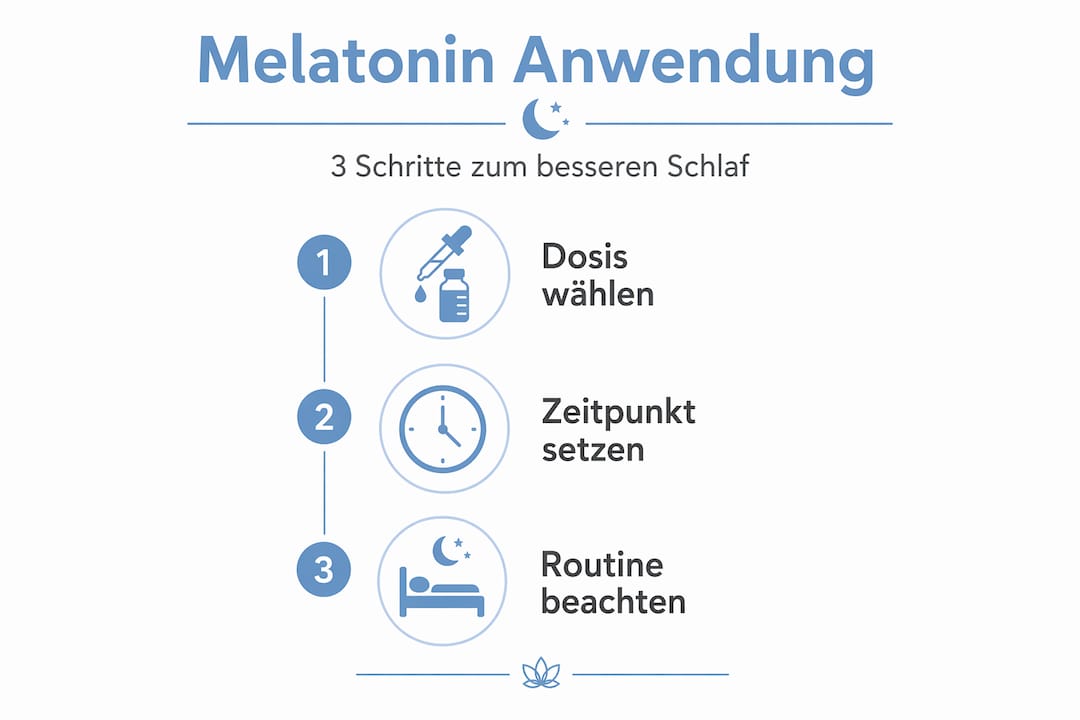
The intuitive answer for many people is: more is better. That is wrong when it comes to melatonin. Dietary supplements on the European market often contain 5 mg or even 10 mg per capsule, although the scientifically effective and safe dose for reducing sleep-onset latency is 0.5 to 1 mg. Higher doses can desensitize receptors and lead to residual effects the next morning. The German Federal Institute for Risk Assessment (BfR) has therefore recommended not exceeding daily doses of 1 mg.
| Goal | Recommended dose | Time of intake |
|---|---|---|
| Shorten sleep-onset latency | 0.5 to 1 mg | 30 to 60 minutes before bedtime |
| Jet lag (eastward travel) | 0.5 to 3 mg | At the destination, at the local bedtime |
| Chronobiological phase shifting | 0.5 mg | 5 to 7 hours before natural sleep onset |
| Medication indication (Circadin®) | 2 mg extended-release | 1 to 2 hours before bedtime |
Effectiveness depends on timing and dosage: The optimal window is approximately 1 to 2 hours before bedtime. Taken too early, melatonin can shift the internal clock. Taken too late, it can cause morning grogginess.
This is how you avoid the most common mistakes when taking it:
- Choosing too high a dose: Start with 0.5 mg and increase only if necessary. Many people already respond to very small amounts.
- Taking it too late in the evening: Anyone who takes melatonin only shortly before falling asleep risks residual effects the next morning.
- Irregular use: For jet lag and shift work, melatonin works best when taken consistently at the same time.
- Expecting an immediate deep-sleep effect: Melatonin is not a sleeping pill. It gives the body a timing cue, nothing more.
- Simultaneous blue-light exposure: Anyone who continues looking at their smartphone after taking melatonin partially counteracts its effects because blue light inhibits melatonin's effects at the receptor.
As with vitamin D timing, the exact time you take melatonin also plays a central role in its effectiveness. The body responds to signals, not quantities. A well-timed, low-intensity signal is more effective than a high dose at the wrong time.
Pro tip: Taking melatonin too late, especially in higher doses, can cause residual drowsiness, reduced reaction speed, and impaired concentration the next morning. This is particularly relevant for anyone who drives in the morning or performs complex professional tasks. Therefore, always plan when to take it based on your realistic bedtime, not your desired bedtime.

Anyone who wants to systematically develop healthy sleep routines will find practical approaches there that go beyond supplementation alone and can significantly improve the effectiveness of melatonin.
Side effects, risks, and open questions about long-term use
Many people consider melatonin a harmless natural product. This perception is problematic. Although melatonin has a favorable safety profile compared with conventional sleeping pills, side effects and risks are real and should be known.
The German Federal Institute for Risk Assessment (BfR) points out that side effects are possible when taking it, even at a low dose. Documented side effects include:
- Drowsiness and sedation, including the following morning
- Headaches and dizziness
- Reduced alertness and slower reaction time
- Drop in blood pressure (hypotension), particularly relevant for people with a corresponding predisposition
- Nightmares and unusually vivid dreams
- Morning grogginess (the so-called “hangover effect”)
These side effects are not uncommon. In studies, up to 15 percent of users report at least one of these effects after taking it. Reduced alertness in particular is relevant in everyday life.
Important note: The BfR expressly recommends not driving or operating machinery after taking melatonin until the individual response is known. This recommendation also applies to low doses.
The question of long-term risks has not yet been conclusively answered by science. Current observational studies discuss a potentially increased risk of heart failure and higher mortality with long-term melatonin use, although the evidence is based on observational data and no causality has been established. This means that we do not know whether melatonin causes these risks or whether people who take melatonin long term are at greater risk of health problems for other reasons.
In this context, anyone who uses medical self-tests to monitor their health parameters is well advised to regularly check relevant markers such as blood pressure, heart rate, and hormone levels.
Particularly vulnerable groups for whom melatonin is not recommended by the BfR:
- Pregnant and breastfeeding women
- Children and adolescents (except for specific medical indications)
- People with autoimmune diseases
- People with epilepsy or other neurological conditions
- People taking anticoagulants or certain antidepressants
Interactions with medications are often underestimated. Melatonin is broken down in the liver by the enzyme CYP1A2. Caffeine, fluvoxamine, and other substances that inhibit this enzyme can significantly increase melatonin levels and lead to unwanted effects.
Anyone who is also interested in mental health and stress reduction should note that chronic stress itself disrupts melatonin production. Stress increases cortisol, which in turn inhibits melatonin synthesis. Taking melatonin as a supplement without addressing the underlying stress is merely treating the symptoms.
What Truth About Melatonin Do Most Guides Miss?
Most articles about melatonin give the impression that it works for everyone as long as they take the right dose at the right time. That is too simplistic. In practice, this exact image leads to frustrating experiences.
Here is an uncomfortable truth: Melatonin is not equally helpful for everyone. The individual chronotype plays a decisive role. People with a late chronotype, known as night owls, naturally have a late melatonin peak. For them, exogenous melatonin can indeed help move their time of falling asleep earlier. But people with an early chronotype, the larks, or people with a normal sleep–wake rhythm will benefit little from melatonin and are more likely to risk side effects than gain benefits.
Another myth is that it works immediately. Many people take melatonin once, notice no dramatic change, and think it does not work or is useless. With some applications, especially shifting the sleep phase, melatonin requires several days of consistent use to gradually adjust the internal clock. It is a process, not a switch.
Also, unlike conventional guides, the question of whether melatonin is useful cannot be answered without self-observation. Anyone who notices no improvement in falling asleep after two to three weeks with the correct dosage and timing should not increase the melatonin, but should question whether the cause of the sleep problems lies elsewhere. For example, in disrupted sleep architecture caused by sleep apnea, a nutrient deficiency (magnesium, vitamin D, B vitamins), or a genetic predisposition.
The genetic sleep profile shows which genetic variants may influence sleep structure, chronotype, and even sensitivity to melatonin. Knowing your individual foundation helps you make better decisions about whether and how melatonin is relevant to you at all.
Our assessment: Melatonin is a useful tool in a specific context, namely for jet lag, shift work, or a clearly defined delayed sleep phase syndrome. Its effectiveness as a general sleep aid for broad sections of the population is overestimated. At the same time, its potential relevance for personal sleep optimization, when used on a genetic and chronobiological basis, is underestimated. This distinction is missing from most guides.
Next Steps for Your Sleep Health
If this article has shown anything, it is this: Sleep is individual, and one-size-fits-all solutions fall short. Before turning to melatonin or other sleep aids, it is worth understanding what is really disturbing your sleep. On the mybody-x Health Portal, you will find scientifically sound information, analyses, and tests that can help you do exactly that. With a DNA metabolism test or a hormone test, you can gain insights into genetic sleep factors, chronotype, the stress axis, and nutrient status. Knowing the individual causes of sleep problems allows you to take more targeted action and make a more informed decision about whether and how melatonin may be useful for you.
Frequently asked questions about melatonin
How quickly does melatonin work after taking it?
The effects usually begin 30 to 60 minutes after taking it. The optimal window for the best effect on the process of falling asleep is 1 to 2 hours before bedtime.
Is melatonin addictive, or can you develop a tolerance?
Melatonin is not considered addictive, and current studies do not indicate that physical dependence should be expected. Nevertheless, long-term use should be critically reconsidered without medical supervision.
What side effects are particularly common with melatonin?
The most common side effects include next-morning sleepiness, morning grogginess, and headaches, even at low doses.
Are there groups of people for whom melatonin is not suitable?
Melatonin is not recommended for pregnant or breastfeeding women or for people with certain pre-existing conditions, such as autoimmune diseases or epilepsy. The BfR expressly advises these at-risk groups against taking it.



Share now:
Submit a stool sample: Instructions for your 2026 bowel test
Understanding Dietary Fiber: Effects, Benefits, and Tips