
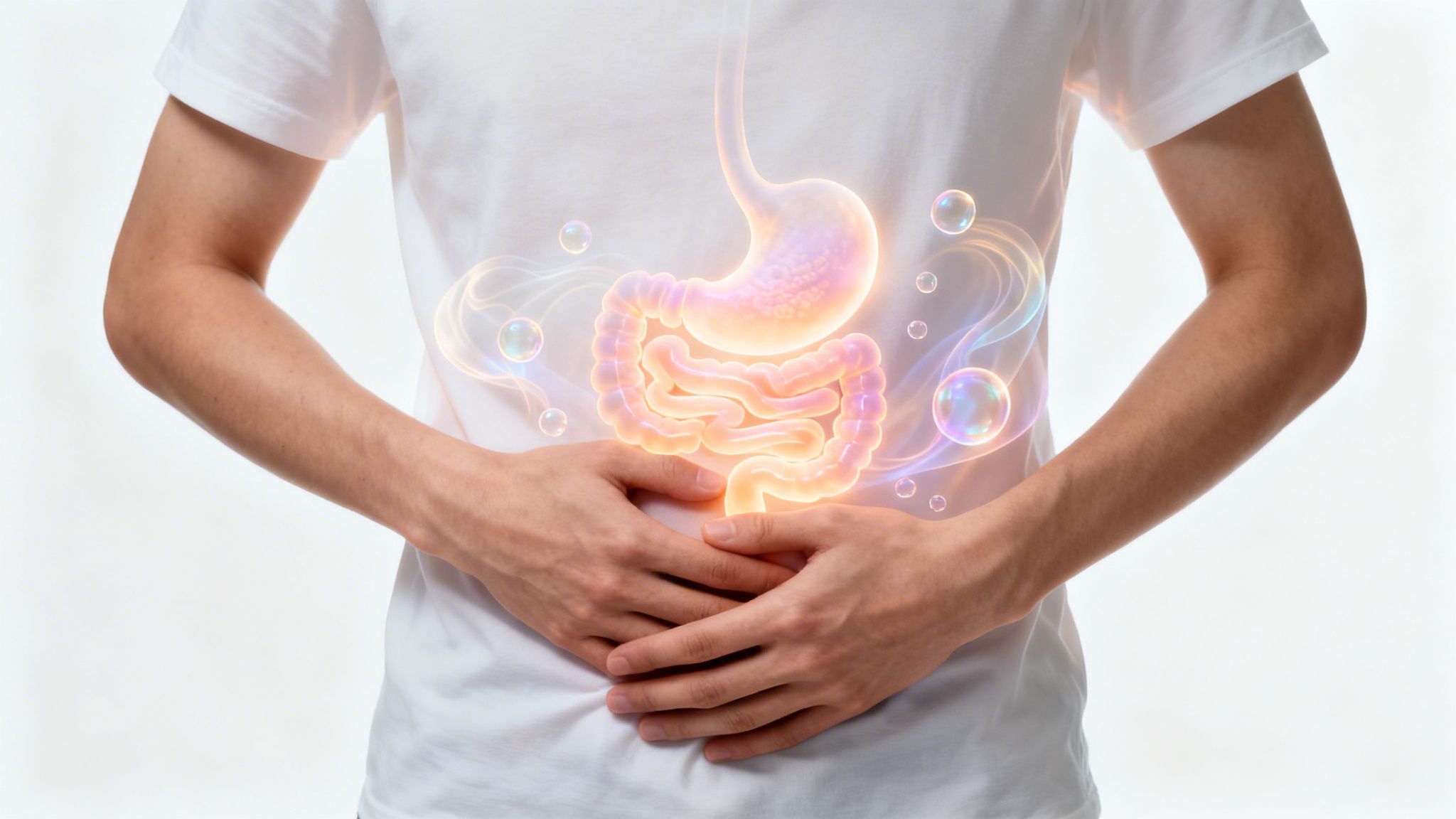
Constant bloating and gurgling in your stomach? Causes & help
You may be sitting there after eating, discreetly pulling in your stomach and hoping no one can hear the rumbling. Or perhaps you have known this unpleasant feeling since the morning, even though you have hardly eaten anything yet. Constant bloating and gurgling in your stomach can start small and then stretch across the entire day.
What makes this so difficult is not only the physical aspect. Many people become more cautious, eat less comfortably when out, cancel plans, or constantly worry about what they have done “wrong.” That is often where the frustration begins. General tips such as “eat more slowly” or “drink fennel tea” sometimes help, but often not enough.
The first important thing is this: Your stomach is not making itself known without reason. Bowel sounds, pressure, bloating, or changing symptoms are not imaginary. They are signals. And signals are easier to understand when you carefully distinguish the possible causes instead of eliminating everything at random.
Does your stomach keep making itself known? You are not alone
Many people describe it in a similar way. After breakfast, things are still fine. Then comes the coffee, followed later by a quick lunch, and suddenly the stomach starts making audible noises. It gurgles, feels tight, and presses, and by evening the stomach feels as if it has a plan of its own.

With recurring symptoms in particular, something very human can quickly happen. You get used to them and tell yourself that this is simply normal. At the same time, everyday life becomes more restricted. You plan around bathrooms, avoid certain foods just in case, or feel that you are no longer completely at ease in your own body.
With constant bloating and gurgling in your stomach, a single blanket tip rarely helps. A more useful question is: What exactly is triggering the symptoms, and why you? Similar symptoms can have completely different causes. For some people, the gut is particularly sensitive. For others, the issue is more likely to be intolerances, an imbalanced gut flora, or factors that hardly anyone considers at first.
Why you should take your feelings seriously
Your digestive system reacts to food, bacteria, hormones, stress, sleep, and past influences such as medication. That’s why two people can have the same bloated stomach and still need completely different things.
This is where many people get stuck. They look for “the one solution,” even though more clarity is needed first.
If your stomach regularly rumbles, bloats, or reacts sensitively, that is not a sign of weakness but an indication that you should take a closer look.
What can really help you
Don’t give things up blindly; recognize patterns instead. For example:
- When does it start after eating—almost immediately or only later?
- What accompanying symptoms occur, such as cramps, diarrhea, constipation, or a feeling of fullness?
- Are there triggers such as dairy products, periods of stress, antibiotics, or cycle fluctuations?
- Does it occur in episodes or is it present almost every day?
The more accurately you interpret this, the easier it becomes to take the next sensible step.
What is behind the gurgling and bloating
A gurgling stomach often sounds more dramatic than it is. Some of these sounds are a completely normal part of digestion. The intestines move food, liquid, and air along. This movement is called peristalsis. When some liquid and gas come together, you hear exactly this bubbling or rumbling.
It becomes problematic when your abdomen is constantly working, becomes severely bloated, or additional symptoms occur.
What actually happens in the intestines
Imagine your intestines as a long, flexible route. Food is transported, broken down, and processed by enzymes. Anything that is not fully digested ends up with the intestinal bacteria. These small “co-inhabitants” continue to process the leftovers. Gases are produced in the process.
This is fundamentally normal. Without gas production, there is no normal digestion.
What matters is more how much gas is produced, where it is produced, and how well your intestines move it along. If too much undigested food reaches the wrong section of the intestine or intestinal movement gets out of rhythm, you feel pressure, hear sounds, and get the feeling that everything in your abdomen is “working.”
When normal no longer seems normal
Some situations are more likely to have a harmless explanation. For example, your abdomen may temporarily be louder after a very large meal. It is different when you notice these patterns regularly and they affect your daily life.
Typical signs that something more than just a “sensitive stomach” could be behind it:
- Recurring gurgling regardless of individual exceptions
- Significant bloating even after normal meals
- Symptoms after certain foods
- Alternating diarrhea and constipation
- A feeling of fullness, even though you have not eaten much
Why bacteria play such an important role
Your gut microbiome is not a minor issue. It affects how food is processed and how much gas is produced. When the balance shifts, fermentation can increase. Normal digestion then turns into constant rumbling.
In some people, bacteria are also present where they should not be in larger quantities: in the small intestine. Symptoms often then develop soon after eating. You can find an easy-to-understand introduction in the article on SIBO symptoms, causes, diagnosis, and treatment.
Bowel sounds do not automatically indicate illness. However, frequent sounds together with pressure, bloating, or changes in bowel movements are a pattern that should not simply be dismissed.
A simple look at possible mechanisms
| Observation | What may be behind it |
|---|---|
| Loud rumbling shortly after eating | rapid fermentation, sensitive intestinal movement |
| Especially after consuming dairy products | Possible lactose-related issue |
| Bloating plus alternating stool patterns | functional disorder such as IBS or dysbiosis |
| Persistent feeling of fullness | impaired digestion or slowed intestinal movement |
The most important thing is this: The sound itself is not the enemy. It is more of a sign that something in the digestive process is not running smoothly somewhere.
Tracking down the most common suspects
If your stomach sends similar signals almost every day, one simple question can help: When exactly do the symptoms begin, and what triggers them? This is often where a vague feeling in your stomach becomes distinguishable from a testable cause.
Irritable bowel syndrome often involves a combination of heightened intestinal sensitivity, altered bowel movements, and a stronger reaction to stimuli that are actually normal. According to Smartpraxis on irritable bowel syndrome, irritable bowel syndrome affects 10 to 15 percent of the adult population in Germany, and up to 70 percent of those affected struggle with chronic bloating.

Irritable bowel syndrome
A sensitive intestine works a little like a smoke detector that goes off very early. Digestion continues, but the system perceives harmless stimuli as disruptive more quickly. Small amounts of gas then feel significant, normal movements seem loud, and an ordinary digestive process feels uncomfortably intense.
Typical signs include:
- Symptoms occurring in episodes
- Abdominal pain or cramps
- Alternating diarrhea and constipation
- Bloating that keeps coming back
What is important is that IBS is an umbrella diagnosis. It describes a pattern, but does not automatically explain the underlying cause. That is precisely why it is worth taking a closer look instead of hastily attributing all symptoms to a single label.
Food intolerances
This is where careful observation can help. The stomach often does not react to “unhealthy food” in general, but to very specific components.
With lactose intolerance, the body does not produce enough of the enzyme that breaks down lactose. The lactose then passes into the intestine, where it is fermented by bacteria. This produces gas, pressure, and audible rumbling. The IQWiG information on lactose intolerance explains that lactose intolerance is common in Germany and can cause typical symptoms after consuming dairy products.
Other intolerances, such as fructose intolerance or intolerance to certain FODMAP-rich foods, can look very similar. The difference often lies in the timing and the trigger.
| Possible cause | Typical everyday pattern |
|---|---|
| Irritable bowel syndrome | Symptoms vary considerably and occur in different situations |
| Lactose intolerance | Reactions after consuming milk, cream, ice cream, or larger amounts of lactose |
| Fructose or other intolerances | Symptoms after certain types of fruit, juices, onions, wheat, or highly fermentable foods |
If you suspect a pattern here, keeping a food diary for one to two weeks is often more helpful than immediately avoiding everything completely. It shows whether there is truly a clear trigger or whether the situation is more complicated.
SIBO and gut dysbiosis
With SIBO, meaning bacterial overgrowth in the small intestine, fermentation begins too early. Put simply, food reaches an area where too many bacteria are already waiting for it. This can cause your abdomen to feel tight, become bloated, or gurgle noticeably shortly after eating.
A systematic review in Clinical Gastroenterology and Hepatology30826-5/fulltext) describes SIBO as being found significantly more often in people with irritable bowel syndrome than in comparison groups. For everyday use, one point is particularly helpful: The earlier symptoms begin after eating, the more worthwhile it is to look at the small intestine and the microbiome.
Dysbiosis is a broader term. It refers to an imbalance in the gut flora. This can develop after infections, antibiotics, prolonged stress, a very one-sided diet, or slowed intestinal movement. SIBO is therefore not the same as dysbiosis, but the two can be related.
A practical rule of thumb helps:
Late symptoms are more suggestive of the large intestine. Very early symptoms are more suggestive of processes that begin higher up in the digestive tract.
What you can use as your initial guide
This assessment does not replace a diagnosis. However, it helps you test more selectively instead of eliminating foods at random.
- Cramps plus alternating stool consistency are more commonly associated with IBS.
- Symptoms after clearly defined food groups are more suggestive of an intolerance.
- Bloating and gurgling shortly after eating make SIBO more likely.
- Increased symptoms around the menstrual cycle, PMS, or hormonal fluctuations also deserve attention. In that case, it may make sense to specifically regulate your hormone balance and better understand the connections.
The most important point is simple. The same symptoms can result from completely different mechanisms. Anyone who looks only at “foods that cause bloating” often overlooks the actual trigger. By contrast, those who identify patterns and then test specifically usually find real answers much faster.
The underestimated influence of hormones and the microbiome
Many people look for the cause only on their plate. That’s understandable, but sometimes too narrow a view. The gut responds not only to food, but also to internal rhythms and earlier interventions affecting the microbiome.

When hormones help regulate the gut
Women in particular often notice that their stomach isn’t the same every month. Sometimes digestion is calm; other times it’s noticeably slower, more bloated, or noisier. This isn’t a coincidence.
A frequently overlooked cause is the connection to hormonal imbalances. Thirty-five percent of women with IBS-like symptoms have low vitamin D or estrogen dominance, which slows intestinal motility and intensifies gurgling, according to Apotheken Umschau on bloating and gas.
When intestinal movement slows down, food remains in the digestive tract longer. This increases the likelihood of pressure, gas, and that persistent, uncomfortable feeling of fullness.
Anyone who wants to better understand the connection between the menstrual cycle, energy, and digestion can also find practical background information in the article on regulating hormone balance.
Why antibiotics can continue to have an effect long afterward
Many people think of antibiotics only in terms of the acute phase. You take the tablets, the infection is gone, and the matter is settled. That isn’t always true for the gut.
The impact of microbiome disruption caused by antibiotics is often underestimated. When the gut flora becomes unbalanced, it also changes how food is processed. Some people then report more bloating, louder digestive sounds, or a feeling that their stomach has been “different” ever since—sometimes months later.
That’s also why changing your diet alone is sometimes not enough. If the underlying problem lies in the bacterial balance or accompanying nutrient deficiencies, it requires a closer look.
Two questions that are often overlooked
Instead of asking only, “What did I eat?”, it can sometimes also be helpful to ask:
- When during your cycle are the symptoms worse?
- In the months beforehand, were there antibiotics, infections, or other stressors?
These questions often point in a new direction. Not everything is an intolerance. Not every sensitive stomach reacts only to FODMAPs. Sometimes hormonal fluctuations and the microbiome work together.
If symptoms occur cyclically or began after medication, that’s a strong signal not to examine your diet alone.
Your path to clarity through targeted testing
Perhaps you recognize this pattern: One day you cut out dairy, the next gluten, then raw foods and coffee. After a week, you’re exhausted, your stomach is still gurgling, and the real question remains unanswered.
This is exactly where a clear testing pathway helps. Not to label every symptom immediately, but to turn vague suspicions into verifiable clues. Your gut is not a puzzle that can be solved by imposing more and more restrictions. It is more like a system with several possible triggers that can be assessed sensibly, one after another.

When you should see a doctor
Some signs should not be handled through self-monitoring. Severe pain, blood in the stool, unexplained weight loss, fever, waking at night because of symptoms, or rapid deterioration should be evaluated by a doctor promptly.
If the symptoms keep recurring but remain stable, a structured approach is often the most sensible next step. The goal is not blind testing, but asking: Which suspicion fits your pattern?
Which test is right for which suspicion
A simple framework can help. It connects the symptom with a plausible cause and the appropriate next step.
| Your pattern | Useful next step |
|---|---|
| Symptoms after certain foods | Intolerance test plus a targeted elimination phase |
| Bloating and pronounced rumbling without a clear trigger | Microbiome analysis |
| Suspected connection to your menstrual cycle, exhaustion, or deficiencies | Nutrient or hormone test |
| Irregular digestion with signs of bacterial overgrowth | Microbiome assessment plus evaluation of associated deficiencies |
The order matters. A test should clarify a suspicion, not create new confusion. For example, if you react immediately after consuming dairy products, a different approach makes sense than if your stomach bloats and audibly gurgles mainly in the evening, regardless of what you eat.
Even if SIBO or another form of bacterial overgrowth is suspected, it is worth taking a closer look at the overall picture. Such patterns often show up not only through gas and noises, but also through a feeling of fullness, irregular stools, fatigue, or signs of nutrient deficiencies. A single finding rarely explains everything. Several small clues often come together to form a coherent picture.
Why at-home tests are practical for many people
At-home tests do not replace a medical diagnosis. However, they can help you bring some initial structure to vague discomfort.
A stool test is useful if you want to better understand what your gut environment looks like and whether there are signs of an imbalanced microbiome. A good introduction can be found in the article on the gut microbiome test and when it may be useful. Blood tests are more suitable for questions about nutrients, signs of inflammation, or hormonal abnormalities. An intolerance test makes sense if you notice a recurring trigger pattern and want to investigate it properly.
In the field of at-home diagnostics, mybody x blood test is an option if you want to check your nutrient status, hormone patterns, or other clues to the causes behind digestive symptoms from home. What matters is that the test matches your specific question.
The real strength of tests
A good test does not turn a vague problem into a definitive diagnosis. It works more like a flashlight in a dark room. You still cannot see every detail, but you can identify which corner to look at next.
That alone is a relief for many people. Instead of saying, “I somehow can’t tolerate anything anymore,” you can say, “I’ll first check for an imbalance in the gut, then intolerances, and then possible hormonal or nutrient-related issues.” The difference sounds small, but in practice it often saves time, prevents unnecessary restrictions, and reduces a lot of worrying.
Your action plan for a calm stomach
You have now gathered some initial clues. The next step is to turn assumptions into small, verifiable steps. That is precisely what brings calm to a subject that often feels chaotic.
Confirm the pattern first, then take targeted action
Many people immediately overhaul their entire diet out of uncertainty. The problem is simple. If you cut out dairy products, bread, fruit, legumes, and onions all at once, you often no longer know what was actually causing the symptoms.
A more helpful approach is to proceed as you would when troubleshooting something at home. If the light in one room flickers, you do not replace all the electrical wiring in the house. You first check the switch, then the bulb, then the wiring. The same applies to your gut. A symptom such as gurgling after eating, bloating in the evening, or pressure after certain foods is a clue, but not yet an answer.
That is why, especially when lactose is suspected, you should not avoid everything indiscriminately. Instead, investigate the suspicion systematically and then change only what fits the result. This reduces the risk of unnecessary restrictions and of ending up with a diet that limits more than it helps.
How to test triggers sensibly in everyday life
-
Choose only one suspected trigger at a time
Start with the food or pattern that seems most plausible to you. For example, dairy products, large amounts of raw vegetables, or meals containing a lot of onions. -
Pay attention to the timing
Does your stomach react while you are eating, one to two hours later, or only the next morning? Early reactions often indicate different processes than symptoms that appear significantly later. -
Don’t just observe bloating
Gurgling, a feeling of fullness, the urge to have a bowel movement, pressure in the upper abdomen, or a visibly bloated lower abdomen can also be part of the pattern. The more closely you look, the clearer the picture becomes. -
Keep the test short and controlled
A few days with meals that are as similar as possible usually reveal more than three unclear weeks with exceptions, stress eating, and constantly changing rules.
If you are looking for practical everyday ideas, the article what you can specifically do about bloating is a useful supplement.
If SIBO or dysbiosis is more likely
This is where a different perspective often helps. The issue is not just one particular food, but whether bacteria are helping with digestion in the wrong place or in an unfavorable balance.
This also explains why healthy foods can sometimes have paradoxical effects. An apple, oatmeal, or legumes are not inherently the problem. If too much fermentation takes place in the small intestine, foods like these can temporarily cause more gas and gurgling. The gut then behaves like a pot that is already almost boiling over. Adding even more fermentable material makes it bubble over more quickly.
During this phase, a simple, less irritating diet for a short time is often more sensible than maximum variety.
Everyday signals that are often underestimated
The gut loves rhythm. It responds not only to what you eat, but also to how you eat.
These points often make a bigger difference than many people think:
- Spacing out meals so the intestines can work between digestive phases
- Eating more slowly and chewing well, because preparation for the rest of the digestive process begins in the mouth
- Taking a short walk after eating to gently support intestinal movement
- Less constant stress, because tension directly affects the gut-brain axis
- Getting enough sleep, because an overburdened body often reacts more sensitively to food as well
A nervous stomach often needs not only the right food choices, but also more reliable signals throughout the day.
A realistic starting point for 14 days
| Period | Focus |
|---|---|
| Days 1 to 3 | Record symptoms, times, meals, and stomach noises |
| Days 4 to 7 | Test a specific possibility without eliminating additional foods at the same time |
| Days 8 to 10 | Evaluate your reaction and pay attention to accompanying symptoms such as pressure, changes in bowel movements, or fatigue |
| Days 11 to 14 | Only test the next possibility if the first pattern has remained genuinely unclear |
The goal is not perfection. The goal is clarity.
A calm stomach often develops step by step. Not through the strictest possible rules, but through observations that fit your symptoms and can later be compared with your test results.
Interpreting and applying test results correctly
A result is not a verdict. It is a clue. That may sound simple, but it matters.
If a test indicates an intolerance, that does not automatically mean you have to avoid a food forever. Often, the first step is to reduce the strain, calm the gut, and then consciously assess what is possible again and in what quantity.
It is similar with microbiome abnormalities. An imbalance does not just say, “something is wrong here”; it can show you which direction to consider. More likely fermentation? More likely an irritable bowel pattern? More likely lingering effects of antibiotics or a sensitive intestinal environment?
This is how data become real steps
This sequence is helpful:
- Read the results without immediately interpreting everything
- Compare patterns with your symptoms
- Only implement the recommendations that logically fit your everyday life
- Observe changes for a while, instead of changing the plan every day
How to recognize good implementation
Not because everything is perfect right away, but because you are gaining clarity.
You will have a better idea:
- what really triggers you,
- what probably was not the main problem at all,
- and which changes actually do you good.
Especially with digestive issues, that is a major step. Diffuse discomfort becomes an understandable process. And that sense of clarity often takes a lot of pressure off right away.
Frequently asked questions about bloating and bowel sounds
How quickly can things improve
That depends on the cause. When there are clear triggers, a targeted adjustment can bring noticeable improvement fairly quickly. With microbiome-related issues or long-standing symptoms, the gut often needs more time.
Can stress alone trigger something like this
Stress can significantly worsen digestive problems. It often changes bowel movements and how sensations in the abdomen are perceived. However, if you have persistent severe symptoms, you should not automatically blame stress alone.
Are probiotics always useful
No. They help some people, while initially worsening the situation for others. Especially when the abdomen becomes very bloated or reacts very sensitively, trying things blindly is often not ideal.
Can antibiotics still play a role months later
Yes, that is possible. The impact of microbiome disruptions caused by antibiotics is an often-overlooked cause. In Germany, around 20 to 30 percent of the population take antibiotics each year, and 40 percent of patients with irritable bowel syndrome have post-antibiotic dysbiosis. This is described in Orthomol’s information on bloating and flatulence and can be diagnosed precisely with microbiome tests.
If you no longer want to guess, a mybody x blood test can help you systematically check for possible nutrient deficiencies, hormonal abnormalities, or other clues behind your symptoms from the comfort of your home.



Share now:
Your checklist: Tips for scientifically grounded tests
Home Testing: Easily Optimize Personalized Health