
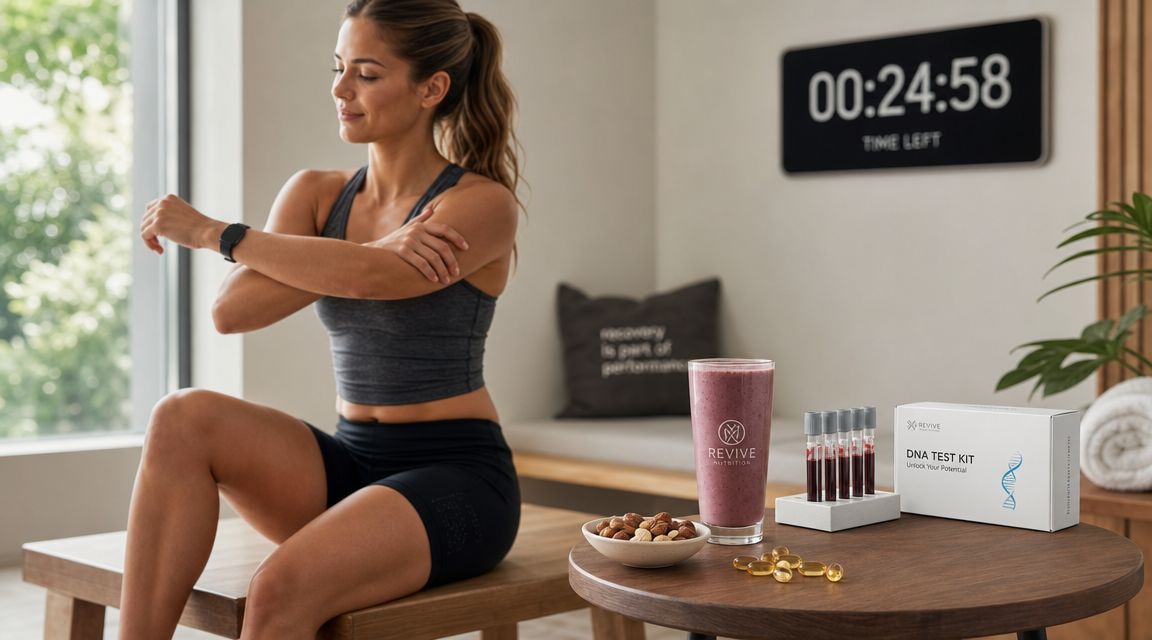
Recovery After Exercise: Top Methods for 2026
You may know the feeling: The workout went well, and you even feel proud immediately afterward. But the next morning, your body tells a different story. Your legs feel heavy, the stairs suddenly seem longer, and you have less energy in your head than usual.
Many interpret this as a sign that they “simply need to train harder.” In reality, the opposite is often true. It is not the next stimulus that moves you forward, but the quality of your recovery. That is exactly where it is decided whether your body becomes stronger, more capable, and more resilient, or whether you simply accumulate fatigue from one session to the next.
Recovery after exercise is therefore not a by-product of training. It is a biological process in its own right. And the better you understand it, the more easily you can manage it.
What your body really needs after training
Muscle soreness, fatigue, and an empty battery are not disruptions. They are feedback. Your body is telling you that it is currently repairing, replenishing, and reorganizing.
This is an important change in perspective. Many people treat recovery as standing still. They train hard, eat whatever, sleep somehow, and hope their body will take care of the rest. But that is not how adaptation works reliably.
Recovery is part of the building process
After exercise, your body has to handle several tasks at the same time:
- Repair tissue. Stressed muscles need building blocks, especially protein and energy.
- Replenish energy stores. Carbohydrate stores are especially depleted after intense sessions.
- Calm the nervous system. It is not just your muscles that become fatigued. Your mind, concentration, and motor control also suffer under high loads.
- Regulate inflammatory responses. Some inflammation is normal. Too much of it slows you down.
If you ignore these signals, you may be training on top of a body that is not yet ready. Performance often then stagnates, even when motivation and discipline are present.
Remember: You do not improve during training, but in the time afterward, when your body processes the training stimulus.
Where many people struggle
The problem is often not the training plan, but the basics afterward. Too little protein, too little structure, poor sleep quality, or simply a misguided sense of exertion and recovery.
Protein in particular is a source of considerable confusion. If you are unsure how much you actually need in everyday life, this overview of daily protein requirements can help, as it explains the topic in practical terms.
A clear-eyed look is also worthwhile when it comes to supplementary recovery strategies. If you are interested in how different approaches to focus, recovery, and body awareness are discussed, Regeneration and Focus with Cannabis offers a nuanced introduction.
What You Can Change in Everyday Life Right Away
After every hard session, ask yourself three simple questions:
- Have I given my body energy and building blocks quickly?
- Am I planning recovery as consciously as I plan training?
- Am I relying only on how I feel, or am I observing patterns?
Even this small reflection can change a lot. You no longer move blindly from one session to the next but begin to manage your recovery after exercise consciously.
The Science of Recovery in Your Body
After an intense session, your muscle is like a construction site. Not broken, but busy. Fibers have been stressed, energy stores depleted, and nerves and brain had to coordinate performance. Now the phase begins in which your body restores order.

What Happens in the Muscle
Demanding exertion causes minor structural strain in the muscle fibers. This is no cause for concern but part of the adaptation process. The body responds with repair mechanisms. These require amino acids, energy, and time.
At the same time, your available energy reserves decrease, especially when you have trained intensely or for a long time. If these stores are not replenished, the next session often feels unnecessarily difficult.
There is also the neurological side. Many people think of only their muscles when they are exhausted. In practice, the nervous system is often tired too. You notice this as reduced tension, a lack of explosiveness, or the feeling that you “can’t quite get into it.”
Why Time Is a Biological Factor
As a general rule, recovery after exercise takes 48 to 72 hours. Techniker Krankenkasse often recommends 24 to 48 hours for light sessions and up to 72 hours for intense exertion. After extreme competitions, recovery can even take several days to one or two weeks, as summarized in Techniker Krankenkasse’s guidance on recovery after training.
This is not a rigid schedule. It is a practical guideline for everyday life. Your body needs this time for performance, muscle tone, and neuromuscular function to return closer to their baseline levels.
If you return to full exertion too soon, you often train not toward progress but into existing residual fatigue.
More Than a Feeling
Sports science research from German-speaking countries also shows that recovery brings measurable physiological changes. Following recovery periods, lower heart rates and blood lactate levels, as well as reduced exercise-induced increases in certain stress hormones, have been documented.
In everyday life, this means that recovery is not simply “doing nothing.” It is a process in which your body actively rebuilds itself.
| Area | After exertion | During good recovery |
|---|---|---|
| Muscle | strained, in need of repair | Structure is restored |
| Energy | Stores depleted | Reserves are replenished |
| Nervous system | fatigued, less precise | Motor control stabilizes |
When you view recovery after exercise this way, you also understand muscle soreness differently. Not as an enemy, but as a sign that work is currently taking place in the body.
The right nutrition for rapid recovery
If the muscle is the construction site, food is the material warehouse. Without the right building blocks, repair remains slow. With the right combination, your body can work much more efficiently.

What makes sense immediately after training
For the period immediately after exercise, 1.0 to 1.2 g of carbohydrates per kg of body weight is recommended to replenish glycogen stores. At the same time, 20 to 25 g of protein maximally stimulate muscle protein synthesis. For a body weight of 70 kg, this corresponds to approximately 70 to 85 g of carbohydrates plus 20 to 25 g of protein, as described in Datasport’s recommendations for precise recovery.
This is especially important when your next session is coming up soon. Then it’s not only what you eat that matters, but also when.
How to put the numbers into practice
You don’t have to turn this into a mathematical religion. This logic is often enough for everyday life:
- Refuel first after hard sessions. For example, with rice, potatoes, oats, bread, or fruit plus a clear protein source.
- Choose your protein consciously. Good options include dairy products, eggs, legumes, fish, and lean meat.
- Don’t rely on shakes alone. A complete meal often provides greater satiety and additional micronutrients.
Those looking for specific examples of meals for athletes can find practical everyday ideas in the article Nutrition for Athletes.
Foods that are often underestimated
In coaching, I often see people focusing only on protein powder. Yet whole foods often provide several benefits at once.
- Beetroot provides nitrates, which in a sports context are often associated with blood flow and endurance.
- Walnuts fit well into an anti-inflammatory dietary pattern, partly because of their omega-3 content.
- Feta combines high-quality protein with calcium.
Practical takeaway: The best recovery meal is not the most complicated one. It is the one you can reliably prepare after training.
Simple combinations for home
Here are three simple ideas:
- Potatoes, feta, roasted vegetables, and a little olive oil
- Oatmeal with yogurt, banana, and walnuts
- Rice with chicken or lentils, plus beetroot salad
This is what recovery after exercise looks like in practice. You provide your body with energy, building blocks, and micronutrients—not just calories.
Making the most of sleep and active recovery
You can eat the perfect post-workout meal and still feel like you are not fully recovering. In that case, it is worth looking at two factors that are often connected: sleep and active recovery.
Sleep is not passive downtime
During sleep, your body shifts its priorities. Digestion, tissue repair, hormonal regulation, and mental recovery proceed in a more organized way than under daytime stress. That is why many athletes notice very quickly when sleep quality declines. It is not just their mood that suffers. Their training experience, muscle tension, and resilience also deteriorate.
The mistake is often to focus only on the number of hours. More important is whether your sleep is restorative. Do you feel clear-headed or sluggish in the morning? Do you wake up frequently? Despite spending enough time in bed, do you still not feel fully capable of performing? You can find useful guidance in these healthy routines for better sleep quality.
Active recovery is not automatically better
Many guides make it sound as though light exercise the following day is always better. The evidence is not that clear-cut. Whether active recovery is better than passive rest remains scientifically controversial. The German Journal of Sports Medicine points to gaps in knowledge. Even for cold-water immersion, there is only limited reliable evidence, for example regarding the reduction of muscle soreness after 11 to 15 minutes in water at 11 to 15 °C, as described in the German Journal of Sports Medicine article on gaps in recovery research.
This is important because many methods appear safer on social media than they are scientifically supported.
What has proven effective in practice
Instead of blindly following trends, a simple decision aid can help:
- If you feel heavy but not exhausted, light movement may feel good. For example, walking, very easy cycling, or gentle mobility work.
- If you are completely drained overall, genuine rest may be more beneficial than “active recovery” that ultimately becomes another form of exertion.
- If a method subjectively makes you feel better, that is valuable. You just should not automatically confuse well-being with proven physiological effects.
Some methods mainly help psychologically. That can be useful too. You should simply put it into the right perspective.
A level-headed approach saves energy
Recovery after exercise is often made unnecessarily complicated. You do not need ten tools. In most cases, sleep quality, sensible nutrition, and smart load management achieve more than an entire fleet of recovery gadgets.
Why general recovery tips often fail
You may know the feeling. You do “everything right.” Protein after training, some mobility work, enough time in bed. And yet you keep feeling exhausted. That is not a contradiction. It simply shows that standard advice has its limits.

The same plan does not work the same way for everyone
Two people can complete the same workout and recover completely differently. One is fresh again the next day. The other carries fatigue around for days. The difference often lies not in discipline, but in individual biology, everyday stress, sleep quality, nutrient status, and how the body processes training load.
A common weakness of many guides is precisely this lack of individualization. They rarely answer which sleep or nutrition markers actually limit recovery and how to measure regeneration objectively. Modern sports science therefore views recovery more as the individual management of training load and recovery, as emphasized in Physio Teli's overview of recovery in sport.
Common thinking errors
Blanket advice often fails in three areas:
- You confuse habit with need. Just because many people drink a shake after training does not mean that this is your bottleneck.
- You ignore the context. Work stress, interrupted sleep, or a high training load can significantly change your recovery needs.
- You work without feedback. If you measure nothing and only guess, much remains a matter of speculation.
Why data starts to make sense here
When it comes to recovery after exercise, it is therefore not just about good advice, but about the right advice. Perhaps your bottleneck lies more in inflammation regulation. Perhaps in iron status, cortisol, or an overall training load that is too high. Perhaps you simply tolerate certain nutritional strategies better than others.
This is where personalization becomes useful. Not as a buzzword, but as a pragmatic question: What exactly is currently holding your body back?
Good recovery does not begin with more methods, but with a better diagnosis of your own situation.
Measure recovery instead of just feeling it
A practical example makes this easier to understand. An athlete, 35 years old, came in with a typical problem: constant muscle pain despite disciplined training and solid routines. Everything looked reasonable from the outside. But not on the inside.
A closer look revealed an elevated CK level and a low ferritin level. This fit with the feeling of poor recovery. The subsequent adjustment was not spectacular, but targeted: a higher-protein diet and optimization of iron status. The result was not “more motivation,” but noticeably more balanced recovery in everyday life.
Which markers can help
These cases show why subjective feelings are important but not always enough. Some biomarkers provide additional insights.
| Biomarker | What it indicates | When testing makes sense |
|---|---|---|
| CK | Indication of high muscular strain | when muscle pain lasts unusually long or training load is very high |
| CRP | Indication of systemic inflammation | when recovery stalls and you feel generally “sick with exhaustion” |
| Cortisol | Indication of stress load | when sleep problems, restlessness, and persistent exhaustion occur together |
| Ferritin | Indication of iron status | when performance, energy, and resilience noticeably decline |
What you can take away from this in practical terms
Not everyone needs a complete test panel right away. Testing becomes useful when your body sends signals over an extended period that you cannot clearly explain through sleep, nutrition, and training adjustments.
Then a structured perspective can help:
- Record your symptoms. Not just muscle soreness, but also sleep, mood, feeling rested, and declines in performance.
- Review your training context. Frequency, intensity, demanding blocks, competition phases.
- Supplement with laboratory data if the symptoms persist.
If stress regulation is an issue, it can help to first read up on measuring cortisol. This will help you better understand when hormonal markers become relevant in the context of persistent exhaustion.
Where personalized analyses make sense
For people who no longer want to estimate their post-exercise recovery, but understand it in a more structured way, laboratory and metabolic analyses can be a useful addition. MYBODY Lab GmbH offers analyses covering nutrient status, metabolism, and other health markers, prepared at home and evaluated in a laboratory. This is not a substitute for training, sleep, or a balanced diet. But it can help identify the actual bottleneck more precisely.
So you do not have to measure everything. But if you are not making progress despite good habits, “more of the same” is often less useful than taking a clear look at the data.
Your personal recovery plan for the week
Knowledge only becomes useful when it fits into your everyday life. That is why a good recovery plan after exercise does not have to be perfect. It has to be repeatable.

A simple weekly routine
Use this checklist as a template:
- Plan a meal after hard sessions. Make sure to have carbohydrates and a clear protein source immediately afterward.
- Monitor muscle signals. Not every instance of muscle soreness is problematic. But recurring heaviness or a decline in performance deserves attention.
- Take sleep seriously. Check not only how long you sleep, but also how you feel in the morning.
- Keep easy days truly easy. Recovery days are not inferior training; they are part of the plan.
- Take stress into account. Work, family, and mental strain also affect your recovery.
- Document anything unusual. If fatigue, pain, or restlessness persists, it is worth taking a more objective look.
This is what it looks like in practice
An example of a normal week:
Hard session on Monday, followed by a targeted meal. Keep Tuesday relatively easy and pay attention to your body's signals. Train again on Wednesday if you feel recovered. Consciously review your sleep and everyday stress on Thursday. On Friday, train or reduce your workload depending on how you feel. Do not automatically overload the weekend; honestly assess the total load for the week.
Recovery works best when you do not treat it as an emergency solution after too much training, but as a permanent part of your health strategy.
In the end, it comes down to a simple question: Do you know your body well enough to interpret its signals correctly? If not, that is not a deficiency. It is the starting point for better decisions.
If you no longer want to manage your recovery based solely on how you feel, a personal recovery profile may be useful. MYBODY Lab GmbH offers health analyses covering metabolism, nutrient status, hormones, and other individual factors that can help you tailor recovery, nutrition, and training load more precisely to your body.



Share now:
Biotin: Effects, Requirements, and Myths Examined
Get Your Thyroid Tested: The Complete Guide for 2026