

Testosterone in women: putting the result into context
The essentials at a glance
Testosterone is not a male hormone with a special female exception. It occurs in women too, at a considerably lower concentration, and appears on hormone test reports alongside DHEA-S, FSH, and LH (MSD Manual, professional edition, as of August 2025).
This leads to the article’s most important practical rule. Reference ranges for women differ from those for men, and a figure from an article about men cannot be applied to a woman’s test result.
You will first learn why the information on your own test result matters. This is followed by a comparison of the relevant values, the role of SHBG, a fact check of three common statements, the connection with the menstrual cycle, who may benefit from testing, and the limitations of a single measurement.
What to expect in this article
1. Why male levels are not helpful here
2. Where testosterone in women comes from
3. Comparing the relevant values
4. SHBG determines the available fraction
5. Three statements about testosterone in women: fact check
6. When the level is measured in clinical practice
7. Testosterone, the menstrual cycle, and life stage
8. Who may benefit from testing
9. What a capillary blood test can show here
10. Limitations: what the level does not answer
11. What matters about testosterone levels
Frequently asked questions
Sources
Why male levels are not helpful here
Anyone searching for testosterone levels almost always comes across figures for men. The MSD Manual, professional edition, gives a normal range there of 300 to 1,000 nanograms per deciliter (as of April 2025).
For a woman’s test result, this information is useless—not approximately, but fundamentally. The concentrations are many times lower, so the reference ranges are also in a different range.
Documented source
“You should always follow the reference range stated on your own laboratory report.”
Institute for Quality and Efficiency in Health Care
Understanding laboratory values correctly, gesundheitsinformation.de, as of April 2, 2025
This statement applies to every laboratory value. For testosterone in women, it is the key point because the internet is full of figures intended for a different sex.
There is also a second limitation from the same source: reference ranges may vary from one laboratory to another (as of April 2, 2025). At low concentrations, this matters more than at high ones.
Why the unit matters twice here
Two units are commonly used for testosterone. The MSD Manual gives the male range in both: 300 to 1,000 nanograms per deciliter, equivalent to 10.5 to 35 nanomoles per liter (as of April 2025).
With the much lower levels in women, a third unit is added: nanograms per milliliter or picograms per milliliter. Therefore, when comparing two test results, first check whether the same unit is shown.
This sounds like a minor detail and is by far the most common mix-up. The same blood sample can appear as a seemingly completely different number depending on how a laboratory calculates it.
The simplest safeguard is the one IQWiG generally recommends: consult the range shown on the same report. For tracking changes over time, stick with the same provider.
The 95-percent rule and what it means
A reference range is not a boundary between health and illness. IQWiG explains how it is established: The limits are set so that 95 percent of results fall within the range, while 5 percent of people have results outside it even though they are healthy (as of April 2, 2025).
This matters twice as much for a value that can only be interpreted in combination with others. A value just beyond the limit is a reason to look at the accompanying values, not a finding.
That is precisely the invitation to have a conversation rather than interpret the result yourself. Whether a deviation means anything depends on the overall context, not on how far it is from the range limit.
Where testosterone comes from in women
Testosterone is an androgen. In women, it is produced in the ovaries and adrenal glands, where it also serves, among other things, as a precursor to estrogens.
That is precisely why it is rarely measured alone. The MSD Manual, professional edition, describes measuring free and total testosterone together with DHEA-S, as well as FSH and LH, when evaluating hirsutism (as of August 2025).
DHEA-S originates predominantly from the adrenal cortex, while a larger proportion of testosterone comes from the ovaries. Together, the two values therefore provide information about the source of a change.
The values involved, compared
Four values are side by side for this question. The table compares them according to the same four criteria.
| Criterion | Total testosterone | DHEA-S | SHBG |
|---|---|---|---|
| What it describes | The total amount of the hormone in the blood, bound and unbound | An androgen that originates predominantly from the adrenal cortex | The transport protein that binds testosterone and estradiol tightly |
| What it represents | The baseline value from which the available fraction can be derived | The question of whether a change originates in the adrenal glands | The condition under which a testosterone value can be interpreted at all |
| Without the other one | Not very informative because the binding remains unknown | Without testosterone, the second direction is missing | Silent on its own; it only becomes readable in relation to the others |
| Included in the range | Menopause Check | Menopause Check | Menopause Check and Women’s Wellness Check |
The third line is the most important in terms of content. Each of the three values alone says little; only the combination answers a question.
What the last line says about the test selection
The fourth line is the most awkward. Of the three values, only one test in the range includes all three, while the women’s health test provides only the transport protein.
This is not a weakness of one test, but a question of scope. A broad health profile covers the thyroid, iron, vitamins, and metabolism, while a hormone profile covers hormones.
For you, this means that the question determines the test, not the other way around. Anyone who wants to know where their testosterone stands needs a hormone profile, while anyone who wants to investigate the obvious alternative explanations needs a broad profile.
This distinction removes much of the frustration from the process. A test result that cannot answer the question asked is not a bad result, but the wrong one for that question.
SHBG determines the available fraction
As in men, testosterone in women is predominantly bound. Sex hormone-binding globulin binds it, and what is bound to it is not available to the tissues.
This leads to an effect described by the MSD Manual, Professional Edition: The level of free androgens may also be elevated as a result of reduced production of sex hormone-binding globulin (as of August 2025). The hormone itself does not necessarily have changed.
Why hormonal contraception matters particularly here
The same source also describes the mechanism in the other direction. Oral contraceptives increase sex hormone-binding globulin, thereby lowering the level of free testosterone (as of August 2025).
For interpreting test results, this means that a testosterone level measured while using hormonal contraception describes the situation under the preparation, not the baseline state.
This is not an argument against using it or against measuring it. It is why every preparation belongs on the list that accompanies the test results.
What SHBG exactly is and what else affects the level is covered in the companion article SHBG: what the level says about available hormones.
Three statements about testosterone in women: a fact check
These three statements come up regularly. All three can be assessed against the evidence.
Checked against the evidence
Common
“Testosterone is not an issue for women.”
Documented
To evaluate hirsutism, free and total testosterone as well as DHEA-S are measured together with FSH and LH (MSD Manual, Professional Edition, as of August 2025). The value is therefore routinely included in women’s test results.
Common
“The symptoms show how high the level is.”
Documented
The same source notes that the severity of hirsutism does not correlate with the level of circulating androgens because hair follicles differ individually in their sensitivity to androgens (as of August 2025).
Common
“I can compare my value with the figures online.”
Documented
Most freely accessible figures refer to men, such as the normal range of 300 to 1,000 nanograms per deciliter (MSD Manual, as of April 2025). The range on your own test report is the relevant one, and reference values may vary between laboratories (IQWiG, as of April 2, 2025).
The second point is the most surprising. It says that the severity of a sign does not allow conclusions about the level of a value, and vice versa.
When the Level Is Measured in Medical Practice
Testosterone is not part of routine testing for women. It is measured when there is a specific question to investigate.
The severity of a sign says nothing about the level of the value. The two are considered separately.
The reason described in the sources reviewed is the evaluation of hirsutism, meaning excessive body hair growth in a male pattern. Free and total testosterone, DHEA-S, and FSH and LH are measured for this purpose (MSD Manual, professional edition, as of August 2025).
The same source identifies polycystic ovary syndrome as the most common cause of elevated androgens (as of August 2025). In cases of menstrual irregularities, a prolactin level is also measured.
Important for interpretation: One laboratory value does not establish this diagnosis. It is one piece of the puzzle, while the overall assessment is made by a medical professional.
Why FSH and LH Appear on the Same Line
In the examination series mentioned, two regulatory hormones appear alongside the androgens. FSH and LH come from the pituitary gland and give the ovaries the signal.
Their relationship to one another and to the androgens allows an assessment that none of the values can provide on its own. It is the same idea as with DHEA-S: Only the direction makes the number meaningful.
In practice, this has one consequence for test selection. A profile that measures testosterone without FSH and LH cannot answer the question of what caused a change.
And because FSH is tied to a specific cycle day, this value ultimately determines the timing for the entire sample. This is the practical reason why this test cannot be added spontaneously.
Testosterone, the Menstrual Cycle, and Stage of Life
Because testosterone is measured together with FSH and LH, the timing is determined by whichever of these values has the strictest requirements. For FSH, the medical literature specifies cycle days 2 to 5 (MSD Manual, professional edition, as of January 2024).
How to count cycle days and what applies to irregular cycles is covered in the related article Hormone Levels and the Correct Cycle Day.
This also depends on the stage of life. During perimenopause, several levels shift in a specific sequence: reduced concentrations of inhibin and estrogens lead to a substantial increase in LH and FSH levels (as of January 2024).
A testosterone value during this phase therefore exists in a shifting context. The companion article Perimenopause: which hormone values change first explains what shifts when.
Who may benefit from testing
Testosterone is not a value every woman needs to know. The comparison makes that clear in both directions.
Makes sense for you if …
You are already having a hormone profile measured and it includes testosterone together with DHEA-S and SHBG.
You want to establish a baseline value with the date and cycle day recorded, which can be used for later comparison.
You want to be prepared for a conversation at the doctor’s office instead of having values measured only at the first appointment.
You use a hormonal medication and want to interpret its effect on SHBG.
Probably not if …
You want to have testosterone measured as a standalone value. Without DHEA-S and SHBG, the number remains largely meaningless.
You want to compare your value with a number from an article about men. The ranges are on different scales.
You are hoping the value will explain your energy levels or libido. A point-in-time value cannot provide that information.
Changes in body hair, skin, or voice that have appeared rapidly. These should be evaluated by a doctor promptly.
What a capillary blood test can show here
A capillary blood self-test does not provide a diagnosis and does not detect polycystic ovary syndrome. It provides point-in-time values that should be interpreted together.
Two tests from mybody®x (MYBODY Lab GmbH) differ in how they handle this value. What they can and cannot do is shown in the cards.
Capillary blood test
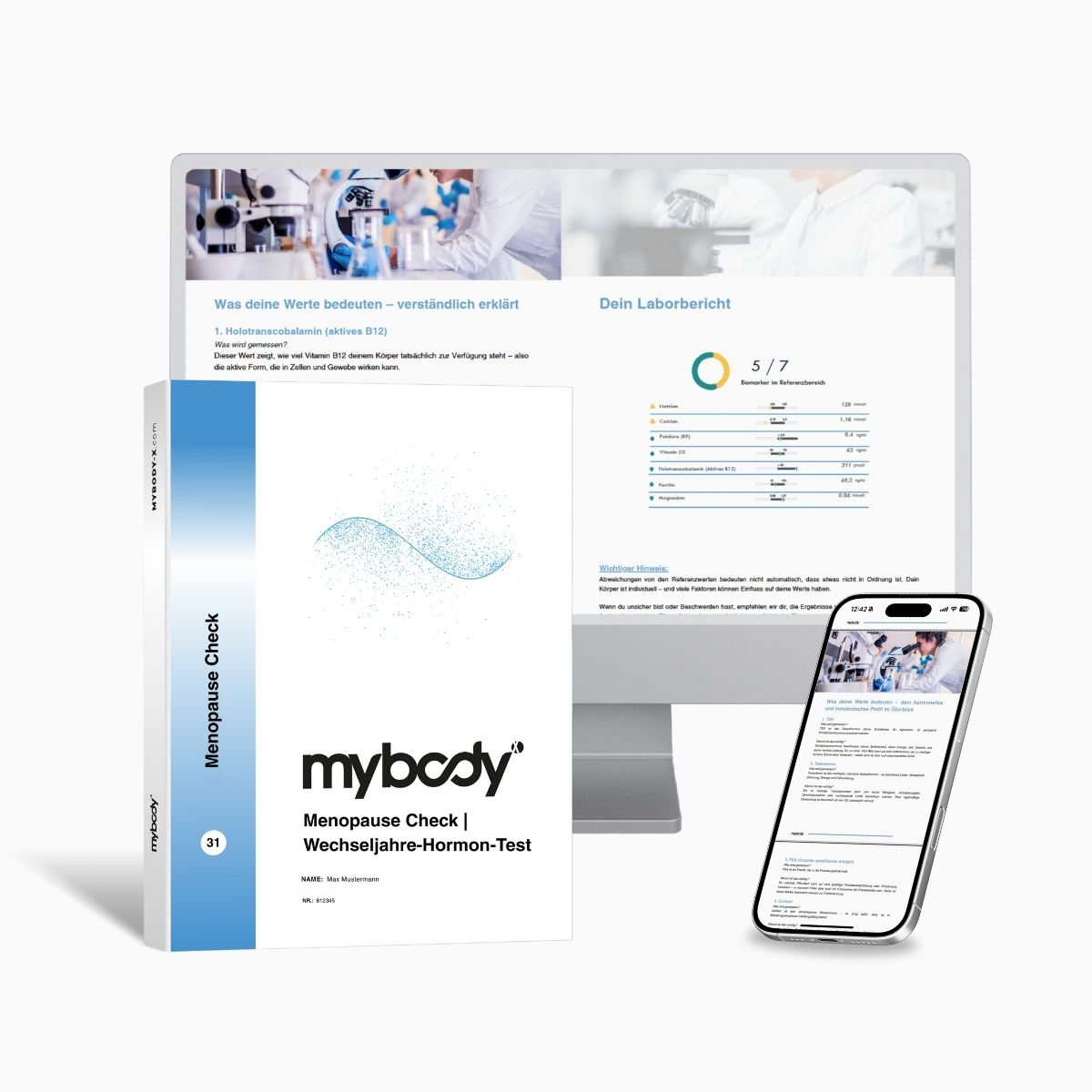
Menopause Check | Menopause Hormone Test
Measures 8 values: testosterone, DHEA-S, SHBG, estradiol, FSH, LH, progesterone, and TSH. This provides the three values discussed in this article together, supplemented by the regulatory hormones. What the test does not provide: It does not measure free testosterone as a separate value, does not detect polycystic ovary syndrome, and provides point-in-time values without a trend over time. It does not diagnose anything and does not replace a medical examination.
Laboratory analysis 3–5 business days after sample receipt
Product page information, accessed 13.08.2026
Capillary blood test
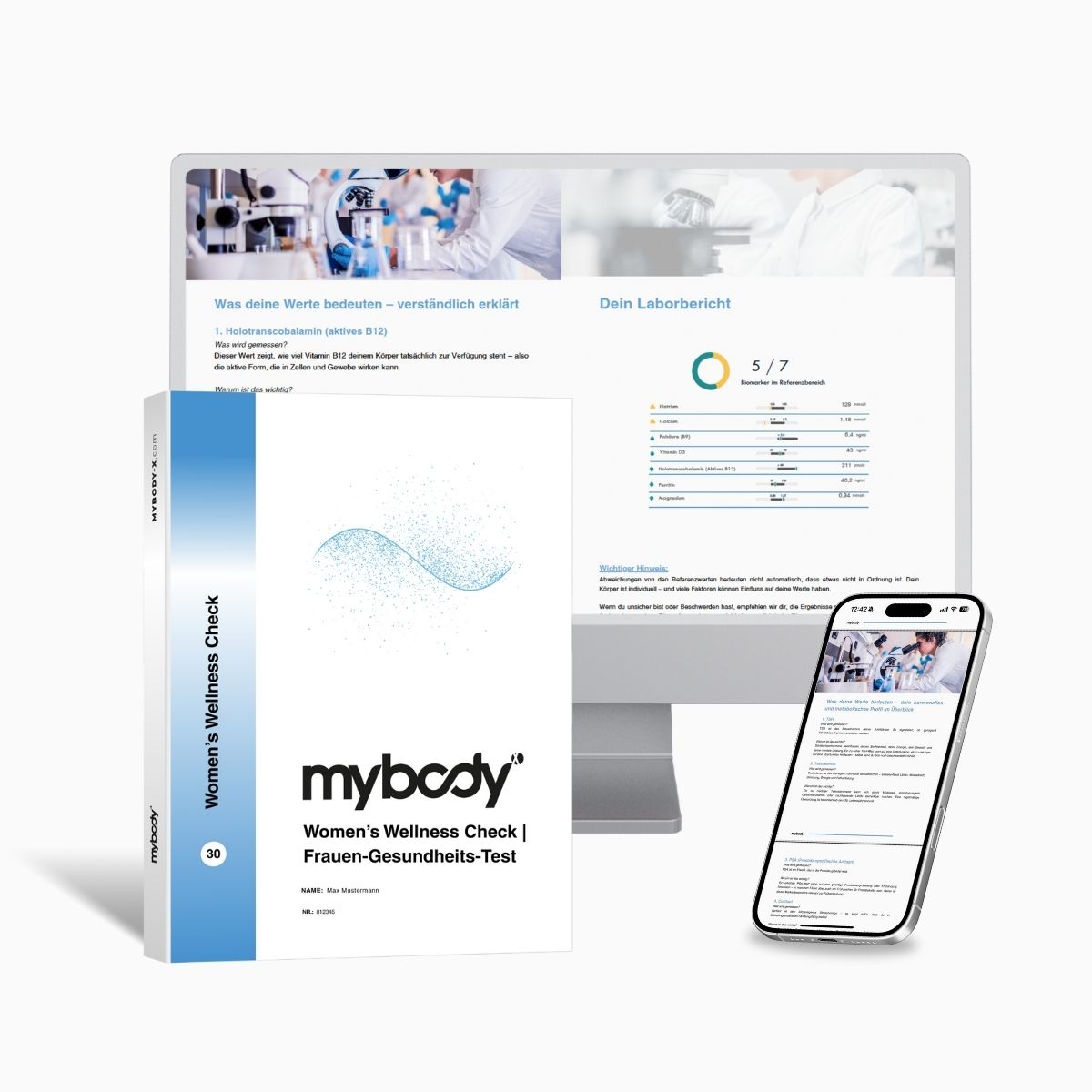
Women’s Wellness Check | Women’s Health Test
Includes 18 markers, including SHBG, as well as a complete thyroid profile consisting of TSH, fT3, and fT4, plus prolactin, cortisol, ferritin, vitamin B12, long-term blood sugar, and a cholesterol profile. What the test does not provide: It includes neither testosterone nor DHEA-S. For the question addressed in this article, it provides only the transport protein and therefore half the information. It does not diagnose anything.
Laboratory analysis 3–5 business days after sample receipt
Product page information, accessed 13.08.2026
Four points determine whether a measurement becomes useful information.
Never interpret it as an isolated value
DHEA-S and SHBG should appear on the same lab report.
Take the cycle day into account
Because FSH and LH are also measured, their testing window applies.
Record any preparations
Oral contraceptives increase SHBG and thereby lower free testosterone.
Compare it with your own lab report
What matters is the reference range on your laboratory report, not a number from the internet.
Chapter at a glance
A capillary blood self-test provides a single testosterone measurement and does not constitute a diagnosis. Its usefulness for this question depends on whether DHEA-S and SHBG are included. Four points are decisive: never interpret it as an isolated value, take the cycle day into account, record any preparations, and compare it with your own lab report.
Limitations: what the value does not answer
The first limitation is the lack of correlation with how you feel. The severity of hirsutism does not correlate with the level of circulating androgens because hair follicles differ individually in their sensitivity (MSD Manual, professional edition, as of August 2025).
The second limitation is the reference ranges. We found no generally applicable figures for women in the sources reviewed. That is why none is stated here, and the range provided by the evaluating laboratory remains authoritative.
The third limitation concerns diagnosis. Polycystic ovary syndrome is cited as the most common cause of elevated androgens (as of August 2025), and no laboratory value alone can establish this diagnosis. It emerges from an overall assessment in medical practice.
The fourth limitation is that it is only a snapshot. A single measurement describes one morning at a specific point in the cycle. Only a second measurement under the same conditions can show whether anything has changed.
What matters when it comes to testosterone levels
If you take away just one thing from this article, let it be this: compare your value exclusively with the reference range shown on your own lab report.
The reason is banal and yet overlooked every day. The vast majority of freely accessible testosterone figures refer to men, and they are on a completely different scale.
At the outset was the question of what the value puts into context. The most honest answer is: together with DHEA-S and SHBG, it forms part of a larger question, and on its own, very little. What it explicitly does not put into context is how you feel.
Frequently asked questions
Do women even have testosterone?
Yes, but at a significantly lower concentration than in men. It is produced in the ovaries and the adrenal cortices. The MSD Manual, professional edition, describes measuring free and total testosterone together with DHEA-S, FSH, and LH when evaluating hirsutism (as of August 2025). The value is therefore routinely included on women’s laboratory reports.
What testosterone level is normal for women?
We found no general figures for women in the sources reviewed, so none are provided here. The relevant value is the reference range stated on your own laboratory report, and reference ranges can vary from one laboratory to another (IQWiG, as of 02/04/2025). The frequently cited 300 to 1000 nanograms per deciliter refer to men (MSD Manual, as of April 2025) and cannot be applied to women.
Does the pill affect testosterone levels?
The MSD Manual states that oral contraceptives increase sex hormone-binding globulin, thereby lowering the level of free testosterone (as of August 2025). A result obtained while using hormonal contraception therefore describes the situation under the contraceptive and not the baseline state. Every preparation should be listed with the results.
Can I infer the level from my symptoms?
No. The same source states that the severity of hirsutism does not correlate with the level of circulating androgens because hair follicles differ individually in their sensitivity to androgens (as of August 2025). The severity and laboratory value are considered separately and brought together in medical practice.
On which day of the cycle is testosterone measured?
Because testosterone is measured together with FSH and LH, the timing is based on their testing window. For FSH, the MSD Manual specifies cycle days 2 to 5, counted from the first day of bleeding (as of January 2024). As for the time of day: Many hormone levels change significantly over the course of the day (IQWiG, as of 02/04/2025), so measure in the morning and note the time.
Next step
Three values instead of one number
If you want to put testosterone into context, you need DHEA-S and SHBG alongside it. The Menopause Check measures all three together with the regulatory hormones from capillary blood. It does not provide a diagnosis and does not replace medical evaluation.
Go to the Menopause Check Go to the Women’s Wellness CheckRead more
You may also be interested in
The transport protein without which a testosterone value remains silent.
The value that is additionally measured in cases of menstrual disorders.
Sources
- Institute for Quality and Efficiency in Health Care (IQWiG): Understanding Laboratory Values Correctly, as of 2 April 2025 – gesundheitsinformation.de
- MSD Manual, Professional Edition: Hirsutism and Hypertrichosis, Levinbook WS (as of August 2025) – msdmanuals.com
- MSD Manual, Professional Edition: Menopause, Pinkerton JV (as of January 2024) – msdmanuals.com
- MSD Manual, Professional Edition: Male Hypogonadism, Jimbo M (as of April 2025) – msdmanuals.com
The verbatim quotation regarding the relevant reference range, the note about differences between laboratories, and the statement about the daily variation of hormone levels are taken from source [1]. The information on which values are determined when investigating hirsutism, the statement that there is no correlation between severity and androgen levels, the description of the relationship between sex hormone-binding globulin and free androgens, the effect of oral contraceptives, and the identification of polycystic ovary syndrome as the most common cause are taken from [2]. The reference to FSH on cycle days 2 to 5 and the description of hormonal changes during perimenopause are taken from [3]. The normal total testosterone range for men of 300 to 1000 nanograms per deciliter is taken from [4] and is expressly included here as a counterexample. We found no reliable information on generally applicable reference ranges for women in the sources reviewed; therefore, no figure is given for this in the text. Information on price, values, sample type, and laboratory comes from the mybody®x product pages, accessed on 13 August 2026; processing times follow the central specification for blood tests. All sources were accessed and reviewed on 13 August 2026.

mybody®x Editorial & Expert Team
Laboratory diagnostics Blood analysis interpretation Nutritional science Nutrigenetics
This article was created by the mybody®x editorial and expert team. The team combines laboratory diagnostics, nutritional science, and the interpretation of blood analyses. Those who contribute to it are listed on the authors page.
Published on 13 August 2026 · Last updated on 13 August 2026
The content is intended for general information and does not replace medical advice, diagnosis, or treatment. Reference ranges depend on the laboratory, method, and age—the information on your test report is always decisive.




Share now:
Interpreting PSA levels correctly: what they indicate and what they cost
Interpreting blood sugar after eating correctly