

Understanding blood glucose after eating
The essentials at a glance
Blood glucose rises after a meal. This is not a warning sign, but the process the metabolism is designed for: carbohydrates are converted into glucose, the glucose enters the bloodstream, and the body brings it back down.
The question is therefore not whether the value rises, but how high it rises, how long it remains elevated, and how it behaves under defined conditions. That is precisely what the diagnostic criteria are designed to assess, and none of them measures an everyday spike.
You will first read what actually happens after eating. Then come three common statements, fact-checked, followed by a comparison of the criteria, the role of the glucose tolerance test, an explanation of the target value of 180 mg/dl, and the limitations of a single observation.
What to expect in this article
1. What happens in the body after eating
2. The target value and where it comes from
3. Why the height of the spike says little
4. Three statements about blood glucose spikes, fact-checked
5. The test that asks exactly this question
6. The criteria compared
7. How persistently high values differ from this
8. What you can observe in everyday life
9. Who may benefit from measuring
10. What a capillary blood test can show here
11. Limitations: what a spike does not answer
12. What matters after eating
Frequently asked questions
Sources
What happens in the body after eating
Carbohydrates from a meal are broken down into glucose in the intestine and enter the bloodstream. Blood glucose rises—and it does so in everyone.
The pancreas responds by releasing insulin. This hormone ensures that glucose moves from the blood into the cells, and the level falls again.
The rise is therefore not a system error, but the system at work. What matters is not that it occurs, but how effectively the feedback regulation works.
The target value and where it comes from
The medical literature does contain a specific number for the post-meal value. It is frequently quoted online and almost always taken out of context.
Documented source
“Peak postprandial (1 to 2 h after the start of the meal) blood glucose < 180 mg/dl (< 10 mmol/l)”
Erika F. Brutsaert, MD
MSD Manual, professional edition, Diabetes Mellitus, Treatment Goals, as of December 2025
“Postprandial” means after a meal, and “peak” means the highest value. The statement therefore describes the highest value one to two hours after the start of the meal.
The heading under which this sentence appears is crucial. It is a treatment target for people with established diabetes, not a threshold for people without diabetes.
Anyone who interprets the value as a general everyday benchmark is applying a treatment target to a context for which it was never intended. This regularly creates concern about values that have no clinical implications.
Why the height of the peak says little
How high a value rises after a meal depends on a whole range of factors that have little to do with metabolism.
The meal’s composition is one factor, as are the amount, the order of the courses, the time of day, physical activity before and afterward, and the time since the last meal.
Two measurements taken on two different days are therefore hardly comparable unless everything about them was the same. That is exactly why diagnostic testing does not use everyday meals.
The pattern matters as well as the peak value
In addition to the level, there is a second factor that is almost never considered in everyday life: how long the value remains elevated.
A brief rise followed by a rapid return describes a different situation from a shallower rise that remains high for a long time. The peak value alone cannot distinguish between these two cases.
That is precisely why the glucose tolerance test uses a fixed time point two hours later. It does not measure the peak, but how far the value has fallen again by that time.
So, anyone who sees a single high number on a device knows neither where it falls in the timeline nor the baseline value. Without both, the number has no context.
Three statements about blood glucose spikes: a fact check
These three statements come up regularly. All three can be checked against the evidence.
Checked against the evidence
Common
“A rise after eating is a bad sign.”
Documented
The medical literature lists the post-meal value as a treatment target with an upper limit, not as a sign whose occurrence would itself be abnormal (MSD Manual, professional edition, as of December 2025). An increase is part of the process.
Common
“Over 180 mg/dL means diabetes.”
Documented
A value below 180 mg/dL is a treatment target. By contrast, the diagnostic criterion based on the glucose tolerance test is 200 mg/dL or higher, equivalent to 11.1 mmol/L or higher, measured two hours after a defined amount of sugar (as of December 2025).
Common
“My reading after lunch shows it.”
Documented
The diagnostic criteria use defined conditions: fasting plasma glucose, a glucose tolerance test with a specified amount of sugar, and HbA1c (as of December 2025). An everyday meal meets none of these conditions.
The second point explains a common mix-up between numbers. There is a 20 mg/dL difference between the treatment target and the diagnostic criterion, and the two numbers come from entirely different contexts.
The test that asks precisely this question
There is a test that examines exactly how the body handles a glucose load. It is called the oral glucose tolerance test.
A defined amount of glucose is consumed, and blood sugar is measured two hours later. Because the amount is standardized, the results are comparable between people and over time.
The thresholds for this value after two hours are: below 140 mg/dL is considered normal, 140 to 199 mg/dL indicates impaired glucose metabolism, and 200 mg/dL or higher meets the diabetes criterion (MSD Manual, professional edition, as of December 2025).
This already answers the question of what happens after consuming sugar, using a standardized procedure. An everyday measurement after lunch does not replace it.
The criteria compared
The table reproduces the criteria from the MSD Manual, professional edition (as of December 2025). It provides context and does not constitute a diagnosis.
| Method | Normal | Impaired glucose metabolism | Diabetes |
|---|---|---|---|
| Oral glucose tolerance test, two-hour value | Below 140 mg/dL, corresponding to below 7.7 mmol/L | 140 to 199 mg/dL, corresponding to 7.7 to 11.0 mmol/L | 200 mg/dL or higher, corresponding to 11.1 mmol/L or higher |
| Fasting plasma glucose | Below 100 mg/dL, corresponding to below 5.6 mmol/L | 100 to 125 mg/dL, corresponding to 5.6 to 6.9 mmol/L | 126 mg/dL or higher, corresponding to 7.0 mmol/L or higher |
| Glycated hemoglobin (HbA1c) | Below 5.7 percent, corresponding to below 39 mmol/mol | 5.7 to 6.4 percent, corresponding to 39 to 46 mmol/mol | 6.5 percent or higher, corresponding to 48 mmol/mol or higher |
| Peak value after an everyday meal | Not included in the diagnostic criteria | Not included in the diagnostic criteria | Not included in the diagnostic criteria; the figure below 180 mg/dL is a treatment target |
The final line is the core of this article. The everyday spike does not appear in the criteria at all, and therefore nothing can be inferred from it.
What distinguishes persistently high values
A single spike and a persistently elevated blood sugar level are two different things, and they are measured using different methods.
The post-meal spike is not part of any diagnostic criterion. The average over several months is.
HbA1c reflects the long-term state. This value reflects glucose control over the past three months (MSD Manual, professional edition, as of December 2025) and is unaffected by individual meals.
That is precisely where its value lies for this question. If many spikes are too high over a long period, this is reflected in the average. A single spike is not.
How the long-term value develops and which interfering factors can shift it is covered in the companion article HbA1c: what period the value reflects.
What you can observe in everyday life
When a single number says little, the question remains: what should be used instead? The answer lies in observations over a longer period, not in measurements from individual meals.
Anything that can be described over several weeks is useful: unusual thirst, frequent urination, persistent fatigue, or a change in weight without any apparent reason.
Such observations are nonspecific and can fit many conditions. Their value lies in describing a period of time, and periods of time are the right level of detail for this question.
What follows from this is not a self-test in the kitchen cabinet, but a conversation. Anyone who can describe such an observation will receive a more targeted examination in medical practice than someone with a collection of individual measurements.
Why individual measurements are of little help in a consultation
A list of twenty values after twenty different meals may look thorough, but it still provides little information. The reason is that each of these values was obtained under different conditions.
No pattern can be identified from this in medical practice because no two lines have the same starting conditions. Such a list does not answer any of the questions posed by the diagnostic criteria.
A single statement about a period of time is much more useful. The thirst has been unusually strong for six weeks, or the weight has fallen without any apparent reason.
Statements like these lead to a targeted examination. And the appropriate examinations are the three from the criteria table, not another measurement after dinner.
Who may benefit from a measurement
The comparison refers to long-term blood sugar because a daily spike is not part of any criterion.
It makes sense for you if …
You can describe an observation over several weeks and want to add a number that represents a period of time.
You want to establish a baseline value with a date against which something can be compared in three to six months.
You have never had your long-term blood sugar measured.
You want to be prepared for a consultation at the medical practice instead of only having values collected at your first appointment.
Probably not, if …
You want to know how a particular meal affects you. A monthly average is not designed for that.
You want to have a single spike interpreted. It is not part of the diagnostic criteria.
You have developed unusual thirst, frequent urination, or unintentional weight loss. This should be addressed promptly at a medical practice.
You expect a diagnosis. That is based on several components in a medical practice.
What a capillary blood test can show here
A capillary blood self-test does not measure a meal-related peak or provide a diagnosis. It provides long-term blood sugar, the value that is actually useful for this question.
A test by mybody®x (MYBODY Lab GmbH) measures this value together with a broad nutrient profile. What it does and does not do is shown in the card.
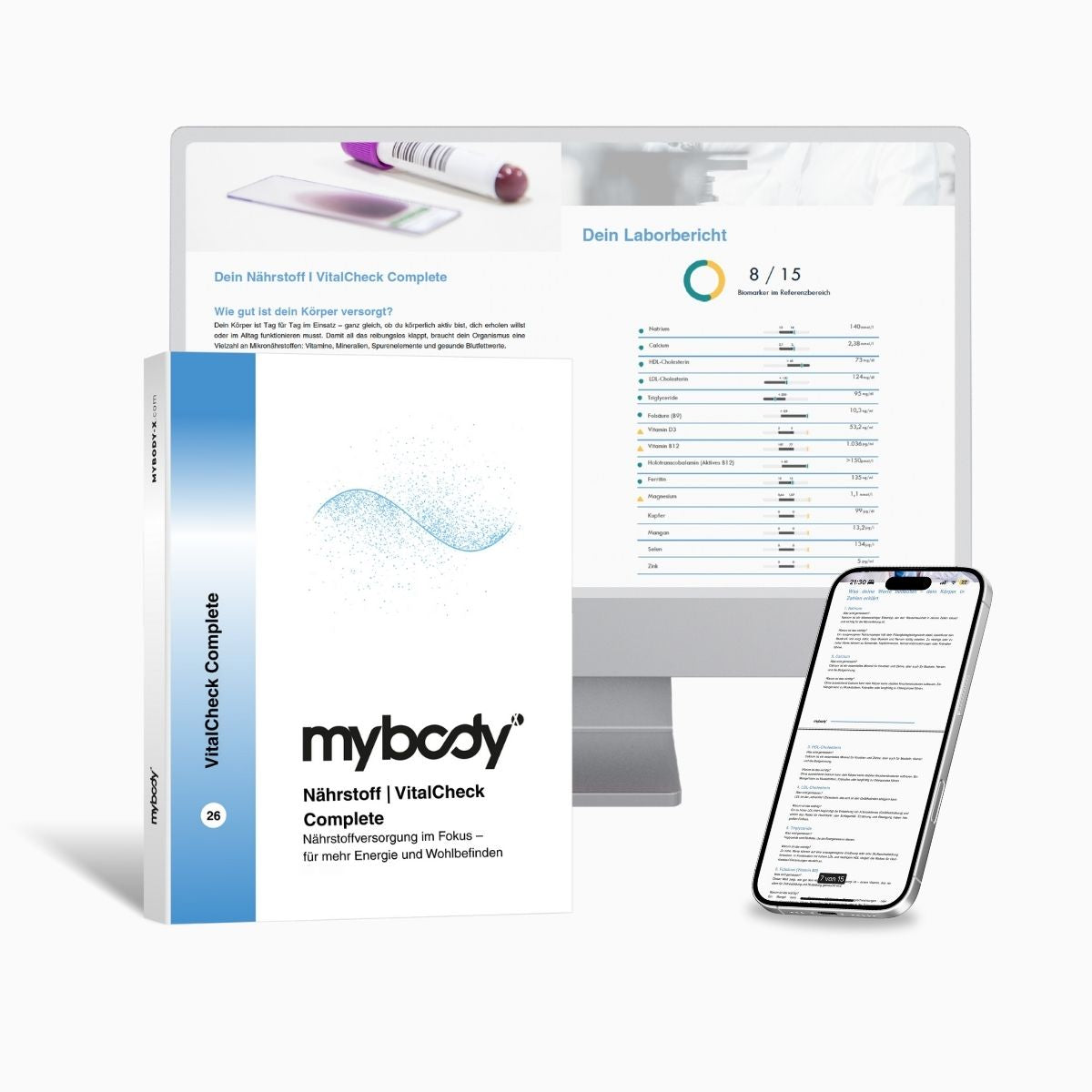
Capillary blood test
VitalCheck | Complete Nutrient & Mineral Test
Includes 18 values, including long-term blood sugar, as well as a cholesterol profile, CRP, ferritin, iron, transferrin, vitamin B12, folic acid, vitamin D, and calcium, magnesium, phosphate, selenium, and zinc. What the test does not do: it does not measure a post-meal value, includes neither a fasting glucose test nor a glucose tolerance test, and therefore covers only one of the three diagnostic methods. It does not provide a diagnosis and does not replace a medical examination.
Laboratory analysis 3–5 business days after sample receipt
Product page information, accessed 13/08/2026
Four points determine whether an observation becomes useful information.
Periods rather than points in time
An observation over several weeks is more informative than a measurement after lunch.
Read numbers in context
A treatment target is not a diagnostic criterion or an everyday benchmark.
Check the unit
Milligrams per deciliter and millimoles per liter describe the same thing.
Discuss anything unusual
Thirst, frequent urination, and unintentional weight loss should be discussed with a medical practice promptly.
Chapter at a glance
A capillary blood self-test does not measure a meal-related peak but long-term blood sugar. That is precisely the more useful value for this question, because an everyday peak does not appear in any diagnostic criterion. Four points are decisive: read periods rather than points in time, interpret numbers in context, check the unit, and discuss anything unusual.
Limitations: what a peak does not answer
The first limitation is the lack of comparability. No two meals are ever the same, so two post-meal measurements cannot be meaningfully compared.
The second limitation is the lack of a benchmark. The peak value after an everyday meal does not appear in the diagnostic criteria, and the only widely used figure for it is a treatment target.
The third limitation is a gap in the sources. We found no reliable information on what peak level is considered unremarkable in people without diabetes. That is why the text contains no figure on this.
The fourth threshold is diagnosis. It is based on several components assessed in a medical practice, and no self-test or everyday measurement can anticipate it.
What matters after eating
If you take away just one thing from this article, let it be this: Blood sugar rising after eating is a normal process, not an abnormal finding.
The question that actually matters is the one about the long-term state. Standardized procedures are available for this, and they use defined conditions rather than everyday meals.
The starting question was how to interpret readings after eating. The most honest answer is: hardly at all individually, but well on average. And that average is called HbA1c.
Frequently asked questions
Is a rise in blood sugar after eating normal?
Yes. Carbohydrates are broken down into glucose, enter the bloodstream, and are then transported into cells by insulin. The rise is part of the process. The medical literature cites the post-meal value as a treatment target for people with diabetes, not as a sign that would itself be considered abnormal (MSD Manual, professional edition, as of December 2025).
What does the number 180 mg/dl mean?
It comes from diabetes treatment targets: a peak value of under 180 mg/dl one to two hours after starting a meal, corresponding to under 10 mmol/l (MSD Manual, as of December 2025). This is a treatment target, not a threshold for people without diabetes. It is not intended as a benchmark for everyday use.
Which two-hour value is considered abnormal?
The oral glucose tolerance test answers this question using a defined amount of sugar. For the two-hour value, below 140 mg/dl is considered normal, 140 to 199 mg/dl indicates impaired glucose metabolism, and 200 mg/dl or higher is a criterion for diabetes (MSD Manual, as of December 2025). An everyday meal does not meet the conditions of this test.
Why do my readings fluctuate so much?
Because many factors are involved: the composition and amount of the meal, the order of the courses, the time of day, physical activity before and afterward, and the interval since the last meal. Two measurements taken on two different days are therefore hardly comparable. That is precisely why diagnosis uses defined conditions.
Which value indicates persistently elevated blood sugar?
HbA1c. It reflects glucose control over the past three months (MSD Manual, as of December 2025) and is unaffected by individual meals. A value below 5.7 percent is considered normal, 5.7 to 6.4 percent indicates impaired glucose metabolism, and 6.5 percent or higher is a criterion for diabetes. The reference range on your own test result remains decisive.
Next step
Measure the period instead of the moment
If the question of your long-term state is on your mind, VitalCheck measures long-term blood sugar together with 17 other values from capillary blood. It does not provide a diagnosis and does not replace medical evaluation.
Go to VitalCheckRead more
You might also be interested in
The value that describes the long-term state.
Why a curve after eating looks more precise than it is.
Sources
- MSD Manual, Professional Edition: Diabetes mellitus (DM), Brutsaert EF (as of December 2025) – msdmanuals.com
- MSD Manual, Professional Edition: Diagnostic criteria for diabetes mellitus and impaired glucose metabolism, table (as of December 2025) – msdmanuals.com
- Institute for Quality and Efficiency in Health Care (IQWiG): Understanding laboratory values correctly, as of 02.04.2025 – gesundheitsinformation.de
The verbatim quote concerning the postprandial target value of less than 180 mg/dl, including the one- to two-hour timeframe, as well as the quote concerning the three-month period for HbA1c, come from source [1]; both are presented there in the context of diabetes treatment. All thresholds for fasting plasma glucose, the oral glucose tolerance test, and HbA1c come from [2]. The explanation of the reference range and the note about differences between laboratories come from [3]. Regarding what blood glucose peak is considered unremarkable in people without diabetes, we found no reliable information in the sources reviewed; therefore, no figure is given in the text. Information on price, values, sample type, and laboratory comes from the mybody®x product page, accessed on 13.08.2026; processing times follow the central specification for blood tests. All sources were accessed and reviewed on 13.08.2026.

mybody®x Editorial & Medical Expert Team
Laboratory diagnostics Blood analysis interpretation Nutritional science Nutrigenetics
This article was created by the mybody®x editorial and medical expert team. The team combines laboratory diagnostics, nutritional science, and the interpretation of blood analyses. Everyone involved can be found on the authors page.
Published on 13.08.2026 · Last updated on 13.08.2026
The content is intended for general information and does not replace medical advice, diagnosis, or treatment. Reference ranges depend on the laboratory, method, and age—your test report always takes precedence.




Share now:
Testosterone in women: how to interpret the level
Plant-based iron: why absorption matters