
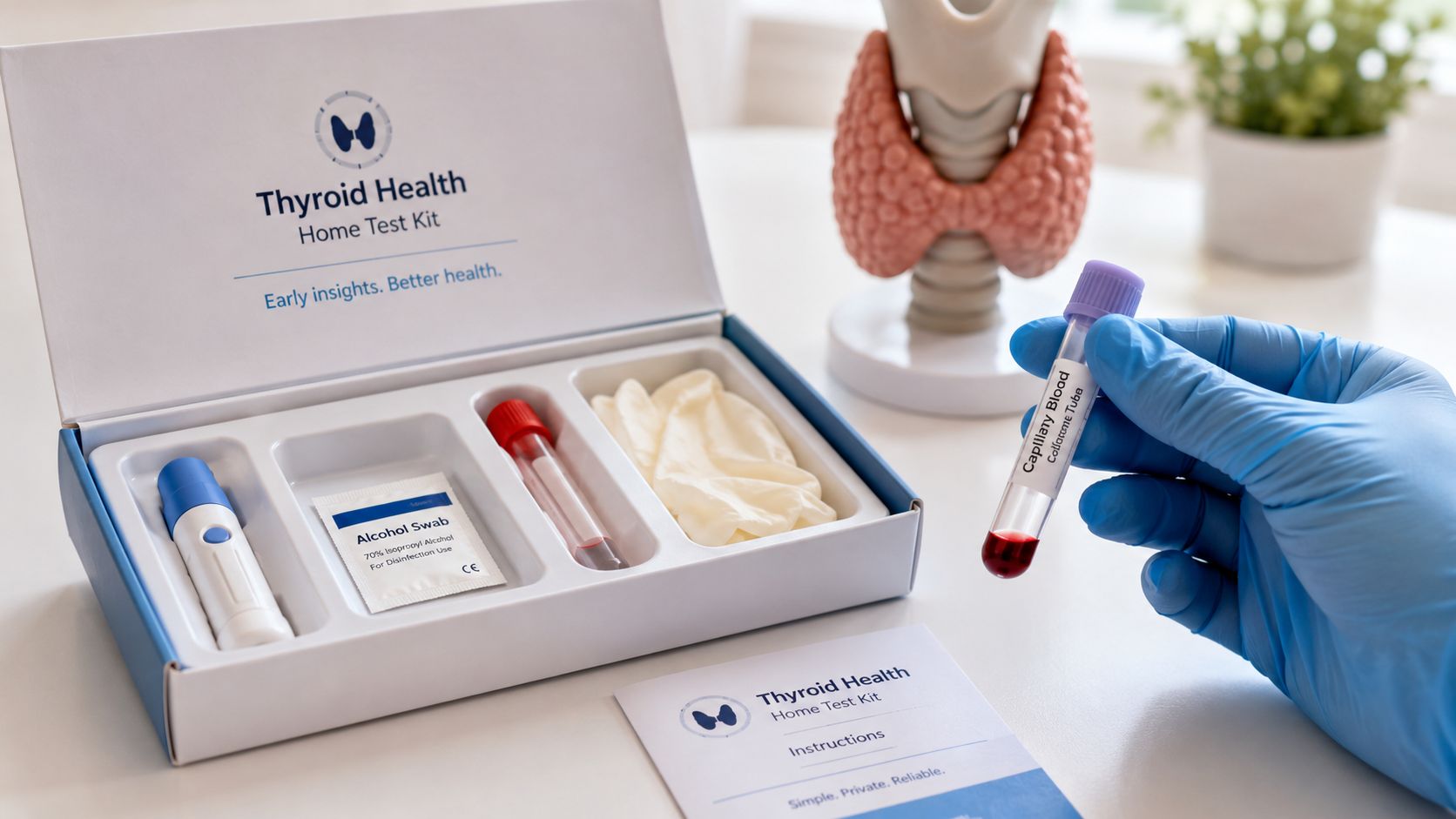
Getting your thyroid tested: The complete guide for 2026
You get enough sleep and are still exhausted. The number on the scale is going up even though you have not changed your diet. Or your pulse suddenly feels too fast, you are nervous and restless, and you have trouble calming down. In such moments, many people first look for the cause in stress, sleep, or diet. That is understandable. But it is often worth taking a look at the thyroid as well.
The thyroid is small, but it plays a surprisingly important role in many aspects of everyday life. It affects how your body uses energy, how actively your metabolism works, and how stable you feel overall. When it gets out of balance, symptoms can develop that seem nonspecific and are therefore often overlooked for a long time.
People who want to get their thyroid tested usually have the same questions. Do I even need a test? Which values are important? Is a home test enough, or should I go straight to a doctor? And what should I do if the results are abnormal? That is exactly what this guide is about. Practical, easy to understand, and without unnecessary technical jargon.
Constantly tired and gaining weight for no apparent reason? Your thyroid could be the answer
It often starts gradually. In the morning, you struggle to get out of bed, need longer to get going, and wonder why exercise, diet, or sleep no longer have the same effect as they used to. Others first notice that they feel cold even though everyone else is warm. Still others are puzzled by weight fluctuations, concentration problems, or a general feeling of inner restlessness.

Why the thyroid is so often overlooked
Precisely because the symptoms seem so commonplace, the thyroid does not always immediately appear on the list of possible causes. Fatigue can have many causes. So can weight gain. Nervousness can, too. The problem is not that these symptoms are rare. The problem is that they are difficult to interpret without laboratory results.
The thyroid works in your neck, but you feel its effects throughout your body. Put simply, it is a central regulator of your energy balance. If it works too slowly, many things feel sluggish. If it works too quickly, the entire body tends to feel overstimulated.
Your symptoms do not automatically mean you have a thyroid disorder. But they are a good reason to take a closer look instead of explaining them away for months.
What people affected commonly describe in everyday life
Typical are not spectacular individual complaints, but patterns that add up:
- You constantly lack energy. You are not just tired after a long day—you are already exhausted in the morning.
- Your weight changes without a clear explanation. Despite similar eating and exercise habits, your body reacts differently than usual.
- Your mind and body do not feel synchronized. Some people feel slowed down, while others feel driven from within.
- Everyday life becomes harder to manage. Concentration, resilience, and well-being fluctuate more noticeably.
If you recognize yourself in this, a test is not an end in itself. It is a logical first step toward turning suspicions into reliable information. That is precisely what makes such a difference with thyroid issues. Don’t guess—measure.
When a thyroid test is genuinely advisable
Not everyone should automatically have their thyroid tested. This is important if you want to make a good decision. There is a clear difference between targeted evaluation of symptoms and routine screening without a specific reason.

Typical signs of hypothyroidism or hyperthyroidism
An evaluation is particularly advisable when typical symptoms occur together.
- More suggestive of hypothyroidism. Fatigue, weight gain, sensitivity to cold, dry skin, and feeling slower in everyday life.
- More suggestive of hyperthyroidism. Palpitations, nervousness, sweating, weight loss despite having an appetite, inner restlessness.
- Special situations. Desire to have children, abnormal previous findings, palpable changes in the neck, or a history of known thyroid issues.
In Germany, basic diagnostic testing in such cases usually starts with a general practitioner, including a medical history and blood test. This is particularly indicated for symptoms such as weight changes or a desire to have children, as described in Primo Medico’s overview of thyroid diagnostics.
Why blanket screening is viewed critically
In asymptomatic, non-pregnant adults, the evidence is considerably more cautious. The IGeL-Monitor rates blood testing for early detection as “tending toward negative” because the available studies show no clear benefit. If there is no well-founded suspicion, statutory health insurers generally do not cover the costs. Screening without symptoms usually has to be paid for privately and, according to the IGeL-Monitor, costs around €16.90 to €26.22 plus a consultation for the basic option, as summarized in its assessment of early detection of thyroid dysfunction.
This is not an argument against testing. It is an argument against testing blindly.
Practical rule of thumb: If you have specific symptoms, risk factors, or previously abnormal findings, a test can often provide real clarity. Without a specific reason, restraint is usually more sensible.
If you want to explore the topic in more depth, you can also find an overview of getting your thyroid tested on the mybody® website.
Getting your thyroid tested: your options at a glance
Once it is clear that an evaluation makes sense, the next question arises: which route do you want to take? In practice, there are three typical options: a general practitioner, an endocrinologist, or a home self-test. None of them is always the right choice in principle. It depends on your goal.
What the traditional medical route does well
A general practitioner is usually the first point of contact. This is especially suitable when you want your symptoms assessed or also need a physical examination. In Germany, basic diagnostics typically involve a medical history, blood tests, and an ultrasound if needed.
An endocrinologist is particularly relevant when findings are unclear, nodules need to be assessed, or targeted specialist diagnostic follow-up is required. This is the right address for more complex cases, but not always the quickest starting point.
When a self-test may be useful
A home test is particularly useful if you want to get started with minimal barriers. For example, if you want an initial laboratory indication without immediately arranging an appointment. This is not an alternative to medical diagnostics when you have significant symptoms, but it is often a pragmatic first step.
Especially in healthcare, many people also search locally for guidance. Those interested in how providers can become more visible online and why good health information is important in the region can find an interesting perspective on local healthcare communication in Edmund Barks' pharmacy strategies.
Comparison of testing options for your thyroid
| Feature | General practitioner | Endocrinologist | Self-test (e.g., mybody®) |
|---|---|---|---|
| Starting point | Good for initial symptoms | Good for abnormal or complex findings | Good for a quick initial check |
| Process | Consultation, blood tests, and further steps if needed | Specialist assessment, often with in-depth diagnostics | Test kit sent to your home, collect the sample yourself, and send it in |
| Scope | Usually TSH, with additional values if there is a suspicion | Broader evaluation depending on the question | Depending on the test, usually more limited and often intended as an initial step |
| Time required | Appointment required | Referral or specialist appointment possible | From home without a doctor’s appointment |
| Strengths | Overall medical perspective | Specialized assessment | Discrete, convenient, and easy to access |
| Limitations | Not always comprehensive right away | Greater organizational effort | Does not replace imaging or complex diagnostics |
One straightforward point is important. A self-test provides data. The medical interpretation depends on exactly what was measured and how it relates to your symptoms.
The most important thyroid values explained simply
Laboratory findings often seem more complicated than they are. For an initial assessment, you usually only need to understand three terms: TSH, fT3, and fT4.
How the values are connected
The thermostat analogy is the easiest way to understand it. TSH is like the control signal. It tells the thyroid whether to work more or less. fT4 is the hormone that is provided. fT3 is the active form that produces the actual effect in the body.
In Germany, TSH measurement is the central laboratory parameter. A normal TSH value is usually 0.4 to 4.0 mU/l. If TSH is abnormal, fT3 and fT4 are also measured because the combination reflects thyroid function more reliably than a single value, as the overview of the Thyroid Test by Apollo Hospitals explains.
Why a single value is not always enough
A single TSH value can be a good starting point. But that is all. It shows whether the regulatory system is responding unusually. It does not automatically explain the whole picture. That is why additional values are measured when deviations occur.
In short:
- TSH shows how strongly the body stimulates the thyroid.
- fT4 shows how much hormone is available.
- fT3 helps assess what is actually active and effective.
A good finding is not just a number within the reference range. It is a result that fits your symptoms.
And what about antibodies?
Antibodies are not always part of the initial standard measurement. They become more important when an autoimmune disease is suspected, such as Hashimoto's disease. In that case, looking at TSH alone is not enough. More targeted diagnostics are needed.
If you want to learn how to read laboratory values better, this article on TSH thyroid values is a good next step.
Your thyroid home test step by step
A home test may feel unfamiliar to many people at first. In practice, it rarely fails because of the test itself, but rather because of avoidable errors during sample collection. If you work carefully, you will get much more useful results.

This is how collection at home works
The practical process is kept simple:
- Order the test kit. You receive the materials at home.
- Collect blood while fasting in the morning. This is important because TSH can fluctuate depending on the time of day.
- Package the sample correctly and send it in.
- Access the digital report. You can then decide whether medical evaluation is necessary.
With mybody®, the process typically works exactly this way. Order the test kit, collect blood while fasting in the morning, send in the sample, and receive the results digitally with interpretation and recommendations for what to do next. This is especially appealing to people who want an initial data point without a doctor's appointment.
The most common mistakes with DIY tests
Three mistakes are particularly common in practice:
- Collected too late. If you collect the sample later in the day, the TSH value may be more difficult to interpret.
- Too little blood. This makes the analysis more difficult or unreliable.
- Transported at too high a temperature. Shipping should be prepared appropriately wherever possible so that the sample remains stable.
Collect the sample fasting in the morning and send it promptly in suitable packaging. With home tests, this is often more important than the puncture itself.
You should still assess the home test realistically. A typical laboratory workflow for a thyroid evaluation in Germany involving venous blood collection, TSH, fT3 and fT4, as well as digital transmission of the results, is given as an example at €64.83 including blood collection and 19% VAT. At the same time, home tests often primarily measure the TSH screening value. This is not sufficient when more complex conditions such as Hashimoto's disease are suspected, because antibody testing and an ultrasound are then required, as explained by the German Thyroid Center's information on thyroid diagnostics.
How long you wait for results
The laboratory processes described usually state 3 to 5 business days from receipt of the sample to completion of the analysis. That is fast enough to respond promptly, but slow enough to ensure proper laboratory work rather than instant diagnostics.
If you are taking blood yourself for the first time, specific instructions can help. This step-by-step guide to performing a blood test at home removes much of the uncertainty.
Understanding the results and taking the right next steps
The result is not a label. It is a decision-making aid. A simple, action-oriented interpretation is especially helpful for TSH levels.

TSH in practical terms
In laboratory practice, the following thresholds are often used to provide further guidance:
- Below 0.4 mU/l. This suggests possible hyperthyroidism and should be assessed by a doctor promptly.
- Above 2.5 mU/l. Further assessment is advisable, especially if you have symptoms.
- Above 4.0 mU/l. You should discuss the finding with a doctor and not stop at a self-test.
These thresholds are not a substitute for a diagnosis. They simply help you avoid looking at numbers without a plan.
What may be relevant to you depending on your goal
The same number can have different significance depending on the situation. Someone who wants to lose weight and has been stuck for months despite being disciplined often views a value above 2.5 differently from someone without symptoms. Anyone strongly focused on energy, performance, or longevity will usually want to understand abnormalities earlier, before they significantly affect everyday life.
It is important to remain objective. Not every borderline finding requires immediate treatment. But an abnormal or inconsistent value often calls for the next sensible step. This could be a more comprehensive laboratory panel, a consultation with a doctor, or, if symptoms are significant, both right away.
A thyroid test does not answer every question. But it separates assumptions from facts. That alone helps many people move beyond uncertainty.
If an underactive thyroid is more likely in your case, you can also find practical advice here on nutrition for an underactive thyroid.
If you want to have your thyroid tested and are first looking for a straightforward way to gain clarity, a home test from MYBODY Lab GmbH can be a sensible starting point. You receive a structured initial laboratory indication at home. Abnormal values, severe symptoms, or suspected complex thyroid issues should then be assessed further by a doctor. That is exactly how to use diagnostics sensibly: start with a low barrier, interpret the results properly, and then take the right next steps.



Share now:
Recovery After Exercise: Top Methods for 2026
Selenium drops: effects, dosage, and tips