

Macronutrients explained: Your key to better health
TL;DR:
- Around 60 percent of Swiss people feel uncertain about nutrition.
- Macronutrients are essential for the body's energy, structure, and functions.
- Personalized recommendations and balance are essential for long-term health.
Around 60 percent of the Swiss population feels uncertain about nutrition, even though most people make conscious choices at the table every day. Many people know macronutrients by name, but how carbohydrates, proteins, and fats actually work in the body and why their balance is so crucial often remains unclear. This guide brings clarity without the technical jargon. You will learn what functions each macronutrient performs, what the Swiss recommendations mean in practical terms, and how you can optimize your diet in a targeted and sustainable way.
Table of contents
- What are macronutrients, and why are they important?
- How carbohydrates, proteins, and fats work in the body
- Swiss recommendations and individual adjustments
- Macronutrients in practice: Optimization for health and everyday life
- A personal perspective: Why balance and individuality matter more than perfection
- Individual nutritional analysis: Your path to optimal balance
- Frequently asked questions
Key insights
| Point | Details |
|---|---|
| Three main nutrients | Carbohydrates, proteins, and fats are essential for energy and bodily functions. |
| Swiss recommendations as a foundation | National guidelines provide guidance but should be adapted to individual needs. |
| Individual optimization | Analysis and digital tools can be used to improve macronutrient intake strategically. |
| Quality over quantity | Complex carbohydrates, high-quality proteins, and unsaturated fats are essential for good health. |
What are macronutrients, and why are they important?
Macronutrients are the three major building blocks of our diet: carbohydrates, proteins, and fats. The term “macro” comes from the Greek word for “large” and indicates that these nutrients need to be consumed in comparatively large amounts. Macronutrients are needed in large quantities because they form the foundation for energy, cell growth, and nearly all bodily functions.
In contrast, micronutrients—vitamins and minerals—are needed by the body in smaller amounts, but they are just as essential. While micronutrients primarily act as catalysts and regulators, macronutrients provide the actual energy and building materials for muscles, organs, and cells. Understanding the basics of macronutrients is therefore the first step toward a truly well-founded nutrition strategy.
The three macronutrients at a glance:
| Macronutrient | Calories per gram | Main function |
|---|---|---|
| Carbohydrates | 4 kcal | Energy source, brain function |
| Proteins | 4 kcal | Muscle building, repair, enzymes |
| Fats | 9 kcal | Hormone production, cell protection, energy reserve |
What surprises many people is that fats provide more than twice as many calories per gram as carbohydrates or proteins. This makes them energy-dense, but not automatically unhealthy.
- Carbohydrates are the preferred fuel for the brain and muscles.
- Proteins build and repair tissue and serve as building blocks for enzymes and hormones.
- Fats protect organs, transport fat-soluble vitamins, and regulate inflammatory processes.
“A balanced intake of all three macronutrients is not a matter of trends, but a biological necessity.”
A long-term deficiency in any of the three macronutrients can lead to serious health problems. For example, anyone who eats too little protein risks muscle loss and a weakened immune system. Those who drastically reduce their fat intake impair hormone production. And anyone who avoids carbohydrates completely places unnecessary strain on the metabolism. How nutrient deficiencies affect health often becomes apparent only after months, which is why early analysis is so valuable.
How carbohydrates, proteins, and fats work in the body
Now that it is clear what macronutrients are, it is worth taking a closer look at how the body processes them. Not all carbohydrates are the same, not all fats are bad, and not every protein has the same effect.
Carbohydrates are broken down into glucose, proteins into amino acids, and fats into fatty acids. These basic substances are then used for energy, stored, or used to build body structures, depending on the body's needs. The key difference lies in the speed and quality of this process.
Carbohydrates: complex beats simple
Simple carbohydrates such as sugar or white flour are quickly converted into glucose, causing blood sugar levels to rise rapidly. Complex carbohydrates from legumes, whole grains, or vegetables are broken down more slowly and provide a steady supply of energy. Choosing healthy carbohydrates is one of the most effective ways to maintain stable energy and manage weight.
Proteins: the building blocks with memory
Proteins consist of amino acids, nine of which are considered essential. This means the body cannot produce them itself and depends on food for them. Animal sources such as meat, eggs, or dairy products provide all the essential amino acids in one source. Plant sources such as beans or lentils often need to be combined to achieve a complete profile. The optimal protein intake varies considerably depending on age, activity, and health goals.
Fats: saturated versus unsaturated
Saturated fatty acids from butter or meat should be consumed in moderation. Unsaturated fatty acids from olive oil, nuts, or fatty fish protect the heart and support cognitive function. Trans fats from highly processed foods are the only group that should truly be avoided consistently.

Comparison: Everyday carbohydrate sources
| Source | Type | Effect on blood sugar |
|---|---|---|
| White bread | simple | fast, sharp increase |
| Oatmeal | complex | slow, steady |
| Lentils | complex + fiber | very slow, steady |
The order in which they are processed in the body is clear:
- Carbohydrates are preferably used as immediate energy.
- Proteins are used for repair and building.
- Fats are mobilized when energy is needed over a longer period.
- Excesses of all three macros are stored as fat.
Pro tip: Combine all three macronutrients at every meal. A serving of salmon with quinoa and avocado provides high-quality proteins, complex carbohydrates, and healthy fats in one meal. This keeps blood sugar stable and keeps you feeling full for longer. Find more macronutrient details on the Swiss nutrition platform impuls.migros.ch.
Swiss recommendations and individual adjustments
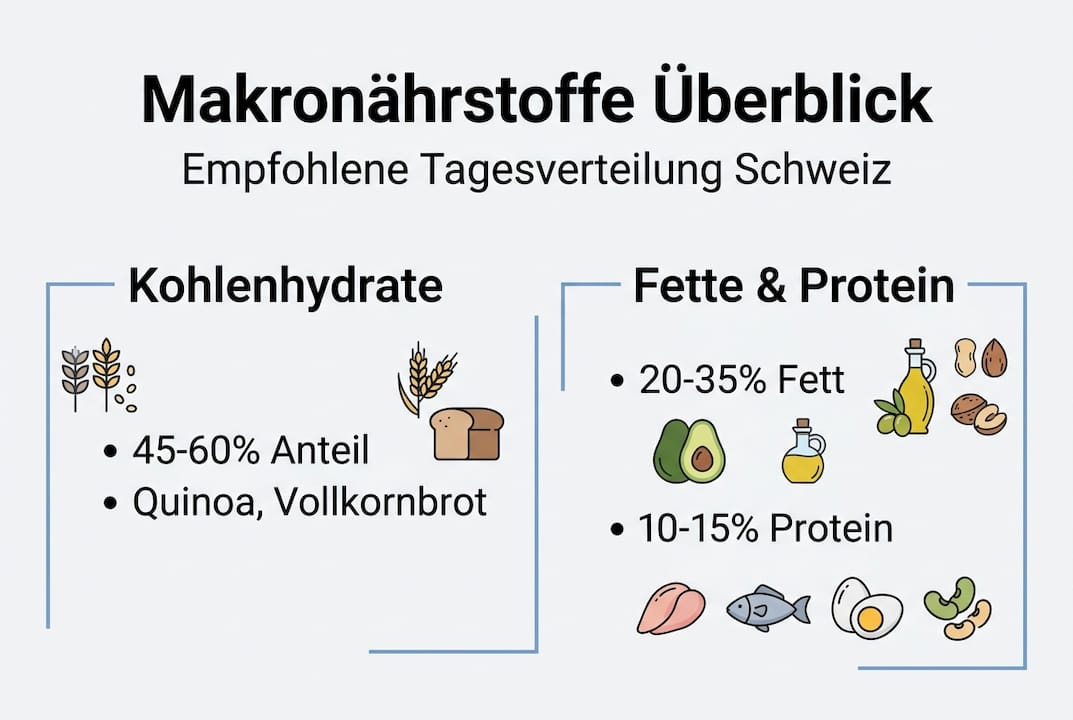
Switzerland has clear guidelines for macronutrient distribution. Official Swiss recommendations call for 45 to 60 percent of energy from carbohydrates, 20 to 35 percent from fats, and 10 to 15 percent from proteins. These values apply to healthy adults with moderate activity.
Recommended values at a glance:
| Macronutrient | Recommended proportion | Example at 2,000 kcal |
|---|---|---|
| Carbohydrates | 45 to 60% | 225 to 300 g |
| Fats | 20 to 35% | 44 to 78 g |
| Proteins | 10 to 15% | 50 to 75 g |
But reality looks different. The menuCH survey shows that the Swiss population consumes too much sugar and too few vegetables and fruits. This means that although carbohydrate intake is often adequate quantitatively, it is frequently inadequate qualitatively. Too many simple sugars, too little fiber from natural sources.
The reference values are a good starting point, but not a universal formula. The following factors significantly shift optimal requirements:
- Physical activity: Endurance athletes need more carbohydrates, while strength athletes need more protein.
- Age: From age 60 onward, protein requirements increase to help prevent muscle loss.
- Pregnancy and breastfeeding: Increased requirements for protein and healthy fats.
- Chronic conditions: Different recommendations apply to diabetes or kidney disease.
- Dietary pattern: Vegans need to pay particular attention to protein sources and essential amino acids.
Anyone who wants to detect nutrient deficiencies early should not focus only on macros, but also keep micronutrients in mind. Increased protein requirements often go hand in hand with a higher need for B vitamins.
Pro tip: Calculate your individual protein requirement not as a blanket figure, but based on your body weight and activity level. As a rule of thumb: 0.8 g of protein per kilogram of body weight for inactive people, up to 2 g for competitive athletes. The Swiss Nutrition Strategy 2025 to 2032 explicitly emphasizes the need for individual adjustments.
Macronutrients in practice: Optimization for health and everyday life
Knowing the recommendations is good. Putting them into practice in everyday life is better. Here are concrete methods that really work.
Step by step toward practical implementation:
- Determine your starting point: Keep a food diary for three days before making any changes. Many people massively underestimate their sugar intake.
- Use app tracking: Tools such as MyFitnessPal or Cronometer automatically record macros after scanning barcodes. This takes less than a minute per meal.
- Structure meals: Plan meals so that each portion contains all three macronutrients. This prevents cravings and energy dips.
- Quality over quantity: A calorie from lentils is not the same as a calorie from white sugar. The source of the macronutrients determines their effect.
- Make adjustments gradually: Extreme changes fail. Replace one meal per week with a more mindful alternative.
Different rules apply in certain health situations. For example, anyone who wants to optimize macros for diabetes must consider the glycemic index of every carbohydrate source. Anyone who has undergone a micronutrient analysis can tailor their macro distribution even more precisely to address deficiencies.
A common mistake: People optimize macros in isolation without considering the overall context. Anyone who consumes 180 g of protein daily but hardly sleeps and is chronically stressed is unlikely to build much muscle. Individual adaptation based on calorie needs, activity, and genetics is the key to achieving real results.
Pro tip: Use the so-called plate method. Fill half your plate with vegetables, one quarter with a protein source, and one quarter with complex carbohydrates. No tracking required, yet you still achieve a balanced macro distribution.
Statistics: Studies show that people who actively track their macronutrient intake eat 20 percent more vegetables on average and estimate their calorie intake more accurately than people who do not track.
A personal perspective: Why balance and individuality matter more than perfection
In the world of nutrition optimization, much revolves around numbers. Grams of protein, percentage of carbohydrates, calorie deficit. These have their value. But at mybody®, we see every day what happens when people turn macros into an obsession: They eat according to plan but feel worse than before.
The uncomfortable truth is this: No macronutrient ratio in the world can compensate for chronic sleep deprivation, ongoing stress, or social isolation around food. Those seeking additional perspectives on macronutrients will also find indications that nutrition must always be considered in the context of lifestyle.
Macronutrient trends come and go. Low-carb, high-fat, protein-first. What remains is the principle of balance and adapting to your own life. Flexibility is not a weakness but a strength. Anyone who eats mindfully 80 percent of the time and enjoys themselves 20 percent of the time will live healthier in the long term than someone who pursues perfect macros and loses the joy of eating in the process.
Individual nutritional analysis: Your path to optimal balance
The theory is clear, and the recommendations are well known. But what does your personal optimal macro distribution look like? That cannot be determined from a table. Genetics, metabolism, the microbiome, and current blood values determine how your body actually processes carbohydrates, proteins, and fats. With personalized nutritional analyses from mybody®, you receive scientifically validated insights that go far beyond general guidelines. Our ISO-certified laboratory analyses of saliva, blood, or stool provide specific recommendations for action tailored to your life. More than 11,300 satisfied customers with a rating of 4.77 stars speak for themselves.
Frequently asked questions
What are macronutrients in simple terms?
Macronutrients are carbohydrates, fats, and proteins that the body needs in large quantities to produce energy and maintain vital functions. They form the basis of every diet and differ from micronutrients in terms of quantity and energy function.
How much protein, fat, and carbohydrates should I consume each day?
Swiss guidelines recommend that 45 to 60 percent of daily total energy intake come from carbohydrates, 20 to 35 percent from fat, and 10 to 15 percent from protein. These values are a starting point and should be individually adjusted depending on age, activity level, and health goals.
Why is the right balance of macronutrients important?
According to the Swiss nutrition strategy, a balanced macro distribution helps protect against obesity, diabetes, and other chronic diseases. At the same time, it promotes energy, concentration, and long-term well-being.
How can I monitor my macronutrient intake?
Apps and tracking tools such as MyFitnessPal or Cronometer make it easy to monitor your macro distribution every day. For a more in-depth analysis, a laboratory-based nutritional analysis that takes genetic and metabolic factors into account is recommended.
Recommendation
- Get your micronutrients tested and address deficiencies effectively – mybody®x
- Fat, carbohydrates, protein: Your guide to the most important nutrients – mybody®x
- Proper nutrition for more energy and well-being – mybody®x
- What is a nutrient? Simply explained for your health – mybody®x
- Premium supplements: 5 criteria for optimizing your health – BioEssentials
- The most important micronutrients for your body | FITTASTE



Share now:
What really helps with gas and bloating
Bloating—what to do? Quick relief and effective solutions for you