
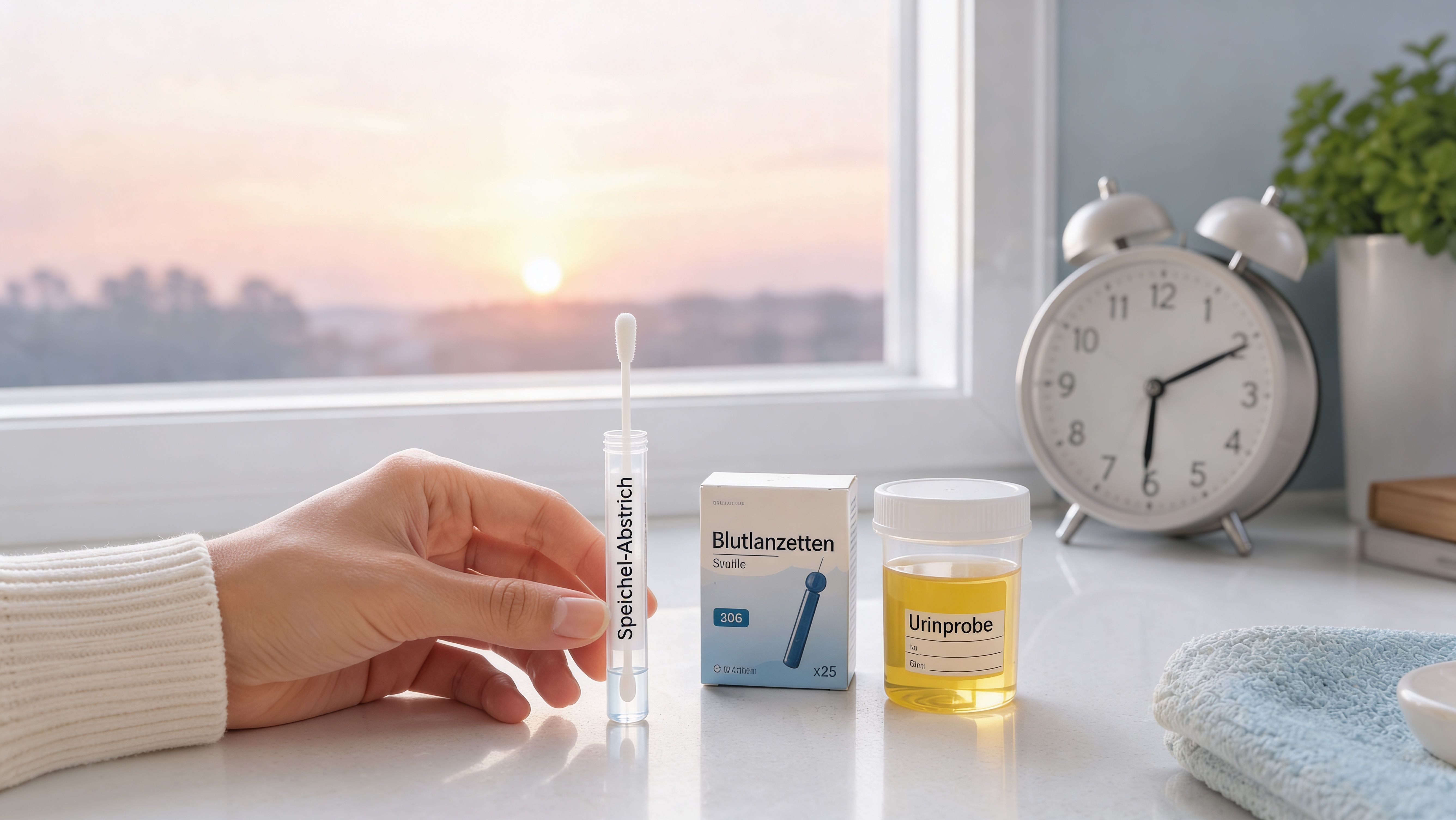
Testing Cortisol Levels: Your Guide to Your Hormone Status
You're still functioning, somehow. But not like you used to.
You sleep, but still wake up tired, it takes ages to get going in the morning, and your mind won't shut off at night. Perhaps you've been wondering for a while if it's just "stress." Or if your body is trying to tell you something more specific. This is exactly where the topic of testing cortisol levels comes into play.
Cortisol isn't just a trendy social media term. It's a hormone with real influence on energy, sleep, internal tension, and your daily rhythm. If you want to understand why you feel out of sync, measuring is often more helpful than guessing.
Do you constantly feel wired?
You're still at your laptop in the evening, even though you really wanted to finish work hours ago. Your body is exhausted, but your mind keeps going. In the morning, you hit snooze multiple times, coffee somehow keeps you functional during the day, and in the late afternoon, that slump hits where you feel both drained and restless.

If this sounds familiar, you're not "too sensitive." Many people notice that their system no longer switches cleanly between tension and relaxation. This is precisely why it's worth looking at cortisol. This hormone is closely linked to your internal stress system and doesn't work in isolation, but together with nerves, brain, and your sleep-wake rhythm. If you want to better understand how your body switches between activation and regeneration, it also helps to look at everything related to the autonomic nervous system.
Why stress often feels so diffuse
The confusing thing is: symptoms related to cortisol often feel vague. You're not just tired. You're tired and tense at the same time. You're exhausted, but you can't switch off. You want to improve your daily life, but you don't know where to start.
That's why many people look for a way to test their cortisol levels. Not out of fear. But because objective data can help make patterns visible that you only vaguely sense in everyday life.
Your feeling is real. But a feeling alone doesn't tell you whether your daily rhythm is truly biologically out of balance.
Guessing often costs more energy than measuring
Many people first try the usual things: less coffee, earlier bedtime, magnesium, breathing exercises, digital detox. That can be helpful. But if you don't know when your cortisol is high or low, much remains trial and error.
Others have long been optimizing their blood values, nutrients, or hormone data, instead of spending months experimenting. This doesn't have to be exaggerated or complicated. Sometimes a well-chosen test is simply the more precise next step.
Cortisol: Your double-edged sword
Cortisol has a bad reputation. But it's not your enemy. Without cortisol, you would wake up worse in the morning, react less well to stress, and mobilize energy less effectively. The problem is not the hormone itself. The problem is a rhythm that no longer suits your daily life and your regeneration.

The good side of cortisol
Cortisol helps you get going in the morning. It supports wakefulness, provides energy, and is part of a normal stress response. In the short term, this is useful. If you have a challenge, your body doesn't react incorrectly, but quite cleverly.
An important German reference point is the salivary awakening response. According to IMD Berlin, cortisol rises immediately before waking and reaches its peak about 30 minutes after waking. An increase of at least 60% compared to the baseline is considered ideal. A divergent diurnal rhythm can indicate hypercorticolism or hypocorticolism, measured there by LC-MS/MS (IMD Berlin on Cortisol Diagnostics in Saliva).
If you want to read a more concise overview of the basic principle of cortisol, you'll find a clear explanation of what cortisol is at mybody-x.
The downside of constant tension
It becomes difficult when your body no longer switches clearly between "on" and "off." Then cortisol is no longer the helpful morning wave, but rather a constant background activation. Some notice this as internal restlessness. Others more as exhaustion, low drive, or sleep problems.
Typical confusion: Many people think that high stress must automatically mean persistently "high cortisol." It's not that simple. The crucial factor is not just a single value, but how your levels progress throughout the day.
Why the daily rhythm is so important
Healthy cortisol behaves more like a wave than a fixed level. It rises around waking and falls throughout the day. This rhythm is often more informative than any single value.
Key takeaway: When testing cortisol levels, the question is rarely just "too high or too low?" More important is often "does the pattern match your time of day and your symptoms?"
Once you understand this, it also becomes clear why some tests provide more insight than others.
When a cortisol test makes sense for you
Not every stressful week warrants diagnostics. But if certain patterns persist, a closer look is worthwhile. Especially if you feel that your body is out of sync and you're not making real progress despite healthy routines.
You can't get going in the morning
There are people who are tired in the evening and still start the morning relatively stable. And there are people who sleep but feel upon waking that their system hasn't recharged. If this happens frequently, it's a reason to look closer at the rhythm.
This is especially true if you recognize these thoughts:
- Waking up groggy: It takes you a very long time for your mind to clear.
- Functional but not fit in the morning: You manage your daily life, but only under pressure.
- Afternoon slump: Energy drops significantly later in the day.
If you recognize yourself in this, a test can help instead of just interpreting symptoms. A helpful starting point is also the article on high cortisol symptoms in women, because many everyday complaints initially feel non-specific.
Sleep is there, recovery is missing
Some people have trouble falling asleep. Others fall asleep but wake up at night or wake up too early in the morning. Still others sleep long enough but still don't feel regenerated. These differences are important.
In Germany, a clinically reliable look at cortisol usually relies not on a single value, but on a time-staggered protocol. A salivary cortisol day profile typically includes 3 to 5 measurement points and is particularly helpful in suspected Cushing's syndrome (Fernarzt on Cortisol Day Profile).
A single measurement can be reassuring or unsettling. A day profile is more likely to show whether your body is still maintaining its rhythm cleanly.
Weight, cravings, and internal restlessness
Not every weight gain is related to cortisol. Not every craving either. But when symptoms occur together, the picture becomes more interesting. Many affected individuals report a mix of tension, energy dips, sleep problems, and a metabolic feeling that "isn't quite right."
Three typical clusters where testing cortisol levels often seems useful:
- Energy problems that cannot be explained by sleep alone
- Evening restlessness, even though you are actually tired
- Fluctuating appetite or cravings, especially during periods of high stress
Where self-assessment reaches its limits
Self-observation is valuable. But it has limits. The same symptoms can have very different causes. That's why a test is not an exaggeration, but often the more efficient path to clarity.
If you've already tried many things, spare yourself further guesswork. Data doesn't replace body awareness. It makes it more precise.
Blood, Saliva, or Urine: Which test is right for you?
You wake up tired, feel frazzled at lunchtime, and suddenly wide awake in the evening. The obvious question then is not just whether your cortisol is abnormal. The more important question is often: Which measurement method reveals the exact problem you want to understand?
This is where a clear perspective is worthwhile. Because blood, saliva, and urine don't just measure the same thing in three ways. They answer different questions.
The brief decision logic
Cortisol behaves like a daily program with fixed peaks and resting phases. A blood test takes a single snapshot of this. A saliva test shows multiple images throughout the day. A 24-hour urine test collects the total amount your body has excreted during that period.
Therefore, not every test fits every goal.
If you want to know if your value is abnormal at a specific time, blood is often used. If you want to understand whether your body gears up well in the morning and winds down on time in the evening, saliva is usually much more revealing. If a medical question aims at the total cortisol excretion over the day, urine can be useful.
Cortisol test methods at a glance
| Test Method | What is measured? | Advantages | Disadvantages | Ideal for |
|---|---|---|---|---|
| Blood | Cortisol at a specific time | Clinically established, good for a single reference point | Highly dependent on timing, stress before sampling can influence results, no daily profile | Medical clarification of a specific measurement time |
| Saliva | Free, biologically active cortisol at multiple times | Suitable for everyday use, possible at home, good for questions about the daily rhythm | Timings and preparation must be strictly followed | People who want to better understand their stress curve throughout the day |
| 24-hour Urine | Total excretion over 24 hours | Can be helpful for certain medical questions | More cumbersome, no fine-grained profile within the day | Medical diagnostics focusing on total excretion |
Why saliva is the most sensible choice for many
Many symptoms that people associate with stress are not purely quantity problems. They are rhythm problems. No real start in the morning. Energy dips in the afternoon. The internal engine stays on in the evening, even though the body is tired.
For exactly these questions, a salivary day profile is often the most practical method because it makes the progression visible. This is the difference between a snapshot and a short film. You don't just see a value, but a pattern.
Those who want to know how to measure cortisol at home over the course of the day will find a simple classification of the process there.
If your goal is: "I want to understand my daily stress rhythm," a multi-point saliva test often fits better than a single blood draw.
When blood or urine are a better fit
Saliva is not automatically always the best solution. A blood test is suitable when a specific time needs to be assessed medically or when additional lab values are needed simultaneously. A urine test has its place when the total excretion over 24 hours is the focus.
The good decision is therefore not a question of modern or simple. It is guided by your actual question.
In short:
If you want a single value, blood is often appropriate.
If you want to understand your daily rhythm, saliva is usually the best choice.
If you want to check the total amount over 24 hours, urine is an option.
Your Path to Clarity: The mybody-x Cortisol Test
If you opt for a day profile, then comes the practical part. The process is usually much simpler than many think. No guesswork, no waiting for a doctor's appointment, no unnecessary stress from a blood draw right before the measurement.

How a home test typically works
A salivary cortisol test is performed at home at specified times. You take several samples throughout the day and send them for lab analysis. This creates a profile, not a random value.
An example from the market is the mybody x blood test, or rather the provider's cortisol self-test offering, where a daily profile is recorded via saliva sample. The measurement principle is particularly relevant here, not the marketing: multiple samples at home provide a different picture than a single measurement in a practice.
What to pay attention to before sampling
For saliva tests, preparation is not a side issue, but part of the measurement quality. For home tests, it is recommended not to eat, drink, or brush your teeth 30 minutes before sample collection. The methodological advantage: saliva tests detect free, biologically active cortisol components and capture diurnal dynamics better than a single blood value (Technical notes on pre-analytics of saliva tests).
In practice, this means:
- Take timing seriously: Adhere strictly to the specified collection times.
- Implement preparation meticulously: Eating, drinking, and brushing teeth shortly before the sample will falsify sample quality.
- Document your daily life: Note down if a particularly stressful appointment or poor sleep could have influenced the measurement.
Good data doesn't start in the lab, but with clean sample collection at home.
Why this is more efficient for many
If you want clarity, a home test is often a quicker way than weeks of observation without a reliable basis. You measure where your daily life truly takes place. This often makes the data more helpful than an isolated appointment in an unfamiliar environment.
Understanding the results and what to do next
You hold your report in your hand and are looking for a clear answer. Instead, you see values, times, and perhaps the note "within reference range." This is where the actual interpretation begins: a cortisol test is only helpful if you understand whether the result matches your daily rhythm and your symptoms.
Cortisol usually doesn't follow a straight line. Rather, it follows a daily curve. In the morning, your system should rev up so you wake up and can mobilize energy. Throughout the day, the level then gradually drops. That's why a single value is only of limited significance. The context is crucial, meaning when it was measured and what goal you are pursuing with the test.
Single value or daily pattern
A blood value primarily answers the question of how high cortisol was at a specific time. This can be useful if a doctor specifically wants to look for significant deviations. However, for many people with non-specific symptoms such as exhaustion, internal restlessness, or sleep problems, something else is more helpful: the pattern throughout the day.
A salivary diurnal profile functions like a small map here. It doesn't just show one point, but several stations. This makes it easier to see if your body starts up well in the morning, is overactive during the day, or doesn't wind down properly in the evening.
Typical patterns include:
- Appropriate progression: higher in the morning, then gradually decreasing
- Flat curve: little difference between morning and evening
- Evening activation: later values remain elevated, although the body should actually be moving towards rest
Such patterns are not a diagnosis. They are a guide. And that's exactly the difference between guessing and measuring.
What your result can mean in practice
If your curve doesn't match your daily routine, it's no reason for premature concern. Often, it merely shows that your stress rhythm is out of sync. This is important to know because it allows you to intervene more precisely.
A simple analogy often helps: Cortisol is like a conductor for activity and recovery. If it kicks in too late in the morning, you'll struggle to get going. If it remains too loud in the evening, relaxation becomes difficult. Your test result therefore doesn't just show whether something is "high" or "low." It shows at what time of day your body needs support.
This can lead to sensible next steps:
-
Stabilize sleep times
A consistent rhythm helps the body to better regulate its hormone curves again. -
Observe stress according to time of day
Not just "How stressed am I?", but "When does my system tip?". Precisely this question makes a diurnal profile test so useful. -
Reduce evening activation
Less late light, less mental work, more clear signals for recovery. If you're looking for concrete approaches, you'll find practical tips here on naturally lowering cortisol. -
Seek medical clarification if values are significantly abnormal or severe symptoms occur
This applies particularly to persistent exhaustion, a significant drop in performance, pronounced sleep disturbances, or other physical changes.
When self-observation is enough and when you need more clarity
Slight shifts in the diurnal profile can often be managed well with sleep, recovery, meal rhythms, and stress management. If, however, you are under severe strain or your symptoms persist despite adjustments, simple observation is often no longer sufficient.
Then it also becomes clear why the choice of test was so important. A single blood value can easily be overestimated or misunderstood. A salivary diurnal profile usually provides a better basis because it reflects your real daily course. Especially for the question "Am I exhausted in the morning, distracted at noon, and wide awake in the evening?", this is often the more appropriate form of clarity.
Good decisions are easier to make when you don't just know one value, but understand your rhythm.
So you're not looking for perfection, but for orientation. That's a sensible step. A carefully chosen test helps you not just to feel symptoms, but to classify them with objective data.
If you want to check and better understand your cortisol rhythm at home, you'll find health self-tests on hormones, nutrients, and other topics on mybody x Bluttest. Especially if you're still unsure which test suits your goal, clarity often begins with the right measurement method.



Share:
Complex B Vitamin Supplements: Correct Dosing
Vitamin B Complex: Effects, Benefits, and Safety