

Lose Weight Around Your Stomach, Legs, and Buttocks: Your Path to Visible Results
Do you want to lose weight specifically around your stomach, legs, and buttocks, but those stubborn pockets of fat persist no matter what you try? I know that feeling all too well. The truth is that visible results require more than just discipline. They come from a smart combination of the right nutrition, targeted training, and, above all, an understanding of your own body.
Often, it is underlying biological causes that are blocking your progress—not your willpower. This is exactly where mybody-x blood tests come in: They help you understand your body and uncover the real reasons behind your problem areas.
Why Your Stomach, Legs, and Buttocks Are So Stubborn
Do you sometimes feel frustrated because the fat around your stomach, legs, and buttocks simply refuses to go away, even though you are giving it your all? You are definitely not alone. Many people struggle with these exact areas, and there are solid reasons for this that go far beyond the simple “calories in, calories out” concept.
The key is to work with your body rather than against it. Three central factors interact to determine where your body stores fat and how readily it releases it again.
The Hidden Causes of Your Problem Areas
The distribution of body fat is anything but random. It is driven by a complex system deeply rooted in our biology. To truly make a difference, you first need to understand these causes.
- Genetics: Your DNA is essentially the blueprint for your body. It determines whether you tend to store fat around your abdomen (the classic “apple shape”) or around your hips and thighs (the “pear shape”).
- Hormones: Your hormonal balance is the key regulator of fat storage. Hormones such as estrogen, cortisol, and insulin direct where the energy from your food goes.
- Lifestyle: Your daily habits—from nutrition and exercise to stress and sleep—constantly send signals to your body. And these signals directly influence your fat metabolism.
This graphic sums it up and shows the three main pillars that shape your “problem areas.”
Genetics, hormones, and lifestyle are inextricably linked and work together to shape your individual body shape. This is not your fate, but your personal starting point.
The Role of Hormones and Evolution
Especially for us women, the tendency to store fat around the hips, buttocks, and thighs is rooted in evolution. In the past, this was clever, because these reserves served as a vital energy supply during pregnancy and breastfeeding. The hormone estrogen plays a major role in regulating this process.
At the same time, the stress hormone cortisol directly promotes fat storage in the abdominal region. Chronic stress, too little sleep, or an unfavorable diet can drive up cortisol levels. The result? Stubborn belly fat, even in otherwise slim people.
A hormonal imbalance can sabotage even the best nutrition and training plan. When your body is constantly under stress, it clings to its fat reserves as if they were treasure.
Another often unnoticed obstacle is developing insulin resistance. When your cells no longer respond properly to the hormone insulin, excess sugar in your blood is stored in the fat deposits around your abdomen much more quickly.
When your metabolism simply isn't cooperating
An often-overlooked but extremely important factor is your body's supply of micronutrients. A deficiency in certain vitamins or minerals, such as vitamin D or magnesium, can slow down your entire metabolism. Fat burning then runs on low power. You feel tired and unmotivated, and simply don't lose weight despite all your efforts.
The desire for a slimmer midsection is widespread. In Germany, more than half of adults are overweight. Studies show that more than 90 percent of people trying to lose weight specifically want to reduce belly fat. For women, however, the hips (51%), buttocks (36%), and legs (42%) are also high on the list—a perception deeply rooted in female biology. You can read more about the different weight-loss goals of men and women on focus.de.
The first step toward real change is clarity. Instead of stumbling in the dark and getting frustrated, find out what's really going on in your body. A targeted hormone test or nutrient test from mybody-x provides the data you need to uncover the true causes. This sets you on the path to a flatter stomach, firmer legs, and a toned butt on a solid, science-based foundation—and finally lets you see the results you've been working so hard for.
Your nutrition strategy for fat loss

Anyone who wants to specifically lose weight around the abdomen, legs, and buttocks needs to understand this: The truly significant results begin not in the gym, but on your plate. But don't panic—that doesn't mean you have to eat nothing but salad from now on. A truly effective nutrition strategy doesn't feel like a diet. It's delicious, practical for everyday life, and gives your body exactly what it needs to burn fat while building firm muscles.
The be-all and end-all of any fat loss is a moderate calorie deficit. It sounds technical, but it is simple: You simply give your body slightly less energy than it uses throughout the day. This essentially forces it to draw on its own reserves—namely, the unwanted fat on your thighs and stomach. If you need an exact starting number, our guide explains in detail how to calculate your personal calorie deficit for weight loss.
Macronutrients: The building blocks of your success
Much more important than simply counting calories, however, is what you eat. How you divide up your meals determines whether you feel full and energized or are constantly battling cravings. This is where the three macronutrients come into play.
- Proteins: They are your best friends on this mission. Protein is extremely filling and keeps you satisfied for a long time, protects your valuable muscles from breaking down, and even slightly boosts calorie burning (the so-called thermic effect of food).
- Complex carbohydrates: Forget the old myth that carbohydrates are the enemy. Your body needs them as a source of energy, especially when you exercise. The trick is to choose the right ones: oats, whole-grain products, or legumes give you steady energy without sending your blood sugar on a roller coaster.
- Healthy fats: Fats are vital, including for hormonal balance and the absorption of certain vitamins. Without them, nothing works properly in the body. Choose high-quality sources such as avocados, nuts, seeds, or good flaxseed oil.
A balanced meal that skillfully combines all three components is the key. It not only keeps you full for hours, but also provides all the building blocks you need for fat loss and muscle growth.
What an intolerance has to do with your belly fat
Does this sound familiar? You generally eat healthily and exercise regularly, but your stomach simply does not get flatter. Sometimes the cause lies deeper and has nothing to do with discipline. One often completely overlooked factor is undetected food intolerances.
When your body cannot properly process certain foods, it often reacts with silent inflammation. These underlying inflammatory processes can slow your metabolism, cause water retention, and lead to constant bloating. You feel tired and bloated, and your attempts to lose weight come to nothing.
Many people suffer for years from a bloated stomach, energy dips after eating, or skin problems without realizing that a simple intolerance may be behind them. This can seriously sabotage your weight-loss efforts around your stomach, legs, and buttocks.
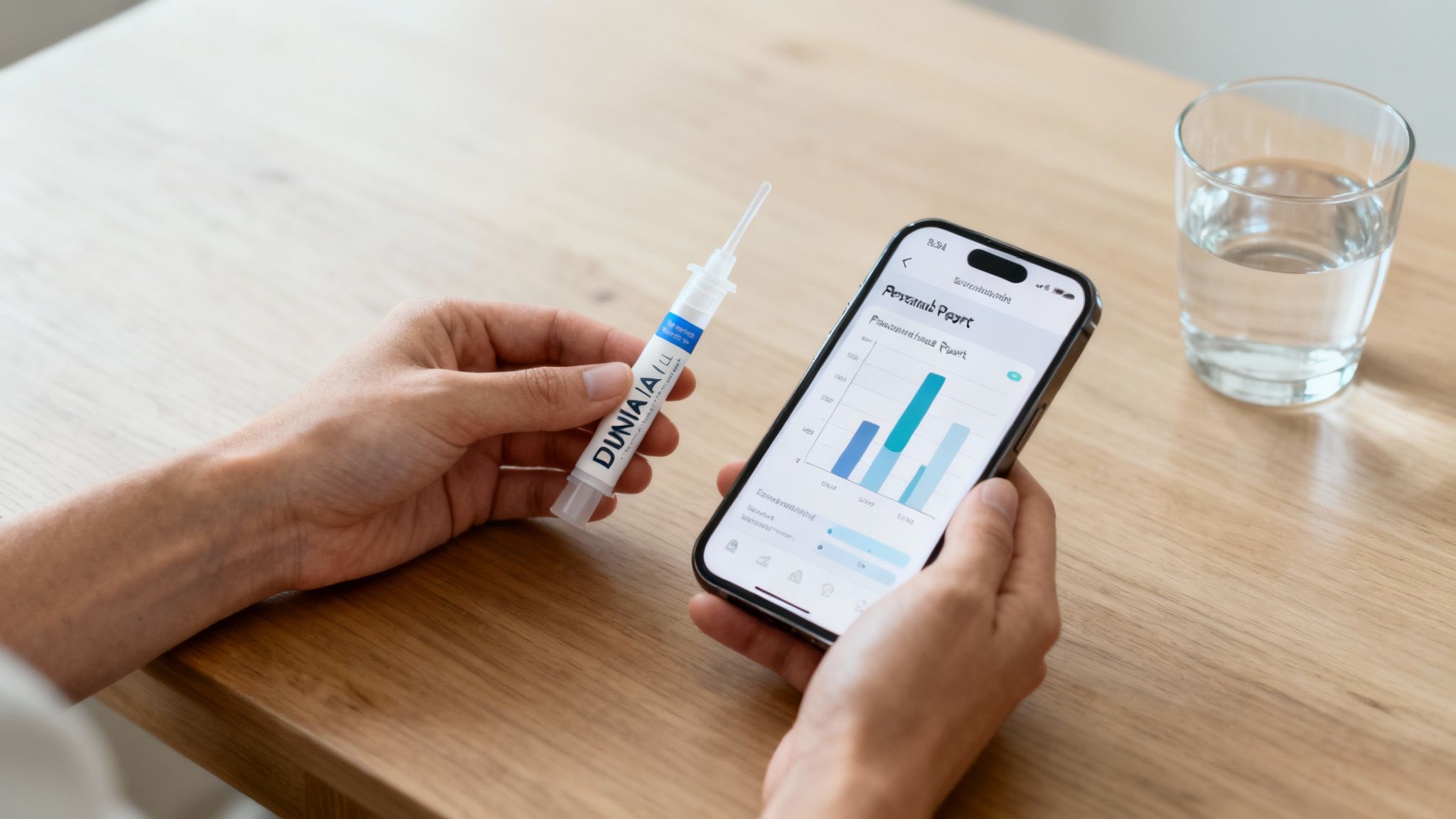
At this point, a targeted food intolerance test from mybody-x can be a real eye-opener. Instead of spending months wondering which foods agree with you and which do not, you get clear facts. Such a test precisely analyzes how your body reacts to a wide range of foods.
Armed with this knowledge, you can adjust your meal plan strategically and give your gut a break. The result is often astonishing: the bloated stomach disappears, your energy returns, and suddenly losing weight works again. It is a crucial step toward clearing away the last obstacles on the path to your goals.
An effective training plan that works
Anyone who wants to specifically lose weight around their stomach, legs, and buttocks and shape their body needs to train intelligently. Hours of cardio are certainly good for endurance, but on their own they will not give you the toned, defined figure you want. The secret lies in the right mix.
I always think of an effective training plan as a sturdy three-legged stool. Each leg contributes an important part to overall stability and success.
- Foundation – Strength Training: This is the basis for everything. Targeted muscle building in problem areas not only shapes your body but also boosts your basal metabolic rate. More muscle means you burn more calories even while sitting on the couch.
- Booster – HIIT: High-intensity interval training is your fat-burning turbocharger. Short but brutal intervals drive your heart rate up and ensure maximum calorie consumption. The real trick, however, is the afterburn effect, which keeps your metabolism running at full speed for hours after your workout.
- Balance – Active Recovery & Mobility: This aspect is woefully neglected, yet it is crucial. Gentle movement such as stretching, yoga, or relaxed walks helps your body recover, prevents injuries, and keeps you flexible.
A simple 3-day weekly plan for maximum results
To make getting started easier, here is a specific plan that you can put into practice immediately. It is structured so that you can combine the three pillars optimally without completely burning yourself out.
It’s best to always take one rest day between training days. A schedule such as Monday–Wednesday–Friday or Tuesday–Thursday–Saturday has proven effective in practice.
We’ve summarized the training days for you in a clear table. This plan combines targeted strength training with an intense HIIT day to burn fat while building muscle at the same time.
Sample 3-day-per-week training plan
An effective weekly plan combining strength training, HIIT, and active recovery to build muscle and maximize fat burning.
| Day | Focus | Sample exercises (sets x repetitions) |
|---|---|---|
| Day 1 | Full-body strength training (focus: legs & glutes) | Squats (3x 8–12), lunges (3x 10–15 per leg), hip thrusts (3x 12–15), rows (3x 10–12), plank (3x hold) |
| Day 2 | HIIT (fat burning) | 4 rounds of circuit training: burpees, high knees, jumping jacks, mountain climbers (40 sec. work, 20 sec. rest) |
| Day 3 | Full-body strength training (focus: abs & core) | Romanian deadlifts (3x 10–12), leg press (3x 12–15), leg raises (3x 15–20), Russian twists (3x 15–20 per side), push-ups (3x to failure) |
This plan gives you a solid structure. You’ll find the details of the exercises for each day in the next section.
Day 1: Strength training focused on legs and glutes
Today, we’re laying the foundation for a strong lower body and a toned backside.
- Squats: 3 sets of 8–12 repetitions. The ultimate powerhouse exercise. Keep your back straight and only go as deep as you can while maintaining proper form.
- Lunges: 3 sets of 10–15 repetitions per leg. Perfect for shaping your thighs and glutes. Keep your upper body nice and upright.
- Hip thrusts: 3 sets of 12–15 repetitions. No exercise targets the glutes as effectively and in such isolation. For perfect technique and more killer exercises, I recommend our guide to achieving a rounded butt.
- Rows (cable machine or dumbbells): 3 sets of 10–12 repetitions. A strong back supports great posture and makes your waist look slimmer.
- Plank (forearm plank): 3 sets, for as long as you can. Strengthens your entire core and is a must for a flat stomach.
Day 2: HIIT for maximum fat burning
Today will be short and intense. We'll get your metabolism working at full speed.
Choose four of the following exercises and perform them as a circuit:
- Burpees
- High knees
- Jumping jacks
- Mountain climbers
- Jump squats
The format is simple: 40 seconds all-out, then 20 seconds to catch your breath. Complete a total of 4 rounds of your circuit. Including the warm-up and cool-down, you'll be done in under 30 minutes.
Day 3: Strength training with a focus on abs and core
On the last training day of the week, we target the core and round out the program with additional full-body exercises.
- Romanian deadlifts: 3 sets of 10–12 repetitions. A top exercise for the hamstrings, glutes, and lower back.
- Leg press: 3 sets of 12–15 repetitions. A great addition or alternative to squats if you have access to a gym.
- Leg raises (lying or hanging): 3 sets of 15–20 repetitions. Perfectly targets the often-neglected lower abdominal muscles.
- Russian twists: 3 sets of 15–20 repetitions per side. Shapes the waist and strengthens the oblique abdominal muscles.
- Push-ups: 3 sets to muscle failure. Whether on your knees or toes, this exercise strengthens your chest, shoulders, and entire core.
See this plan as your personal roadmap, not a law carved in stone. Listen to your body, adjust the weights, and always focus on proper technique. Quality always beats quantity!
With this holistic approach, you don't just burn fat—you also build valuable, metabolically active muscle. This combination is exactly what helps you achieve a toned stomach, defined legs, and a firm buttocks—and makes you fitter, stronger, and more confident along the way.
Maintaining motivation and overcoming plateaus
Let's be honest: The hardest part of losing weight around your stomach, legs, and buttocks is rarely the plan itself. It's the mental strength to keep going when the results take time to appear. You give it your all for weeks, and suddenly… nothing. The scale doesn't move another millimeter. That's exactly when most people throw in the towel. But not you. Because now you know how to tackle these hurdles cleverly.
Motivation doesn't fall from the sky. It's the result of clear goals, realistic progress tracking, and knowing how your body really works. It's about shifting your focus and seeing the journey for what it is: a marathon, not a sprint.
The scale lies—measure your progress correctly
The biggest motivation killer of all? The number on the scale. It can fluctuate because of water retention, your menstrual cycle, or—and this is a good sign—new muscle growth. Your body has already begun reshaping itself in a positive way, but the scale doesn't show you that.
A plateau on the scale is often not a stop sign, but evidence of positive body recomposition. You're losing fat while simultaneously building valuable, toning muscle.
To truly see your progress and keep your motivation up, you need better tools.
- The measuring tape: Measure your waist, hips, glutes, and thighs every two weeks. Fewer centimeters are a much more honest sign of fat loss than fewer kilos.
- Before-and-after photos: Take pictures from the same angle every four weeks. You'll be amazed at the changes you might otherwise have missed in the mirror.
- The clothing check: Does your favorite pair of jeans suddenly feel looser? That's one of the best and most tangible signs of your success!
- How you feel: Do you feel more energetic in everyday life? Have you become stronger during your workouts? These successes are at least as important as what you can see.
The typical stumbling blocks (and how to avoid them)
Everyone—truly everyone—encounters obstacles. The only thing that matters is how you respond to them. Often, they are the same mental traps we all fall into.
The biggest mistake is comparing your journey with other people's. Your body is unique, and your genetics and hormone balance are individual. If you feel like you're not making progress despite all your efforts, it's worth looking into the deeper causes.
Another classic: impatience. Real, lasting changes take months, not days. Give your body the time it needs. Instead, set yourself small, achievable milestones. And when you reach one? Reward yourself! But not with food—with something that genuinely does you good: a relaxing bath, new workout clothes, or an afternoon just for yourself.
Mental strength is your most important muscle
The past few years have shown us all how difficult it can be to stay on track. At 52 percent, lack of motivation was the biggest obstacle to Germans' fitness. At the same time, home workouts for the abs, legs, and glutes became increasingly popular because they are so flexible. This shows how crucial mental strategies are for staying motivated even without external pressure.
Find your very own “why.” What is really driving you? Do you want to feel fitter, be healthier, or simply move through life with more confidence? Write down this goal and bring it to mind in difficult moments.
Don't see setbacks as failure, but as what they are: part of the process. A bad day when your diet didn't go as planned? Let it go. Tomorrow is a new day. Perfection is the enemy of progress. Your mindset is just as important as every single squat. With these tools in your toolkit, you can overcome any plateau and stay on track for long-term success.
Stop guessing: How to personalize your success
Imagine that your journey to a flatter stomach and firmer legs did not involve blindly guessing. What if you no longer had to wonder which diet or workout truly works for you? This is where mybody-x's self-tests come in. They give you tools based on hard facts—your own personal facts.
Everyone is different. Your metabolism, hormones, and potential intolerances determine how your body responds to certain foods and training stimuli. A general plan can bring initial results, but a plan tailored to you will get you to your goal faster, more efficiently, and above all, more sustainably.
Your body provides the answers—with the right tests
Have you ever wondered why the low-carb diet works wonders for your friend, while the number on the scale barely changes for you? The answer often lies in your individual biology. A self-test at home is essentially like taking a look at your body's operating manual. It can reveal in black and white which hidden obstacles could be sabotaging your success.
- Hormone test: A hormonal imbalance, for example involving stress hormones, can promote fat accumulation around the abdomen. A test gives you clarity.
- Food intolerance test: Chronic inflammation caused by undetected intolerances can slow down your metabolism and lead to bloating. Find out which foods your body can truly tolerate.
- Nutrient test: If you are lacking important vitamins or minerals, your fat burning only operates at a reduced level. A test reveals deficiencies that you can specifically address.
With this knowledge, you stop fighting against your own body. Instead, you use your biological strengths to your advantage. Cravings subside, you have more energy, and losing weight suddenly no longer feels like a constant battle.
Optimize your training and nutrition based on facts
A mybody-x test gives you not only data but also concrete recommendations for action. You’ll learn which foods you may want to avoid or which nutrients you should consume more of to optimally support your metabolism.
By using these personalized insights, you take control yourself. You save yourself frustrating detours and develop a strategy that is 100% tailored to you.
Of course, that doesn’t mean you have to change everything. But you can specifically adjust your training and nutrition plan to achieve the best results for your stomach, legs, and buttocks. Perhaps you need more magnesium for energy production or should avoid gluten to soothe your stomach.
A mybody-x self-test provides you with precisely these valuable insights. Learn more about how a metabolic test can help you lose weight, and start your journey with a clear, scientifically sound plan.
Your questions, our answers
You probably still have one or two questions on your mind—that’s completely normal! Here, I’ve compiled the most frequently asked questions I keep hearing about losing weight in typical problem areas. Let’s bring some clarity so you can get started with confidence and motivation.
Can I lose weight specifically only around my stomach, legs, and buttocks?
The short, honest answer: Unfortunately, no. Targeted fat loss in a single area is and remains a myth. Where your body loses fat first is genetically and hormonally predetermined—you have no direct control over it.
But—and this is the good news—you can absolutely strengthen and shape the muscles in precisely these areas. That is ultimately what creates the firm, defined look you want. The calorie deficit melts fat throughout your body, while your training makes the muscles underneath visible. This brings you closer to your goal by the only approach that truly works.
How long does it take before I see my first results?
This is the question everyone asks, but no one can answer it in general terms. Your starting point, your genetics, and above all your consistency play the main roles here. Realistically, though, with consistent implementation, you can see and feel the first noticeable changes after as little as four to six weeks.
My tip: Don't rely solely on the scale! Instead, measure your circumferences or pay attention to how your clothes fit. This is often much more meaningful and a real motivation boost.
Patience is your most important training partner. Real, sustainable changes take time. Think of it as a marathon, not a sprint, and celebrate even the small improvements along the way.
Which type of exercise is best for your stomach, legs, and butt?
The most effective strategy isn't a single type of exercise, but an intelligent combination. You need a mix that provides all the important stimuli.
- Strength training: Absolutely essential for building toned muscles. Squats, lunges, hip thrusts, and plank variations are the gold standards here.
- HIIT (High-Intensity Interval Training): The secret weapon for getting fat burning into high gear and boosting your metabolism for hours after your workout.
- Everyday movement (NEAT): Never underestimate the power of walking or taking the stairs. Every single step counts and adds up!
This combination ensures that you burn fat, build muscle, and increase your daily calorie expenditure at the same time.
Do I now have to completely overhaul my diet?
No, absolutely not! It's about smart adjustments, not radical deprivation. The foundation is always a moderate calorie deficit combined with a protein-rich diet. Protein keeps you feeling full for a long time and protects your hard-earned muscle.
Don't forget complex carbohydrates and healthy fats either—they provide the energy you need for training and everyday life. Sometimes, undetected intolerances can also hold back your progress or cause persistent bloating. An intolerance test from mybody-x can provide genuine aha moments here.
Do you have more questions? No problem! We have prepared an extensive collection for you. You can find a lot more information in our FAQ section. There, we address many specific topics relating to our tests and your health.
Do you want to stop guessing and finally know what your body really needs? At mybody-x, we analyze your blood values and give you clear, personalized recommendations for nutrition and lifestyle that are perfectly tailored to you. Find the right test now at https://mybody-x.com and start your journey toward visible results.



Share now:
Avoid the yo-yo effect and maintain your weight permanently
Metabolism analysis for weight loss: Your path to your desired weight