

What Is a Nutrient? Simply Explained for Your Health
Imagine your body as a highly complex high-tech company that runs nonstop. To keep the machines from coming to a standstill, it needs the right fuel—and that is exactly what nutrients are. Put simply, they are the vital building blocks from your food. Every single cell needs them to produce energy, renew itself, and grow.
What exactly is a nutrient?
Nutrients are the invisible heroes of your diet. You take them in every day through food and drink, often without truly realizing the crucial role they play in your energy, well-being, and disease prevention. They are far more than just calories. Think of them as the directors behind the scenes, controlling all the important processes in your body—from energy production at the cellular level to defending against pathogens.
Having a clear understanding of what a nutrient is lays the foundation for more energy and well-being in everyday life. It is not about rigidly counting calories, but about giving your body the right tools. These little powerhouses are directly responsible for your physical and mental fitness.
The Foundations of Your Energy
Broadly speaking, nutrients can be divided into two main groups: macronutrients and micronutrients. Both are absolutely essential for your health, but they perform very different tasks in your system.
- Macronutrients: These are the big players, the energy providers—carbohydrates, proteins, and fats. As the name suggests, you need them in larger amounts. They are the fuel for your engine.
- Micronutrients: This is where things get more specific. They include vitamins and minerals such as 25-OH-Vitamin-D3, Magnesium, Iron (whose stores are measured as Ferritin), and Zinc. Your body only needs them in tiny amounts, but without them the whole system will sooner or later break down.
The key lies in a balanced supply of both groups. A deficiency in just one micronutrient can throw your entire well-being out of balance.
The following illustration shows the basic definition of a nutrient, as we also understand it in everyday language.

This definition makes it clear: nutrients are the essential substances your body needs to maintain its vital functions at all.
People repeatedly express concern that our soil is depleted and that foods no longer contain as many nutrients as they used to. Although large studies such as the National Nutrition Survey II show that the overall nutritional situation in Germany is good, awareness of the importance of a truly optimal intake is growing. You can find more information in the summary of the National Nutrition Survey.
The major energy sources for your body
Imagine your body as a power plant. To run, it needs fuel. Macronutrients are the main fuels here—the large, solid logs that provide long-lasting energy and warmth. They are the famous “big three” of your diet: carbohydrates, proteins, and fats.
Your body needs them every day in larger quantities (measured in grams) to function properly at all. Each of these three has its own unique, indispensable role. They are not an interchangeable trio, but a well-coordinated team that gives you strength, repairs your cells, and keeps you healthy.
Carbohydrates: Your fastest fuel
Carbohydrates are the preferred and fastest fuel for your brain and muscles. You can think of them as premium gasoline: They are quickly converted into glucose and are immediately available to your cells when you need them.
Without them, your concentration and physical performance suffer. A deficiency often becomes noticeable quickly—through fatigue, cravings for sweets, and the feeling that your mind simply is not keeping up. Good sources that release their energy slowly and steadily include whole-grain products, potatoes, oats, and legumes.
Proteins: The builders of your body
Proteins, often also called protein, are the fundamental building blocks of life. They are found in every single cell of your body. They are essential for building and repairing muscles, skin, and hair, as well as for producing hormones and enzymes.
So they are less a direct source of energy and more the diligent construction crew that maintains and renews everything. At the same time, they provide a lasting feeling of fullness. This makes them an important ally when you want to keep your weight under control. You can read more about this in our guide to losing weight through diet without giving anything up.
A protein deficiency can have unpleasant consequences: muscle loss, a weakened immune system, and poor wound healing. Therefore, focus on high-quality sources such as lean meat, fish, eggs, dairy products, or plant-based alternatives such as lentils, chickpeas, and tofu.
Fats: Your protective layer and vitamin taxis
Fats often get an undeservedly bad reputation—in reality, they are absolutely essential for life. They are your most concentrated source of energy and serve as important protective cushioning for your organs.
Even more important is their role as a “taxi” for the fat-soluble vitamins A, D, E, and K. Without fats in your diet, your body cannot absorb and utilize these important micronutrients in the first place. Healthy fats are also crucial for hormone production and the formation of stable cell membranes. It is best to focus on unsaturated fats from avocados, nuts, seeds, and high-quality oils such as olive or flaxseed oil.
To give you a quick overview, we have summarized the most important information in a table.
Overview of macronutrients and their main sources
This table shows the three main types of macronutrients, their primary function in the body, and examples of foods in which they are abundant.
| Macronutrient | Main function in the body | Good food sources |
|---|---|---|
| Carbohydrates | Fastest source of energy, fuel for the brain & muscles | Whole-grain products, potatoes, fruit, legumes, oatmeal |
| Proteins | Building material for cells, muscles, skin, and hormones; satiety | Lean meat, fish, eggs, dairy products, lentils, tofu, nuts |
| Fats | Long-term energy storage, organ protection, absorption of fat-soluble vitamins | Avocados, nuts, seeds, olive oil, flaxseed oil, fatty fish |
As you can see, each macronutrient has its own specific role. None is “good” or “bad”—it always comes down to the right balance and the quality of the sources.
The following infographic shows you once again how nutrients can be broadly categorized.
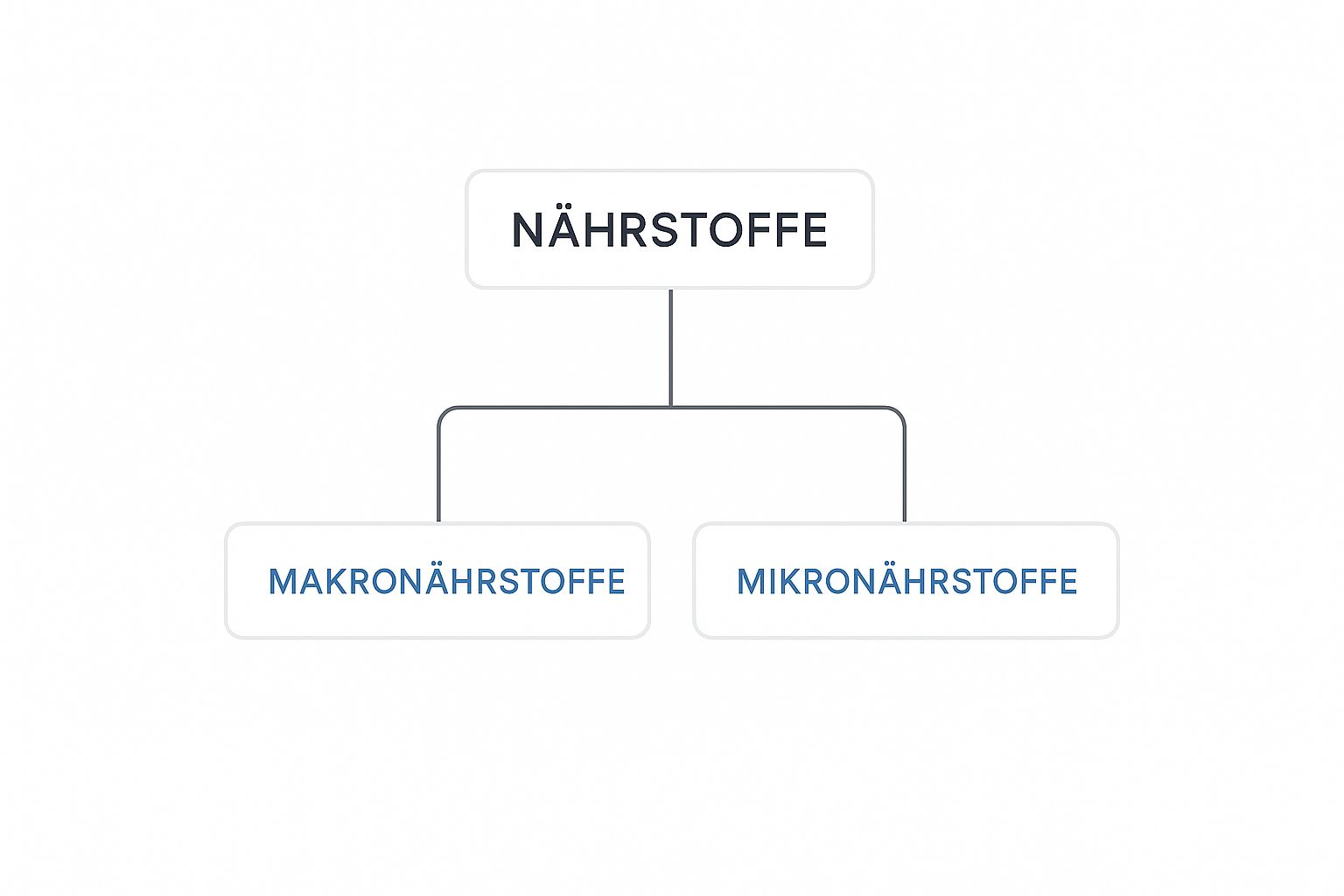
This simple breakdown makes it clear: The two main categories must work together to ensure your body is optimally nourished. A good balance between them is the key to lasting health and well-being.
The quiet heroes of your health
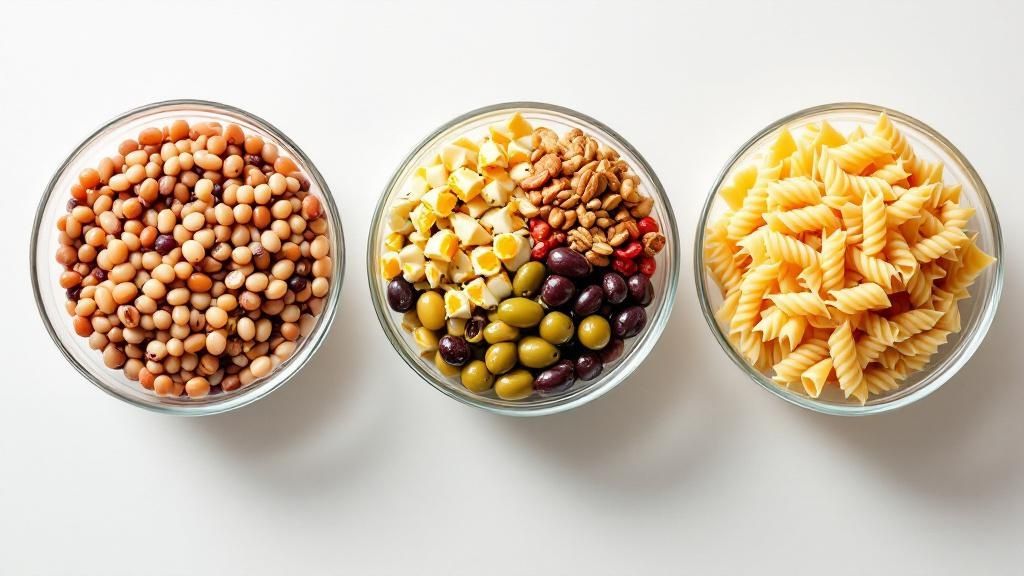
While macronutrients are your body's big, loud energy providers, a second group works more behind the scenes: micronutrients. They are the quiet heroes of your health. Your body needs them only in tiny amounts—often just milligrams or even micrograms—but their impact is enormous.
Think of them as the spark plugs in an engine. Without them, nothing starts, no matter how full the tank is. In the same way, vitamins and minerals provide the essential sparks that make thousands of biochemical reactions in your body possible in the first place. From immune defense and nerve function to energy production in every single cell, they play a role everywhere. A deficiency can therefore have far-reaching effects on your well-being.
What exactly do vitamins and minerals do?
Instead of rattling off a dry list of names, let’s take a closer look at what these little helpers actually do for you in everyday life. They are not abstract terms but active players whose effects you can feel directly.
-
25-OH vitamin D3: Sure, everyone knows it as the “sunshine vitamin” for strong bones. But it is so much more! Vitamin D is a key player for your immune system and your mood. A good level helps your body fight off infections and can help you feel more balanced.
-
Magnesium: Do you know that feeling of muscle cramps after exercising or that annoying twitching in your eyelid? It is often a cry for magnesium. It is the relaxation manager for your muscles and nerves, ensuring that everything can loosen up again after tensing.
-
Ferritin (as a measure of iron): Do you often feel tired and drained for no apparent reason? Iron is the oxygen courier in your blood. Without enough iron, too little oxygen reaches your cells—leading directly to exhaustion and difficulty concentrating. Your ferritin level shows how well stocked your iron stores are.
-
B vitamins (vitamin B12 & folic acid): This duo is the powerhouse for your nerves and blood formation. Vitamin B12 in particular, whose active form is measured as transcobalamin, is crucial for your energy production. Folic acid, meanwhile, plays a central role in cell division—and is therefore extremely important not only during pregnancy.
Think of these micronutrients as a finely tuned orchestra. If even one instrument is missing or out of tune, the entire symphony suffers—your well-being.
A look at other important players
In addition to these familiar names, there are a whole host of other micronutrients that are essential for your body to function smoothly. They often work as a team and support one another.
Minerals such as selenium, zinc, copper, and manganese, for example, are important cofactors for countless enzymes. This means they are the small helpers that enable enzymes to do their job in the first place—such as protecting your cells from oxidative stress or supporting wound healing. Calcium and sodium are also essential for nerves, muscles, and a balanced fluid level.
The balance of your blood lipid levels—namely HDL cholesterol, LDL cholesterol, and triglycerides—is also closely linked to your nutrient intake and lifestyle. They are an important indicator of your metabolism. A conscious diet can help you optimize these levels, which is an important step if you want to lose weight healthily and reach your comfortable weight.
Our dietary habits in Germany are changing. Meat consumption is declining, while plant-based alternatives are becoming increasingly popular, as Statista shows. However, the nutrient content of fruit and vegetables depends heavily on variety, climate, and soil quality, which can sometimes make adequate intake a challenge.
That’s why it’s so important not just to guess, but to know. Taking a targeted look at your individual levels shows you where you stand and where you may need to make improvements to reach your full potential.
Typical signs of a nutrient deficiency
Do you often feel tired, unable to concentrate, or constantly ill? Your body is a clever communicator. It often sends subtle but clear signals when it is missing important building blocks. Understanding these signs is the first step toward proactively supporting your well-being.
This isn’t about panicking over every little ache or complaint. Rather, we want to help you become more attuned to interpreting your body’s language. Many everyday complaints can have countless causes, but nutrient deficiency is one of them—and the best part is that it can be measured and addressed.
Common signs you should know
Certain symptoms occur particularly often when specific nutrients are deficient. Think of them as small warning lights on your body’s dashboard.
-
Persistent fatigue and paleness: Do you often feel exhausted from the moment you wake up? Could your skin use a little more color? These are classic signs of a deficiency in iron (measured as ferritin) or vitamin B12. Both are essential for blood formation and oxygen transport—when they are lacking, so is your energy.
-
Muscle twitching and cramps: Does your eyelid twitch uncontrollably, or do you often get calf cramps at night? This is often caused by a deficiency in magnesium or calcium, the relaxation minerals for your muscles and nerves.
-
High susceptibility to infections: Do you feel like you catch every wave of colds? A weakened immune system may be a sign that your body is lacking 25-OH vitamin D3, zinc, or selenium. These three are the bodyguards of your immune defenses.
-
Difficulty concentrating and low moods: Do you find it difficult to focus, or is your mood often low? A deficiency in B vitamins such as folate and vitamin B12, as well as low vitamin D levels, may play a role.
Remember: These symptoms are signposts, not diagnoses. They are an invitation from your body to take a closer look and get to the root of the cause.
When the body needs more help
Sometimes the signs are less obvious. Brittle nails, hair loss, dry skin, or poor wound healing can also indicate an imbalance. For example, copper and zinc are important for healthy skin and strong connective tissue.
Fatigue in particular is complex and can have many causes. If you often feel sluggish, it is worth taking a closer look. In our article about the connection between nutrient deficiencies, fatigue, and lack of energy, we take a deeper look at this important topic.
Ultimately, it is crucial to understand that many everyday complaints may be caused by a correctable micronutrient deficiency. Your body gives you clues—the next step is to follow up on them with reliable data so you can take targeted action.
How to reliably check your nutrient status

Guessing about your own health is a start, but solid data is simply better. So if you feel you might be lacking important nutrients because you recognize the typical signs in yourself, you no longer have to remain in the dark. Fortunately, there are now simple and reliable ways to finally get clarity.
Instead of simply guessing, you can support your body in a targeted way. The key is to see your individual levels in black and white and understand what they really mean for your health. This way, you make decisions based on facts—not hope.
Blood count at the doctor’s office vs. targeted nutrient analysis
A standard blood count at your family doctor’s office is an important first check, without question. However, it is often not designed to examine your micronutrient status in detail. In most cases, it checks only basic values and leaves specific micronutrients such as selenium and zinc, as well as the exact status of your vitamin B12 stores, out of consideration.
This is where targeted nutrient analyses come in. You can think of them as a zoom lens for your health: They focus precisely on the vitamins and minerals that are crucial for energy, the immune system, and overall well-being. This is the most direct way to find out whether your cells are truly receiving optimal nourishment.
A good nutrient test does not only measure what is currently circulating in your blood. It also examines storage forms, such as ferritin for iron or 25-OH vitamin D3 for vitamin D. This gives you a much more accurate and honest picture of your long-term nutritional status.
How modern at-home nutrient tests work
The good news is that you do not have to wait weeks for a specialist appointment to get such a detailed analysis. Modern at-home test kits, such as Nährstoff | VitalCheck Basic und complete, make it surprisingly easy to gain precise insights.
The process is remarkably straightforward: At home, you take a small blood sample from your fingertip yourself in just a few simple steps and send it to a certified specialist laboratory. There, your levels are analyzed according to the same high standards used by doctors. Shortly afterward, you receive an easy-to-understand report that shows you clearly and unambiguously where you stand.
This trend toward self-tracking aligns with growing health awareness. In Germany alone, 225 million packages of dietary supplements were sold in 2018, generating sales of 1.44 billion euros. This not only shows that many people are well supplied with nutrients, but also underscores the strong interest in deliberately optimizing one’s diet, as demonstrated by current figures for the dietary supplement market.
Such a test provides you with specific values, for example, for your active vitamin B12 (transcobalamin), magnesium, or selenium. With this data in hand, you can make targeted adjustments to your diet and lifestyle instead of blindly taking random pills. If you want to delve deeper, read our article about how a blood test can reveal your nutrient deficiency. This way, you take control of your own well-being.
Still have questions? Here are the most important answers about nutrients.
We’ve now learned a great deal about the world of nutrients. But often, it’s the small, specific questions that continue to linger in your mind. Here you’ll find clear, direct answers to what most people want to know.
Think of it as your quick cheat sheet for reinforcing your knowledge and finally putting common myths to rest.
What’s the difference between macronutrients and micronutrients?
Imagine your body as a construction site. Macronutrients—that is, carbohydrates, proteins, and fats—are the bricks and cement. You need them in large quantities (measured in grams), because they provide the energy and building materials for everything from your muscles to your cells. Without them, nothing works.
Micronutrients, on the other hand, are the site managers and electricians on this construction site. Vitamins such as 25-OH-Vitamin D3 and folic acid, and minerals such as magnesium, ferritin (iron), and zinc, are needed only in tiny amounts (milligrams or even micrograms). Yet without their instructions, all processes grind to a halt. They ensure that your metabolism runs smoothly, your immune system defends you, and your nerves can transmit signals. Small but mighty!
Can I meet my nutrient needs through good food alone?
A colorful, varied diet is and remains the absolute foundation. That’s how you lay the groundwork for good nutritional intake. But honestly? For some nutrients, even conscientious eaters can struggle to get enough. A classic example is 25-OH-Vitamin D3, the “sunshine vitamin.” Our bodies produce it mainly through the skin when the sun is shining. But at our latitudes, especially from fall through spring, that often simply isn’t enough.
Nutrient requirements can also increase in special life situations—whether during pregnancy, intensive training, or while following a vegan diet. Instead of guessing, a targeted nutrient test such as the Nutrient | VitalCheck Basic or complete gives you the reassurance you need. This way, you know exactly where you stand and whether everything is in the green.
The important thing is that a healthy diet is the foundation. But knowing where you may need to make targeted adjustments gives you control over your well-being.
Do these at-home nutrient tests really work?
Yes, absolutely. High-quality at-home tests are now a reliable and recognized method for getting an accurate picture of your nutrient levels. You simply collect the sample yourself with minimal discomfort and send it in. It is then analyzed in the same certified specialist laboratories that doctors also work with.
The result is not gibberish, but a detailed, easy-to-understand report. It precisely shows your levels of important markers such as ferritin (your iron stores), transcobalamin (the truly active form of vitamin B12), as well as selenium and zinc. This gives you a scientifically backed basis for making the right decisions for your health.
Do I need to take tablets immediately if I have a deficiency?
Not necessarily. The first and most logical step is always to adjust your diet. Many mild deficiencies can already be corrected by deliberately adding more nutrient-rich foods to your plate.
However, if a test reveals a significant deficiency, taking high-quality dietary supplements for a limited period can be extremely beneficial. This quickly replenishes your depleted stores—something that may take months through diet alone. It is important to follow your test results or consult an expert to avoid incorrect dosing and achieve the best effect for your well-being.
Are you ready to replace guesswork with knowledge and take targeted control of your nutrient levels? We offer scientifically backed nutrient tests such as the Nutrient | VitalCheck Basic and complete, giving you clarity and helping you unlock your full potential.
Discover the nutrient now | VitalCheck and optimize your well-being!



Share now:
Understand and specifically resolve constant burping and stomach pressure
Recognize the symptoms of vitamin B12 deficiency and take the right action