

Recognizing vitamin B12 deficiency symptoms and taking the right action
Do you often feel inexplicably tired, unfocused, or simply not quite yourself? There may be more behind it than just the usual everyday stress. The symptoms of vitamin B12 deficiency often develop gradually and are nonspecific, but they can have far-reaching effects on your energy levels and nerve health.
What vitamin B12 deficiency really means
Think of vitamin B12, also known as cobalamin, as a diligent manager in your body. It ensures that the departments responsible for energy production, nerve function, and blood formation work together smoothly. Without this manager, critical processes grind to a halt—and you feel the effects directly in your well-being.
This vital vitamin is a true multitasker. It is essential for the formation of red blood cells, which transport oxygen throughout your body. It also protects and regenerates the myelin sheaths, the insulating layers around your nerves. Without this protection, nerves are more susceptible to damage.
The subtle signals from your body
The insidious thing about B12 deficiency is that the first signs are often very subtle. You may quickly attribute them to a stressful week or too little sleep. But this is exactly when you should take notice:
- Persistent tiredness and exhaustion: You feel sluggish and unmotivated despite getting enough sleep.
- Difficulty concentrating: You find it difficult to stay focused or remember things.
- Pale skin: A lack of red blood cells can give your skin a dull, pale appearance.
These early signs are your body's first warning signals. They indicate that your energy manager needs support.
Key insight: Vitamin B12 deficiency is not an isolated problem—it affects your entire system, from your everyday energy levels to the long-term health of your nerves.
A widespread problem
You are not alone with this issue. In fact, the symptoms of vitamin B12 deficiency are so varied that they can range from nonspecific complaints to severe neurological disorders. As a result, a deficiency is often only detected at a late stage. In Germany, an estimated 10% of the population is affected by low levels. Among people over 65, this figure rises to almost 20%. You can find out more about the background to this issue at sueddeutsche.de.
The following infographic shows the three main areas in which a vitamin B12 deficiency can make itself felt.
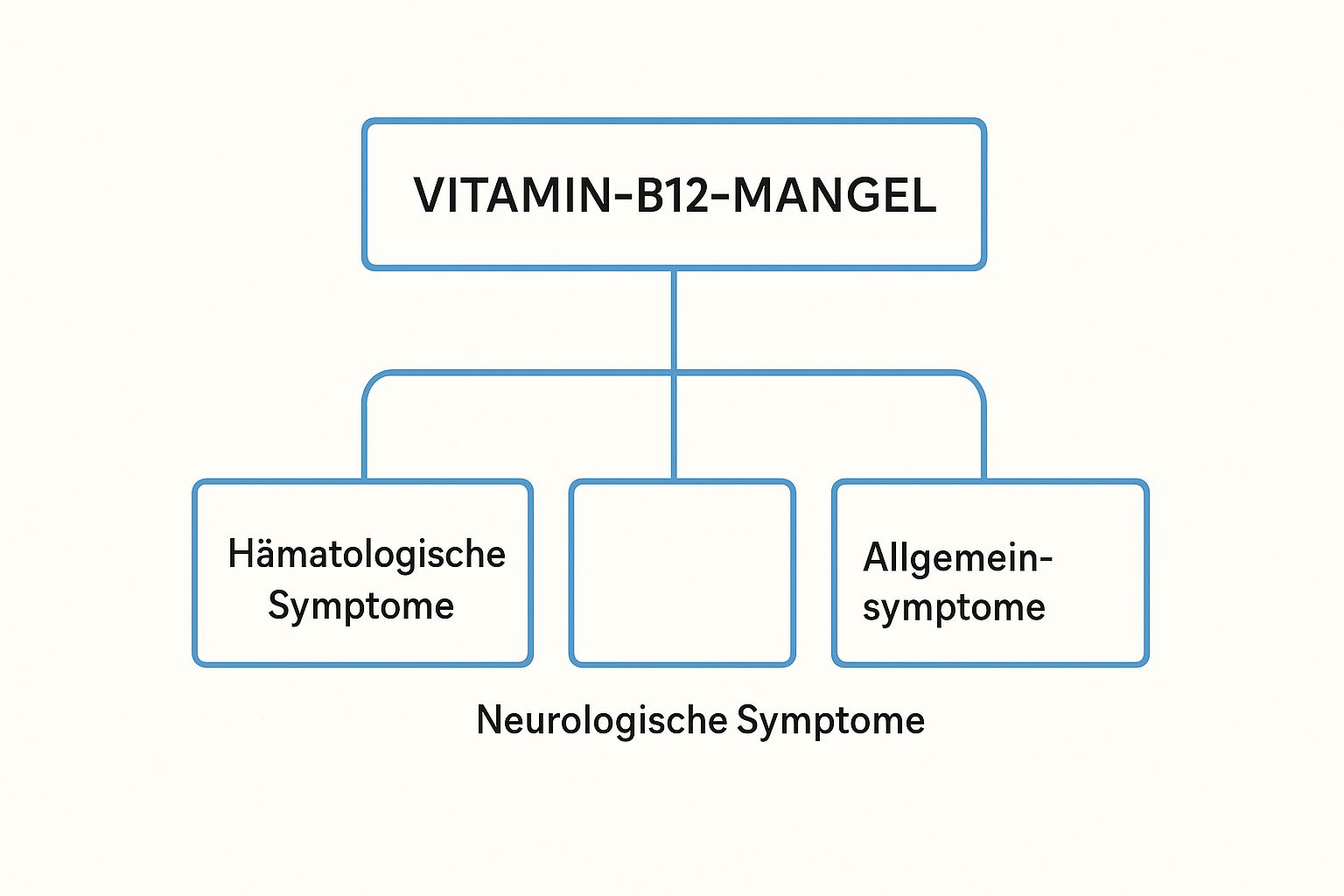
As you can see, a deficiency affects not only your general well-being but also your blood count and nervous system in very specific ways. This broad range makes early diagnosis all the more important. In general, nutrient supply is a complex issue, and it is worth taking a closer look at how widespread vitamin and mineral deficiencies in Germany really are.
Where does B12 deficiency come from? The most common causes
Vitamin B12 deficiency rarely develops overnight. It is usually the result of a long process in which either too little B12 enters your body or your body can no longer absorb it properly. Think of your B12 stores like a bank account: If you withdraw more than you deposit for months on end, the account will eventually be empty.
The reasons are surprisingly varied and often involve a combination of several factors. Let’s take a closer look at what can deplete your stores.

When your diet becomes a B12 trap
The most well-known reason for depleted B12 stores is probably on your plate. The vitamin is produced by microorganisms and is found almost exclusively in animal products because animals obtain and store it through their food.
As someone who cares about their health, it is important for you to know where to find this vitamin. The best sources of B12 are:
- Meat: Liver and red meat in particular are real B12 powerhouses.
- Fish and seafood: Salmon, tuna, and mussels also provide plenty of it.
- Dairy products and eggs: They also contribute to your daily intake.
If you follow a vegan or very strict vegetarian diet, it is almost impossible to meet your needs through food alone. You may sometimes hear about plant-based alternatives such as sauerkraut or algae, but these usually contain only so-called B12 analogues—a form of the vitamin that your body cannot use. Here, targeted supplementation is not a nice extra but simply necessary to avoid vitamin B12 deficiency symptoms.
When the body blocks absorption
Sometimes the problem has nothing to do with your diet at all, but with your body itself. Absorbing vitamin B12 is a surprisingly complex process that can fail at several points.
Imagine it this way: Vitamin B12 is like a VIP guest. To enter the exclusive area (your bloodstream), it needs a personal invitation—the so-called Intrinsic Factor, a special protein from your stomach. If this invitation is missing or the bouncer (your intestinal lining) is damaged, the VIP stays outside.
This is exactly where the hidden causes of a deficiency often lurk:
- Stomach problems: Chronic inflammation of the stomach lining (gastritis) or certain autoimmune diseases can halt the production of intrinsic factor. Without it, B12 has no chance.
- Certain medications: Some medicines are known as true B12 thieves. Leading the list are metformin (for diabetes) and acid blockers (such as omeprazole), which reduce stomach acid and thus prevent B12 from being released from food in the first place.
- Gastrointestinal diseases: Conditions such as Crohn's disease or celiac disease can damage the intestinal lining so severely that it can no longer absorb the vitamin—the “bouncer,” so to speak, is out of action.
- Age: Over the years, the stomach often produces less acid and less intrinsic factor. This is why older people are one of the largest risk groups.
In fact, vitamin B12 deficiency is often overlooked in Germany, even though it is widespread. Studies show that supply is often critical, especially among seniors. According to the German Nutrition Society, up to 20% of people over 60 are affected by a deficiency. So if you belong to a risk group—whether because of your diet, age, or medication—it is all the more important to listen to your body's signals. You can find more scientific background on its prevalence, for example, at Vitamin B12 deficiency on Wikipedia.de.
Interpreting your body's early warning signals correctly
The first symptoms of a vitamin B12 deficiency are often like a quiet whisper from your body. They are so subtle and inconspicuous that you quickly mistake them for everyday stress or a bad night's sleep. But this is exactly where the story begins—long before loud alarm bells start ringing. Think of this section as your personal early-warning system for correctly interpreting these quiet signals.
Imagine waking up in the morning feeling as though you have not slept at all. The coffee helps only briefly, and by late morning a leaden fatigue comes over you that refuses to lift all day. This is more than just a minor energy slump; it is one of the most common early signs of depleted B12 stores.

When energy and concentration decline
The initial symptoms are often vague and gradually creep into your life. This makes it even harder to attribute them to a specific problem. They usually affect your general well-being and mental fitness.
- Persistent fatigue: You feel constantly exhausted and lacking in energy, even after getting enough sleep.
- Difficulty concentrating: Important tasks at work suddenly become difficult, you forget appointments, or you feel unable to organize your thoughts properly. Sometimes it feels as though you are “not quite yourself.”
- Mood swings: You are irritable, downcast, or more emotional than usual for no apparent reason. These unexplained low moods may indicate that your nervous system is not receiving optimal nourishment.
These signs occur because vitamin B12 plays a key role in energy production in your cells. When it is lacking, your body’s motor essentially runs on low power. If you recognize yourself in this, it may be worth learning more about the connection between nutrient deficiencies, fatigue, and lack of energy.
Physical signs you should not ignore
In addition to mental exhaustion, your body also sends visible and noticeable signals. These physical symptoms of a vitamin B12 deficiency are often the first concrete indications that something is wrong.
A classic sign is noticeable paleness of the skin. This is because vitamin B12 is essential for producing healthy red blood cells. In the event of a deficiency, the few blood cells produced may be too large and misshapen—a condition known as megaloblastic anemia. This impairs oxygen transport throughout the body and results in a pale, sometimes almost yellowish skin tone.
Important insight: With a B12 deficiency, paleness is not merely a cosmetic issue. It is a direct sign that your blood can no longer transport oxygen efficiently—which in turn worsens your fatigue and lack of energy.
When your mouth and nerves start sending signals
Your body has other very specific ways of drawing attention to a B12 deficiency. Often, the mouth and tongue are the first to show signs.
Pay attention to these changes in your mouth:
- Smooth, red tongue: A so-called “lacquer tongue” may occur. The small papillae on the surface of the tongue disappear, making it look shiny and red.
- Burning or pain in the tongue: An unpleasant burning or sore sensation on the tongue is a typical neurological symptom.
- Canker sores: Small, painful ulcers in the mouth that recur frequently may also indicate a deficiency of B vitamins.
At the same time, initial neurological problems may become noticeable. Tingling or numbness in the hands and feet, often described as “pins and needles,” is a serious warning sign. It indicates that the protective layer around your nerve pathways has already been compromised.
If you recognize these early symptoms of vitamin B12 deficiency in yourself, you have the chance to take action in time before more serious problems develop. Listen to your body’s whisper—it could be sending you an important message about your health.
When the deficiency progresses and the nerves suffer
If you have ignored the early, often subtle signs of vitamin B12 deficiency, your body does not give up. On the contrary, it simply calls for help even louder. If a deficiency remains undetected for a long time, it can cause serious and sometimes even permanent damage, especially to your nervous system.
Think of vitamin B12 as a protective covering for your nerve pathways. The vitamin is essential for building and maintaining the myelin sheath, a kind of insulating layer of fat that surrounds your nerves. You can think of it like the rubber insulation around an electrical cable: it ensures that electrical signals travel from A to B extremely quickly and without interference.
But when vitamin B12 is lacking, this protective sheath becomes thin and porous. The “wires” are essentially exposed, and the entire signal transmission process begins to falter. This is when the neurological symptoms of vitamin B12 deficiency become noticeable—and they go far beyond simple fatigue.
When your hands and feet tingle and become numb
One of the most common and concerning signs is so-called polyneuropathy. The word sounds complicated, but it describes a very specific and unpleasant sensation: tingling, burning, or numbness that usually begins in the hands and feet.
You may know the feeling when one of your legs “falls asleep”—that annoying pins-and-needles sensation. With B12 deficiency-related polyneuropathy, however, this feeling is persistent and can slowly spread further.
In everyday life, it may feel like this:
- You constantly feel as though you have cold feet, even though they actually feel warm.
- You feel unsteady when reaching for objects, as if your fingers no longer obey you properly.
- You wake up at night because your hands or arms are tingling or feel numb.
These abnormal sensations are a direct distress signal from your nerves. They show you that the myelin sheath has already been damaged.
When coordination and memory begin to decline
However, the damage to the nerve pathways is not limited to the hands and feet. The large nerve tracts in the spinal cord, which are responsible for your balance and coordination, can also be affected.
This leads to symptoms that can significantly impair your movements and safety in everyday life:
- Unsteadiness when walking: You stumble more often, feel wobbly on uneven ground, or feel as though you’re swaying.
- Coordination problems: Fine motor tasks such as buttoning a shirt or writing suddenly become a real challenge.
- Muscle weakness: Your legs feel heavy, and climbing stairs suddenly becomes unexpectedly strenuous.
Very important: As soon as neurological symptoms of vitamin B12 deficiency appear, you need to act quickly. Many types of damage can heal with timely treatment. However, a severe, long-lasting deficiency can cause nerve damage that cannot be reversed.
At the same time, your brain—the central nervous system—is also affected. It needs B12 to produce important neurotransmitters. A deficiency can therefore also affect your mental sharpness:
- Memory lapses: You forget names or appointments, or suddenly lose track of what you wanted to say mid-sentence.
- Confusion: You feel disoriented or have difficulty forming a clear thought.
- Depressed mood: A severe deficiency can even trigger depression or other psychological changes.
These serious symptoms show how crucial vitamin B12 is for your entire nervous system. If you notice signs such as unexplained tingling, new unsteadiness when walking, or significant memory problems, you should definitely have them medically evaluated. It is the most important step to protect your nerves and prevent permanent damage.
How the right tests can finally give you clarity
You now know the subtle and more serious symptoms of vitamin B12 deficiency and may have recognized yourself in some of them. A suspicion is the first important step, but assumptions alone won’t get you anywhere.
To gain real certainty and take the right steps, you need solid data. This is exactly where modern nutrient tests come in. A simple blood test at the doctor’s office or a home test can give you the clarity you’re looking for. But beware: not all tests are the same. There are different methods for checking your B12 status, and they differ significantly in how informative they are.
The classic serum test: often only half the truth
The most common test measures total vitamin B12 in the blood serum. Think of it as taking inventory in a warehouse: The test simply counts all the B12 packages lying around there. The major problem is that it does not distinguish between “active” and “inactive” packages. A large portion of the measured B12 is bound to a protein called haptocorrin and is not usable by your cells at all.
This test can therefore give you a false sense of security. Your levels could be within the normal range even though your cells are already lacking the active vitamin B12 they urgently need.
More precise markers for a clear picture
To truly understand what is going on in your body, we need to look more closely. This is where two more modern and significantly more informative markers come into play:
- Holotranscobalamin (Holo-TC): This is what is known as “active B12.” Only the portion of the vitamin bound to the transport protein transcobalamin is measured here—that is, precisely the form that your cells can actually absorb and use. A low Holo-TC level is often the very first sign of an emerging deficiency, long before the total B12 level even drops.
- Methylmalonic acid (MMA): This is a metabolic product that accumulates in the body when there is too little B12 for certain chemical reactions. An elevated MMA level is therefore a very reliable indication of a functional deficiency directly at the cellular level.
Simply explained: While the serum B12 test only counts the supplies in storage, the Holo-TC test shows you how much is actually being delivered. The MMA test checks whether the employees in the cells are already complaining about a lack of materials.
For a comprehensive diagnosis, combining these values is ideal. If you really want to know how science meets preventive care and a blood test reveals your nutrient deficiency, these precise markers are the key to success.
The following table gives you a quick overview of the most common testing methods.
Comparison of vitamin B12 testing methods
This table shows the common blood tests used to determine B12 status, their informative value, and who they are suitable for.
| Testing method | What is measured? | Informative value & recommendation |
|---|---|---|
| Total B12 (serum) | The total amount of B12 in the blood, both active and inactive. | Limited informative value. May miss a deficiency. Suitable only as a rough initial indication. |
| Holo-TC (Active B12) | Only the biologically available B12 bound to transcobalamin. | Highly informative. Considered an early marker and indicates a deficiency very reliably, often before symptoms appear. |
| MMA (Methylmalonic acid) | A metabolic product that increases in cases of B12 deficiency. | Very high diagnostic value. Confirms a functional deficiency at the cellular level. Ideal in combination with holoTC. |
As you can see, holoTC and MMA provide a much clearer picture of your B12 status.
The importance of early detection is also becoming increasingly significant at the societal level. In Germany, the Federal Joint Committee (G-BA) has decided to expand newborn screening to include vitamin B12 deficiency from around May 2026. This step is intended to detect rare but severe congenital metabolic disorders at an early stage and thus prevent irreversible developmental disorders. You can read more about this important preventive measure here on the G-BA website.
A test gives you not only a diagnosis but also control over your health. It is the starting point for addressing your vitamin B12 deficiency symptoms specifically and restoring your energy and well-being on a solid, evidence-based foundation.
How to replenish your stores
Have you been diagnosed with a vitamin B12 deficiency? Don’t worry—see it as the starting point for a life with more energy and vitality! Once you know what is causing the problem, you can take targeted action, replenish your stores, and make sure they stay full. Fortunately, there are some really good and effective ways to do this.

The right treatment for you depends entirely on the cause and severity of your deficiency. If your body cannot properly absorb the vitamin due to a gastrointestinal condition, for example, tablets are often not very effective. Injections, which completely bypass the digestive tract, are usually the fastest and safest way to replenish depleted stores.
Find the right treatment for your needs
For a mild deficiency that may have resulted solely from your diet, high-dose supplements in the form of tablets, capsules, or drops may already be the perfect solution. Your doctor will tell you exactly which dosage is right for you.
An overview of the most common treatment options:
- High-dose tablets or drops: This is the most common method. The dose needs to be substantial because your body can actively absorb only a small amount when taking it by mouth.
- Vitamin B12 injections: If you have a severe deficiency or impaired absorption, your doctor will inject the vitamin directly into the muscle. This allows it to enter the bloodstream without detours and can relieve vitamin B12 deficiency symptoms extremely quickly.
- Nasal sprays: A less common but equally effective alternative. Here, the vitamin is absorbed through the nasal mucosa.
Important note: You should always make the decision about treatment together with your doctor. They can best assess which approach is safest and most effective for you to fully replenish your stores.
Active forms for maximum effectiveness
If you decide to take a dietary supplement, you’ll quickly come across different forms of B12. The two most important are methylcobalamin and cyanocobalamin. And the difference is crucial.
- Methylcobalamin is the biologically active form. Your body can use it immediately without having to laboriously convert it first. It is available to you directly.
- Cyanocobalamin is a synthetic, highly stable form. However, your body must first convert it into an active form, which means an additional step.
For a quick and direct effect, methylcobalamin is often the better choice. When selecting a product, simply look for high-quality supplements without unnecessary additives.
Preventing deficiency in the long term: Nutrition and smart supplementation
Once the acute deficiency has been corrected, the goal is to remain well supplied in the long term. For at-risk groups such as vegans, vegetarians, and older people, ongoing low-dose supplementation is often the simplest and safest approach.
If your diet allows, consciously include B12-rich foods in your meal plan. These include meat, fish, eggs, and dairy products, for example. Curious about how strongly your genes influence your nutrient metabolism? A genetic nutrition test can provide insights into how to optimize weight loss based on your DNA.
By understanding the cause of your deficiency and choosing the right strategy for you, you can regain full control over your health. This lays the foundation for lasting well-being and the energy you deserve.
What else you wanted to know about vitamin B12 deficiency: Frequently asked questions, clear answers
You’ve already learned a lot about the symptoms of vitamin B12 deficiency, its causes, and treatment options. But often, it’s the very specific questions about your own health that concern you most. That’s why we’ve collected the most common uncertainties here and provide clear, easy-to-understand answers.
Can a B12 deficiency really cause numbness?
Yes, absolutely. Tingling or a numb feeling, usually in the hands and feet, is one of the typical neurological signs. Think of it this way: Vitamin B12 is like a protective layer around your nerve pathways. When this vitamin is lacking, this layer becomes thin and the nerves can be damaged. You then feel this as an unpleasant “pins and needles” sensation or numbness, which may be particularly noticeable at night.
Important note: You should always take neurological symptoms such as numbness seriously. They are a clear signal from your body. Prompt evaluation is crucial to prevent temporary symptoms from becoming permanent nerve damage.
How quickly do B12 supplements take effect?
It depends entirely on how depleted your stores are and which form of treatment is chosen. With high-dose injections, many people report noticeable improvement after just a few days. Symptoms such as extreme fatigue and concentration problems often subside quickly.
If you take tablets, your body needs a little longer to replenish its stores—here, it may take several weeks before you notice a clear difference. Neurological symptoms such as tingling require the most patience. Regeneration can take several months in these cases. Give your body the time it needs.
Can a B12 deficiency also show up in the mouth?
Yes, your mouth can actually reveal quite a bit about your nutrient supply. Certain changes in the mouth are often early signs of a deficiency and a good reason to take a closer look.
Typical signs in the mouth include:
- Burning tongue: A painful, burning sensation on the tongue (also known as glossodynia) is a classic symptom.
- Smooth, red tongue: The tongue loses its typically rough surface, swells, and appears polished and glossy red.
- Recurring canker sores: If you constantly struggle with painful small ulcers on the lining of your mouth, this could also be related to a deficiency.
If you notice these kinds of changes, it is a good idea to have your nutrient status checked to get to the root of the cause.
Are you ready to finally gain clarity about your nutrient supply and take your health into your own hands? A test can give you the certainty you need to make targeted improvements. MYBODY Lab GmbH offers scientifically backed at-home nutrient analyses to help you optimize your nutrient levels and improve your well-being.
Discover your individual nutrient needs now with a test from mybody-x.com



Share now:
The building blocks of your health: What nutrients really do
Vitamin B12 deficiency: which values are meaningful and when it becomes serious