
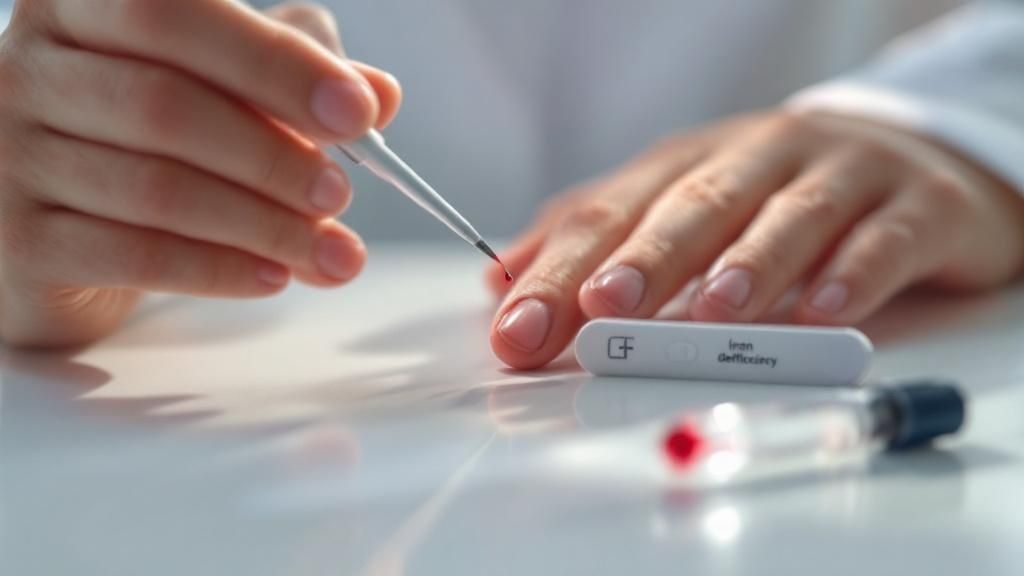
Your Iron Deficiency Test—Everything You Need to Know!
Do you often feel drained, pale, or barely able to concentrate? Many people attribute this to stress, but a simple iron deficiency is often the cause. A targeted iron deficiency test provides clarity and is the first step toward regaining your energy before the symptoms take over your daily life.
Why constant fatigue can be a warning sign
Think of your energy reserves as a bank account. Every day, you withdraw a little to get through your daily life. But if you don’t “deposit” enough through your diet, your body has to tap into its emergency reserves—the iron stores in your liver, spleen, and bone marrow. At first, you probably won’t notice anything.
But what happens when these stores gradually run empty? Your body can no longer produce enough hemoglobin, the red blood pigment that transports oxygen through your body. This is precisely when the first symptoms gradually begin to appear.
The three stages of iron deficiency
Iron deficiency does not develop overnight. It progresses in stages, and once you understand them, you also understand why prompt action is so important. In Germany, around 8% of the population are affected—that means the problem is more widespread than many people think.
Typically, it goes like this:
- Stage 1: Empty stores: Your body begins using up its iron reserves. On the outside, you still feel fit, but in the background, the reserves are being depleted. A test can already provide important initial indications during this stage.
- Stage 2: Impaired blood formation: The stores are now empty. Your body is finding it increasingly difficult to produce enough red blood cells. Initial signs such as fatigue or difficulty concentrating appear.
- Stage 3: Iron deficiency anemia: The deficiency is now so severe that noticeable anemia develops. Symptoms such as paleness, dizziness, and shortness of breath become your constant companions.
This step-by-step process shows why timely testing is so crucial. If you want to delve deeper into the subject, you can find more background information on iron deficiency on Wikipedia.
Testing early can make all the difference. It gives you the chance to take countermeasures long before full-blown anemia develops and severely limits your quality of life.

Which iron deficiency test is right for you?
Do you constantly feel drained and suspect that an iron deficiency could be the cause? Now you’re faced with the question: Should you go straight to the doctor or try a home self-test first? Both options have their merits. The right choice depends entirely on your personal situation.
The traditional route naturally leads to a doctor’s office. There, a blood sample is taken for a comprehensive laboratory analysis. The result provides a very detailed picture of your iron metabolism and various other important values.
The blood test at the doctor’s office
A medical examination is always the best option if you are already experiencing more severe or unexplained symptoms. If you have pre-existing conditions, you should also go directly to a doctor. They can not only check your iron status but also investigate other possible causes of your symptoms.
The following values are typically measured in the laboratory:
- Ferritin: This is the most important value of all. It shows how full your iron stores actually are. A low ferritin level is often the very first sign of an emerging deficiency.
- Hemoglobin (Hb): This value measures the red blood pigment. If it is too low, you already have anemia.
- Transferrin saturation: This indicates how much of the iron transport protein in your blood is actually loaded with iron. An important piece of the puzzle for the overall diagnosis.
A medical diagnosis is unquestionably the most comprehensive method and takes a holistic view of your health. The downside: You need an appointment, have to sit in the waiting room, and often need to come back a second time to discuss the results.
The at-home self-test
An increasingly popular alternative is the iron deficiency test, which you can easily and discreetly perform at home. These tests generally focus on one crucial value: ferritin. With just a few drops of blood from your fingertip, you get a quick initial assessment of whether your iron stores are critically depleted.
A self-test is ideal for you if you:
- You notice initial, mild symptoms such as fatigue and want to get clarity quickly.
- You want to keep an eye on your iron status preventively—for example, because you follow a vegan diet or do a lot of sports.
- You are looking for a straightforward, time-saving solution without the hassle of visiting a doctor.
Important note: A self-test does not replace a medical diagnosis in the case of severe symptoms. However, it is a fantastic tool for early detection and self-monitoring. It gives you the opportunity to take proactive care of your health.
The following graphic shows you once again which blood values play a role in an iron deficiency test to provide a complete picture.
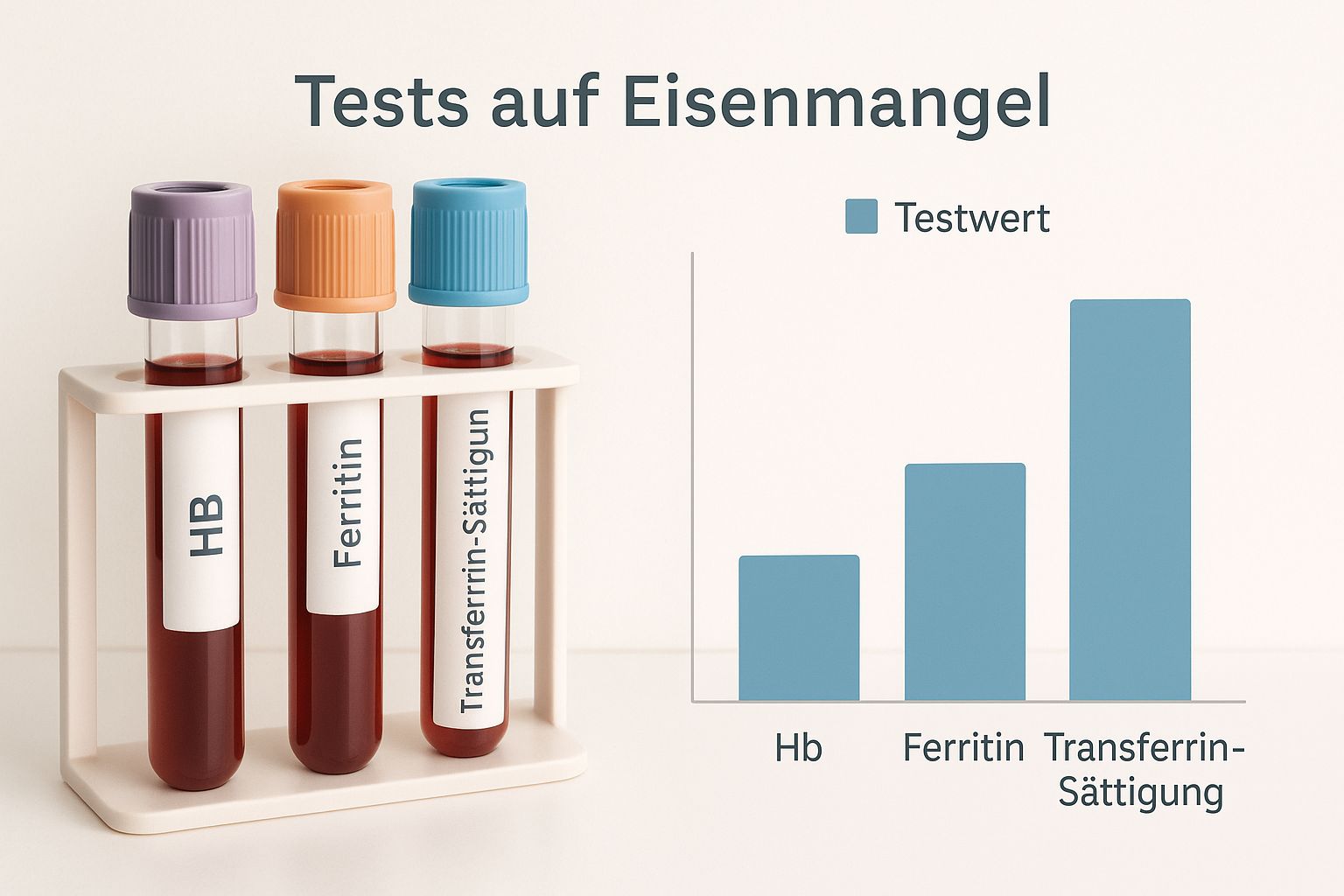
As you can see, ferritin and hemoglobin in particular are key values when diagnosing iron deficiency. If you would like to take a deeper dive and understand exactly how these values interact, read our detailed article about ferritin levels.
Comparison of Testing Methods for Iron Deficiency
To make your decision easier, we have compared the most important features of medical blood tests and self-tests here.
| Feature | Blood test at the doctor's office | At-home self-test |
|---|---|---|
| Scope | Very comprehensive (multiple values) | Focused (usually ferritin only) |
| Context | Comprehensive diagnosis, ruling out other causes | Quick initial indication |
| Effort | Appointment scheduling, waiting time, two visits | Low, can be done at any time |
| Speed | Results after a few days | Results often available within a few days |
| Cost | Covered by health insurance (if suspected) | Self-paying patients |
| Ideal for | Severe/unclear symptoms, pre-existing conditions | Prevention, mild symptoms, quick check |
Ultimately, both options provide valuable insights. You can now better weigh which option makes the most sense for your current situation.
Finally Understand Your Blood Test Results

Holding a laboratory report in your hands can feel like trying to decipher a foreign language. All the abbreviations and columns of numbers can seem intimidating at first glance. But don't worry, the most important values related to your iron balance are easier to understand than you think.
The all-important value that tells you how your iron reserves are doing is ferritin. Simply think of it as your body's warehouse for iron. When the warehouse is well stocked, the ferritin level is high. As it empties, the level falls—often long before you notice anything in everyday life. That is precisely why ferritin is considered the gold standard for reliably diagnosing iron deficiency.
More Than Just Ferritin: Looking at the Bigger Picture
Even though ferritin is the star of the show, other values also play an important role in understanding the overall picture. They are like the supporting actors in a film who make the plot truly come together.
The most important include:
- Hemoglobin (Hb): This is the red blood pigment that transports oxygen throughout your body. A low Hb level indicates existing anemia—this is the third and most severe stage of iron deficiency.
- CRP (C-reactive protein): This value is a marker of inflammation in the body. This is extremely important because inflammation can artificially increase ferritin levels, even though your iron stores are actually empty. Your body essentially holds on to the iron. Looking at the CRP level therefore helps interpret ferritin correctly.
The interaction of these values provides a much more accurate diagnosis than a single measurement. It helps determine whether this is a straightforward deficiency or whether other health issues may be involved. A comprehensive iron deficiency test takes precisely these connections into account, as you can also read in our guide on testing for nutrient deficiencies.
Why “normal” isn't always optimal
Now comes perhaps the most important point: the famous “reference ranges” on your laboratory report. These ranges are based on statistical averages from a huge population group. But what is statistically normal may still be far from sufficient for your personal well-being.
For example, data from Germany shows that the reference ranges for ferritin in women aged 18 to 45 range from 6.5 to 131.0 µg/l. However, this range also includes very low values at which symptoms such as fatigue (often below 50 µg/l) or hair loss (below 70 µg/l) may already occur. Although a value of 30 µg/l is statistically considered “normal,” many people already feel anything but fit at this level.
Your goal should therefore not be to just barely fall within the normal range, but to reach a level that gives you optimal energy and quality of life. For many people, this personal comfort range is significantly higher than the laboratory's lower limit.
With this knowledge, you're well equipped not only to look at your next blood test report, but to truly understand it. You'll be able to interpret the results much more effectively and discuss with your doctor as an equal which values are ideal for you and your well-being.
How the iron deficiency self-test works
Do you finally want clarity about your iron status, but without the detour through a doctor's office and long waiting times? A modern self-test, such as the one from myBody-X, is made precisely for this purpose. The entire process is designed so that you remain in control—from the simple sample collection at home to the easy-to-understand report.
The idea of pricking your fingertip yourself may seem daunting at first. But don't worry: Today's test kits are designed to make blood collection quick, easy, and almost painless. Just a small prick, nothing more.
Your path to the results: From sample to report
The process is divided into a few simple, logical steps that you can easily carry out at home. The myBody-X test kit contains everything you need—clearly organized and self-explanatory.
- Preparation: Wash your hands thoroughly with warm water. This stimulates circulation and makes blood collection even easier.
- Collection: Using a small, automatic lancet, you briefly prick the side of your fingertip once. Just a few drops of blood are enough; collect them in the tube provided.
- Shipping: You then securely package the sample in the return envelope and send it free of charge to our certified specialist laboratory.
Here’s how simple and straightforward the myBody-X test kit is:
Every part of the kit is clearly labeled, and the instructions guide you through the process step by step. Nothing can really go wrong.
What happens after you send in your sample
As soon as your sample arrives at the laboratory, it is pseudonymized—so your data privacy is our highest priority. Specialized laboratory analysts then examine the key value: your stored iron (ferritin). This value is the gold standard for precisely determining how full your iron reserves really are.
The analysis is complete after just a few business days. Instead of a cryptic laboratory report, we provide you with a digital results report that presents your values graphically and explains them in simple terms. This way, you can see at a glance where you stand and what the result means for you.
A self-test is more than just a measurement. It’s a tool that enables you to take a proactive, informed approach to your health—without the stress of appointments or waiting rooms.
The entire process, from simple sample collection to the digital test report, is designed to give you complete control. You decide when and where to take the test, and receive scientifically validated results directly on your smartphone or computer. If you’d like to explore the benefits and exact process in greater depth, our detailed article contains additional information about the iron deficiency self-test.
The combination of modern laboratory diagnostics and user-friendly presentation makes it easier than ever to keep track of important health values. This allows you to take timely, targeted action when needed. You receive not just a number, but the knowledge you need to take an active role in supporting your well-being.
What your test result means for you
You’re holding the test report in your hands—a decisive moment. But what do these numbers really say about your health and everyday life? A test result isn’t a verdict; it’s the starting point for making targeted changes. Let’s decode together what your result means and which steps are right for you now.
Regardless of whether the result comes from a doctor’s laboratory or a self-test, the most important value is almost always ferritin. It is your stored iron and provides the clearest insight into your actual iron reserves.
Your result is low—it’s time to take action
A low ferritin level is a clear signal: Your iron stores have already been tapped into or are even empty. This is the time to take action—ideally before true anemia develops, along with all its unpleasant symptoms such as persistent fatigue and difficulty concentrating. Your body is essentially sending you an early warning signal, and you should take it seriously.
The good news is that you can specifically replenish your stores. The strategy rests on two pillars:
-
Optimize your diet: Make a conscious effort to include more iron-rich foods in your diet. Animal sources such as red meat or liver provide what is known as heme iron, which your body can utilize very efficiently. Plant-based sources such as lentils, chickpeas, pumpkin seeds, and spinach are also valuable. There is just one small trick: Always combine them with vitamin C (e.g., from bell peppers, broccoli, or a glass of orange juice) to significantly increase iron absorption.
-
Targeted supplementation: Diet alone is often not enough to quickly replenish depleted stores. High-quality iron supplements are an extremely effective option here. Look for well-tolerated compounds such as iron bisglycinate to avoid typical gastrointestinal discomfort. However, supplementation should always be based on your test results and ideally taken in consultation with a doctor or therapist.
It is important not only to treat the symptoms but also to find the cause of the deficiency. Is it due to your diet, heavy menstrual bleeding, undetected inflammation, or impaired absorption in the intestines? Only once you know the root of the problem can you take lasting corrective action.
Your result is normal—what does that mean?
A result within the normal range is a relief for now. It shows that you currently do not have a critical deficiency. But beware: “Normal” does not automatically mean “optimal.” As we have already discussed, many people do not truly feel energetic and fit until their levels are in the mid to upper end of the normal range.
Consider a normal result a good starting point. Stay on track, continue focusing on an iron-rich diet, and keep an eye on your levels—especially if you belong to a risk group (e.g., because of a vegetarian diet, intense exercise, or being a woman of childbearing age).
Your hemoglobin level is also crucial. In Germany, for example, a minimum level of 13.5 g/dl for men and 12.5 g/dl for women is required to donate blood at all. Falling below this threshold is often a clear indication of an existing iron deficiency and should always be evaluated by a doctor to clarify the causes. You can find further insights into the importance of hemoglobin levels at Blutspendedienst West.
When seeing a doctor is essential
An iron deficiency test provides you with valuable data. However, there are situations in which seeing a doctor is absolutely essential:
- Very low levels: If your ferritin level is extremely low or your hemoglobin is already below the normal range, medical evaluation to identify the causes and plan treatment is essential.
- Persistent severe symptoms: If you suffer from severe exhaustion, dizziness, or shortness of breath, you should not hesitate to seek medical advice.
- No improvement despite taking action: If your levels and how you feel simply do not improve despite changing your diet and taking supplements, a doctor needs to investigate deeper underlying causes.
A test result is your personal compass. It shows you where you stand and which direction you should take to regain your energy and quality of life. If you would like to know which specific steps you can take if a deficiency is detected, we have summarized what to do about iron deficiency in our guide.
Your questions about the iron deficiency test—we have the answers
Are you considering an iron deficiency test and still have a few questions? Perfect—that’s exactly what this section is for. It’s completely normal to want to know everything in advance. After all, the result should be truly meaningful.
Let’s clear up the most common uncertainties right away.
Do I actually need to fast for the test?
This is one of the top questions—and the answer is: it depends. For a ferritin test alone, such as those offered by at-home self-tests, you generally do not need to fast. Your stored iron (ferritin) does not respond immediately to your last meal.
It’s different when your doctor orders a complete blood count. Other values, such as serum iron, are often tested as well. In this case, you may be asked to arrive fasting for the blood draw.
How reliable is a self-test like this, anyway?
A valid question! The short answer: Very reliable. Modern self-tests whose samples are analyzed in certified specialist laboratories are in no way inferior to a doctor’s blood analysis. Exactly the same analytical methods are used to determine the key value: ferritin.
The only difference is the scope. If needed, a doctor can measure additional values and immediately place your results in a broader medical context.
Here’s what to remember: A high-quality self-test provides a precise and completely reliable result for your ferritin level. It’s a fantastic tool for early detection and occasional monitoring, but in the case of severe symptoms or a complex medical history, it naturally does not replace a comprehensive medical diagnosis.
Another point that concerns many people: Are there things that can distort the result?
What can affect the test result?
Yes, there are. It’s good to be aware of these interfering factors, as they can temporarily raise your iron levels and distort the overall picture.
-
Acute infections & inflammation: Are you currently bedridden with a cold or experiencing another inflammation in your body? Then your ferritin level may be falsely elevated. The body effectively withholds the iron to prevent pathogens from accessing it. A high CRP level (an inflammation marker) would be a typical sign here.
-
Intense exercise: Immediately after a particularly strenuous workout, your levels may temporarily be out of balance. It’s best to give your body a day’s rest before collecting the sample.
-
Taking iron supplements: Obvious, but important. If you already take iron supplements, they will naturally affect the result. To see the true state of your iron stores, you should pause the supplements for several days before the test—after consulting your doctor.
By following these points, you’ll create the ideal conditions for clear and meaningful results. This helps ensure that your iron deficiency test value truly reflects your iron status and that you can draw the right conclusions.
Are you ready to take action yourself and gain clarity about your iron levels? At myBody-X, you’ll find scientifically validated tests that you can perform easily and discreetly at home. Discover the iron deficiency test and take control of your energy and well-being.



Share now:
C-reactive protein too high? Here’s how to lower your CRP level effectively
Nutrition for celiac disease: 6 safe & delicious options