

Hormone test for women: When it makes sense and what it reveals
Do you often feel tired, irritable, or struggle with unexplained symptoms such as weight fluctuations or cycle problems? A hormonal imbalance could be behind them. A hormone test for women is often the first and most important step toward finally gaining clarity. It is a diagnostic tool that measures the concentration of important hormones in your body, helping to uncover the true causes of your symptoms.
Your guide to hormonal balance

You can think of hormones as the unseen conductors of our bodies. When this finely tuned orchestra plays in harmony, we feel energetic, balanced, and simply well. But if even a single hormone falls out of tune, the entire symphony of our well-being can begin to falter.
These disruptions manifest in many different ways and are often mistakenly attributed to stress, an unhealthy lifestyle, or simply “a phase.” Many women are familiar with this feeling, but finding the right answers can be exhausting and frustrating.
Why hormonal imbalance is so common
The female hormonal system is naturally a complex marvel subject to constant fluctuations—from the monthly cycle and pregnancy to menopause. These natural transitions make women particularly susceptible to imbalances. External factors such as stress, our diet, and environmental pollutants can further disrupt this delicate balance.
Our increasing life expectancy also plays a role. In 2023, around 42.9 million women lived in Germany, and their average life expectancy is expected to rise to 87.3 years by 2060. However, a longer life also means that more women will experience the hormonal changes of menopause. By 2025, around one billion women worldwide will be going through menopause, making the need for a targeted hormone test for women to treat symptoms such as hot flashes or sleep disturbances even more important. Learn more about the global impact of menopause at luminouslabs.health.
A hormone test is about far more than simply measuring laboratory values. It is a window into your inner balance and the first step toward regaining control of your health.
Signs of a possible hormonal imbalance
The symptoms of a hormonal imbalance are often so nonspecific that diagnosis without a test is almost impossible. They can manifest physically, emotionally and mentally. This guide is intended to help you interpret your body’s signals more accurately and recognise when a hormone test could really be worthwhile.
The following table provides a quick overview of the most common signs that may indicate an imbalance.
Signs of a possible hormonal imbalance
| Physical area | Possible symptoms |
|---|---|
| Cycle & reproduction | Irregular or missed periods, heavy bleeding, PMS, difficulty conceiving |
| Metabolism & weight | Unexplained weight gain or loss, cravings, water retention |
| Energy & mental health | Persistent tiredness, exhaustion, mood swings, irritability, anxiety, low mood |
| Skin & hair | Adult acne, dry skin, hair loss, thinning hair, brittle nails |
| Sleep & well-being | Sleep disturbances, night sweats, hot flushes, reduced libido |
Do you recognise yourself in one or more of these points? Then it may be time to take a closer look.
This article will provide you with the knowledge you need to have an informed conversation with your doctor and find the best path to your personal well-being.
The most important hormones in women and their functions

Imagine your hormonal system as a finely tuned orchestra. Each hormone is an instrument of its own, which must play at exactly the right moment and at the right volume for your body’s symphony to sound harmonious. If even one instrument falls out of rhythm, the entire piece can become chaotic.
These chemical messengers control virtually everything that happens in our bodies—from our energy levels, metabolism and sleep to our mood and menstrual cycle. An imbalance can therefore trigger symptoms that may not initially seem connected to hormones, such as low mood or difficulty concentrating. A targeted hormone test for women can help check these silent conductors and provide clarity.
Let’s take a look at the main players in the female hormone orchestra and what they do for us in everyday life.
Oestrogen and progesterone: the maestros of the cycle
Oestrogen and progesterone are probably the best-known female hormones. They are a well-coordinated team that regulates the menstrual cycle and fertility. Their perfect interplay is crucial to how we feel throughout the month.
Estrogen is the hormone of the first half of the cycle. You can think of it as the energetic and motivating part of the duo.
- Builds up the uterine lining: It prepares the body for a possible pregnancy.
- Promotes a good mood: Estrogen influences important chemical messengers in the brain, such as serotonin, leading to greater motivation and a better mood.
- Keeps skin and bones strong: It is responsible for skin elasticity and plays an important role in bone density.
Progesterone takes charge during the second half of the cycle. It is also often called the “relaxation hormone.”
Progesterone has a calming effect on our nervous system. A healthy level can promote better sleep, less irritability, and a deep sense of inner calm.
When the balance between these two hormones is disrupted—such as through so-called estrogen dominance or progesterone deficiency—typical PMS symptoms such as mood swings, breast tenderness, or sleep disturbances often result.
Testosterone: the often-underestimated driving force
Although testosterone is often labeled the “male hormone,” it is absolutely essential for women too. It is our engine for energy, libido, and muscle strength.
When we lack testosterone, we often feel tired and listless and have less interest in sex. A healthy level is therefore a real game-changer for overall vitality and enjoyment of life.
Thyroid hormones: the managers of metabolism
The thyroid may be only a small gland in the neck, but its impact is enormous. It produces the hormones T3 and T4, which control the metabolism of the entire body. You can think of it as the accelerator pedal of our body.
- Hypothyroidism: When too few hormones are produced, the body runs on low power. The consequences? Weight gain, constant fatigue, feeling cold, and depressive moods.
- Hyperthyroidism: An excess of thyroid hormones speeds up the metabolism. This can lead to nervousness, weight loss, a racing heart, and inner restlessness.
Because the symptoms are so varied, checking the thyroid is an integral part of a comprehensive hormone test for women. A well-regulated thyroid is fundamental to our physical and emotional balance. Anyone who wants to explore this topic in greater depth will find valuable tips in our article on nutrition for hypothyroidism.
Cortisol: the double-edged stress hormone
Cortisol, produced in the adrenal glands, is our most important stress hormone. In acute danger situations, it is vital for survival: It immediately provides energy and sharpens our senses so that we can react quickly.
However, chronic stress can be problematic. Persistently high cortisol levels can throw the entire hormonal orchestra out of tune. It disrupts the production of sex hormones such as progesterone and throws blood sugar levels out of balance. In the long term, this leads to exhaustion, sleep problems, weight gain (especially around the abdomen), and increased susceptibility to infections.
A hormone test can reveal whether your adrenal glands are overworked and whether stress is the actual cause of your symptoms.
What types of hormone tests are available
If you're considering a hormone test for women, the choice can quickly become overwhelming. Blood, saliva, or urine? Which is right for you? Each method has its own strengths and is designed for different questions.
Imagine the different tests as tools in a toolbox. You need a hammer for a nail and a screwdriver for a screw. In the same way, a blood test is the gold standard for certain hormones, while a saliva test reveals more about others. The right tool determines whether you get a clear result.
The following overview will help you understand which test makes the most sense for your situation—from cycle problems to menopause.
The blood test as the gold standard
A blood test is the best-known and most established method for measuring hormones. A small amount of blood, usually taken from a vein in your arm, is analyzed in a laboratory. The result shows you exactly how much of each hormone is circulating in your blood at that point in time.
The major advantage of a blood test is its reliability and the high degree of standardization for a wide range of hormones. It measures both protein-bound (inactive) and free (active) hormone levels.
A blood test is particularly informative when it comes to the following:
- Thyroid hormones (TSH, fT3, fT4): For these, a blood test is the undisputed gold standard.
- Pituitary hormones (LH, FSH): These are crucial for assessing ovarian function and determining where you are in menopause.
- Sex hormones on a specific cycle day: For example, to check whether ovulation has occurred, measuring progesterone in the blood about a week afterward is ideal.
However, a blood test only ever provides a snapshot. For hormones whose levels fluctuate significantly throughout the day, a single measurement may therefore sometimes be insufficient.
The saliva test for active hormones
A saliva test offers a different perspective on your hormone system. Instead of measuring the total amount of hormones in your blood, it measures only the free, biologically active hormones. These are exactly the hormones that bind to your cells and perform their functions there.
Sample collection is very easy and painless—you can conveniently do it at home by putting some saliva into a tube at different times of day. This makes the method ideal for creating a daily profile.
A classic example is the stress hormone cortisol. Its levels fluctuate significantly throughout the day—it is highest in the morning and declines toward evening. A saliva test using multiple samples provides a much better picture of adrenal function than a single blood draw.
The saliva test is also often used to determine free sex hormones such as estrogen, progesterone, and testosterone, especially in naturopathic practice.
The following infographic provides an example of the normal ranges for important female hormones that are frequently analyzed in a hormone test.
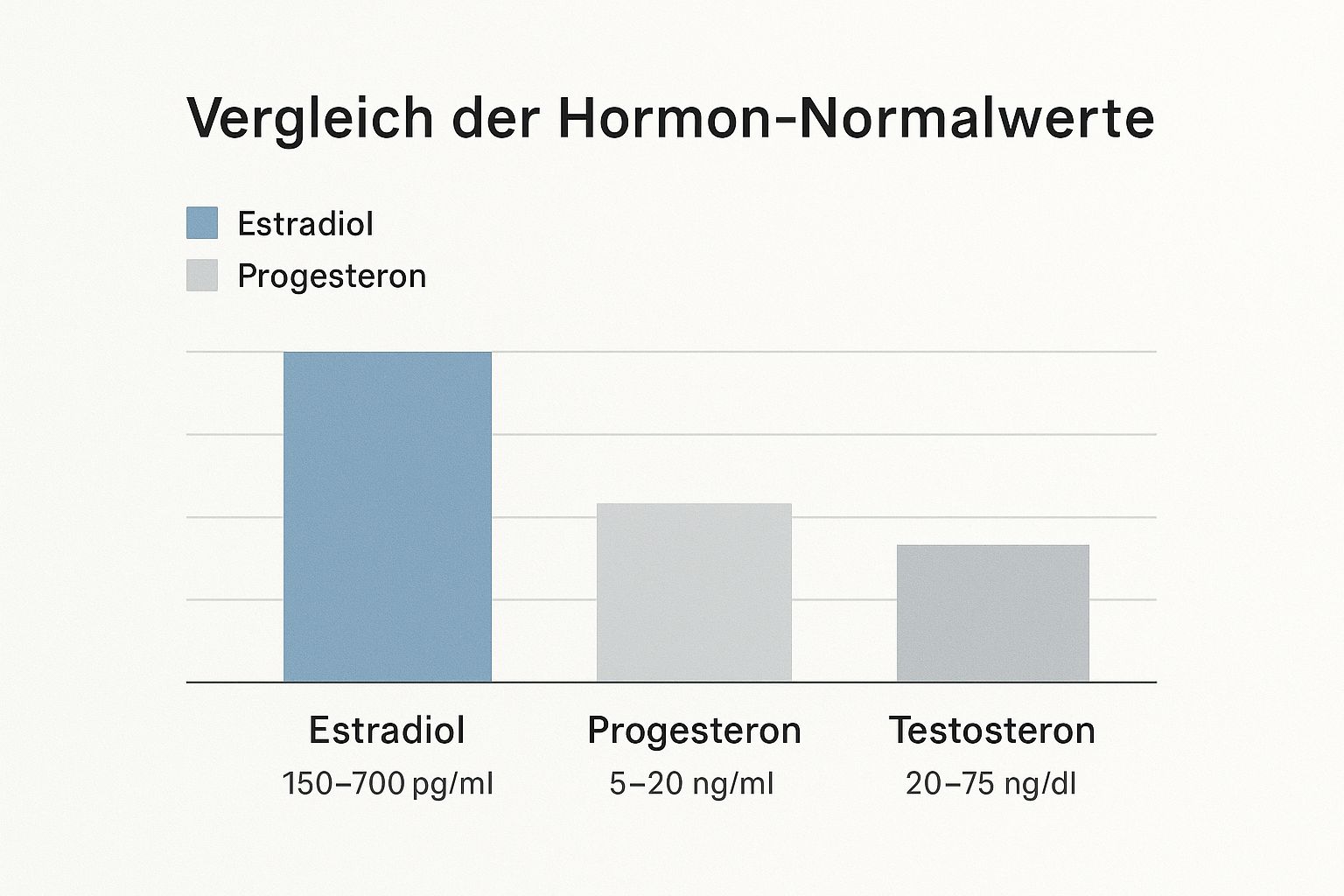
These values serve as a guide and show the range in which concentrations should fall for hormonal balance.
The urine test for hormone breakdown products
The urine test is another highly specialized method, usually performed as a 24-hour urine collection. Instead of measuring the hormones directly, this test primarily looks at their metabolites, or breakdown products.
This gives you deep insight into how your body metabolizes hormones. It’s like checking not only how much gas is in the tank (the blood test), but also how efficiently the engine burns it and what exhaust it produces.
This method is particularly valuable for determining whether hormones are being broken down correctly or whether your body may be taking potentially unfavorable metabolic pathways. It is often used in preventive medicine and for highly complex hormonal questions.
Comparison of hormone testing methods
To make the decision easier for you, we’ve compared the most common hormone testing methods directly here. This way, you can see at a glance what each test can do.
| Test method | What is measured? | Advantages | Disadvantages |
|---|---|---|---|
| Blood test | Bound & free hormones | Gold standard for many hormones, highly accurate, well researched | Snapshot, invasive (blood draw), may be inaccurate when hormones fluctuate significantly |
| Saliva test | Only free, active hormones | Non-invasive, easy to perform at home, ideal for daily profiles (e.g., cortisol) | Not suitable for all hormones, less standardized than blood tests |
| Urine test | Hormone breakdown products (metabolites) | Provides insight into hormone metabolism, good for complex questions | Complex sample collection (24h), does not measure direct hormone levels |
Every test therefore has its justification. The choice depends entirely on your symptoms and your personal concerns. If you want to compare the different options for an at-home test, you can find a good selection of various hormone tests here.
Ultimately, every hormone test for women has its own specific purpose. It is best to discuss which method is right for you with your doctor or an experienced therapist.
What happens during a hormone test at the doctor’s office?

A hormone test for women is far more than just a simple blood draw. It is better viewed as detective work aimed at getting to the true causes of your symptoms. So that you know exactly what to expect and feel confident, we will examine the entire process at the doctor’s office step by step.
The process does not start with the needle but with a conversation. Your doctor will conduct a detailed medical history consultation. This may be the most important part of the whole process, because your symptoms, circumstances, and medical history provide the crucial clues as to which hormone levels are relevant in the first place.
Think of this conversation like the work of a detective. Every piece of information—from cycle irregularities and sleep problems to your stress level and eating habits—is a piece of the puzzle. The more open and detailed you are, the clearer the overall picture of your hormonal situation becomes.
The right timing is everything
One absolutely crucial factor for a meaningful result is timing. The female hormonal system is not a rigid structure but a dynamic system that is constantly changing—especially over the course of the menstrual cycle. Measuring on the wrong day can completely distort the results and is essentially worthless.
Here are a few examples of why timing is so critical:
- Progesterone levels: To find out whether ovulation has occurred, progesterone is measured in the second half of the cycle, typically around day 21 of a 28-day cycle. On any other day, the level would naturally be low and would not be meaningful.
- Estrogen levels: The concentration of this hormone fluctuates significantly throughout the cycle. Depending on the question—whether it concerns fertility or menopause—a different time will be chosen for the measurement.
- Cortisol: The stress hormone follows a clear daily rhythm. Levels are highest in the morning and fall toward evening. A single measurement without taking the time of day into account is therefore hardly meaningful.
Your doctor will therefore determine the optimal time for the test individually, based on your cycle and symptoms.
A hormone test is always just a snapshot. Choosing the right time ensures that this snapshot really captures what matters, rather than just random fluctuations.
Preparing for the test
To ensure that the results are not distorted, thorough preparation is essential. Your doctor will give you precise instructions, which you should follow carefully. Usually, they cover the following points:
- Fasting: For some measurements, especially thyroid hormones or insulin, you must come to the blood draw fasting. This means: Do not eat anything for 8–12 hours before the appointment, and drink only water or unsweetened tea.
- Medication break: Certain medications, especially birth control pills and other hormone preparations, can significantly affect the test results. Your doctor will discuss with you whether you need to stop taking them before the test and, if so, for how long.
- Avoid stress: Since stress can raise cortisol levels, you should try to avoid particularly stressful situations on the day of the blood draw.
The evaluation and the conversation afterward
After the sample is collected, it is sent to a specialized laboratory. The analysis usually takes a few days to a week. Once the report is available, you will be invited to a follow-up appointment to discuss everything.
A laboratory report lists your values alongside so-called reference ranges. These indicate what is considered “normal.” But beware: A value within the normal range does not automatically mean that everything is fine for you. Your personal range in which you feel well may be completely different.
Your doctor will interpret the results in the context of your symptoms and medical history and explain what they mean for you. For women who want an even deeper insight into their hormone status, comprehensive at-home tests are also available. One option, for example, is the Women’s Hormone Vital Check, which covers a broad range of relevant values and helps you understand your body even better.
The problem with at-home hormone self-tests
At-home hormone tests sound tempting: quick, convenient answers to pressing health questions. Ordered with just a click and completed using a saliva or blood sample, they seem like the perfect solution when you are looking for clarity about menstrual irregularities, persistent fatigue, or skin problems. But as simple as the idea may seem, experts are sounding the alarm.
The desire for quick answers is completely understandable. The problem is that the results of these self-tests often need to be treated with great caution. The fundamental issue is the lack of scientific basis behind many of these testing methods, which can quickly lead to misleading results. A single hormone level, viewed in isolation and without professional interpretation, is useless at best—and harmful at worst.
The danger of misinterpretation
Imagine that your test result shows a low progesterone level. Without medical background knowledge, you might jump to the conclusion that you now need progesterone cream from the internet. But what the test does not tell you is this: Perhaps you simply took the sample on the wrong day of your cycle. Or perhaps the low level is actually the result of chronic stress, which is the true cause of your symptoms and should be treated.
Such misinterpretations can trigger unnecessary fears, lead to incorrect self-diagnoses, and result in self-directed treatment attempts that can harm your health. A hormone level is not a fixed number, but the result of an incredibly complex interplay that only an expert can correctly interpret in the context of your overall health.
A single lab result is not a diagnosis. Only when combined with a detailed medical history, a physical examination, and a doctor's expertise does a meaningful overall picture of your hormonal health emerge.
That is precisely why professional associations are increasingly warning against the unconsidered use of such kits. In October 2024, for example, the German Society for Endocrinology (DGE) issued a clear warning against commercial hormone self-tests. The DGE points out that many of these tests have not been validated and can produce incorrect results, ultimately leaving those affected even more confused and alone with their questions. You can read the experts’ official assessment on endokrinologie.net.
When medical expertise is indispensable
A hormone test for women is a medical diagnostic tool. Interpreting it requires extensive specialist knowledge, because a doctor or endocrinologist takes crucial factors into account that a home test can never capture:
- The right timing: As already mentioned, the day of your cycle and even the time of day are absolutely crucial for accurately measuring certain hormones.
- Your individual life situation: Factors such as your stress level, diet, sleep quality, and medication use have a huge impact on your hormone levels.
- Your clinical symptoms: Your symptoms are the most important indicator. A doctor compares your laboratory results with your symptoms to find the actual cause—not just treat one symptom.
Of course, there are exceptions. Ovulation tests when trying to conceive, for example, serve a very clear, simple purpose. But as soon as complex symptoms are involved, visiting a specialist’s practice is essential to obtain a reliable diagnosis and effective treatment. This is the only way to protect yourself from misdiagnoses and the consequences of incorrect self-treatment.
The most frequently asked questions about hormone tests for women
A hormone test for women often raises very practical questions. Feeling uncertain before your doctor’s appointment or about the costs is completely normal. To help you be well prepared and know exactly what to expect, we have compiled the most important answers for you here.
How much does a hormone test for women cost?
The question of costs is naturally one of the first to arise, and the answer is not always straightforward. In general, if there is a clear medical suspicion of a hormonal disorder, statutory health insurance providers usually cover the cost of the test.
This is the case, for example, with:
- Persistent cycle disorders or if your period fails to occur
- An unfulfilled desire to have children
- A suspected thyroid condition
- Symptoms that clearly indicate menopause
However, if you want to take the test purely as a precautionary measure, without specific symptoms, or have it performed at your own request as an IGeL service (individual healthcare service), you will usually have to cover the costs yourself. Depending on the range of hormones tested, this can cost between 30 and more than 150 euros. An open conversation with your doctor and a quick inquiry with your health insurance provider will quickly clarify the situation.
Which doctor performs a hormone test?
In most cases, your first and best point of contact is your gynecologist. They know your medical history and menstrual cycle and can directly assess and clarify many hormone-related questions. Your general practitioner can also be a good first point of contact, especially when the symptoms are rather nonspecific, such as constant fatigue.
For more complex hormonal disorders that go beyond the gynecological field, an endocrinologist is the right specialist. They specialize in the entire hormonal system and are therefore the best person to see for problems with the thyroid, adrenal glands, or diabetes.
Do I need to fast for a hormone test?
A very important question for proper preparation! The answer is: it depends. Whether you need to fast before having your blood drawn depends entirely on which hormones are being tested.
For measuring thyroid hormones, such as TSH, or insulin, it is often necessary to be fasting. This means you should not eat anything for around 8 to 12 hours before the appointment and should only drink water. However, fasting is not always strictly necessary when measuring most sex hormones, such as estrogen or progesterone.
Don’t worry—your doctor will explain exactly what you need to consider before the appointment. If in doubt, it’s better to ask once too often—this will help ensure that the result isn’t distorted. If you have any other specific questions, you can find additional answers about various tests in our section on frequently asked questions.
Are you looking for a way to proactively shape your health based on sound data? MYBODY Lab GmbH offers scientifically validated tests that can provide important insights into your body—all from the comfort of your home. Discover your options now at https://mybody-x.com.



Share now:
Improve gut health for greater well-being
What to do if your HDL cholesterol is too low?