
Electrolyte loss through sweating: what is really lost
The essentials at a glance
Sweat contains an average of about 900 milligrams of sodium per liter, ranging from 175 to 1,512 milligrams depending on the individual. This is the figure reported by the sports nutrition working group of the German Nutrition Society (2019). The loss therefore primarily concerns sodium, and it varies greatly from person to person.
Trace elements are different. A review in the journal Temperature concludes that sweat-related deficiencies in trace elements and vitamins pose minimal risk (2019). The widespread claim that sweating primarily depletes magnesium is therefore not supported.
You’ll first read about what sweat actually is. Then comes a comparison of the three ways losses occur, the documented composition, the figures for volume and sodium, the question of when replacement is even worth discussing, three common statements fact-checked, and the limits of measurement.
What to expect in this article
1. What sweat is and what it is for
2. Why sweat changes on its way out
3. Three groups of substances, three very different losses
4. What is actually needed during exertion
5. How the body adapts to heat
6. Sweat and sodium in numbers
7. When replacement is even worth discussing
8. The mistake that is more dangerous than the loss
9. Three statements about sweating fact-checked
10. What a blood test can show here
11. Limits: what cannot be measured
12. What matters when sweating
Frequently asked questions
Sources
What sweat is and what it is for
Sweating is the most effective cooling mechanism the body has. When fluid evaporates from the skin, it removes heat, keeping body temperature within a safe range. Everything else in sweat is a by-product of this task.
The MSD Manual quantifies how much this cooling can be ramped up in its professional edition: under heat stress, sweat production rises from negligible levels to more than two liters per hour (2025).
Key takeaway
When sweating, the body primarily loses water and sodium. For trace elements such as zinc, copper, and iron, the risk of a sweat-related deficiency is minimal according to the available review.
Why salt is carried along in the first place
Sweat forms as fluid diverted from the space between cells. Whatever is dissolved there initially comes along. The body reclaims some of it on its way out, but not all of it.
How much is reclaimed depends on the rate. Baker’s review in the journal Temperature notes that higher sweat rates are associated with proportionally lower reabsorption rates, resulting in higher electrolyte concentrations in the final sweat (2019).
Why sweat changes on its way out
This section may sound like a minor technical detail, but it is the reason incorrect figures circulate online. The fluid produced in the sweat gland is considerably saltier than the sweat that ultimately reaches the skin.
A considerable portion of the sodium is reabsorbed on its way through the sweat duct. Anyone who cites the values from the first stage and presents them as the composition of sweat arrives at a multiple of the actual loss.
A second source of error lies on the skin
Baker also describes a measurement problem that undermines many widely circulating figures: contamination from the skin’s surface led to reported concentrations of trace elements such as iron and calcium that were two to five times higher (2019).
So if you read that sweat contains surprisingly much calcium or iron, you may be reading a measurement of the skin rather than the gland. This is not a peripheral issue but the crux of the debate about trace elements in sweat.
Three substance groups, three very different losses
Not everything found in the blood is lost through sweating to a comparable extent. The table compares the three groups according to the same four criteria.
| Criterion | Water | Sodium | Trace elements |
|---|---|---|---|
| How much is lost | 0.3 to 2.5 liters per hour, depending on exercise intensity and climate | On average, around 900 milligrams per liter of sweat | No reliable quantity given in the sources reviewed |
| How well supported | Good, with ranges and example calculations | Good; mean and range of 175 to 1,512 milligrams per liter | Low. Measurements are distorted by skin contamination |
| Risk of deficiency | In reality, during prolonged exercise; measurable performance declines from 2 to 4 percent weight loss | In reality, significant with a very high sweat rate over several hours | Minimal according to the 2019 review |
| What the body does in response | Thirst and reduced urine output | Reabsorption in the sweat duct; in addition, adaptation to heat | Reabsorption; in addition, the initial amounts are very small |
The third column is the key finding of this article. It contradicts what is stated on most electrolyte powder packages.
What is actually needed during exercise
In 2019, the Sports Nutrition Working Group of the German Nutrition Society published a position paper on this topic. One sentence from it answers the question addressed in most advertising copy.
Documented source
“The intake of other minerals or vitamins during exercise is not necessary.”
Sports Nutrition Working Group of the German Nutrition Society (DGE)
Fluid management in sport, position paper, 2019
This refers to everything except water, carbohydrates, and sodium. In this list, magnesium, calcium, zinc, and potassium are among the other minerals whose intake during exercise is not necessary.
How the body adapts to heat
Salt loss through sweat is not a fixed quantity. It decreases when someone is regularly exposed to exertion in the heat. The MSD Manual quantifies this effect clearly: With heat acclimatization, sodium levels in sweat decrease by up to 60 percent (2025).
The adaptation takes time. According to the same source, acclimatization generally requires seven to fourteen days in the hot environment.
What this means in practice
Someone experiencing the first warm week of spring loses more salt at the same level of exertion than in midsummer. The same applies to someone who flies directly from winter to a warm holiday destination and immediately exercises there.
The reverse conclusion is equally useful. Anyone who has been working or training in the heat for weeks has already significantly reduced their losses without doing anything to cause it. The body regulates this itself if you give it two weeks.
Why the adaptation works at all
The body improves sodium reabsorption in the sweat gland's duct. So you do not sweat less—in fact, the opposite—but your sweat contains less salt. Cooling performance is maintained while the loss decreases.
This explains an everyday observation familiar to many people. In spring, sweat stings the eyes and leaves white marks on dark clothing; in midsummer, noticeably less so. The amount is the same; the composition is not.
Sweat and sodium in numbers
The following three figures come from the DGE working group's position paper and describe the same process. They are the only reliable figures this article has to offer.
Sweat in numbers
900 mg
Average sodium per liter of sweat, ranging from 175 to 1,512 mg per person
0,3–2,5
Liters of sweat per hour, depending on exertion, climate, and the individual
2–4 %
Fluid loss as a percentage of body weight at which impaired performance can be expected
Source: Sports Nutrition Working Group of the German Nutrition Society, Fluid Management in Sports, as of 2019
What the range means
The range from 175 to 1,512 milligrams is almost ninefold. Two people can lose vastly different amounts of salt during identical exertion, and neither of them will notice.
That is why the DGE position paper also states that blanket recommendations for fluid intake during sports make little sense, because fluid losses vary greatly both between individuals and within the same person.
A calculation for context
One hour of running at 10 kilometers per hour means that, according to the example values in the DGE position paper, a person weighing 70 kilograms loses around 0.79 liters of sweat in cool weather and 0.89 liters in warm weather. Using the average of 900 milligrams of sodium per liter, that amounts to approximately 710 to 800 milligrams of sodium.
For comparison: The DGE's estimated value for an appropriate sodium intake is 1,500 milligrams per day, while actual intake in Germany is significantly higher. An hour of running therefore costs less sodium than many people already consume in excess every day.
Chapter at a glance
Sweat contains an average of around 900 milligrams of sodium per liter, with individual values ranging from 175 to 1,512 milligrams. The sweat rate ranges from 0.3 to 2.5 liters per hour. An hour of running therefore costs roughly 700 to 800 milligrams of sodium—less than the daily estimate of 1,500 milligrams. Performance declines can be expected from a fluid loss of 2 to 4 percent of body weight, and most recreational athletes never approach this point.
When replacement is even worth discussing
The DGE position paper specifies clear thresholds. For exertion lasting less than 30 to 40 minutes, fluid intake is therefore not necessary, and minor fluid deficits are tolerable during exercise.
The second threshold is one hour. Anyone who starts adequately hydrated does not need to drink anything during endurance exercise lasting up to 60 minutes, according to the same position paper. Sodium is recommended only after about one and a half hours of exercise and when the sweat rate is high.
Where heat work is different
A different scale applies to people who work in the heat. The MSD Manual gives a clear figure here: workers, soldiers, endurance athletes, or other people who sweat heavily can lose 20 grams or more of sodium per day (2025).
Twenty grams is more than thirteen times the daily estimate. At this magnitude, replacement is no longer a matter of optimization but part of occupational safety. This explicitly does not apply to one hour of recreational exercise.
After exertion, the plate is usually enough
The position paper also offers reassurance about what comes afterward. If body weight has decreased by less than five percent, the DGE says that consuming normal meals and snacks combined with sufficient water intake is enough to restore fluid and electrolyte balance.
Five percent is three and a half kilograms of weight loss at 70 kilograms in a single session. Anyone who reaches that point knows it. Everyone else is adequately served by a normal dinner.
What can be in the glass instead
The DGE position paper identifies an alternative that appears in no advertising brochure because it costs nothing: fruit juice spritzers made from one part fruit juice and two parts high-sodium, low-carbonation mineral water are well suited as rehydration drinks.
Two details in this sentence are often overlooked. The mixing ratio is one part to two, not half and half, and the mineral water should be high in sodium. Anyone who drinks a ready-made spritzer made with low-sodium water has a drink without the component in question.
For the rare cases in which a drink during exercise is useful, the same source specifies a composition of 4 to 8 percent carbohydrates and 400 to 1,100 milligrams of sodium per liter. These are figures against which a label can be checked.
The mistake that is more dangerous than the loss
During prolonged endurance exercise, drinking too much is a greater risk than drinking too little. In the German Journal of Sports Medicine, Scheer and Hoffman describe exercise-associated hyponatremia as a serum sodium concentration below 135 mmol/L during or up to 24 hours after exercise (2018).
The frequency is surprising. According to the same study, the incidence varies by sport, from 11 percent in the Ironman Triathlon to 51 percent after a 161-kilometer ultramarathon; rates of up to 70 percent have been reported among rowers at a training camp.
Why this has little to do with salt loss
The authors cite hyperhydration caused by excessive fluid intake, together with an inappropriate release of the hormone arginine vasopressin and the resulting water retention, as the cause. The sodium is therefore diluted, not sweated out.
The authors’ recommendation is correspondingly simple: drinking according to thirst is an effective prevention strategy. Anyone who follows this sensation instead of a predetermined amount will not make this mistake.
Exercise-associated hyponatremia is a serious condition and requires medical treatment. Anyone who notices nausea, headaches, or confusion after prolonged exercise should not continue drinking, but should seek medical attention.
Three statements about sweating, fact-checked
The following three statements appear in almost every text on the subject. All three are so widespread that they are hardly questioned anymore.
Checked against the evidence
Widespread
“When you sweat, you mainly lose magnesium, which is why you get cramps.”
Proven
According to the review in Temperature, sweat-related deficiencies of trace elements and vitamins pose a minimal risk (2019). We did not find a reliable figure for magnesium loss through sweat in the sources examined.
Widespread
“Anyone who sweats a lot needs an electrolyte powder.”
Proven
According to the DGE position, no fluid intake at all is required during exercise lasting up to 60 minutes, nor are any additional minerals (2019).
Widespread
“In hot weather, you should drink plenty of fluids as a precaution.”
Proven
During endurance exercise, excessive drinking is the cause of exercise-associated hyponatremia. Drinking according to thirst is considered an effective prevention strategy (Scheer and Hoffman, 2018).
The first point deserves an addition, so that reassurance does not become a free pass. The fact that we found no figure does not mean that no magnesium is lost through sweat. It means that no one has reliably quantified this loss and that the available measurements are distorted by skin contamination.
What a blood test can show here
A blood test does not measure how much you have sweated. It shows where your concentrations stand at the time of sampling, and shows them together with the other electrolytes and trace elements.
A blood test does not measure how much you have sweated.
The converse is also true. Baker's review notes that the usefulness of sweat composition as a biomarker of human physiology is currently limited because further research is needed to determine possible relationships between concentrations in sweat and blood (2019).
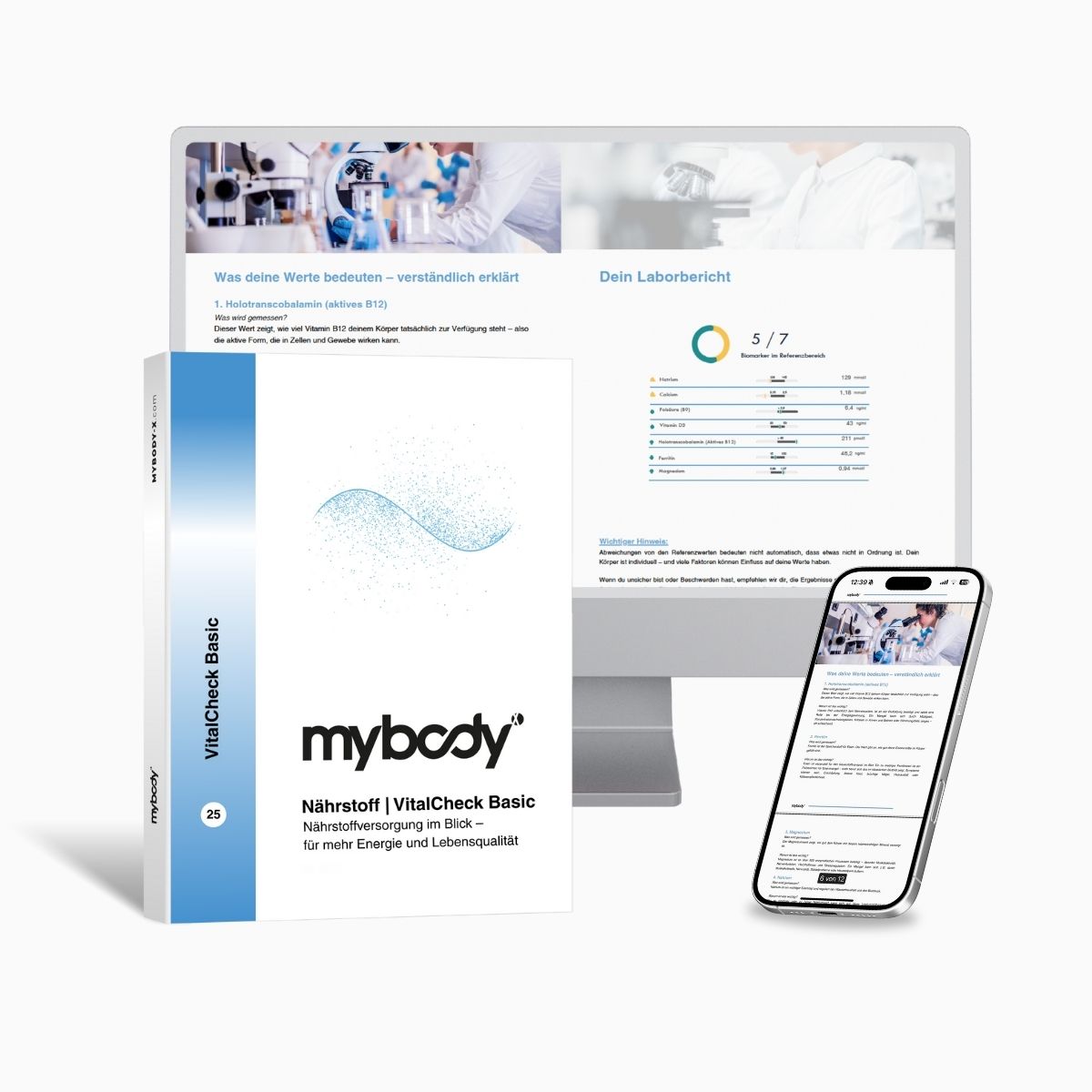
Capillary blood test
BalanceCheck | Electrolytes & minerals test
15 elements from a blood sample: sodium, potassium, calcium, magnesium, and phosphorus, plus six trace elements and four heavy metals. What the test does not do: It does not measure sweat loss or answer how much you have sweated. It does not provide a diagnosis, and there is no evidence-based indication for routine electrolyte testing in healthy recreational athletes.
Laboratory analysis 3–5 business days after sample receipt
Product page information, accessed 08/11/2026
A measurement is useful when there is a specific reason for it. The following four points describe what needs to be clarified beforehand.
Estimate the duration of exercise honestly
For exercise lasting less than an hour, electrolyte replacement is not an issue according to the available evidence. Only beyond that does the question become relevant at all.
Weigh yourself before and after exercise
The difference in body weight is the only practical estimate of fluid loss. One kilogram corresponds to roughly one liter.
Wait two weeks for acclimatization
In hot conditions, sodium loss through sweat decreases by up to 60 percent after seven to fourteen days. Before then, every measurement is only a snapshot.
Get severe sweating checked
Excessive sweating without cause, on one side of the body, or accompanied by fever belongs in a medical practice, not in a self-test.
Limitations: what cannot be measured
Individual salt loss through sweat cannot be determined outside a laboratory. The range of 175 to 1,512 milligrams per liter means that any calculation based on the average could be far off for you personally.
There is no data basis at all for trace elements. In the sources we reviewed, we found no reliable concentrations for magnesium and calcium in sweat, and the available measurements are distorted by skin contamination. That is why this article gives no figure for them.
A blood test does not close this gap either. It measures concentrations, not losses, and only at one point in time. For healthy recreational athletes, none of the sources reviewed contains a recommendation for routine blood electrolyte testing.
Another limitation concerns sweating itself. Excessive sweating can be harmless, but the MSD Manual points out that diffuse sweating, when accompanied by relevant findings, can also suggest infections, disorders of the endocrine system, or cancer, and that an asymmetric sweating pattern indicates a neurological cause (2024). Neither can be clarified by a blood test.
This list may read like an argument against measuring. It is not. It is an argument against expecting one value to represent a loss that is not actually present in the blood.
What matters when you sweat
If you take away one practical step from this article, let it be this: Weigh yourself once before and once after a typical training session, without clothes and without drinking in between. The difference in kilograms roughly corresponds to your fluid loss in liters.
The reason is unremarkable. This one figure tells you more about your personal loss than any average from an article, and it costs nothing except a set of scales. If it is below two percent of your body weight, the question of whether you need replacement is answered for you.
It began with the question of what is lost through sweating. The most honest answer is: water and salt—and less salt than advertising claims might suggest. For everything else, there is still no figure.
Frequently asked questions
How many electrolytes do you lose when you sweat?
Sodium, above all. The DGE’s Sports Nutrition Working Group puts the average sodium content of sweat at around 900 milligrams per liter, with an individual range of 175 to 1,512 milligrams (2019). The sweat rate ranges from 0.3 to 2.5 liters per hour. According to a review in Temperature, sweat-related deficiencies of trace elements pose a minimal risk (2019).
Do you lose a lot of magnesium when you sweat?
We found no evidence of this in the sources reviewed. The available review classifies sweat-related deficiencies in trace elements and vitamins as a minimal risk and points out that measurements can be distorted two- to fivefold by skin contamination (2019). The common explanation that sweating depletes magnesium and thereby causes cramps is therefore not supported.
When should electrolytes be replaced?
According to the DGE position statement, no fluid intake is necessary during exertion lasting less than 30 to 40 minutes, and anyone who starts adequately hydrated does not need to drink during endurance exercise lasting up to 60 minutes. Sodium is recommended only after about one and a half hours of duration and when sweat rates are high. According to the same source, consuming additional minerals or vitamins during exertion is not necessary (2019).
Can you drink too much during exercise?
Yes, and during prolonged exertion this is a serious risk. Scheer and Hoffman describe exercise-associated hyponatremia as a serum sodium concentration below 135 mmol/l during or up to 24 hours after exercise (2018). Depending on the type of sport, incidence ranges from 11 percent in the Ironman to 51 percent after a 161-kilometer ultramarathon. The authors cite excessive fluid intake as the cause. They recommend drinking according to thirst.
Does salt loss change when you are accustomed to the heat?
Yes, significantly. The MSD Manual states that sodium levels in sweat decrease by up to 60 percent during heat acclimatization and that this adjustment generally requires seven to fourteen days in the hot environment (2025). Someone who goes straight from winter into a warm climate and immediately exercises there therefore loses more salt under the same workload than they would after two weeks.
Next step
The scale first, everything else second
If you have a specific reason after weighing up the situation to look at your electrolytes together, the BalanceCheck measures them along with trace elements. It does not measure sweat loss and does not replace medical evaluation.
Go to BalanceCheck Electrolytes at a glanceRead more
You might also be interested in
What matters after exertion, beyond fluids and salt.
An overview of all electrolytes and their signs.
Sources
- Mosler S, Braun H, Carlsohn A et al. (DGE Sports Nutrition Working Group): Fluid management in sports. Ernährungs Umschau, 2019 – dge.de
- MSD Manual, Professional Edition: Heat illness overview, Yip K, Tanen D, Birnbaumer DM (as of 2025) – msdmanuals.com
- Scheer V, Hoffman MD: Exercise-associated hyponatremia. German Journal of Sports Medicine 10/2018 – zeitschrift-sportmedizin.de
- Baker LB: Physiology of sweat gland function. Temperature 6(3), 2019 – pmc.ncbi.nlm.nih.gov
The verbatim quotation regarding the intake of additional minerals, information on sodium in sweat, sweat rate, exertion thresholds, the performance limit at 2 to 4 percent, and rehydration after exertion comes from source [1]. Maximum sweat rate, sodium loss during heat work, and information on heat acclimatization come from [2]. The definition, incidence, and cause of exercise-associated hyponatremia, as well as the recommendation to drink according to thirst, come from [3]. The assessment of sweat-related trace element deficiencies, the note on skin contamination, the relationship between sweat rate and reabsorption, and the statement regarding the limited suitability of sweat as a biomarker come from [4]. The information on warning signs of excessive sweating comes from the MSD Manual, Professional Edition, Hyperhidrosis (as of 2024); the estimated sodium intake is based on the DGE reference values (2016 derivation). Both are attributed in the text with the institution and year. Information on price, biomarkers, sample type, and laboratory comes from the mybody®x product page, accessed on 11 August 2026; processing times follow the central guideline for blood tests. All sources were accessed and reviewed on 11 August 2026.

mybody®x Editorial & Expert Team
Laboratory diagnostics Nutritional science Blood analysis interpretation Nutrigenetics
This article was created by the mybody®x editorial and expert team. The team combines laboratory diagnostics, nutritional science, and the interpretation of blood analyses. Everyone involved can be found on the authors' page.
Published on 11 August 2026 · Last updated on 11 August 2026
The content is provided for general information and does not replace medical advice, diagnosis, or treatment. Reference ranges depend on the laboratory, method, and age; the information on your test report is always authoritative.


Share now:
Zinc deficiency symptoms in women: what is and isn’t proven
Gene diet is a marketing term, not a technical term.