
Understanding & optimizing ferritin levels: Your guide to normal iron levels
Do you often feel tired, unfocused, or perhaps even struggle with hair loss? The key to these problems could be hidden in your blood—more specifically, in your ferritin level. Think of ferritin as the central iron warehouse in your body. If this warehouse is well stocked, you have plenty of energy for the day. But if it is empty, you feel the effects throughout your body. Many people have heard the term ferritin before but do not know exactly what it means or which levels are normal. This guide provides you with clear, practical information.
What your ferritin levels really mean

When you hear “iron deficiency,” you probably first think of the iron currently circulating actively in your bloodstream. But that is only half the story. Much more revealing is a look at your ferritin levels, because they show how well your strategic iron stores are actually filled.
You could compare it to your personal finances: The iron in your blood is like cash in your wallet—practical for immediate use, but quickly spent. Ferritin, on the other hand, is your savings account. It is the iron reserve your body only draws on when its daily intake is insufficient.
To make the whole topic more tangible, we have summarized the most important aspects of ferritin in an overview.
Ferritin at a glance
This table summarizes the core functions and significance of ferritin to give you a quick overview.
| Aspect | Explanation |
|---|---|
| What is ferritin? | A protein complex that stores iron in the body. It is the main storage site for iron. |
| Function | Acts as a buffer, enabling the body to be supplied with iron quickly when needed. |
| Significance | A low value is an early warning sign of developing iron deficiency. |
| Measurement | Determined through a simple blood test. |
These values therefore provide not just a snapshot, but deep insight into the security of your long-term supply.
More than just a blood value
A healthy ferritin level is the foundation for countless processes that go far beyond simply supplying oxygen. Your body relies on full iron stores for:
- Energy production: Iron is a central building block for energy production in cells. Depleted stores almost inevitably lead to tiredness and exhaustion.
- Cognitive performance: Do you often feel “foggy” in the head? Your concentration and memory depend heavily on an adequate iron supply.
- Healthy hair & nails: Cells that divide rapidly—such as those in the hair roots—are true iron guzzlers. Hair loss and brittle nails are therefore classic warning signs of depleted stores.
- A strong immune system: Your immune defenses also need sufficient iron to fight infections effectively.
I have experienced firsthand how a low ferritin level completely drained my energy. This constant fatigue was not a sign of weakness but a clear signal from my body: The stores are empty! So you are not alone.
A low ferritin level is often the very first sign of developing iron deficiency—long before the blood count itself becomes abnormal. Think of it as your body’s early warning system.
Why you should know your level
The greatest advantage of keeping an eye on your own ferritin levels is prevention. Instead of waiting until you have to deal with pronounced deficiency symptoms, you can take proactive action. This is especially important if you belong to a risk group, for example because of a plant-based diet, heavy menstrual bleeding, or intense exercise. For you, this value is an indispensable health indicator.
With modern nutrient tests, such as the iron deficiency ferritin self-test for home use, you can now conveniently check this important value from home. This gives you the control to identify early on whether action is needed and take targeted measures—long before a serious deficiency becomes apparent. In the following sections, we will show you which values are normal and what you can specifically do if they deviate.
Normal ferritin levels for women and men
If you have ever held a lab report in your hands, you may know the feeling: a list full of numbers and technical terms that raises more questions than it answers. Confusion can be especially great when it comes to ferritin levels, because what is completely normal for one person may already be a warning sign for another. Let’s shed some light on the subject together and clarify what these values really mean.
First of all: Normal ferritin ranges are not one-size-fits-all. They differ considerably depending on age, sex, and even stage of life. This is not a flaw in the system, however, but is rooted in clear biological reasons.
Why are there differences between the sexes?
The most noticeable difference is between women and men. Men naturally tend to have significantly higher iron stores. The main reason is that women of childbearing age regularly lose iron through monthly menstruation. This continuous, natural blood loss repeatedly draws on iron stores and therefore tends to keep ferritin levels lower.
Once menopause begins and this monthly loss stops, women’s ferritin levels often become similar to men’s and rise noticeably. A value of 20 µg/L may therefore be within the lower normal range for a young, athletic woman. The same value in a middle-aged man, however, would already indicate a significant deficiency.
A “normal” ferritin level is therefore always relative. It must be considered in the context of your sex, age, and personal circumstances.
This infographic shows you the typical reference ranges and when levels become critical at a glance, giving you quick guidance.
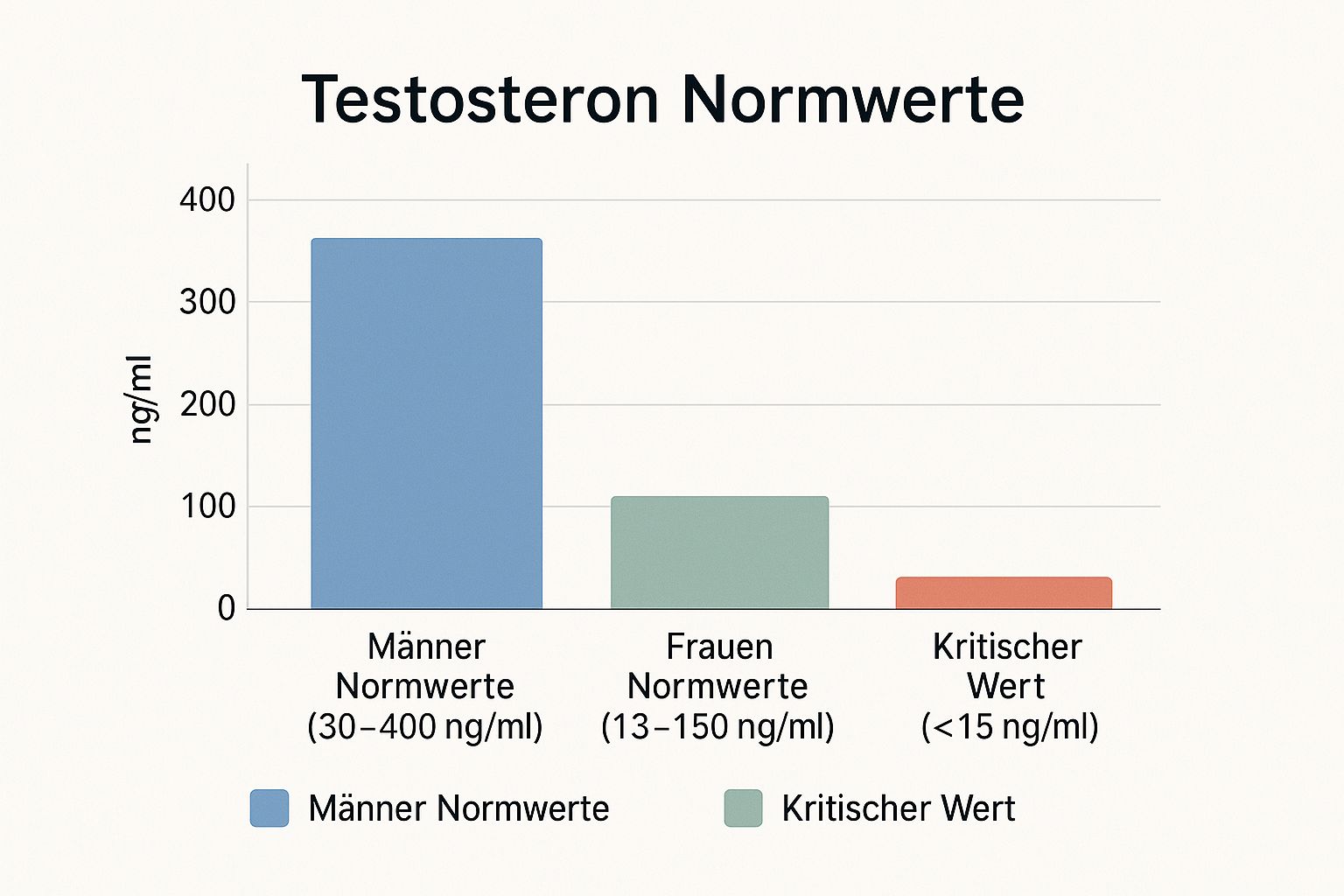
The diagram makes clear how different the reference ranges are for men and women and highlights when a value is classified as critically low.
The official reference values at a glance
To give you an even more precise idea, let’s take a look at the usual laboratory ranges. To assess iron status accurately, ferritin reference ranges in Germany are defined according to sex and age. For men between 17 and 60 years of age, the reference range is 15 to 300 µg/L; in older men, it can even rise to 400 µg/L. For women in the same age group, values of 15 to 200 µg/L are considered normal, while after the age of 60, this value can also increase to as much as 250 µg/L.
However, these ranges are only guidelines. Many experts agree that the lower limit of 15 or 20 µg/L is actually set far too low. Even at values below 50 µg/L, many people—especially women—experience initial symptoms such as fatigue, difficulty concentrating, or hair loss.
- Optimal range: Many functional medicine practitioners and therapists aim for a value between 50 and 100 µg/L. The goal here is not merely to prevent a deficiency, but to ensure genuine well-being and full performance.
- Gray area: Values between 15 and 30 µg/L are considered latent or incipient iron deficiency. The stores are almost empty at this point, even though the complete blood count (hemoglobin) may still be unremarkable.
- Severe deficiency: A value below 15 µg/L is a clear sign of iron deficiency, which is often already accompanied by anemia.
The best way to gain clarity about your personal status is to get tested. If you are unsure and notice initial signs, an at-home iron deficiency ferritin self-test can provide simple and quick initial guidance. This allows you to check for yourself whether your iron stores are well filled and, if necessary, seek targeted advice from your doctor.
Low ferritin levels: The signs and their causes

Do you often feel as though you are going through the day with the handbrake on? As if your internal battery is constantly running on low power? This feeling of chronic exhaustion is one of the most common and clearest signs that your ferritin levels could be extremely low.
But depleted iron stores do not only make themselves known through tiredness. Your body often sends a whole range of subtle but important signals. I have experienced firsthand how a low ferritin level completely drained my energy—so you are not alone. The constant paleness, brittle fingernails, and increasing hair loss were the decisive wake-up calls for me to take a closer look.
The most common symptoms at a glance
The symptoms of low ferritin levels are varied and often nonspecific. That is precisely why they can easily be mistaken for stress or a hectic lifestyle. Keep an eye out for these signs:
- Persistent tiredness and exhaustion: This is the main symptom. Despite getting enough sleep, you simply do not feel rested.
- Pale skin and mucous membranes: A lack of iron-rich blood can quickly make your skin look dull and pale.
- Hair loss: Your hair roots require a great deal of energy and react extremely sensitively to iron deficiency, which can lead to increased hair loss.
- Brittle nails and ridges: Your nails may become soft, split more easily, or develop unsightly vertical ridges.
- Concentration problems and “brain fog”: Iron is essential for cognitive function. A deficiency can lead to memory lapses and difficulty concentrating.
- Shortness of breath during exertion: When your stores are depleted, your body lacks the capacity to transport oxygen. You notice this quickly when climbing stairs or exercising.
- Headaches and dizziness: An insufficient supply of oxygen to the brain can also trigger these symptoms.
- Restless legs syndrome: An unpleasant tingling or an uncontrollable urge to move the legs, especially during periods of rest.
If several of these points sound familiar, taking a closer look at your ferritin levels could be truly informative.
Why are iron stores empty? The most common causes
A low ferritin level does not develop overnight. In most cases, it is the result of a long-term imbalance between iron absorption and iron loss.
It's important to understand that your body only draws on its ferritin reserves when its daily dietary intake is no longer sufficient to meet its needs. Empty stores are therefore a clear sign that this deficiency has been present for quite some time.
The main reasons for low ferritin levels can be broadly divided into three categories:
1. Increased iron loss The most common cause, especially in women, is regular or unnoticed blood loss.
- Heavy menstrual bleeding: Women lose blood and therefore valuable iron during their period. With heavy menstrual bleeding, this loss can easily exceed the amount absorbed through food.
- Pregnancy and breastfeeding: The growing fetus and later breastfeeding require a tremendous amount of iron, which can quickly deplete the mother's stores.
- Hidden bleeding: Chronic, minor bleeding in the gastrointestinal tract, often caused by inflammation or ulcers, can lead to significant iron loss without being noticed.
2. Insufficient iron absorption Sometimes the problem is not iron loss, but simply that too little iron reaches the body.
- Diet: A purely plant-based diet can be challenging. The reason: Iron from plant sources (non-heme iron) is absorbed less efficiently by the body than iron from animal products (heme iron).
- Absorption disorders: Conditions such as celiac disease or chronic inflammatory bowel diseases (e.g., Crohn's disease) can severely impair the intestine's ability to absorb iron.
- Inhibitory substances: Excessive consumption of coffee, black tea, or calcium-rich dairy products directly with meals can effectively block iron absorption.
A large-scale German analysis of more than 120,000 ferritin samples showed that women aged 18 to 45 are particularly likely to have low levels, with an average of just 46.6 µg/L. This highlights how widespread iron deficiency is during this stage of life in particular, which is directly related to the causes mentioned above.
3. Increased need During certain phases of life or with certain activities, the body simply needs more iron than usual.
- Intense exercise: Endurance athletes have an increased need because they lose more iron through sweat and minor muscle injuries.
- Growth phases: Growing children and adolescents need large amounts of iron to produce new blood cells and muscle mass.
The good news is that once you know the cause, you can take targeted action. The first step is always to gain clarity. If you suspect that your symptoms are due to depleted iron stores, it makes sense to have your nutrient levels tested. Modern at-home self-tests offer a simple way to gather initial indications before speaking with your doctor.
What is behind high ferritin levels
While we often focus on low ferritin levels and iron deficiency, it is just as important to know that too much iron can also be a warning signal from your body. High ferritin levels are less common, but they should be taken just as seriously.
But don't panic: A single elevated result does not immediately mean the worst. Instead, see it as an important clue to investigate together with your doctor.
An elevated ferritin level indicates that your iron stores may be overflowing or that something else is going on in your body. The problem? Excess iron can accumulate in organs such as the liver, heart, or pancreas and cause long-term damage there. That is why finding the cause is so important.
The most common causes of iron overload
A high ferritin level can have many different causes. Interestingly, it is often not a sign of true iron overload at all, but rather a reaction by the body to other conditions.
The most important triggers are:
- Inflammation in the body: Ferritin is what is known as an acute-phase protein. This means that during acute or chronic inflammation—whether caused by infections, autoimmune diseases, or injuries—the level shoots up. The body then essentially withholds the iron so that it is not available as food for pathogens. It is therefore more of a defense mechanism than a genuine excess.
- Chronic diseases: Conditions such as chronic liver disease (e.g., fatty liver disease or hepatitis), kidney disease, and some types of cancer can cause ferritin levels to rise.
- Alcohol consumption: Regular and excessive alcohol consumption is toxic to the liver. It damages liver cells, causing more ferritin to be released into the blood, which artificially drives the level upward.
- Iron storage disease (hemochromatosis): This is a genetic metabolic disorder. The body uncontrollably absorbs too much iron from food and stores it. If left untreated, this leads to a gradual but dangerous iron overload of the organs.
The connection with inflammation can make diagnosis somewhat tricky. For this reason, your doctor will often measure additional values such as CRP (C-reactive protein) to get a clearer picture and identify the right path.
Symptoms that may indicate iron overload
The signs of iron overload are often nonspecific and develop gradually over many years. This makes it all the more important to listen carefully to your body's signals.
Possible symptoms may include:
- Unexplained, chronic fatigue and weakness (yes, this can also occur with too much iron!)
- Joint pain, especially in the fingers and hands
- Abdominal pain or a feeling of pressure in the upper right abdomen
- Loss of libido or erectile problems
- Unusual grayish or bronze-colored skin
- Heart problems such as irregular heart rhythms
A high ferritin level is no reason to panic, but it is a clear call to action. It is an important piece of the puzzle in your overall health that must be medically assessed. A single lab value is never a complete diagnosis.
What you should do if your level is high
If your lab report shows an elevated ferritin level, the first and most important step is to stay calm and make an appointment with your doctor. Please do not try to diagnose yourself or take action on your own.
Discuss the next steps with your doctor. They will probably order additional blood tests to rule out inflammation and check other iron values, such as transferrin saturation, as well as liver function. Depending on the results, genetic testing for hemochromatosis or an ultrasound of the abdominal organs may then be advisable.
How to measure your ferritin levels correctly

You recognize the signs, understand the possible causes, and now finally want clarity? Perfect. The most important step is knowing your personal ferritin levels. But how can you obtain this crucial information? Fortunately, there are now several ways to get the answers you need.
The traditional approach involves having blood drawn by a doctor. This is a proven and straightforward method for obtaining highly accurate results. Usually, the ferritin level is not measured on its own; instead, a more comprehensive blood count is performed. This provides you and your doctor with important additional information for the bigger picture.
Seeing a doctor as the gold standard
During a medical examination, additional values are often measured to obtain a complete picture of your iron metabolism. This is crucial for precisely understanding the cause of abnormal values rather than groping in the dark.
- CRP (C-reactive protein): This value is a marker of inflammation. It shows whether acute or chronic inflammation is smoldering in your body. Since ferritin can increase during inflammation, the CRP value helps distinguish whether the high level indicates iron overload or merely inflammation.
- Transferrin and transferrin saturation: Think of transferrin as the “iron taxi” in your blood. The saturation indicates how fully this taxi is loaded. These values therefore show how well your body can use the available iron.
- Hemoglobin (Hb): The classic value for the red blood count. It reveals whether anemia is already present—often the late consequence of prolonged iron deficiency.
Only the combination of these values enables a well-founded diagnosis. It is indispensable if you already have pronounced symptoms or are known to have a chronic condition. The doctor can interpret the results directly and discuss the right strategy with you.
Medical diagnosis is and remains the gold standard for obtaining a comprehensive picture and reliably clarifying the causes of abnormal ferritin levels. Medical supervision is essential when findings are abnormal.
The modern alternative: the iron-ferritin self-test
In recent years, a fantastic alternative has become established for anyone who wants to take a proactive approach to their health: the at-home iron-ferritin self-test. Perhaps you have already heard that various nutrient tests can be carried out yourself. This trend puts you back in control.
A self-test is ideal if you:
- … are simply curious and want to know where you stand.
- … notice initial, mild symptoms such as fatigue or hair loss.
- … want to check your levels regularly as an athlete, vegan, or vegetarian.
- … want to check the success of a dietary change or supplementation.
The process is incredibly simple. At home, you prick your finger with a small lancet to collect a few drops of blood, send the sample to a certified laboratory, and receive your results digitally just a few days later.
Doctor's visit or self-test—which is right for you?
Both options are good and valid. It all depends on your personal situation and your goal. Here is a brief comparison that may help you decide:
| Aspect | Medical diagnosis | Iron-ferritin self-test |
|---|---|---|
| Scope | Comprehensive blood analysis (including CRP, transferrin, etc.) | Focused on the ferritin level |
| Convenience | Appointment and practice visit required | Convenient and discreet from home |
| Speed | Results may take a few days | Results often available within a few business days |
| Application | Ideal for severe symptoms & investigating the cause | Perfect for prevention & regular monitoring |
| Cost | Covered by health insurance (if medically necessary) | Self-pay service |
The good news is that you don’t have to choose just one approach. An iron-ferritin self-test can be an excellent first step toward getting a sense of your levels. If the result is abnormal—either very low or very high—the next step should always be to talk to your doctor. A self-test does not replace a medical diagnosis, but it empowers you to ask informed questions and take an active role in managing your health. If you want to learn more, you can often find helpful answers in the providers’ FAQ sections.
A German data analysis highlights how important this self-monitoring can be. It showed that young women aged 18 to 25 had an average ferritin level of just 52.4 ng/ml. By comparison, men aged 56 to 66 had an average of 241.5 ng/ml. These figures make it clear: Young women in particular face a high risk of depleted iron stores due to menstruation. Regular monitoring is especially useful in this case. You can find more insights in this ferritin data analysis on cerascreen.de.
Frequently asked questions about ferritin and iron deficiency
You now have a good overview of why your ferritin level is so important, what the normal ranges are, and what may be behind deviations. Nevertheless, everyday life often raises very practical questions. That is exactly what we will address now, providing you with quick, clear answers and dispelling any remaining doubts.
We explain how quickly you can replenish your depleted stores, what role your menstrual cycle plays, and whether changing your diet alone is really enough. Every answer is practical and easy to apply—so you can put your knowledge into practice right away and take control of your health.
How quickly can I improve low ferritin levels?
This is probably the most pressing question when the diagnosis “empty iron stores” is on the table. The good news: You can definitely improve your ferritin levels, but it takes some patience. It’s not a sprint but more of a marathon. How quickly it happens depends on several things: your starting level, the method (diet or supplements), and, of course, the cause of the deficiency.
Imagine your iron stores as a large, empty barrel. Changing your diet alone is like slowly filling the barrel with a small cup. It works, but it takes time. With a mild deficiency and a consistent, iron-rich diet, you can often see initial improvements after 8 to 12 weeks.
If you take iron supplements prescribed by a doctor, it is like filling the barrel with a thick hose. The process is significantly faster. In this case, ferritin levels can often increase noticeably within 4 to 6 weeks.
Important: A severe deficiency takes time. It can take three to six months or even longer to completely and sustainably replenish your stores.
Which foods are the best sources of iron?
An iron-conscious diet is the foundation for keeping your ferritin levels stable in the long term. It is crucial to distinguish between the two types of iron:
- Heme iron (from animal-based sources): Your body can utilize this type of iron most effectively. It is, so to speak, the “premium version.”
- Non-heme iron (from plant-based sources): The absorption of this type of iron is less efficient and is more easily inhibited by other foods.
Here are some top sources of iron for your diet:
Animal-based sources (heme iron):
- Red meat: Beef and lamb in particular are true iron powerhouses.
- Liver: Even if it is not to everyone’s taste, liver is one of the richest sources of iron of all.
- Mussels and oysters: Seafood is also an excellent source.
Plant-based sources (non-heme iron):
- Legumes: Lentils, chickpeas, and beans are essential, especially in a plant-based diet.
- Nuts and seeds: Pumpkin seeds, sesame seeds, and flaxseeds are very easy to sprinkle into meals.
- Whole grains: Oatmeal, millet, and quinoa provide valuable iron.
- Dark green leafy vegetables: Spinach and kale are excellent plant-based sources.
Pro tip: Always combine plant-based sources of iron with vitamin C (e.g., from bell peppers, broccoli, or a glass of orange juice). Vitamin C acts as an “absorption booster” and greatly improves the utilization of non-heme iron.
Should I take iron supplements immediately if my ferritin is low?
This question is extremely important, and the answer is a clear: No, not without medical evaluation. Even if the urge is strong to take immediate action when experiencing fatigue and other symptoms, taking high-dose iron supplements on your own is not a good idea.
As you have learned, a low ferritin level can have a wide range of causes, from an improper diet to hidden bleeding. Taking iron without medical supervision could not only mask the underlying problem, but also lead to side effects such as gastrointestinal issues or, in the worst case, trigger dangerous iron overload.
The right approach is always this:
- Measure your levels: Have your levels checked by a doctor or use an iron ferritin self-test to determine your exact status.
- Identify the cause: Discuss the result with your doctor. They will help you find the reason for the deficiency.
- Take targeted action: If necessary, your doctor will recommend the right supplement at the correct dosage.
A self-test can give you valuable initial guidance, but decisions about treatment should always be left to healthcare professionals.
Does my menstrual cycle affect my ferritin levels?
Yes, absolutely! Your cycle has a significant impact on various blood values, and the ferritin level is a prime example. During menstruation, you lose blood and therefore valuable iron. This is the main reason why women of childbearing age often have much lower ferritin levels than men or postmenopausal women.
Studies show that iron markers such as ferritin and hemoglobin are often at their lowest during the second half of the cycle (the luteal phase) and during menstruation itself. Other values, such as the inflammation marker hs-CRP, can also fluctuate depending on the cycle.
What does this mean for you in practice? To ensure that your values are measured as accurately and comparably as possible, it’s smart to have your blood drawn—whether by a doctor or via a self-test—during the same phase of your cycle each time. This prevents natural fluctuations from distorting the results. The first half of the cycle (the follicular phase, i.e. after your period) is often best suited for this.
Your body is a complex system in which many factors interact. Sometimes low ferritin levels are also linked to genetic predispositions that affect how your body processes nutrients. If you’d like to explore your individual constitution in greater depth, a DNA analysis can provide fascinating insights into your personal metabolism and nutritional needs. This will help you understand your body’s signals even better.
Would you like to check your iron status now and proactively support greater energy and well-being? At MYBODY Lab GmbH, you’ll find scientifically backed nutrient tests that you can easily and conveniently carry out at home. Take control of your health – discover the right analyses now.



Share now:
Get your metabolism tested: Your genetic code as the key to greater well-being
What to do about iron deficiency? Your practical guide to more energy