
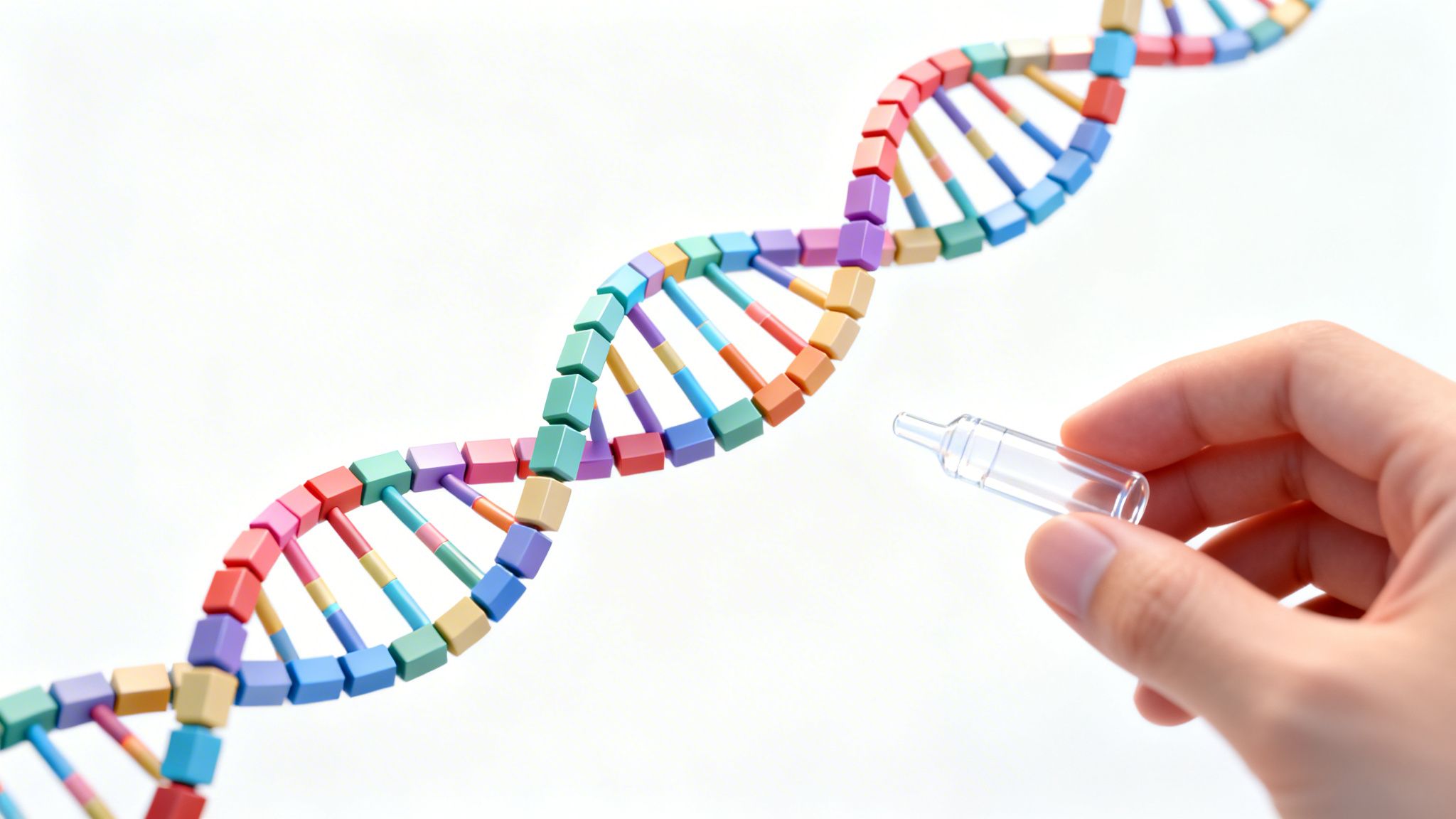
The structure of DNA explained simply and clearly
Imagine that deep within every single cell of your body lies a brilliant code that determines everything—from your hair color to the way you burn energy. That is your DNA. The structure of DNA (deoxyribonucleic acid) is a simple yet brilliant structure—the blueprint for your entire life.
Your personal blueprint decoded
Have you ever wondered why you react completely differently to certain foods than your friends do? Or why some sports come more easily to you while others are a real struggle? The answer lies deep within your cells, more precisely in the structure of your DNA. It is the master plan that determines not only your appearance but also invisible processes such as your metabolism.
You can think of your DNA as a vast digital library. Each book in this library is a gene—a very specific set of instructions for a particular function in your body. One book describes your eye color, another how you process carbohydrates, and yet another how efficiently your muscles generate energy.
Why the structure of DNA is relevant to you
The truly fascinating thing is this: Although the library is basically structured the same way in everyone, the texts in the books differ in tiny details. These small variations are exactly what make you unique. They are why there can be no one-size-fits-all solution for health and nutrition.
The structure of DNA is the key to understanding your individual biological needs. It explains why personalized approaches to nutrition and fitness are often much more effective than general advice.
This is exactly where modern DNA analyses come in. Instead of following one-size-fits-all rules, we can now read your personal blueprint directly. DNA tests, such as those from mybody-x.com, use this knowledge to give you very specific insights. They decode the sections of your genetic code that are crucial to your metabolism, nutrient utilization, and athletic predisposition.
You don't have to be a scientist to use this information for yourself. The goal is to give you a practical tool that helps you take control of your health. When you understand how your body works at the genetic level, you can make targeted adjustments to your diet and lifestyle to achieve your goals—whether that's weight management, more energy, or simply greater well-being. If you would like to explore the fundamentals in more depth, learn more in our article about what genetics actually is and how it affects your everyday life.
Let’s now take apart the structure of DNA step by step, without complicated technical jargon. You’ll see how simple building blocks form a complex information structure and how these insights can help you become the best version of yourself.
The Basic Building Blocks of Your DNA
Every complex system—and your body is one of the most complex of all—consists of simple yet ingenious basic elements. Your DNA is no different. Your entire genetic code, this enormous set of instructions for your body, is based on a single, repeating building block: the nucleotide.
To understand how your genes work, we therefore need to start at the very beginning and take a closer look at this building block.

It is best to think of a nucleotide as a three-part LEGO brick. No matter where this brick occurs in DNA, it is always built according to the same principle.
Each nucleotide consists of these three core components:
- A phosphate group: It is essentially the connector that links the individual building blocks into a long, stable chain.
- A sugar molecule (deoxyribose): Together with phosphate, the sugar forms the robust backbone of DNA—the framework that holds everything together.
- A nitrogenous base: This is the truly exciting part, because this is where the information is stored. The base is the variable part of the building block.
The Alphabet of Your Life
While phosphate and sugar are responsible for the structure, the bases write the actual code. You can think of them as the letters in the alphabet of your genetics. Each nucleotide contains exactly one of four possible bases.
These four bases are:
- Adenine (A)
- Guanine (G)
- Cytosine (C)
- Thymine (T)
The exact sequence of these four letters—A, G, C, and T—along the DNA strand is nothing other than the instructions for everything that happens in your body. It determines which proteins your cells build, how they function, and which unique traits you develop.
Incidentally, the discovery of these four “letters of life” was a milestone achieved by German Nobel laureate Albrecht Kossel as early as 1885 and 1894 succeeded.
From Base to Trait
Every human carries around 3 billion of these bases. And although we all use the same four letters, the specific sequence is unique to each of us. A tiny change—a single swapped letter—can already determine whether you tolerate lactose, how quickly your body breaks down caffeine, or which diet is ideal for you.
The code is astonishingly simple, but its possible combinations are practically infinite. The sequence of A, T, C, and G alone determines how your body responds to nutrients and which metabolic type you have.
This is exactly where the DNA analyses by mybody-x.com come in. We read the specific sequence of letters in important sections of your DNA—in other words, in your genes. By decoding this code, we can draw precise conclusions about your genetic metabolic type and provide you with tailored recommendations based on it.
This knowledge of the basic building blocks is the first step toward understanding the hidden messages in your genes. In our next article, learn what exactly a gene is and how it determines your traits.
The Double Helix: How a Rope Ladder Stores Your Genetic Data
Okay, you now know the individual building blocks of your DNA: nucleotides. But how do these components form the vast information database that makes you who you are? The answer lies in biology's most famous structure: the double helix. It is far more than just a stylish symbol—its ingenious design is the key to how your genetic information is stored stably, copied precisely, and read when needed.

The best way to picture DNA is as a twisted rope ladder. The two long side rails of this ladder consist of the so-called sugar-phosphate backbone. Sugar molecules and phosphate groups alternate continuously, forming two extremely stable, parallel strands.
But the real magic happens with the rungs. These are formed by the four bases you have already learned about: adenine (A), thymine (T), guanine (G), and cytosine (C).
The Perfect Pairing: The Secret of the Code
The truly ingenious thing about the structure of DNA is that the bases do not connect with one another randomly. They follow a simple but extremely strict rule called complementary base pairing.
- Adenine (A) always and exclusively pairs with thymine (T).
- Guanine (G) always and exclusively pairs with cytosine (C).
This simple rule is the core of the genetic code. If there is an A on one strand, we immediately know that a T is opposite it on the other strand. The same applies to G and C.
This legendary double-helix structure, described by researchers Watson and Crick in 1953, consists precisely of these two twisted strands. The base pairs form the rungs that hold everything together. If you want to delve deeper into the fascinating history of its discovery, you can read more DNA curiosities on adntro.com.
This predictable pairing is precisely why DNA can be copied so incredibly reliably. If you know the sequence of bases on one strand, you automatically know that of the complementary strand as well. This is the basis for passing on an exact copy of your genetic blueprint with every cell division.
Complementary base pairing works like a perfect zipper system. The two sides fit together in only one way. This makes the code stable, resistant to errors, and easy to copy.
This reliability is also why the DNA analyses from mybody-x.com are so precise. In the laboratory, we read the exact sequence of base pairs in specific gene segments to decode your unique genetic predispositions related to metabolism and health.
The Glue of Genes: What Holds Everything Together
But what actually holds these base pairs—the rungs of our rope ladder—together? This is where hydrogen bonds come into play. These are relatively weak chemical attractions, but their enormous number provides tremendous stability.
Here is a brief overview that illustrates the principle:
The four bases of DNA and their pairing rules
This table shows the four bases that make up the genetic code and how they pair according to a fixed rule to form the double helix.
| Base (purine) | Partner base (pyrimidine) | Number of hydrogen bonds | Significance for the code |
|---|---|---|---|
| Adenine (A) | Thymine (T) | 2 | Forms a stable pair in the DNA structure. |
| Guanine (G) | Cytosine (C) | 3 | Forms an even more stable pair, stronger than A-T. |
As you can see, two of these bridges always form between adenine and thymine. There are even three between guanine and cytosine. The G-C pair is therefore slightly more stable than the A-T pair.
These bonds are strong enough to hold the DNA strands securely together and protect the valuable genetic information. At the same time, they are weak enough to allow the cell to unzip the strands when needed—for example, to copy or read a gene.
This elegant balance of stability and flexibility is what makes the structure of DNA so ingenious. It is a robust hard drive for the most important data of your life, yet remains dynamic enough to perform all its functions in your body.
So far, we have viewed DNA as a long chain of letters that winds into an elegant double helix. But how does this abstract information—a seemingly endless sequence of A, T, C, and G—become something as tangible as your eye color, your height, or your individual metabolic type? Let’s unravel this fascinating process together.
The answer lies in a concept you have surely heard of before: the gene. A gene is nothing more than a specific section of your long strand of DNA. Think of it as a marked chapter in a huge book.
Imagine all your DNA as a gigantic cookbook contained in every single one of your cells. This book contains thousands of recipes for everything your body needs to function and survive.
- The DNA is the complete cookbook.
- A gene is a single recipe in this book.
- A protein is the finished dish “cooked” according to this recipe.
Each of these proteins has a very specific task in the body. It can be a building material for your muscles, an enzyme that breaks down your food, or a hormone that sends important signals throughout your body. Your individual traits are ultimately the result of the work of all these tiny proteins.
From recipe to finished dish: gene expression
The process by which a cell reads a recipe—that is, a gene—and prepares a finished dish—a protein—is called gene expression. This is precisely the moment when the genetic code comes to life. The cell makes a copy of the instructions from the DNA cookbook and brings it to the cell’s “kitchen,” where the corresponding protein is assembled.
For example, a gene for blue eyes contains the instructions for a protein that produces less of the pigment melanin. A gene for brown eyes, on the other hand, provides the instructions for a protein that produces a great deal of melanin. You see the end result every day in the mirror.
This mechanism lies behind all your traits—including those you cannot see directly. Some genes determine how your body processes fats, how sensitive you are to caffeine, or how efficiently you convert carbohydrates into energy.
Genes are the specific building instructions in your DNA. They are “translated” into functional proteins, which in turn determine your visible and invisible traits—from your hair color to your very personal metabolism.
These invisible traits have a tremendous impact on your health, weight, and well-being. And this is exactly where it gets truly exciting for you personally.
Why your code is unique: the role of SNPs
Although we all have the same basic cookbook, our recipes are not 100% identical. Each of us has tiny, individual variations in the text. In some places, your recipe might say “a pinch of salt,” while your neighbor’s recipe says “two pinches of salt.”
In genetics, these small variations are called SNPs (Single Nucleotide Polymorphisms), which means exactly that. It sounds complicated, but it simply means that a single letter has been replaced at a specific point in the DNA code. For example, instead of an “A,” there may be a “G.”
These tiny differences account for only about 0,1 % of your entire DNA, but they are responsible for the enormous diversity among us humans. A single SNP in the right gene can determine whether:
- Your body breaks down caffeine quickly or slowly.
- You are genetically predisposed to building more muscle.
- A high-fat diet works better for you than a high-carbohydrate diet.
This brings us full circle to the DNA tests from mybody-x.com. Instead of stumbling in the dark and trying one diet after another, we analyze these crucial SNPs in your genes. We read the specific instructions in your personal cookbook and translate what they mean for your diet and lifestyle.
With this knowledge, you no longer have to guess—you can take targeted action. You gain a scientifically sound foundation for finally giving your body the optimal support it needs, based on what is written in your very own personal code.
How your DNA is packaged to save space
Okay, we now know how your DNA is structured and how specific traits emerge from its code. But one question practically begs to be asked: How does this unbelievably long thread of information fit inside the tiny nucleus of every single cell? Just imagine: If you were to unroll the DNA from just one cell, it would be around two meters long. That is a true packaging miracle.
Your body has developed an ingenious solution for this. Imagine an extremely thin but very long strand of sewing thread. To store it compactly, you wind it onto a spool. The same thing happens in the cell nucleus, only on a much more intricate scale.
The biological “spools” are special proteins called histones. The DNA double-helix strand wraps around these small histone proteins several times. Each of these packages of DNA and histones is called a nucleosome.
These nucleosomes then line up like beads on a string. This entire chain is what we call chromatin.
From a Strand to a Compact Chromosome
But the condensation is far from complete at this point. This “bead chain” of chromatin is further coiled, folded, and arranged into loops—somewhat like a headphone cable that you neatly coil so it fits in your bag.
The entire process takes place in stages:
- The long DNA strand wraps around histone proteins.
- Nucleosomes form and link together into a chain.
- This chain folds and condenses into a thicker fiber called chromatin.
- The chromatin is further arranged into loops and coiled.
- DNA reaches its ultimate level of compression when a cell divides. Only then does it become visible under a microscope in its familiar X shape as a chromosome.
The following diagram shows how a biological trait ultimately emerges from a DNA strand through a gene.

Here, you can clearly see the path from the basic structure of DNA through a gene’s specific instructions to the expression of an individual trait.
More Than Just Saving Space: Controlling Your Genes
But this ingenious packaging system is about far more than just saving space. It plays a crucial role in gene regulation—that is, determining which of your genes are active at all. The density of the packaging determines which genes can be read and which are silenced.
The way your DNA is packaged determines which genes are switched “on” or “off.” Densely packaged sections are inaccessible to the cell, while loosely packaged genes can be read easily.
Let’s return to the cookbook analogy: If a chapter (that is, a gene) is tightly bound and sealed shut, the cell cannot read the recipe or produce the corresponding protein. The gene is effectively “switched off.” If another chapter is loosely open, the cell can use the recipe without difficulty. The gene is “switched on.”
This very mechanism is the foundation of epigenetics. Factors such as your diet, lifestyle, and even stress can change this packaging. In a sense, they place small markers on your DNA that determine how tightly or loosely a gene is packaged—and thus switch it on or off. If you want to learn more about how you can control the activity of your genes through your lifestyle, read our detailed article about what epigenetics actually is.
This knowledge is particularly valuable in the areas of longevity and understanding the aging process. The mybody-x.com analyses take precisely these connections into account to give you a comprehensive picture of your genetic predispositions in conjunction with your lifestyle.
Your personal blueprint in practice: How a DNA test works
Okay, the theory of DNA is clear. You now know what your inner blueprint looks like in detail. But what do you do with this knowledge? How does the complex double helix translate into a tangible benefit for your health and well-being? That is exactly what we are looking at now: how a modern DNA analysis works and what secrets it can reveal about you.
The path to your genetic insights is surprisingly straightforward and begins in the comfort of your own home. For a mybody® DNA test, all you need is a simple saliva sample. Completely painless, we promise. Simply run a cotton swab briefly along the inside of your cheek. The cells from your oral mucosa that adhere to it contain your complete DNA—nothing more is needed.
You place the sample tube in the prepaid return envelope and send it to our certified partner laboratory. From this moment on, the strictest security and data protection standards apply. We understand that your genetic data is extremely personal.
Your code in safe hands
Your trust is our top priority. We know how sensitive genetic information is, which is why protecting your data is absolutely paramount.
Data protection is non-negotiable for us: Your sample is pseudonymized immediately in the laboratory. This means it is assigned an anonymous code and, from that point on, is no longer directly linked to your name or personal data. This ensures that the entire analysis is conducted in strict confidence and in accordance with the stringent requirements of the GDPR.
After the analysis is complete, your biological sample will be completely and securely destroyed in the laboratory. Only the digital, pseudonymized results are used for your personal report. You therefore retain control over your data at all times.
Your personal results report: Plain language instead of technical jargon
Once the laboratory has decoded the relevant sections of your genetic code, we translate this raw data into a report that anyone can understand. You won’t find complicated scientific charts here, but clear, actionable recommendations for your everyday life.
A mybody® DNA test can, for example, answer these questions:
- What type of diet are you? Your genes reveal whether your body metabolizes fats, carbohydrates, or a mixed diet most efficiently. This is the perfect basis for adjusting your macronutrient distribution so that you can reach your weight goal or simply feel more energized.
- How does your body respond to nutrients? Discover whether you have a genetically higher need for certain vitamins or how sensitive you are to caffeine and alcohol.
- Which sport is really right for you? Are you naturally more of an endurance athlete or a powerhouse? Your genes provide insight into whether your body is built for explosive sprints or long marathon runs.
These insights are your personal compass for a healthier life. Instead of generic advice, you get a scientifically sound basis for making decisions that truly suit your unique body.
Imagine no longer trying one diet after another by guesswork, but instead tailoring your diet specifically to your genetic metabolic type. This not only increases your chances of success, but also makes the journey much more enjoyable and sustainable. You may find that a low-fat diet isn’t ideal for you after all, even though it works great for your friends.
Want to know more about how an analysis works and what you can learn? You’ll find all the details about the process in our in-depth article on the mybody® DNA test.
Ultimately, it’s about giving you back control over your health. You’ll learn to better understand your body’s signals and give it exactly what it truly needs according to its own blueprint. The fascinating structure of DNA is the beginning—your personal, well-informed health decisions are the goal.
Your DNA – your most pressing questions explained briefly
Great, you’ve already learned a great deal about the fascinating blueprint of life. But that’s often how it is when you delve into a subject: in the end, the most exciting questions tend to arise.
Don’t worry, you’re not alone! We’ve collected answers here to the questions we encounter most often.
Is DNA structured the same way in all people?
Yes and no. Think of it this way: The basic blueprint—that is, the double helix, the sugar-phosphate backbone, and the four bases—is exactly the same for all of us. In a sense, we use the same alphabet and the same grammatical rules.
The crucial difference, however, lies in the story written with these letters. And that story is unique to each of us. Incredible 99,9 % of our DNA are identical in all people.
But the tiny remaining 0,1 % make all the difference! They are responsible for our entire diversity—from hair color to invisible traits such as our metabolism. These are precisely the small but powerful variations that we examine closely in a DNA analysis.
Can my DNA change over the course of my life?
Your basic genetic sequence—the fixed sequence of the bases A, T, C, and G—remains stable throughout your life. It is the hardware you are born with.
What can change, however, is so-called epigenetics. You can think of it as software that controls your genes. Your lifestyle, diet, and environmental influences can flip “switches” on your DNA. This activates some genes and silences others.
Your DNA analysis provides you with your body’s blueprint. However, how that blueprint is ultimately implemented is something you actively shape through your daily decisions.
Why is a simple saliva sample enough for a complete DNA analysis?
A perfectly valid question with a surprisingly simple answer: Every single cell in your body contains a complete and identical copy of your entire DNA. This applies to your skin cells, your muscle cells, and the cells of your oral mucosa.
Thousands of these naturally shed cells float in your saliva. This amount is more than enough to isolate your DNA in the laboratory at the highest quality. That’s why a simple, painless sample collected conveniently at home is all you need to find out everything about the genetic markers for your metabolism, nutrition, and health.
Are you ready to decode your personal blueprint and take your health to a new, scientifically grounded level? Discover the possibilities hidden in your DNA with an analysis from mybody-x.com. Find the right test for you now at mybody-x.com.



Share now:
Online Metabolism Analysis: Your Path to More Energy and Well-Being in 2026
Persistent Bloating in Women: Causes & Solutions 2026