

Which Diet Is Right for Me and How Can I Finally Find It?
There is really only one honest answer to the question “Which diet is right for me?”: The one tailored to your unique body. Standard diets fail so often because they ignore exactly that—your personal biology. The key to success lies in understanding your metabolism, genes, and life circumstances and making them the foundation of your diet.
Why the One Perfect Diet for Everyone Is a Myth

Have you ever wondered why your friend loses weight effortlessly with a low-carb diet while it only makes you feel sluggish and hungry? Or why intermittent fasting is a huge success for your colleague but only triggers cravings for you? This is not personal failure, but simple biological reality.
The idea that there is one universal “best diet” is one of the most persistent myths in the nutrition world. Each of us is a complex, unique system. A way of eating that ignores this individuality is doomed to fail from the outset.
Your Body, Your Rulebook
Your body has its own rules. These are determined by your genetic predisposition, your metabolism, and even the trillions of microorganisms in your gut. All these factors determine how efficiently you process certain nutrients.
Imagine your body as a car. Some engines run best on premium gasoline (perhaps fats), others need diesel (more likely proteins), and still others are optimized for regular gasoline (carbohydrates). If you fill up with the wrong fuel, the engine simply will not run smoothly—you feel tired, unfocused, and may even gain weight.
The crucial step toward sustainable success is to stop working against your body. Instead, learn to interpret its signals. A diet should not feel like a constant struggle, but like an intuitive and supportive partnership.
The Limits of Standard Approaches
Standard diets such as keto, paleo, or vegan diets are based on general principles. They can work very well for a particular group of people, but not for everyone. They often overlook crucial personal differences:
- Genetic predisposition: Your genes can influence whether you respond more sensitively to carbohydrates or fats. A so-called “carb type” will probably have less success with a high-fat diet.
- Metabolic rate: Your basal metabolic rate—the amount of energy your body uses at rest—is individual. It influences how many calories you actually need.
- Gut microbiome: The composition of your gut bacteria has an enormous influence on how you digest food, absorb nutrients, and how strong your appetite is.
- Lifestyle and preferences: You won’t stick with a diet for long if it doesn’t fit your daily life, budget, or taste. It’s as simple as that.
Instead of chasing the next trendy diet, the goal is to take a step back and put yourself at the center. When you understand the fundamentals of your own biology, you can make a much better decision. To explore this topic in greater depth, our article on personalized nutrition offers valuable insights into how you can put exactly that into practice.
This change in perspective is the first and most important step toward a way of eating that not only works, but also feels good and serves you in the long term. In the following sections, we’ll show you how to figure out exactly that.
Define your starting point and goals realistically
Before you dive headfirst into the world of diets, let’s take a decisive step back. You can only answer the question “Which diet is right for me?” once you know crystal clear who “you” actually are—what your exact starting point is and where you really want to go. Without this clarity, every attempt is just a shot in the dark.
An unflinching self-analysis is your compass here. It’s about much more than just a number on the scale. It gives you a solid foundation that helps you make a decision you’ll still feel good about six months from now.
What is your true goal?
Ask yourself honestly: What do you really want to achieve by changing your diet? Weight loss is often just the tip of the iceberg. Beneath it are usually much deeper wishes that are just as important.
Your goals could include:
- More energy in everyday life: You no longer want to collapse exhausted onto the couch after work, but still have the energy for your hobbies or family.
- Improved athletic performance: You want to finally see progress in your training, recover faster, or improve your endurance for your next run.
- Getting digestive issues under control: You’re tired of constantly dealing with bloating, feeling overly full, or irregularity.
- Clearer-looking skin: You hope that targeted nutrition will reduce inflammation and help your skin regain its glow.
- Long-term preventive healthcare: You want to actively help prevent illness and stay fit and vital even as you age.
Define your “why” as specifically as possible. “I want to feel better” is a start, but “I want to be able to play on the floor with my children without joint pain” is a much stronger motivator that will keep you motivated even on difficult days.
Your lifestyle as a reality check
The best nutrition strategy in the world is of no use to you if it does not fit into your everyday life. Be brutally honest with yourself about your capabilities and preferences. This has nothing to do with a lack of discipline, but with smart planning.
Simply ask yourself these questions:
- Time budget: How much time can and do you realistically want to invest in cooking and preparation each day? Are you more the type for quick 15-minute meals, or do you love spending hours in the kitchen on weekends?
- Cooking skills: Are you a passionate home cook, or does anything beyond boiling pasta overwhelm you? Your skills determine how complex the recipes can be.
- Social environment: Do you often eat out, in the cafeteria, or with your family? A diet must also work in these situations without socially isolating you.
- Budget: How much money do you want to spend on food? Some diets based on specialty products or high-quality organic meat can get quite expensive.
Defining your health considerations
Your body sets the most important rules. If you ignore health factors, this can not only prevent your success but, in the worst case, even be risky.
Be sure to clarify these points, preferably in consultation with your doctor or therapist:
- Pre-existing conditions: Do you have diabetes, thyroid problems, high blood pressure, or hormonal disorders? These often require a very specific nutrient composition.
- Intolerances and allergies: Do you have a known lactose intolerance, gluten intolerance, or nut allergy? These foods must be excluded from the plan from the outset.
- Medications: Do you take medication regularly? Some can affect your metabolism or require a very consistent nutrient intake, which can be difficult with some diets.
To make this process easier for you, we have prepared a short checklist. Use it to clearly define your goals, lifestyle, and health considerations. It forms the basis for your decision.
Checklist for your personal nutrition strategy
| Category | Key questions for you | Your notes |
|---|---|---|
| Main goals | What is my most important goal (e.g., lose 10 kg, increase energy, improve digestion)? | |
| Lifestyle | How much time do I have to cook each day? Do I often eat out? Am I cooking for a family? | |
| Preferences | Which healthy foods do I really enjoy? What could I absolutely not give up? | |
| Health | Are there any known pre-existing conditions, allergies, or intolerances that I need to consider? |
Once you have worked through these points, you will have your personal requirements profile in hand. Instead of asking yourself which diet is currently trending, you can now specifically assess which nutritional approach suits your circumstances. And that is exactly the difference between a short-term attempt and a change that truly lasts.
How your metabolism and genes point the way

Imagine no longer having to guess which diet is right for you. Instead, you would have clear, scientifically sound guidance that comes directly from your own body. Sounds like something from the future? It isn’t—it’s the reality of personalized nutrition.
The reason so many diets fail lies deep within our biology: in our DNA. Your genes determine not only your hair and eye color, but also how your body processes nutrients. They determine whether you are more efficient at converting fats or carbohydrates into energy.
The genetic blueprint of your metabolism
Each of us has an individual metabolic type that is genetically determined. This explains why some people thrive on a low-carb diet, while others simply feel drained and can’t get going without carbohydrates.
This genetic code influences a whole range of factors:
- Macronutrient utilization: How efficiently your body uses proteins, fats, and carbohydrates to produce energy.
- Feeling of satiety: How quickly you feel full and how strongly your body responds to the corresponding hormones.
- Predisposition to being overweight: Whether you are genetically more prone to storing fat.
- Response to exercise: Which type of training—endurance or strength—is most effective for your body when it comes to burning fat.
A standard diet that completely ignores these individual differences is like trying to open a lock with the wrong key. It simply doesn’t fit.
How to decode your metabolic type
Instead of stumbling in the dark and trying one diet after another, you can go straight to the source today: your DNA. Modern DNA metabolism tests, such as the mybody® DNA Test, use a simple saliva sample to analyze your genetic predispositions.
This is not hocus-pocus but applied science. Your saliva contains your unique DNA, which is examined in the laboratory for specific gene variants—specifically, those genes known to regulate the metabolism of fats, carbohydrates, and proteins.
The result is a kind of personal handbook for your body. You find out, in black and white, which metabolic type you are and receive clear, actionable recommendations based on your individual genetics.
For example, such a test can show you whether you are a so-called fat-protein type. In that case, a diet rich in healthy fats and high-quality proteins would be ideal for you, while you should reduce your carbohydrate intake. Or perhaps you are a carbohydrate type who needs whole grains, fruit, and vegetables to feel energetic and full.
Personalized nutrition is the key
This scientific approach takes the guesswork out of the question, “Which diet is right for me?” Instead of blindly following trends, you gain clarity about what your body really needs.
A real-life example: Anna had spent years trying to lose weight with a low-carb diet. Despite strict discipline, she constantly felt tired and the number on the scale barely changed. After taking a DNA test, she discovered that she has a balanced metabolic type that needs complex carbohydrates. With this insight, she changed her diet—adding more oatmeal, quinoa, and legumes—and suddenly the pounds started falling off while her energy returned.
These insights are extremely valuable:
- You make targeted decisions: Instead of blindly following trends, you choose a dietary approach that has been proven to suit your biology.
- You overcome plateaus: If you are no longer making progress with weight loss, genetics can often provide the answer and show you which lever you need to adjust.
- You build confidence: At last, you have a strategy based on facts about your own body. This is incredibly motivating and gives you peace of mind.
By using your metabolism and genes as a guide, you lay the foundation for a diet that not only works in the short term but also leads you toward your goals in the long term.
The most important diets put to the practical test
Low-carb, keto, paleo, or perhaps the Mediterranean diet? If you find yourself wondering, “Which diet is right for me?”, the sheer number of concepts can quickly become overwhelming. But don’t worry—we’ll shed some light on the subject.
This is not about declaring one diet “the best.” Rather, you should understand the basic principles, potential benefits, and realistic everyday challenges. That way, you can make an informed initial choice about which approach is even worth considering for you.
Low-carb and ketogenic diets
The basic idea behind low-carb is quite straightforward: You significantly reduce carbohydrates. Sugar, bread, pasta, and often starchy vegetables give way to more protein and fat from meat, fish, eggs, nuts, and vegetables. The goal? To stabilize blood sugar levels and get the body to use fat as its primary energy source.
The ketogenic diet is essentially the hardcore version of low-carb. You reduce your carbohydrate intake so drastically—often to under 30 grams per day—that your body enters a metabolic state called ketosis. Your liver then produces so-called ketone bodies from fat, which serve as an alternative fuel for your brain and body.
- Potentially suitable for: People whose genetics favor highly efficient fat utilization—often referred to as a “fat type.” A DNA test can provide clarity here. This approach may also be worth considering for people with insulin resistance.
- Potential challenges: The initial phase can feel like a “keto flu,” with fatigue and headaches. Following it strictly requires discipline, especially when eating out or being invited to friends’ homes.
Paleo – The Stone Age diet
The Paleo diet is based on what our ancestors presumably ate in the Stone Age. The focus is clearly on unprocessed, natural foods. The menu includes meat, fish, eggs, plenty of vegetables, some fruit, nuts, and seeds.
What gets eliminated? Grains, legumes, dairy products, and all processed sugar. The theory behind it: Our bodies are not genetically adapted to the modern, highly processed diet. Returning to “original” foods is intended to reduce inflammation and promote health.
Paleo is less a strict calorie-counting diet and more an entire lifestyle. The quality of the food is crucial here—think grass-fed meat or wild-caught fish.
The Mediterranean diet
The Mediterranean diet is less a strict diet than a proven lifestyle inspired by the eating habits of countries such as Greece and southern Italy. It is packed with plant-based foods such as vegetables, fruit, whole grains, legumes, and nuts.
The main source of fat is high-quality olive oil. Fish and poultry are served in moderation, while red meat is eaten less frequently. This approach is particularly known and valued for its positive effects on cardiovascular health.
- Potentially suitable for: Pretty much everyone. It is especially well suited to people looking for a balanced approach that is, above all, realistic to maintain over the long term. People whose metabolism responds well to a moderate amount of complex carbohydrates (“balanced type”) generally feel right at home with it.
- Potential challenges: There are no hard-and-fast rules, which can make following it more difficult for some people. The focus on fresh, high-quality ingredients can also make it somewhat more expensive.
Popular diet types compared
To make the decision easier for you, we have summarized the most important features of the most popular eating styles in a table. Here you can see at a glance which approach might suit which type.
| Diet type | Basic principle | Potentially suitable for | Potential challenges |
|---|---|---|---|
| Low-carb | Reduction of carbohydrates, with more protein and fat. | People who respond quickly to carbohydrates; for stabilizing blood sugar. | Social occasions, giving up bread & pasta, and the initial adjustment period. |
| Ketogenic | Extreme reduction of carbohydrates (<30g), with a very high fat content to induce ketosis. | Genetic “fat types,” people with insulin resistance, and those seeking strong short-term results. | Very restrictive, requires careful planning, and carries a risk of nutrient deficiencies. |
| Paleo | Only unprocessed foods such as meat, fish, vegetables, and nuts. No grains, sugar, or dairy products. | People with intolerances, with a focus on nutrient density and natural foods. | More expensive, requires giving up entire food groups, and can be time-consuming in everyday life. |
| Mediterranean | Plenty of vegetables, fruit, olive oil, and fish; little red meat. Balanced and plant-based. | Almost everyone, especially for long-term heart health and as a sustainable lifestyle. | Less strict rules require more personal responsibility and a focus on quality. |
This overview is intended as a guide. In the end, what matters is not only what feels right for you, but also what you can realistically put into practice in everyday life.
The connection to your metabolic type
Now it gets really exciting: How does all this relate to your very own biology? A DNA metabolism test can tell you whether your body is genetically more predisposed to burn fats or carbohydrates efficiently.
Imagine that the test shows you are a “fat type”. This means your body can use fat exceptionally well as a source of energy. In this case, a ketogenic or low-carb diet might not only be effective for you but could even feel really good. You would probably feel full quickly and have plenty of energy.
If, on the other hand, you are a “carbohydrate type”, an extremely high-fat diet such as keto could leave you feeling tired and dissatisfied. A more balanced approach such as the Mediterranean diet, with complex carbohydrates from whole grains and legumes, would probably be the wiser choice here. To deepen your knowledge, our guide contains 7 more examples of diet types and how they work.
This overview is intended to serve as your compass. Instead of blindly following a trend, you can now consider which of these philosophies might best suit your goals, preferences, and—if known—your metabolic profile.
How to put your new diet to the test in everyday life
The best theory and the most careful preliminary selection are worthless if they do not pass the practical test. Now that you have found a diet that could suit your goals and your body, the truly decisive part begins: the testing phase. This is where you find out whether the diet you chose is really your diet.
The process can be easily divided into three phases: first, you define your profile, then you make a preliminary selection, and finally comes the crucial testing phase, which we will examine more closely now.
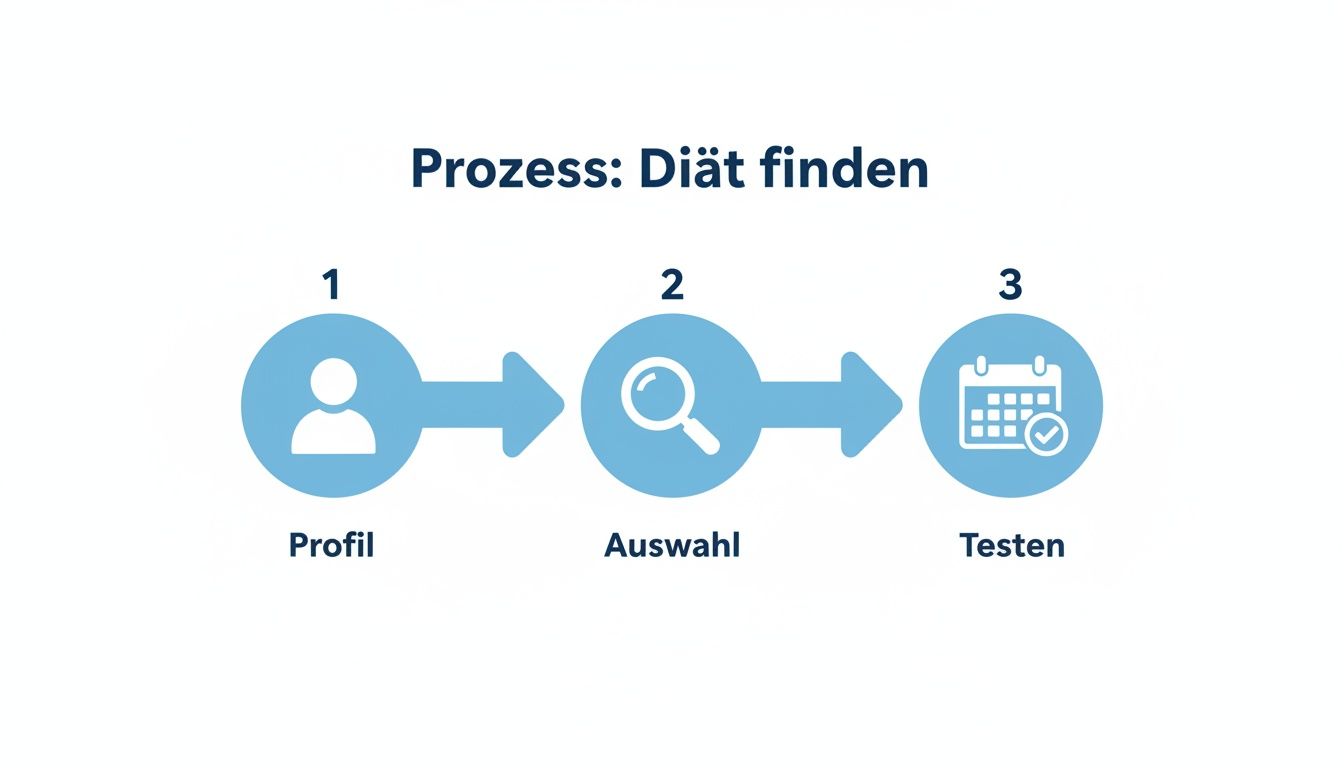
At the end of this systematic process, you will no longer be guessing; you will make informed decisions for your body.
Set a clear test period
Your body and mind need time to adjust to the new diet. Such a transition does not happen overnight. A test period of four to six weeks has proven ideal.
During this time, your body can adapt. The first few days may be tough—think “low-carb flu” or giving up sugar. That’s normal. But after about one to two weeks, you should start noticing the first positive signals.
More than just the scale: the true indicators of success
Your weight is only one of many metrics and often not even the most important one. A diet that makes you lighter but leaves you feeling drained and miserable at the same time is not a solution. Instead, pay attention to a broader range of signals from your body.
These metrics give you a much more honest picture:
- Your energy levels: Do you feel more alert and stable during the day? Has that dreaded afternoon slump disappeared?
- Your sleep quality: Are you sleeping more deeply and waking up feeling more rested? Or are you lying awake at night because you are hungry or restless?
- Your digestion: How does your stomach respond? Do you feel less bloated? Your digestion is an excellent indicator of whether your body can process the new food well.
- Your mood and concentration: Do you feel mentally clearer and more balanced? Or do you feel irritable and have trouble concentrating?
- Cravings: Are they becoming less frequent? That is a great sign that your blood sugar level is more stable.
Think of this testing period as an experiment in which you are curiously gathering data about yourself. There is no “failure,” only learning processes. You are the researcher, and your body is the subject of your study.
The food journal—your most important tool
Your memory can deceive you, but a journal does not lie. For at least two weeks, document what you eat and—most importantly—how you feel while doing so. It does not have to be complicated at all.
A simple notebook or app is perfectly sufficient. Write down:
- What and when you eat: All meals and snacks.
- How you feel afterward: Energy level, digestion, mood (e.g., on a scale of 1–10).
- Special considerations: Sleep quality, athletic performance, stress level.
After a short time, you will recognize patterns. Perhaps you will notice that a protein-rich breakfast gives you much more energy than a sweet smoothie. These insights are incredibly valuable. To delve even deeper into the subject, it can help to have your metabolism tested and compare your personal observations with solid data.
Adjusting instead of giving up: How to deal with initial difficulties
It is completely normal for things not to go perfectly from the start. The key to success is to stay flexible and make small adjustments instead of giving up completely at the first hurdle.
Here are a few typical scenarios and possible solutions:
-
Scenario 1: You constantly feel tired.
- Possible cause: You may be eating too little, or your nutrient distribution is not quite right yet. With a low-carb diet, you may be lacking electrolytes such as salt and magnesium.
- Adjustment: Slightly increase your calorie intake with healthy fats (avocado, nuts) or protein. A salty bone broth can also help.
-
Scenario 2: You have uncontrollable cravings for sweets.
- Possible cause: Your body is still accustomed to sugar, or your meals are not filling you enough.
- Adjustment: Make sure each meal contains enough protein and fiber. A handful of berries can often satisfy your sweet cravings wonderfully.
-
Scenario 3: The diet is too complicated for your everyday life.
- Possible cause: You have chosen recipes that are too elaborate.
- Adjustment: Simplify your meals! Focus on one protein source, a large portion of vegetables, and a healthy source of fat. Meal prepping on the weekend can also make your life easier.
This dynamic process of testing, observing, and adjusting is what truly makes a dietary change sustainable. In this way, you develop a deep understanding of your body's needs and become an expert in your own health.
The most frequently asked questions about choosing the right diet
Questions almost always arise on the way to an ideal diet. That's a good thing, because it shows that you're taking your body seriously. We've collected the most common ones here and provide you with clear, practical answers.
How long should I test a diet to know whether it really works?
Your body isn't a machine that can simply be reprogrammed at the push of a button. It needs time to adjust to a new way of eating. Our experience shows that a four- to six-week test period is ideal for seeing meaningful results.
In the first week or two, you may still struggle with adjustment effects such as fatigue or cravings—that's completely normal. The important thing is not to give up immediately and, above all, not to focus only on the number on the scale. The true indicators of success are your energy level, the quality of your sleep, your digestion, and your overall well-being. If you notice positive changes in these areas, you're on the right track.
Do I have to exercise for my dietary changes to work?
Honestly, diet is by far the biggest lever when you want to change your weight. You can hardly compensate for an unfavorable diet with exercise. But—and this is the crucial point—exercise is the perfect partner for changing your diet. It acts like a turbo boost.
Exercise boosts your metabolism, builds valuable muscle (which burns more calories even at rest), and improves your overall physical well-being as well as your body's response to insulin. But the most important thing is this: Find something you genuinely enjoy. Whether it's dancing, hiking, strength training, or cycling—what you stick with long-term beats any short-term ordeal.
What if my DNA test says Diet X is perfect, but I don't feel good on it?
An extremely important question, and the answer is very simple: Always listen to your body! Your body does not lie. A DNA metabolism test, such as the one from mybody®, provides you with a scientifically grounded blueprint of your genetic predisposition. That is an incredibly valuable starting point.
But you are more than the sum of your genes. Your current lifestyle, stress level, gut microbiome, and hormonal fluctuations play at least as important a role.
Your genetics are the map, but you are still in the driver’s seat. If a road feels bumpy, you adjust the route instead of stubbornly continuing on.
For you, this may mean making a few small adjustments within your genetic recommendations. For example, a “fat-protein type” might notice that a somewhat more moderate amount of fat or certain vegetables suit them better than an extremely strict keto approach. The test points you in the right direction—you handle the fine-tuning.
How do I deal with setbacks or a standstill on the scales?
A plateau is not failure. It is a signal from your body that it is getting used to the new situation. This happens to almost everyone. Instead of throwing in the towel out of frustration, use it as an opportunity to review your strategy.
These points usually help:
- Check your food diary: Have small habits crept in unnoticed? Perhaps your portions have gradually become larger, or you are snacking more often than you realized.
- Vary your training: Your body is smart and gets used to routines. A new training stimulus can fire up your metabolism again.
- Pay attention to stress and sleep: Chronic stress and too little sleep can effectively block fat burning through the hormone cortisol. Sometimes an extra hour of sleep does more than an extra hour at the gym.
- Adjust your calorie intake: If you have already lost a few kilos, your body now needs less energy too. A small adjustment to your calorie intake may be necessary to break through the plateau.
Setbacks are part of the process. What matters is not that you fall, but that you get back up with what you have learned and keep going.
Are you ready to stop guessing and finally find a nutrition strategy based on the facts of your own body? Discover the right DNA tests and analyses at mybody® to decode your metabolism and achieve your goals sustainably.



Share now:
Why am I not losing weight despite dieting? 10 often-overlooked reasons
Experiences with Metabolism Diets: What Really Works and What Doesn’t