

Experiences with the Metabolic Diet: What Really Works and What Doesn’t
When you look into experiences with the metabolic diet, you quickly encounter a broad spectrum: from impressive success stories to frustrating defeats. Many rave about rapid weight loss in the first few weeks, while others see hardly any change on the scale despite iron discipline. The secret behind these stark differences lies in our individual biological predisposition.
Metabolic Diet: Between Euphoria and Despair
You probably know the feeling: You scroll through forums and social media and read countless personal accounts of the metabolic diet. Some describe a complete transformation that has given them an entirely new outlook on life. Others complain about agonizing cravings, the number on the scale refusing to budge, and the dreaded yo-yo effect undoing all their hard work. So what is behind the hype and these contradictory stories?

The basic principle behind most metabolic diets sounds logical and quite tempting at first: A targeted change in diet is supposed to rev up your metabolism so that your body burns fat more efficiently. Essentially, the aim is to get your body’s engine running at full speed.
Why the results vary so dramatically
But practice clearly shows that this approach does not work equally well for everyone. Many personal accounts do confirm rapid initial success, which is incredibly motivating and inspires hope. Yet all too often, progress stagnates after a short time, or the lost weight returns faster than you can imagine as soon as you fall back into old patterns.
This circumstance raises one crucial question: Why does one person achieve huge success with a particular diet, while another gets absolutely nowhere with it?
The answer lies in our biological uniqueness. Every metabolism works differently. What is the perfect fuel for one person can bring another to a complete standstill.
Your genetics play the absolutely decisive role here. Your DNA determines how your body responds to different nutrients such as fats, carbohydrates, and proteins. A general “one-size-fits-all” diet plan simply cannot take this individual predisposition into account.
- There is no single silver bullet: Your body has its own unique needs that a standard plan simply ignores.
- Your genes play a role: They have a major influence on whether you are more of a carbohydrate or fat type.
- Frustration is inevitable: If a diet does not suit your genetic predisposition, results often fail to materialize—no matter how disciplined you are.
This is precisely where modern approaches come in. Instead of continuing to guess what might work for you, you can now find out exactly how your body really works. A genetic test for weight loss can show you precisely which nutrition strategy is best suited to your metabolic type. This lays the foundation for sustainable success—without frustration or guesswork.
How a typical metabolic diet really works
Most experiences with a metabolic diet begin in a similar way: with a strict, clearly defined set of rules. At its core, the aim is almost always to drastically reduce carbohydrates and calories while increasing protein intake. But what does this actually do to your body?
Essentially, this approach pursues two main goals. First, depriving your body of carbohydrates—its favorite source of energy—forces it into a state called ketosis. It then begins burning fat as its primary fuel instead. Second, the high protein intake gives your metabolism an additional boost. This is due to the so-called thermic effect of food (TEF), because your body has to expend more energy digesting proteins.
Curious about how your metabolism works? Our article Understanding metabolism made simple provides an accessible explanation.
The truth behind rapid weight loss
Almost every testimonial raves about the kilos that seemingly melt away in the first few days. What often gets overlooked is that this initial success is largely due to pure water loss. Every gram of carbohydrates stored as glycogen in your muscles and liver binds around three to four grams of water. When you cut off the flow of carbohydrates, your body empties these stores—and simply flushes out the bound water.
Of course, this is a great motivational boost on the scale, but it is not yet genuine fat loss. Knowing this is important for setting realistic expectations and avoiding frustration when your rate of weight loss slows down later.
Phases, Pitfalls, and What Really Happens
A classic metabolic reset program is often divided into several very rigid phases. Each has a clear goal, but also brings typical challenges reflected in countless user experiences.
Typical Phases of a Metabolic Diet and Their Pitfalls
The following table shows what diet plans promise and what many people actually experience in practice.
| Phase | Goal according to the diet plan | Typical experience & risks |
|---|---|---|
| Phase 1 (Strict Phase) | Rapid weight loss, adjusting the metabolism | Fatigue, headaches, irritability, and brutal cravings for anything containing carbohydrates. |
| Phase 2 (Stabilization) | Slowly reintroducing foods | Uncertainty when choosing foods, a high risk of the yo-yo effect, and frustration when weight loss stalls. |
| Phase 3 (Maintenance) | Long-term weight management, reinforcing new habits | Relapsing into old eating patterns because strict control is hardly sustainable in everyday life. |
These standardized phases do not take individual needs, your personal daily routine, or your own metabolism into account—and therefore often lead straight to frustration.
In Germany, according to data from the Robert Koch Institute, 53.5% of the population is overweight. Of those who want to lose weight, three out of four ultimately fail with such rigid approaches. Anyone who wants to delve deeper into the topic can find more facts on this informative page about being overweight. To understand the bigger picture, it also helps to look beyond the obvious and explore different dietary approaches and food cultures. You quickly realize that there is no single approach that works for everyone.
Why Most Diets Are Destined to Fail
Does this sound familiar? You stick strictly to a new diet plan for weeks, but the number on the scale simply doesn’t budge. Or even worse: A friend celebrates huge success with exactly the same method, while absolutely nothing happens for you. This is not only incredibly frustrating—it also has a very real reason.
The most common reason for this failure is that standard diets and blanket experiences with metabolic diets completely overlook the decisive factor: your biological uniqueness.
Your metabolism is as unique as your fingerprint
Think of your metabolism as a personal code—it is absolutely unique and largely controlled by your DNA. That is precisely why a “one-size-fits-all” diet intended to work for millions of people is ultimately nothing more than a gamble. You are following rules that were not designed for your body at all.
This explains why so many dieting attempts end in a dead end. A recent AOK-forsa survey confirms the problem with clear figures: Although 68% of overweight people in Germany have tried to lose weight at least once, a full 75% fail in the long term. Respondents cited the difficulty of implementation in everyday life (51%) and establishing new habits (59%) as the biggest hurdles. Often, however, the lack of success is also due to the chosen diet simply not matching a person’s individual predisposition—the yo-yo effect is practically preprogrammed. You can find more interesting details directly in the survey results.
Whether fat or carbohydrates—your genes play a role
Your genes determine how efficiently your body processes different nutrients. There are very specific genetic variants that determine whether you obtain energy more effectively from fats or carbohydrates.
- The carbohydrate type: Some people are genetically predisposed to metabolize carbohydrates extremely efficiently. A strict low-carb diet would literally put the brakes on their engine, leading to constant fatigue and cravings.
- The fat type: Others, meanwhile, are genetically predisposed to use fats optimally as an energy source. For them, a low-carb or ketogenic diet is the key to success, while a carbohydrate-rich diet can quickly lead to weight gain.
This is exactly where the problem with blanket diet advice lies. When a “fat type” follows a low-fat diet or a “carbohydrate type” opts for low-carb, they are fighting against their own biology. The result? Usually not only a lack of success but also unnecessary stress on the body.
Instead of continuing to guess and accumulating one frustrating diet experience after another, it makes far more sense to finally tailor your diet to yourself. A personalized analysis of your genetic predisposition shows you in black and white what fuel your body really needs.
This puts an end to the endless guesswork and lets you leave the yo-yo effect behind once and for all. It is not about fighting even harder, but about finally finding the right strategy for your unique body.
Decoding your personal metabolic code
Most experiences with a metabolic diet unfortunately follow the same, often frustrating pattern: You try a plan, hope for the best, and end up disappointed when nothing changes again. But what if you could stop guessing and get targeted answers instead?
That is exactly what modern at-home laboratory tests make possible today. Instead of continuing to grope in the dark, they allow you to truly understand your metabolism and tailor your diet precisely to it.
From sample to personalized roadmap
The process is surprisingly straightforward and requires no visit to the doctor. A mybody-x DNA analysis starts with a simple saliva sample. You collect it conveniently at home, send it to our certified laboratory, and your genetic code is decoded there.
Using this scientific data, we create a detailed yet, above all, easy-to-understand report of your results. Think of it as a personal instruction manual for your body.
You will find out specifically:
- Your optimal macronutrient mix: How much fat, carbohydrates, and protein does your body really need to function efficiently and burn fat?
- Your genetic predisposition: Are you naturally prone to being overweight or to the dreaded yo-yo effect? And more importantly: How can you specifically counteract it?
- Your ideal exercise type: Which type of exercise—endurance or strength—is most effective for you to burn calories and build muscle?
The following graphic shows quite clearly why standard diets that completely ignore your individual profile often end in an endless cycle of failure.
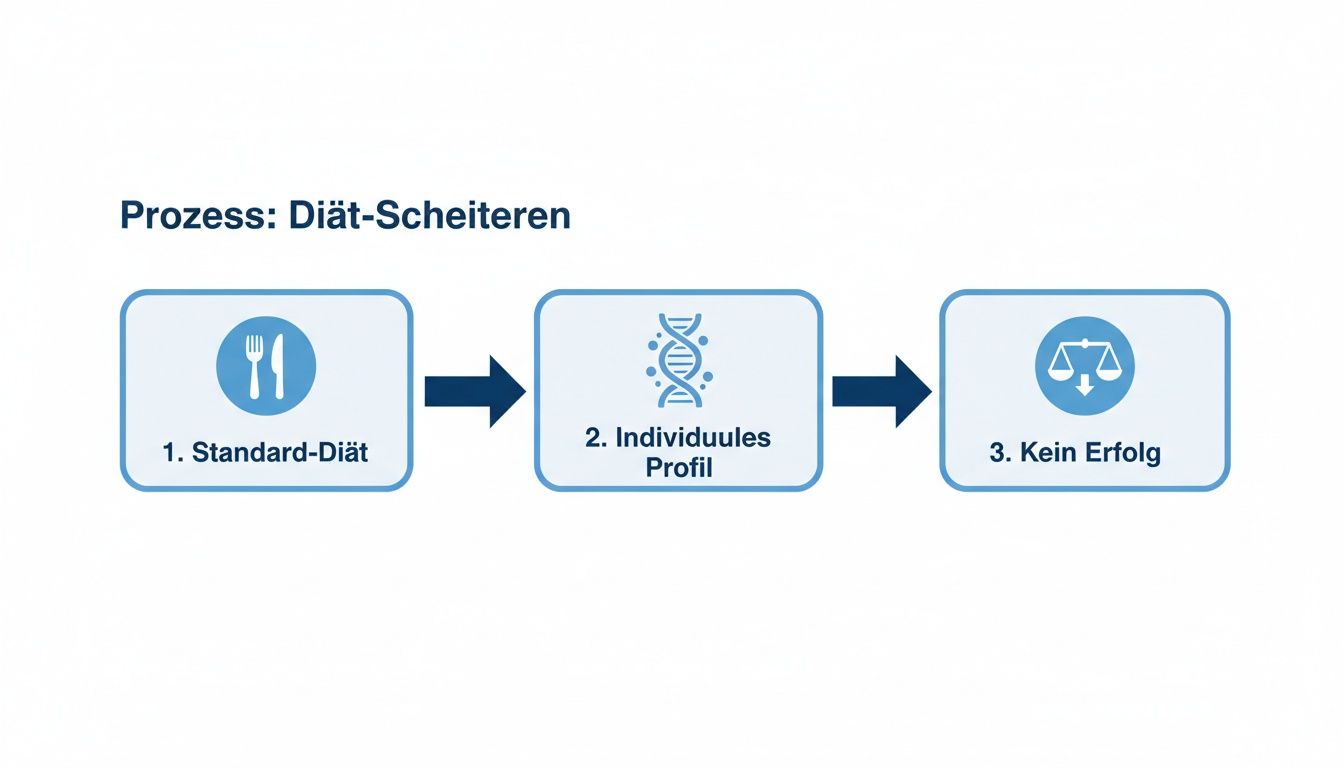
You can immediately see why a “one-size-fits-all” approach that ignores your DNA so rarely leads to lasting success.
From the lab to your everyday life
But what good is all that data without a clear plan for everyday life? Consider an anonymized example: Anna, 34, has tried countless low-carb diets, but success remained elusive. Her DNA analysis then reveals something surprising: Her metabolism can process complex carbohydrates exceptionally well but is sensitive to saturated fats.
So instead of giving her generic advice to cut out carbohydrates, Anna is given a personalized plan: more whole grains, legumes, and starchy vegetables, but less fatty meat and cheese.
Suddenly, frustration becomes a clear, actionable path. She no longer has to go hungry or fight against her body; instead, she gives it exactly the fuel it is genetically predisposed to process best. That is the crucial difference between yet another failed diet and a sustainable health strategy tailored to you.
If you’d like to delve deeper into the fascinating world of genetics, our article explains how a DNA analysis for your nutrition can help you crack your personal code. This allows you to finally turn old diet myths into scientifically sound facts for your success.
From diet frustration to a personalized success story
What actually happens when you discard rigid diet rules and instead rely on data-driven, personalized recommendations? It’s simple: You trade frustration for success. Many negative experiences with a metabolic diet arise at exactly this point—a rigid plan meets a unique body. The real key, however, lies in turning this equation around and starting with your own biology.
Imagine stopping counting calories and starting to listen to your body—but using the data it provides itself. Personalized success stories show exactly this shift from guessing to knowing.

Anna’s carbohydrate dilemma becomes a source of energy
Meet Anna. For years, she struggled through various low-carb diets, always accompanied by fatigue and nasty cravings. Her experiences were incredibly frustrating because despite iron discipline, the number on the scale barely budged.
A DNA analysis then brought a surprising turning point. Anna’s genes showed that her body could metabolize complex carbohydrates, such as those found in whole-grain products and legumes, extremely efficiently. Her real problem was not carbohydrates, but an excessive intake of saturated fats. With this one insight, she changed her diet—and suddenly pasta and potatoes went from enemies to allies. The result? Not only sustainable weight loss, but also an entirely new level of energy in everyday life.
How Markus broke through his performance plateau
Or take Markus, an ambitious amateur athlete. He trained hard, but his performance stagnated. He tried all kinds of things, from more protein shakes to even more extreme training plans, but the progress he hoped for simply failed to materialize.
His genetic test revealed the truth: He is genetically predisposed to endurance and has a very specific need for recovery phases. His strong focus on strength training alone simply did not suit his muscle type. By adjusting his diet and incorporating targeted endurance sessions into his training, he finally overcame his plateau.
These stories make one thing very clear: It’s not about eating less, but about doing what’s right for your individual body. Personalized data turns pure guesswork into a clear, actionable strategy.
Interest in solutions like these is enormous. In Germany, 3.73 million people show particular interest in diet products, while 49% are dissatisfied with their weight. This enormous demand coincides with the well-known high failure rate of standard diets. Find out more about this trend on Statista.com.
By understanding your personal metabolism, you can finally stop working against your body. Instead, you give it exactly what it needs to be healthy, perform at its best, and stay balanced. Find out what this journey can look like in practice in our guide to personalized nutrition.
Still have questions about the metabolic diet and personalized nutrition?
After all that information, you probably still have a few questions on your mind. That’s completely normal. Moving from a general diet to such a personal approach naturally raises entirely new considerations. We’ve collected the most frequently asked questions we encounter time and again to give you greater clarity.
How quickly will I see results with a DNA-based diet?
Unlike crash diets, which usually focus only on rapid water loss, a genetically tailored diet is about genuine, sustainable fat loss. Many of our customers notice a significant difference within the first two to four weeks—they feel fitter and have more energy.
Visible results on the scales or in the mirror usually appear after four to eight weeks. Your body simply needs some time to adjust. Don't think of it as a sprint, but as the starting point for a long-term healthy relationship with your body.
A DNA analysis like this must be complicated and expensive, right?
Fortunately, the days when genetic tests were available only at specialized clinics for exorbitant prices are over. Today, you can easily and conveniently complete an analysis like mybody-x's at home. You receive a test kit with simple instructions for collecting a saliva sample—child's play.
The cost is a one-time investment in yourself and your health. Think about how much money you may have already spent on failed diet attempts. This investment could save you all that in the future. It is essentially a shortcut to the right path.
The crucial difference is this: You are not investing in yet another diet product, but in knowledge about yourself. This knowledge stays with you for life and helps you make informed decisions about your health.
And what happens to my genetic data?
Data protection and security are our top priorities. Your sample is pseudonymized in the laboratory, meaning it is linked to you only through a code, not your name. Once the analysis is complete, all biological samples are destroyed in accordance with regulations.
We handle your data strictly in accordance with the GDPR and never share it with third parties without your explicit consent. Your genetic information is used solely to create your personalized recommendations. Your health and data are in safe hands with us.
Are you ready to stop guessing and finally find out what your body really needs? At mybody-x, we decode your personal metabolism code and give you a clear, scientifically grounded roadmap. Discover the power of personalized nutrition now and start your journey toward lasting well-being at https://mybody-x.com.



Share now:
Which diet is right for me and how to finally find it
How much does a DNA test cost: what’s included in the price and what isn’t