
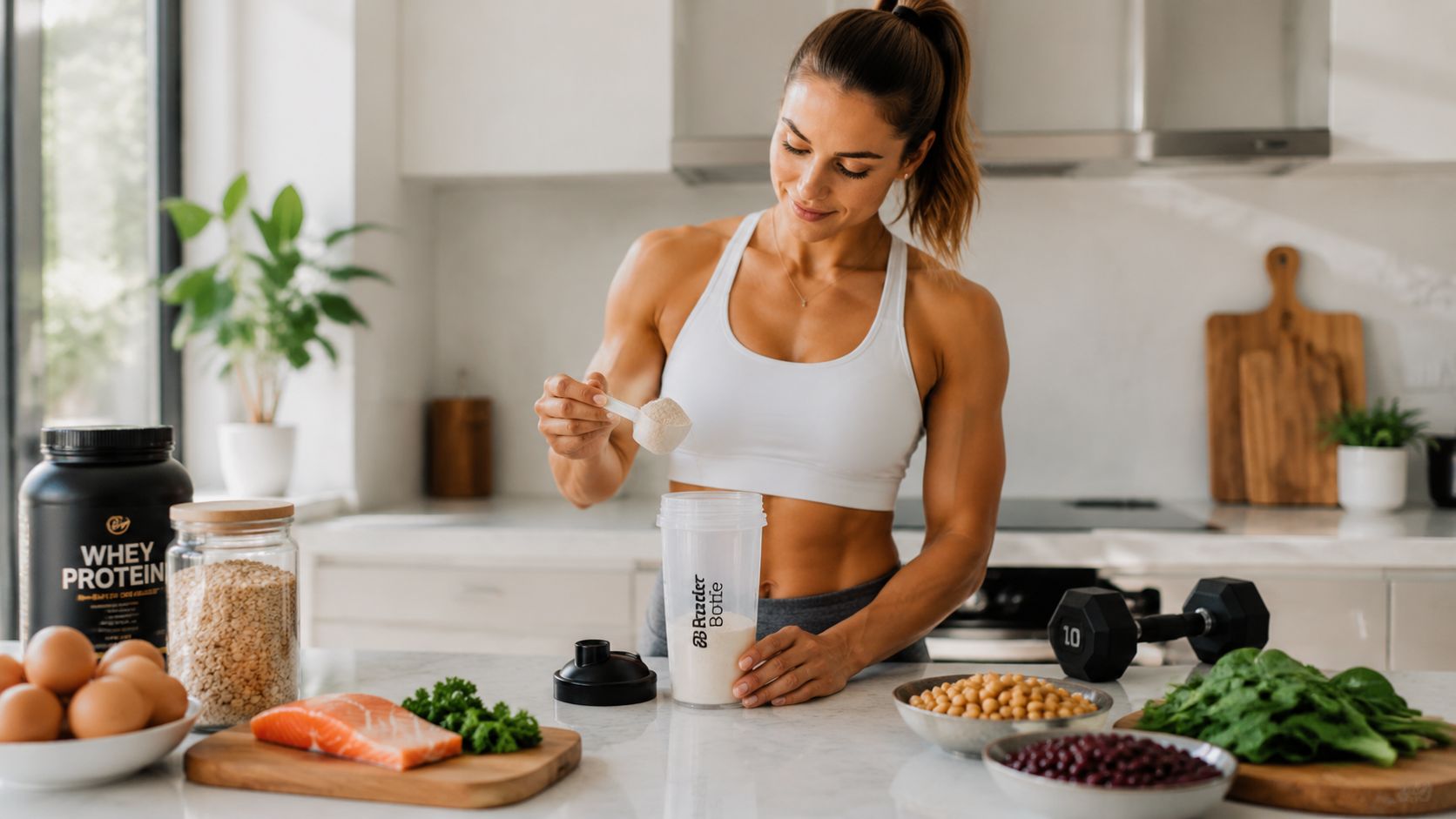
Protein for Muscle Growth in Women: Your 2026 Guide
You train regularly, pay attention to your diet, rarely miss a workout, and yet your body is not changing as you expected. This is exactly where many women end up. Not because they lack discipline, but because they often follow general recommendations that are simply too imprecise for muscle growth.
When it comes to protein for muscle growth in women, the issue is rarely just a lack of willpower. Often, the total daily amount is not right, the distribution throughout the day is unfavorable, or the body is not getting enough energy to build muscle in the first place. Differences in daily life, the menstrual cycle, recovery, and individual predisposition also play a role. Anyone who ignores this often ends up training against a plateau.
Why your training has stalled and protein is the answer
Many women make the same mistake. They train hard, eat “actually healthily,” and wonder why their legs, back, or shoulders become more capable but not visibly more defined. The problem is often not the training alone. It is the lack of coordination between the training stimulus and nutritional support.

Women in particular still often follow recommendations to “eat healthily,” “eat lightly,” or “not eat too much protein.” That may be enough for everyday life. Often, it is not enough for muscle growth. In Germany, the D-A-CH reference value for moderately active women is 0.8 g of protein per kg of body weight, while the DGE recommends 1.2 to 2.0 g/kg/day for ambitious athletes, depending on their goal, as summarized by the consumer advice center with reference to the DGE.
Why “healthy” does not automatically support muscle growth
A typical day often looks like this: bread or muesli in the morning, salad or pasta at lunchtime, and something hot in the evening. This can be balanced. However, protein is often distributed too sparingly. As a result, the body lacks the exact building material it needs after training and during recovery at several points throughout the day.
There is also the old myth that more protein immediately makes women look “bulky.” That is not a realistic problem in everyday life. Much more often, I see the opposite: women eat too little protein, train ambitiously at the same time, and wonder why they experience fatigue, cravings, a lack of visible change, and poor recovery.
Anyone who wants to get stronger needs more than just training stress. The body also needs material to build with.
How you can often recognize a protein gap
These signs often appear together with surprising frequency in practice:
- Significant fluctuations in energy levels after training or in the afternoon
- Evening cravings despite having eaten “enough”
- Hardly any progress in shape and definition despite regular strength training
- Muscle soreness that lingers, or the feeling of never being fully recovered
Protein is not the only variable. But it is often the first one that truly makes a difference. Not as a trend, but as a concrete strategy. If your body regularly receives training stimuli but is not adequately nourished, muscle growth will not occur. In that case, “training even harder” usually helps less than a more precise nutrition plan.
Your foundation: How much protein do you really need?
If you want to build muscle, you need a number you can work with. Not perfect for all time, but good enough as a starting point. For active women, the range frequently cited in sports nutrition science for targeted muscle building is 1.6 to 2.2 g of protein per kg of body weight, as described in the German-language overview by Christine Lohr.
How to calculate your range
The formula is simple:
Body weight in kg × protein target
A concrete example from practice is included directly in the overview mentioned above: A woman weighing 60 kg would need 96 to 132 g of protein daily.
So if you start toward the lower end, you are working with a foundation that is practical for everyday life. If your training is demanding, you want to build muscle deliberately, or you are in a phase of high stress, the upper range may be more suitable.
Why the number is only the beginning
The calculation is useful. But it is not personalization yet. Two women with the same body weight can respond very differently to the same amount of protein. This is not due to a lack of discipline, but to differences in everyday life and physiology.
What I pay particular attention to in consultations:
-
Training goal
Do you want to maintain, define, or deliberately build muscle? Maintaining often requires less than a clearly structured muscle-building plan. -
Training load
Someone who trains casually needs to plan differently from someone who regularly does intensive strength training. -
Energy availability
If you eat too little, even a good protein intake cannot fully unfold its potential. -
Stress and recovery
Poor sleep, high everyday stress, and irregular eating patterns often make implementation more difficult.
Practical rule: Calculate your range first. Then honestly check whether you regularly reach this amount at all and whether it fits into your daily life.
Many women realize at this point that their problem is not “eating too clean,” but eating without enough purpose. That is exactly why blanket plans are often unsatisfying. If you want to take a deeper look at the calculation, the guide to protein requirements for women provides a good foundation.
When an individual assessment becomes useful
If you are not seeing progress despite training, it is often worth looking beyond simply estimating your macros. The question is not only how much protein would theoretically make sense, but also whether your body may be held back elsewhere. This can include nutritional deficiencies, hormonal factors, or a stage of life in which your needs are changing.
A nutrient test can help here because it allows you to stop guessing. Instead of simply planning in even more protein, you can check whether your body has the overall prerequisites for building muscle, recovery, and performance.
The best protein sources for visible results
Your target value is set. Now what matters is how you reach it in everyday life. Not every protein source is equally practical, filling, or easy to incorporate into your daily routine. What matters is that the foods suit your lifestyle, digestion, and preferences.
I do not approach this with rigid either-or thinking, such as “animal-based only” or “plant-based only.” Visible results usually occur when your choices are realistic, consistent, and easy to plan.
Animal-based, plant-based, or a shake
Animal-based sources are often straightforward because they provide plenty of protein in manageable portions. Eggs, quark, salmon, or tuna therefore fit well into a muscle-building plan for many women.
Plant-based sources such as edamame and lentils are also excellent, especially when you consciously vary your choices instead of always relying on the same meals. They also provide other nutritionally relevant benefits, which is often helpful in everyday life.
Protein powder is not essential. It is a tool. Especially after training or on busy days, whey or vegan protein powder can be practical when it is difficult to fit in whole meals.
Top protein sources at a glance
| Food | Protein per 100 g (approx.) | Special benefit |
|---|---|---|
| Eggs | High quality | Complete amino acid profile |
| Quark | High quality | Good for breakfast or dinner |
| Salmon | High quality | Protein plus omega-3 |
| Tuna | High quality | Practical for quick meals |
| Edamame | Rich in plant-based protein | Plant-based option with iron benefits |
| Lentils | Rich in plant-based protein | Suitable for everyday use, filling, versatile |
| Whey protein powder | Concentrated protein source | Quickly usable after training |
| Vegan protein powder | Concentrated protein source | Option for a plant-based diet |
For a specific selection of foods for everyday life, the overview of protein-rich foods and their sources can also help you.
What works well in practice
It is not the theoretically “best” source that wins, but the one you can reliably incorporate.
- In the morning, quark, eggs, or a shake are suitable if you have little time early in the day.
- For on the go, prepared lentil bowls, edamame, yogurt, or tuna work much better than improvised snacking.
- After training, protein powder is often useful simply because it is quick.
- In the evening, many women prefer a calmer, filling option such as quark or a balanced meal with fish, legumes, or eggs.
You recognize good protein sources not only in theory, but by whether you actually eat them on long workdays.
If you find it difficult to assess digestion, satiety, or tolerance, you should not look only at macros. Especially with recurring complaints, it is often more useful to systematically assess your own reaction to certain foods instead of struggling through ever-changing dietary rules.
The perfect timing: Your protein clock for muscle growth
The daily amount matters. Timing also helps determine how effectively your body actually uses it. Many women eat most of their protein only in the evening. That is better than none at all. For muscle growth, spreading it throughout the day is usually much more beneficial.
As a simple analogy, I like to use the image of gas stations for your muscles. Your muscles do not need one huge delivery once a day, but rather recurring, well-timed moments of nourishment.
The most important times in everyday life
For optimal muscle protein synthesis, 25 to 30 g of high-quality protein per meal is recommended. In addition, a window of 30 to 60 minutes after training is considered particularly favorable for nutrient absorption and recovery, as summarized by the Academy for Sport and Health.

This is what your day could look like
In the morning
A protein-rich breakfast is a real turning point for many women. It stabilizes the start of your day and prevents you from already falling behind by lunchtime. Quark, eggs, or a shake with a proper side work better here than a start consisting purely of carbohydrates.
Around your workout
If you train, the period afterward is particularly convenient for targeted protein intake. It does not have to be a complicated ritual. An easily digestible shake or a simple meal with a high-quality protein source is often entirely sufficient.
Evening
In the evening, a filling source of protein is worthwhile so that you do not have to compensate all day for consuming too little. Many women do well with quark or a regular evening meal intentionally built around protein.
What often does not work
-
Putting everything into one meal
This is common in everyday life, but rarely ideal for muscle growth and recovery. -
Eating nothing at all after training
This often happens with late workouts, either out of convenience or because “it’s already too late.” -
Skipping protein completely in the morning
Then reaching the daily amount becomes unnecessarily difficult.
Small, well-distributed protein anchors often work better in practice than large evening portions.
You do not need a rigid schedule. You need a system that fits into your day. If you manage three to four well-planned protein moments, implementation suddenly becomes much easier.
More than just protein: training, hormones, and your genetic code
You train regularly, pay attention to protein, and yet your reflection in the mirror has looked the same for weeks. I often see this in women. The reason is rarely a lack of willpower. Usually, the plan is not precise enough for your body.
Protein is only one part of the equation. Muscle growth also depends on how well you respond to training stimuli, how stable your energy supply is, how you recover, and how much your cycle, stress, or hormonal changes come into play. That is precisely why general recommendations often fall short.

Training only works with sufficient energy and recovery
In consultations, I often see the same pattern. A woman trains diligently and even increases the weights, but unknowingly eats too little, sleeps too little, and also tries to stay as “lean” as possible with lots of cardio. On paper, this looks disciplined. In practice, the body lacks the foundation needed to build new muscle.
Performance, recovery, and training quality often decline at the same time. The result is frustrating because the effort is high, but visible progress fails to appear.
Typical obstacles include:
- insufficient energy intake over several days
- high everyday stress and poor sleep
- too much additional cardio
- a training plan without clear progression
- Fear of slight weight gain during the gaining phase
Women in particular often eat more cautiously during a gaining phase than their goal allows. That is understandable, but it slows progress.
Hormones affect how well your plan works
The female body does not function under the same conditions every day. Cycle phase, hormonal contraception, perimenopause, sleep quality, and stress affect appetite, performance, fluid balance, and recovery. When a plan ignores this, it quickly seems illogical, even when you are following it correctly.
The article by ESN on nutrition and building muscle in women points out that nutritional needs and body composition can shift with hormonal changes. This aligns with what I see in practice. Women in their mid-30s and older often react more sensitively to sleep deprivation, overly aggressive dieting phases, and poorly timed exertion.
That is why I adjust plans not only according to weight and training goals, but also according to cycle patterns, symptoms, recovery, and laboratory results when available. If you are hungrier or sleep worse during the second half of your cycle, you often do not need stricter rules, but a different distribution of energy, training, and recovery.
Your genetic code may explain why standard plans fail
Two women can follow the same training plan and respond to it in completely different ways. One builds strength quickly, while the other needs more recovery. One copes well with many sets, while the other stagnates despite being highly disciplined. These differences are not imagined. They can be related to training history, stress, nutrient status, and genetic factors.
If you want to understand how individual differences in training adaptation, recovery, and nutrient utilization can play a role, the article on building muscle with DNA testing and training offers a sound professional overview.
I do not use such data to treat destiny as fixed. I use it to make better decisions. People who are genetically more likely to recover slowly or who react more sensitively to certain training volumes often benefit more from a more precise plan than from pushing even harder.
What blood, hormone, and DNA tests contribute in practice
Not every woman needs testing right away. But in cases of prolonged stagnation, tests often provide exactly the insights that a standard plan cannot.
- Blood tests help assess iron status, vitamin D status, thyroid markers, or other factors when energy, resilience, or recovery do not align.
- Hormone tests can provide indications when cycle-related symptoms, major fluctuations, perimenopause, or noticeable changes in sleep, hunger, and performance occur.
- DNA tests can reveal differences in training response, recovery, and metabolism that are useful for fine-tuning a plan.
The benefit lies in personalization. Instead of simply training more or eating less, you can make more targeted decisions: Do you need more recovery, a different training frequency, more carbohydrates around your workouts, or a different protein intake throughout the day?
That is exactly where general fitness knowledge becomes a plan that suits your body.
Your path to success: summary and next steps
Monday morning, little sleep, a full calendar, and still training in the evening. It is often in weeks like these that your plan, not your willpower, makes the difference. Women do not build muscle more effectively by becoming even stricter. They make progress when their protein intake, training stimulus, energy intake, and recovery fit their body and everyday life.
For protein muscle building women, this ultimately means consuming enough protein throughout the day, doing regular strength training, and getting enough energy for the body to build muscle in the first place. Anyone who consistently eats too little, skips recovery for too long, or ignores their cycle often unknowingly slows their progress.
The order that has proven effective in practice
-
Start with your actual needs
Base your protein intake on your body weight, training load, and goal rather than on general social media rules. -
Choose protein sources you can follow consistently
A good plan does not consist of perfect meals, but of meals that work on workdays, while traveling, and during stressful periods. -
Distribute protein consciously throughout the day
For many women, several protein-rich meals are more practical than consuming a very large amount in the evening. -
Review your overall plan
Progress does not depend on protein alone. Training, calorie intake, sleep, cycle phase, and recovery all work together.
If you remain stuck for weeks despite having a solid foundation, it is worth taking a closer look. In my work, this is often the point at which generic recommendations stop being helpful. Blood values can explain why energy and recovery do not align. Hormone data can show whether the menstrual cycle, perimenopause, or unusual symptoms should be taken more seriously. DNA analyses can provide insights into how your body responds to training volume, macronutrients, and recovery.
The DNA Metabolism Analysis from mybody®x can be a useful component if you want to tailor your nutrition and training more precisely to your metabolism type. Data like this cannot replace consistent implementation. But it can help shorten the trial-and-error phase and make decisions more precise.
Your body responds according to patterns. The better you know these patterns, the clearer the next steps become.
If you no longer want to manage your body according to general fitness rules, take a look at mybody x Gesundheit. There you’ll find self-tests for hormones, nutrients, and DNA-based analyses that can help you assess training, nutrition, and recovery based on data.



Share now:
Metabolism too slow symptoms? Here’s how to find the cause
Genetic Basal Metabolism Explained: Your Basal Metabolic Rate