

Genetic Basal Metabolism Explained: Your Basal Metabolic Rate
Genetic basal metabolism describes the basal metabolic rate determined by your genes—the minimum energy your body needs at rest to maintain your heartbeat, breathing, and cell repair. In adults, this value is usually between 1,300 and 1,800 kcal per day and accounts for 60–75% of total energy expenditure. Genes set the framework, but they are not a verdict. Anyone who understands how genetics and lifestyle interact can make targeted changes to their diet and training instead of hiding behind their predisposition. Modern analytical tools such as mybody x’s DNA metabolism test make this connection tangible today.
How do genes determine basal metabolic rate?
Genes regulate basal metabolic rate in several ways at once. They influence how efficiently your mitochondria produce energy, how actively your thyroid functions, and how your nervous system regulates resting metabolism. The result is a biological baseline that differs noticeably from person to person.

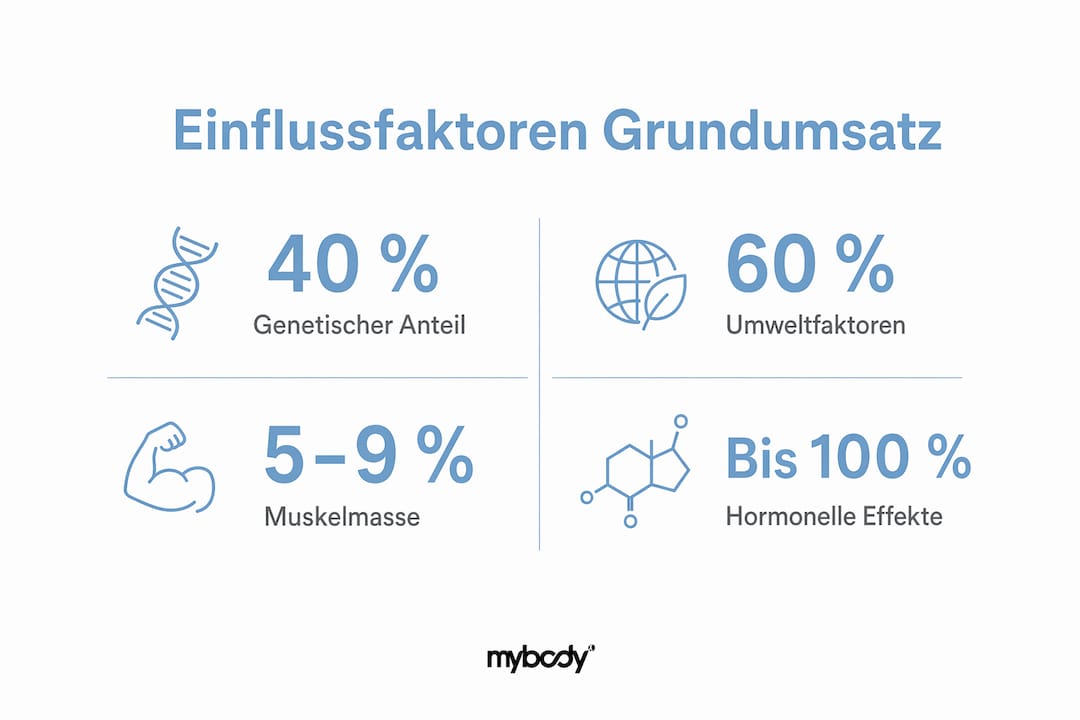
Genetic factors explain approximately 40% of the differences in basal metabolic rate between people. That may sound like a lot, but in practice it usually means a difference of just 200–300 calories per day between people with genetic advantages and those with less favorable genetics. This difference is real, but it can be overcome.
Specifically, genes affect the following areas:
- Mitochondrial efficiency: Variants in genes such as PPARGC1A influence how many mitochondria your muscle cells produce and how efficiently they burn fat.
- Thyroid hormone production: Genes regulate the thyroid’s sensitivity to TSH. An underactive thyroid can reduce basal metabolic rate by 10–40%.
- Body composition: Genetically determined differences in muscle mass directly affect resting energy expenditure.
- Sympathetic nervous system: Some people have genetically higher sympathetic nervous system activity, which slightly increases their resting metabolic rate.
The remaining share of around 60% of the variability is attributable to environmental factors: diet, exercise, sleep, stress, and hormone status. So genetics provides the starting point, but not the destination. Anyone who wants to understand their metabolism in their genes gets a tool, not a destiny.
How muscle mass and lifestyle change basal metabolic rate
Muscle mass is the strongest modifiable factor affecting basal metabolic rate. One kilogram of muscle tissue burns around 13 kcal per day at rest, whereas fat tissue burns only about 4.5 kcal. Building 5 kg of muscle mass therefore increases your basal metabolic rate by 50–65 kcal per day. It may sound like little, but it adds up over the months.
Progressive strength training can increase resting metabolic rate by 5–9% over several months. With a basal metabolic rate of 1,600 kcal, this corresponds to an increase of 80–145 kcal per day. This effect clearly exceeds the genetically determined difference between two people.
Hormones also play a central role. An overactive thyroid can increase basal metabolic rate by up to 100%, while an underactive thyroid can reduce it by up to 40%. This shows how strongly hormonal factors can outweigh the genetic starting point.
Epigenetic influences also play a role. Cold exposure and nutrient timing can activate genes in adipose tissue that stimulate brown adipose tissue and increase energy expenditure. Brown adipose tissue burns calories to produce heat, whereas white adipose tissue only stores them. Regular brief cold stimuli, such as cold showers or walks in winter, can trigger this mechanism.
Pro tip: Combine strength training three times a week with a daily protein intake of at least 1.6 g per kilogram of body weight. Protein has the highest thermic effect of all macronutrients and also supports muscle growth.
A common myth is that certain foods permanently boost the metabolism. Green tea, chili, or coffee produce short-term effects that are barely measurable in daily energy expenditure. What has a lasting effect is more muscle mass and an active lifestyle.
How you can use your basal metabolic rate in practice
Knowing your own basal metabolic rate is the first step toward a nutrition strategy that truly works. Without this number, you are in the dark about whether you are eating too little or too much.
- Calculate your basal metabolic rate: Use a validated formula such as the Mifflin–St. Jeor equation or a calorie needs calculator to determine your individual value. This value is your starting point for all further considerations.
- Build muscle mass: Start with two to three strength-training sessions per week. Compound exercises such as squats, deadlifts, and bench presses activate the largest muscle groups and increase basal metabolic rate most effectively.
- Ensure adequate protein intake: Protein has a thermic effect of 20–30%, meaning that when digesting 100 kcal of protein, your body already uses 20–30 kcal. This noticeably increases total energy expenditure.
- Avoid crash diets: Prolonged calorie restriction lowers basal metabolic rate through metabolic adaptation. Strength training and increased protein intake can reverse this effect, but it takes months.
- Use nutrient timing: Scheduling meals around training supports muscle protein synthesis and can influence epigenetic signals in adipose tissue.
For a critical assessment of DNA nutrition tests: Commercial offerings usually analyze only a few genetic variants. Behavior has a greater effect than genetics when it comes to weight management. A DNA test can provide useful insights, but it does not replace consistent dietary changes. Anyone using such a test should view it as a guide, not a prescription.
Pro tip: Have your thyroid-stimulating hormone (TSH) level checked by a doctor once a year. An undiagnosed underactive thyroid can render any diet and training plan ineffective because it can reduce basal metabolic rate by up to 40%.
In the long term, the following applies: Metabolic adaptations take time. Anyone who consistently does strength training and eats sufficient protein for six months will see measurable changes in basal metabolic rate. There are no quick fixes.
Basal metabolic rate versus total energy expenditure: What is decisive?
Basal metabolic rate is only part of the picture. Total energy expenditure, known in English as Total Daily Energy Expenditure (TDEE), is calculated by multiplying basal metabolic rate by an activity factor (PAL factor). TDEE includes basal metabolic rate plus activity calories and is the figure that is actually relevant for weight control.
Anyone who walks 8,000 steps a day burns significantly more than someone who sits all day, even if both have the same basal metabolic rate. Everyday activities such as climbing stairs, standing, and spontaneous movement together make up what is known as NEAT (Non-Exercise Activity Thermogenesis). This value varies between people by up to 800 kcal per day.
| Influencing factor | Type | Changeable? | Typical effect |
|---|---|---|---|
| genetics | biological | no | 200–300 kcal difference |
| muscle mass | biological/behavioral | yes | up to 65 kcal per 5 kg of muscle |
| Thyroid | hormonal | conditional | up to ±40% of basal metabolic rate |
| Daily activity (NEAT) | behavioral | yes | up to 800 kcal per day |
| Diet and protein | behavioral | yes | 20–30% thermic effect |
The table makes it clear: Genetics is the least modifiable factor and, at the same time, the one with the smallest absolute effect. Anyone who wants to lose or maintain weight is better off focusing on daily activity, muscle mass, and diet. A daily calorie deficit of 300–500 kcal, achieved through exercise and dietary adjustments, outweighs any genetic disadvantage.
Key findings
Genetic basal metabolic rate sets the framework, but muscle mass, daily activity, and diet determine how much energy your body actually uses each day.
| Topic | Details |
|---|---|
| Genetic contribution to basal metabolic rate | Genes explain approximately 40% of the differences, usually only a 200–300 kcal difference between individuals. |
| Muscle mass as a lever | An additional 5 kg of muscle mass increases basal metabolic rate by 50–65 kcal per day; strength training increases it by 5–9%. |
| Pay attention to your thyroid | An underactive thyroid can lower basal metabolic rate by up to 40%; regular TSH monitoring is advisable. |
| Avoid crash diets | Calorie restriction lowers basal metabolic rate through metabolic adaptation; strength training can reverse this. |
| TDEE is crucial | Total daily energy expenditure, not basal metabolic rate alone, is the relevant figure for weight control. |
What I have learned after years of metabolic counseling
At mybody x, we see every day how people use their genetics as an explanation for a lack of results. This is understandable, but it is rarely the actual reason. The truth is more uncomfortable: Genetics provides the framework, but behavior fills it in.
What continues to surprise me is the effect of muscle mass. Many people who have dieted for years have also lost muscle in the process. As a result, their basal metabolic rate decreased—not because of their genes, but because of their dietary strategy. When they then begin strength training and increase their protein intake, their basal metabolic rate rises again. That is not magic; it is physiology.
Genetic analyses are valuable when used correctly. They show tendencies, not certainties. If you know that you are genetically predisposed to a slower fat metabolism, you can train and eat more strategically. But if you use this knowledge as an excuse, you are wasting your potential. Epigenetic factors show that genes are not fixed switches but can be influenced by lifestyle.
My honest advice: Have your basal metabolic rate calculated, build muscle mass, and eat enough protein. These are the three levers that really work, regardless of your genetic starting point.
— mybody x
Your metabolism, scientifically understood
Anyone who truly wants to know their basal metabolic rate needs more than a rule of thumb. mybody x offers scientifically grounded DNA metabolism tests that show how your genes influence fat metabolism, muscle mass, and energy production.

More than 11,300 customers have already gained a better understanding of their health and taken more targeted action with mybody x. The tests are conveniently performed at home, and the analysis is carried out in an ISO-certified laboratory. The result is a personal report with specific nutrition and training recommendations tailored to your genetic profile. All samples are pseudonymized and destroyed after analysis in compliance with the GDPR. Take a look at mybody x's DNA metabolism offering and find out what your body really needs.
FAQ
What is genetic basal metabolic rate?
Genetic basal metabolic rate is the basal metabolic rate partly determined by your genes—that is, the energy your body needs at rest for vital functions. In adults, it typically ranges from 1,300 to 1,800 kcal per day.
How much do genes really influence basal metabolic rate?
Genes explain approximately 40% of the differences in basal metabolic rate between people, which in practice usually amounts to a difference of 200–300 kcal per day. Muscle mass and everyday activity have a significantly greater—and above all, modifiable—influence.
Can I increase my genetically determined basal metabolic rate?
Yes. Progressive strength training increases resting metabolic rate by 5–9% over several months because muscle mass burns more calories at rest than fat tissue. This effect exceeds the genetically determined difference between two people.
What is the difference between basal metabolic rate and total daily energy expenditure?
Basal metabolic rate describes the energy needed at rest, while total daily energy expenditure (TDEE) also includes all calories burned through exercise and everyday activities. For weight control, TDEE is the decisive factor.
Is a DNA test for optimizing metabolism worth it?
A DNA test can provide useful insights into genetic tendencies, but it does not replace consistent dietary and training adjustments. Commercial tests usually analyze only a few genetic variants, and behavior has a greater overall impact on weight management than genetics alone.



Share now:
Protein for Muscle Building in Women: Your 2026 Guide
Why does a genetic test take so long? All steps explained