

Understanding genetic analysis: Your personal compass for health
A genetic analysis is essentially a targeted look at your personal instruction manual – your DNA. Think of your genes as your body's blueprint. This blueprint determines how you react to certain foods, nutrients, or even training stimuli. With this knowledge, you can stop guessing and start making the right choices for your well-being.
What a genetic analysis really is

Have you ever wondered why some people seem to be able to eat anything without gaining weight, while others feel like they gain weight just by looking at a piece of cake? Or why a certain diet works wonders for your friend but is completely ineffective for you? The answers to these questions are often deeply hidden in your DNA.
A genetic analysis deciphers precisely these parts of your unique blueprint. It's not about reading your entire DNA from A to Z. Instead, we specifically look for small but crucial variations that make the difference and make your body so unique.
These tiny variations, known in scientific terms as single nucleotide polymorphisms (SNPs) , are the reason why each of us is unique. You can think of it like a tiny change in a huge cookbook: even if 99.9% of the recipes are identical, a single altered ingredient—an SNP—can change the taste of the entire dish. It works the same way in your body.
How small gene variants affect your everyday life
These genetic variations can have surprisingly far-reaching effects on your body. A genetic analysis focuses on uncovering precisely these connections and making them usable for you.
Here are some of the most important areas that you will be able to understand better as a result:
- Your metabolism: How efficiently your body processes carbohydrates, fats, and proteins is largely genetically determined. Some of us are natural "carbohydrate types," while others metabolize fats much better.
- Your nutritional needs: You may have a genetically determined higher need for certain vitamins such as vitamin D or B12 in order to function optimally.
- Your eating habits: Yes, even your feeling of satiety or your tendency to emotional eating can be influenced by your genes.
This knowledge is the key to taking responsibility for yourself. You don't have to simply accept your genetic hand – you can learn to play it smartly. When you understand how your body is "programmed," you can finally adjust your diet and lifestyle in a targeted way, instead of continuing to grope in the dark.
A genetic analysis doesn't provide you with irrefutable judgments, but rather a personalized user manual for your body. It's a tool that helps you make the right decisions for your health.
If you would like to delve even deeper into the basics, you can find more exciting information in our article on DNA analysis .
This is how a genetic analysis works step by step
Many people imagine the process from a simple saliva sample to the final result to be extremely complicated. However, the entire process of genetic analysis is surprisingly straightforward and transparent these days. And the best part? It all starts conveniently at home, without you having to visit a doctor's office or a laboratory.
The first step is sample collection . We'll provide you with a test kit containing everything you need. Using a simple swab, you'll collect a saliva sample from the inside of your cheek – it's completely painless and takes less than a minute. This small sample contains more than enough cells with your DNA for later analysis in the lab.
Once your sample arrives at the specialized laboratory, the scientific part begins. First, your DNA is isolated from the cells. Because the amount of DNA in the sample is too small for direct analysis, it is amplified millions of times using a process called polymerase chain reaction (PCR). This ensures that there is enough material for a precise analysis.
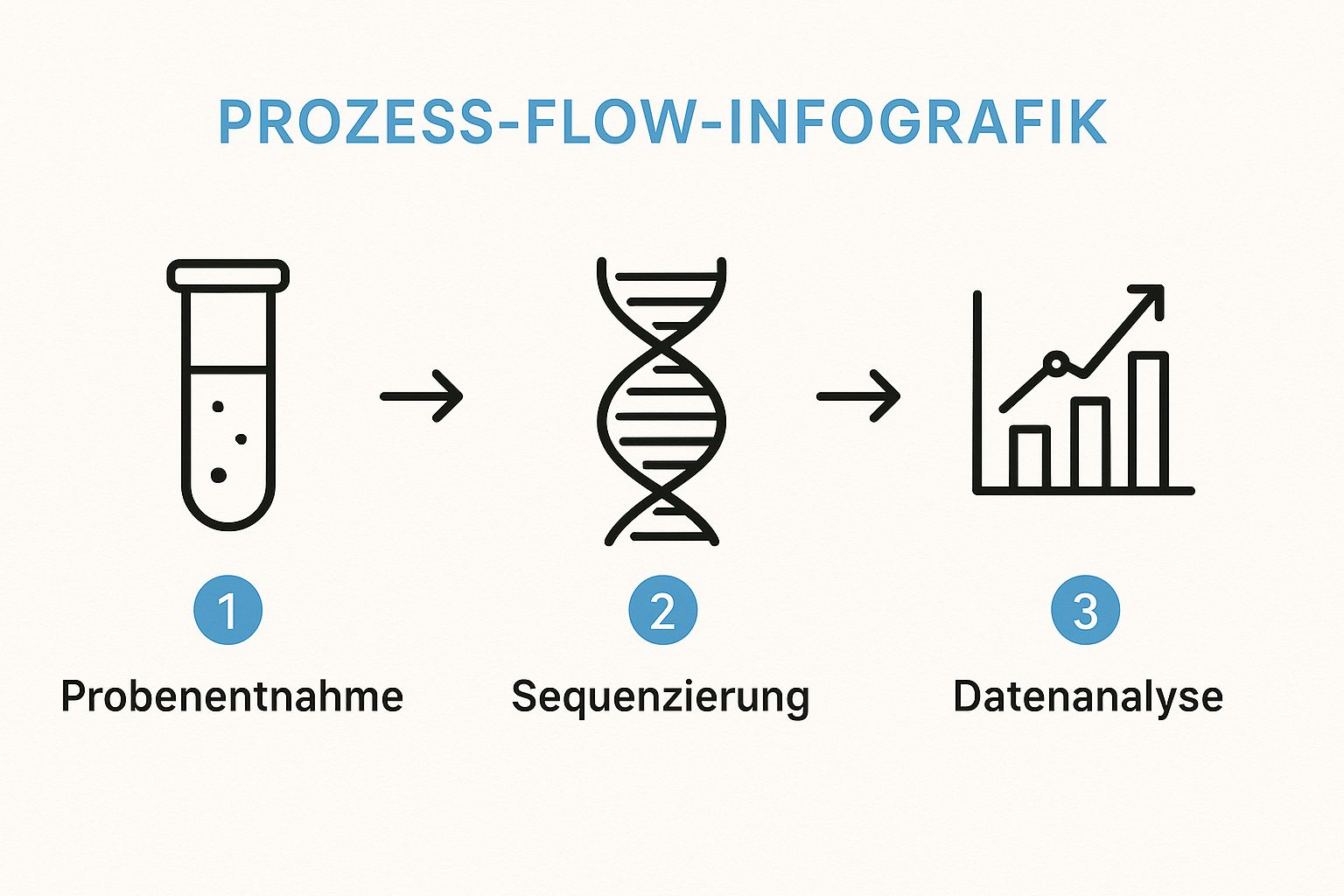
Every single step, from the sample to the final data analysis, is designed for maximum precision and data security.
From DNA to an understandable report
After amplification, state-of-the-art technology is used. So-called microarrays – tiny chips on which hundreds of thousands of DNA fragments are placed – specifically identify the relevant gene variants (SNPs) in your genome. This process is also called genotyping .
The raw data generated in this process is completely incomprehensible and extremely complex for laypeople. This is precisely where our bioinformaticians and specialized algorithms come into play. They translate the genetic information into clear, actionable insights into your metabolism, your nutritional needs, and other health predispositions.
Data privacy is our top priority: Your sample is immediately pseudonymized in the lab. This means it is processed without your name, only with a code. After analysis, the sample is destroyed according to regulations, and your data is protected according to the highest security standards (GDPR).
This meticulous process ensures that you receive a scientifically sound yet easy-to-understand report. If you'd like to delve even deeper into the process, our step-by-step DNA analysis guide offers further insights. This transforms a simple saliva sample into a valuable foundation for your personal health decisions.
Understanding nutrition through your genes

Why can your friend eat seemingly endless amounts of pasta, while even a small portion goes straight to your hips? Or why does the keto diet work wonders for some, while you just feel sluggish and lethargic? The answer is as individual as you are – and it's deeply ingrained in your DNA.
This is precisely where nutrigenetics comes in. It's the fascinating branch of science that explores the interplay between your genes and your diet. It helps us understand how your body reacts to specific foods and nutrients. A genetic analysis acts like a personal compass, guiding you toward a diet that truly suits you.
Your personal blueprint for nutrients
Each of us carries a unique genetic blueprint. This determines not only your eye color, but also how efficiently your body utilizes macro- and micronutrients.
A few concrete examples illustrate the extent of these genetic differences:
- How your body handles carbohydrates and fats: Certain gene variants can cause your body to convert carbohydrates less efficiently into energy and store them more as fat. Other people, however, are genetically predisposed to metabolize fats more effectively.
- Your individual vitamin needs: You may need more vitamin D or B vitamins than average to stay healthy, due to your genes. A genetic analysis can reveal such an increased need.
- Caffeine metabolism: The CYP1A2 gene determines how quickly your body breaks down caffeine. People with slow metabolisms might experience heart palpitations after just one cup of coffee, while those with fast metabolisms can easily drink several cups.
These genetic predispositions are not an unalterable fate. They are valuable information that allows you to tailor your diet and optimally nourish your body. If you are interested in learning more about this topic, read our article on what nutrigenetics is and how it influences our lives .
Intolerances in the genetic check
Besides metabolism, genes also play a central role in intolerances. Lactose intolerance and a predisposition to gluten intolerance are two of the best-known examples.
The ability to digest lactose (milk sugar) is controlled by the LCT gene. In most people, the activity of this gene decreases in adulthood, resulting in genetically determined lactose intolerance. There are also clear genetic risk markers for celiac disease, the most severe form of gluten intolerance. A genetic test can provide certainty in these cases.
The market for online genetic tests is booming, but that's precisely why caution is advised. Data protection poses significant challenges for many providers. Not all companies are transparent about how they use sensitive genetic data or secure it according to GDPR standards. Therefore, always look for reputable partners and inform yourself about the risks of online genetic tests .
Don't see genetic analysis as a limitation, but as an opportunity. It gives you the knowledge to specifically choose the foods that truly suit you and to free yourself from sweeping diet myths.
By adapting your diet to your genetic profile, you lay the foundation for greater well-being, energy and a healthy body weight – without any guesswork.
Genetically optimize metabolism and weight
Do you know that feeling? Some people seem to be able to eat whatever they want without gaining a single gram, while you feel like you gain weight just by looking at a cake. The explanation often lies not only in self-discipline, but much deeper – in your own personal genetic predisposition. Think of your genes as the directors of your metabolism: They determine the pace and efficiency with which your body burns calories, stores fat, and signals when you're hungry or full.
A genetic analysis gives you precisely this crucial insight into your personal metabolic blueprint. It shows you in black and white whether you are, for example, more of a "carbohydrate type" or a "fat type." With this knowledge, you finally understand why generic diets simply haven't worked for you so far. It's the key to tailoring your weight management to your body, instead of constantly fighting against it.
The genetic fingerprint of your metabolism
Your DNA controls a whole range of key factors that are crucial for your body weight. Knowing these individual predispositions allows you to counteract them much more effectively and adapt your lifestyle to truly suit you.
Here are some of the most important areas that are genetically influenced:
- Your basal metabolic rate: Genes like the UCP1 gene (Uncoupling Protein 1) can control how efficiently your body converts energy into heat. A specific variant can cause your basal metabolic rate to be slightly lower – meaning you gain weight more quickly with the same calorie intake.
- Satiety and appetite: The FTO gene is one of the best-known genes associated with a higher risk of obesity. Certain variants of this gene can reduce the feeling of satiety and thus promote cravings.
- Predisposition to fat storage: Genes like the PPARG gene play a role in the formation of fat cells. Some variants can promote fat storage, especially in the abdominal area.
But don't worry: These genetic factors are not an unchangeable fate. Quite the opposite! They give you a clear roadmap of exactly where you need to start. For example, if you know that your feeling of satiety is naturally weaker, you can consciously focus on meals rich in fiber and protein, which have been proven to keep you feeling full for longer.
Avoid the yo-yo effect sustainably
Who isn't familiar with this frustrating cycle? After a diet, the lost pounds return in a flash, often with a few extra on top. Genetics plays a role here, too. Evolutionarily, your body is programmed to conserve energy in times of "emergency"—and that's exactly what a diet is to it. Afterwards, it tries all the more desperately to build up new reserves.
A genetic analysis is like a personal nutritional compass. It helps you understand which "fuels" your body uses best and how to support your metabolism so that it works for you, not against you.
By tailoring your diet and training to your genetic metabolic type, you lay the foundation for lasting success, completely free of the yo-yo effect. Discover how your metabolism is genetically determined and how you can use this knowledge to your advantage. Personalized analyses from mybody-x, such as the mybody-x DNA Metabolism Test, provide you with the precise tools you need to put your diet and weight management on a scientifically sound footing. This way, you'll not only reach your goals faster, but above all, maintain them permanently.
Adapt your exercise and recovery to your genetic profile

You go to the gym regularly, run mile after mile, but the results you're hoping for aren't coming? Or do you often just feel overwhelmed? The answer could be buried deep in your DNA. Your genes determine not only how your metabolism works, but also your athletic performance and recovery. They dictate whether you're more of a born sprinter or a long-distance marathon runner.
A genetic analysis can clearly show you how your body reacts to physical exertion and how you can truly optimize your training. Instead of following a general training plan, you can tailor your sessions specifically to your genetic strengths. The result? You not only improve your performance but also minimize the risk of injury and overtraining. It's about training smarter, not necessarily harder.
Your genetic blueprint for muscles and endurance
Your genetic predisposition has a massive influence on how your muscles are structured and how efficiently your body uses oxygen. These are two absolutely key factors for athletic success. Knowing your predisposition allows you to find the right sport for you and take your training to a whole new level.
Some of the most important genetic factors are:
- Muscle fiber types (sprint vs. endurance): The well-known ACTN3 gene is often referred to as the "sprint gene." Certain variants of this gene promote the formation of fast-twitch muscle fibers, which are ideal for explosive power and speed. Other variants, however, promote slow-twitch fibers—perfect for endurance sports such as long-distance running or cycling.
- Oxygen uptake capacity (VO2max): Your genes play a significant role in your maximum oxygen uptake, one of the most important indicators of endurance performance. An analysis can show you how high your genetic potential is in this area.
- Susceptibility to injury: Certain gene variants can increase the risk of tendon or ligament injuries because they affect the stability of your connective tissue. With this knowledge, you can integrate targeted preventative measures, such as specific strengthening exercises, into your training.
Targeted control of regeneration and avoid overtraining
Just as important as the training itself is the recovery afterward. Here, too, your DNA provides valuable clues. Some people are genetically predisposed to simply need longer breaks to fully recover and improve their performance. If you ignore these signals from your body, you risk chronic fatigue and a decline in performance.
Think of genetic analysis as your personal coach at the molecular level. It helps you understand which training stimuli your body can best process and how to optimize your recovery to stay healthy and perform at your best in the long term.
With the insights gained from a genetic analysis, such as that provided by the mybody-x DNA Fitness Test, you can finally put an end to the guesswork. You'll learn which training intensity and duration are ideal for you, how to effectively manage your recovery phases, and which nutrients optimally support your body after exercise. This allows you to build your fitness on a solid, scientifically sound foundation – perfectly tailored to you and your body.
Understanding and using your genetic analysis report
It's finally here: your very own genetic analysis report. When you first flip through it, you might feel a little overwhelmed by the amount of data, charts, and recommendations. That's perfectly normal, don't worry! Don't think of the report as a complicated textbook, but rather as your personal instruction manual for a healthier life.
It's crucial to understand that genetic analysis doesn't provide definitive diagnoses. Rather, it reveals your individual predispositions – an incredibly valuable tool for better understanding your body's signals and making informed decisions about your health. Now it's about translating these insights into your daily life, step by step.
Here's how to read your report
A typical mybody-x report is intentionally simple and clearly structured so you can quickly find your way around. Usually, you'll find a summary of the most important results at the beginning. This is followed by detailed analyses of individual areas such as metabolism, nutrition, exercise, and your individual nutritional needs.
Pay particular attention to these elements:
- The traffic light system: Many results are presented using a simple color system (e.g., green, yellow, red). This gives you an overview at a glance of where your genetic strengths lie and in which areas you might want to take a closer look.
- The genetic details: For each predisposition, the corresponding gene is also named (for example, the FTO gene for the feeling of satiety). This serves scientific transparency – but of course you don't have to memorize these names.
- Specific recommendations: This is the most important part! For each result, you'll receive directly actionable tips for your diet, training, or lifestyle.
These recommendations are the core of your report. Don't think of them as strict rules, but rather as scientifically sound suggestions perfectly tailored to your unique genetic profile.
Your genetic profile is one half of the equation, your lifestyle the other. Your genes are unchangeable, but every day you have the chance to make the most of your genetic predisposition through your choices.
From knowledge to practical implementation
The true power of your genetic analysis only unfolds when you actually put the insights into practice. But don't panic, you don't have to turn everything upside down at once. Start small and focus on one or two recommendations that seem particularly important to you or that can be easily integrated into your daily routine.
Practical example: How data becomes a plan
Imagine your report shows the following results:
- Metabolism: You are genetically a carbohydrate type, but you process fats less efficiently.
- Sport: Your muscle fibers are more suited to endurance sports (you have less of the ACTN3 “sprint gene”).
- Nutrients: Your body has a genetically increased need for vitamin D.
What does that mean for you specifically?
- Nutrition: Incorporate more high-quality carbohydrates such as whole grains, potatoes, or legumes into your meals. At the same time, you should reduce saturated fats and instead focus on healthy fat sources such as avocados, nuts, or olive oil.
- Training: Instead of focusing solely on short, explosive strength training, longer cardio sessions such as jogging, swimming, or cycling could be significantly more effective for you in achieving your goals.
- Supplementation: Especially during the darker winter months, targeted supplementation with vitamin D could be beneficial for you to reliably meet your increased needs.
Products like the mybody-x DNA metabolism test are designed precisely to provide you with these individual pieces of the puzzle. This allows you to create a clear and actionable health plan that truly suits you.
Understanding legal and ethical aspects
Your genetic data is among the most sensitive information there is about you – perhaps even the most personal. Naturally, questions arise: How secure is this data? What rights do I actually have? Genetic analysis is a matter of great trust, and this trust must be underpinned by crystal-clear legal frameworks and ethical standards.
Fortunately, Germany has strict regulations that ensure exactly that. So you are by no means unprotected, but have clearly defined rights that put your informational self-determination at the forefront.
The Genetic Diagnostics Act as your protective shield
The central regulatory framework in Germany is the Genetic Diagnostics Act (GenDG) . You can think of it as a strong protective shield that has strictly regulated the handling of genetic analyses since 2010. The main goal is to prevent risks such as genetic discrimination or the misuse of data from the outset.
The law guarantees your right to informational self-determination. This means two things: You have the right to know everything about your genetic findings, but also the right to consciously choose not to – the so-called "right not to know." You can find more information about the specific aspects of these legal regulations here.
The Genetic Diagnostics Act (GenDG) also stipulates that comprehensive and understandable information must be provided before every test. You must know exactly what is being analyzed, what the results might mean, and where the limitations of the analysis lie.
A reputable provider like mybody-x strictly adheres to these guidelines and ensures that you retain full control at all times. Specifically, this means:
- Pseudonymization of your sample: As soon as your sample arrives at the lab, it will be separated from your name. Processing will then only be carried out using a code.
- Maximum data security: Your data is handled according to the strict rules of the GDPR and stored on secure, encrypted servers.
- Sample destruction: After the analysis is complete, your biological sample will be professionally and irretrievably destroyed. Nothing will be stored.
One thing is perfectly clear: your genetic data belongs exclusively to you. No employer, no insurance company, and no other unauthorized person may demand or obtain access to this information without your explicit consent.
For a more in-depth look at the general data protection regulations , which of course also apply to sensitive data such as genetic data, you can find further information here. This transparency is crucial so that you can make an informed and safe decision regarding your health.
Everything you always wanted to know about genetic analysis
Here we answer some of the questions we are frequently asked about genetic analysis . This should help you clear up any remaining uncertainties and realistically assess what such a test can do for you.
Is my genetic data safe with you?
Yes, absolutely. Protecting your data is our top priority. Providers like mybody-x strictly adhere to the requirements of the GDPR and the German Genetic Diagnostics Act.
Your sample will be pseudonymized in the lab, meaning it will be analyzed without your name. After the analysis, it will be securely destroyed. We store your results encrypted on secure servers – no one can access them.
Can a genetic analysis predict whether I will get sick?
Here we need to make a clear distinction: The lifestyle genetic analyses we offer at mybody-x look at your predispositions for metabolism, nutrition, and exercise. They are not medical diagnostics and do not make any statements about specific disease risks.
Medical genetic tests, on the other hand, may only be ordered by doctors. Their aim is to clarify specific hereditary diseases. That's a completely different matter.
Your genes are not an unchangeable destiny. They merely indicate a predisposition. Your lifestyle, your diet, and your daily choices are key to making the most of your genetic makeup.
Do my genes change over the course of my life?
Your basic DNA sequence, your genetic blueprint, remains the same throughout your life. What can change, however, is the activity of your genes – this is called epigenetics.
Factors such as your diet, stress levels, and exercise can essentially "switch on" or "off" certain genes. A genetic analysis reveals your blueprint, which you can then optimize through a conscious lifestyle.
Are you ready to understand your body's language and put your health on a scientifically sound footing? Discover the personalized health analyses from mybody-x and start your journey to a fitter, healthier you. Find the test that's perfect for you here .



Share:
Step-by-step DNA analysis: Understanding individual health data
Omega-3 fatty acids explained for heart, brain and skin