

Omega-3 fatty acids explained for the heart, brain, and skin
Omega-3 fatty acids are vital, polyunsaturated fats that your body cannot produce itself. They are essentially the essential building blocks for the health of your cells, brain, and cardiovascular system. They therefore need to be obtained through food or targeted supplementation.
What are omega-3 fatty acids really?

You’ve probably heard of omega-3 fatty acids many times, but what exactly are they? It’s best to think of them as a dedicated service team that works tirelessly behind the scenes to keep your body in top shape. Instead of complicated chemistry, it essentially comes down to one simple fact: Your body needs them but cannot produce them itself.
These special fats are therefore “essential.” That means they must come from outside the body, much like vitamins. They are fundamental nutrients that play a central role in your health.
The three main players: ALA, EPA, and DHA
The “omega-3 team” consists of three important members that perform very different tasks in your body. Each of these players has its own strengths and is indispensable for certain processes.
- ALA (alpha-linolenic acid): This is the plant-based form of omega-3. You can find plenty of it in flaxseeds, chia seeds, and walnuts. ALA primarily serves as an energy source for your body, but it can also be converted—in small amounts—into the other two important fatty acids.
- EPA (eicosapentaenoic acid): EPA is a powerful anti-inflammatory. Think of it as your body’s firefighter, extinguishing small and large “fires” (in other words, inflammation) before they can cause damage. It plays a crucial role in your cardiovascular system.
- DHA (docosahexaenoic acid): DHA is the architect of your brain and eyes. It is a critical building block for the structure of brain cells and the retina. An adequate supply of DHA is therefore essential for your cognitive performance and eyesight.
While ALA is found primarily in plant oils, EPA and DHA are mainly found in oily sea fish such as salmon, mackerel, and herring. The German Nutrition Society recommends a daily intake of at least 250 mg of EPA and DHA—a level that many people in Germany unfortunately do not reach.
The crucial point is this: Your body can convert ALA into the directly usable forms EPA and DHA only very inefficiently. That’s why obtaining EPA and DHA directly through your diet or targeted supplements is so important for your health.
Individual needs can vary considerably. Your genetic predisposition, lifestyle, and health goals influence how well your body processes these fats and how much you actually need. For example, the mybody-x Skincare DNA Metabolic Analysis can provide insight into whether your skin has a genetically determined increased need for anti-inflammatory nutrients such as omega-3.
How omega-3 supports your health

Omega-3 fatty acids are far more than just a fleeting health trend. These essential fats are true all-rounders and deeply involved in your body’s central processes. They play a role in almost everything—from the smallest cell to complex organ functions.
Let’s take a look at what exactly happens in your body. Imagine your cardiovascular system as a huge, finely tuned road network. Omega-3 fatty acids, especially EPA, are the specialized maintenance crew here. They ensure that the “roads”—your blood vessels—remain flexible and free of traffic jams and deposits.
This has a direct impact on your blood pressure and blood lipid levels. A good supply of omega-3 has been shown to help lower triglyceride levels—blood fats that, in excessive concentrations, increase the risk of cardiovascular disease. At the same time, they promote a healthy cholesterol balance. If you would like to learn more about why a level of “good” cholesterol that is too low can be a problem, take a look at our article on low HDL cholesterol.
Your brain: A high-performance organ needs the right fuel
Did you know that your brain consists of almost 60 percent fat? Omega-3 fatty acid DHA makes up a particularly important part of it. You can think of DHA as the most important building block for the communication centers in your head: neurons. Without enough DHA, signal transmission simply does not function properly.
You can notice this directly in everyday life:
- Better concentration: DHA helps you stay focused and avoid being distracted so easily.
- Stronger memory: It supports your brain in storing and recalling information.
- Emotional balance: A consistent supply of omega-3 is also repeatedly associated with better mood regulation.
The importance of omega-3 for our mental fitness extends well into old age. Studies suggest that a good supply of omega-3 fatty acids may help preserve cognitive function and reduce the risk of age-related neurodegenerative diseases.
The Silent Battle Against Inflammation
Inflammation is actually a great thing—a natural and important response of your immune system. It only becomes problematic when it turns chronic. Then it can become the root of many health complaints, from joint pain to skin problems. This is where EPA and DHA come in as natural counterparts, helping to restore balance to these low-grade inflammations in the body.
Omega-3 fatty acids act like a dimmer switch for inflammatory responses. They do not simply turn them off; instead, they regulate them down to a healthy level so that your body remains in balance.
This anti-inflammatory property is precisely what makes omega-3 so valuable for your skin. It strengthens the skin barrier from within, provides moisture, and can help relieve inflammatory skin conditions such as acne or atopic dermatitis.
But not every body is the same. Your genetic makeup influences how efficiently you metabolize omega-3 fatty acids and use them for your skin. The mybody-x Skincare DNA Metabolism Analysis can show whether you are genetically predisposed to dry skin, faster collagen breakdown, or an increased tendency toward inflammation. With this knowledge, you can adjust your diet strategically and take your skin health to a whole new level.
Meeting Your Personal Omega-3 Needs
After looking at the impressive benefits of omega-3 fatty acids, we now come to the crucial question: How much do you personally really need? The answer is as individual as you are. There is no one-size-fits-all solution, because your personal needs depend on many different factors.
Your age, sex, general health, and especially your lifestyle play a central role here. An elite athlete who regularly pushes their body to its limits logically has different needs than someone with a quiet office routine. This is because omega-3 supports recovery and helps keep inflammatory processes in check after exercise.
Similarly, women have a significantly higher need during pregnancy and breastfeeding. The omega-3 fatty acid DHA in particular is absolutely crucial for the development of the unborn child’s brain and eyes.
The Best Natural Sources of Omega-3
The best and most natural way to meet your needs is always a balanced diet. Fortunately, nature has given us a whole wealth of foods rich in these valuable fats. They are generally divided into animal and plant sources.
Animal-based sources: The champions of EPA & DHA
These provide the directly usable, long-chain omega-3 fatty acids EPA and DHA, which our bodies can use immediately.
- Fatty fish: Salmon, mackerel, herring, and sardines are the absolute frontrunners. A single 150 g serving of salmon can cover your needs for several days.
- Other seafood: Shrimp, mussels, and certain types of tuna are also good sources and contribute to your intake.
Plant-based sources: Valuable ALA
Plant-based foods contain the short-chain omega-3 fatty acid ALA (alpha-linolenic acid). Your body must first convert it into the important forms EPA and DHA—a process that is not always very efficient.
- Flaxseeds & flaxseed oil: They are the undisputed stars among plant-based sources. One tablespoon of flaxseed oil a day is already an excellent foundation.
- Chia seeds: These small powerhouses are not only full of fiber but also packed with ALA.
- Walnuts: A handful of walnuts is the perfect snack between meals and provides a substantial amount of omega-3.
- Rapeseed oil & hemp oil: These oils are also good sources of ALA for everyday cooking.
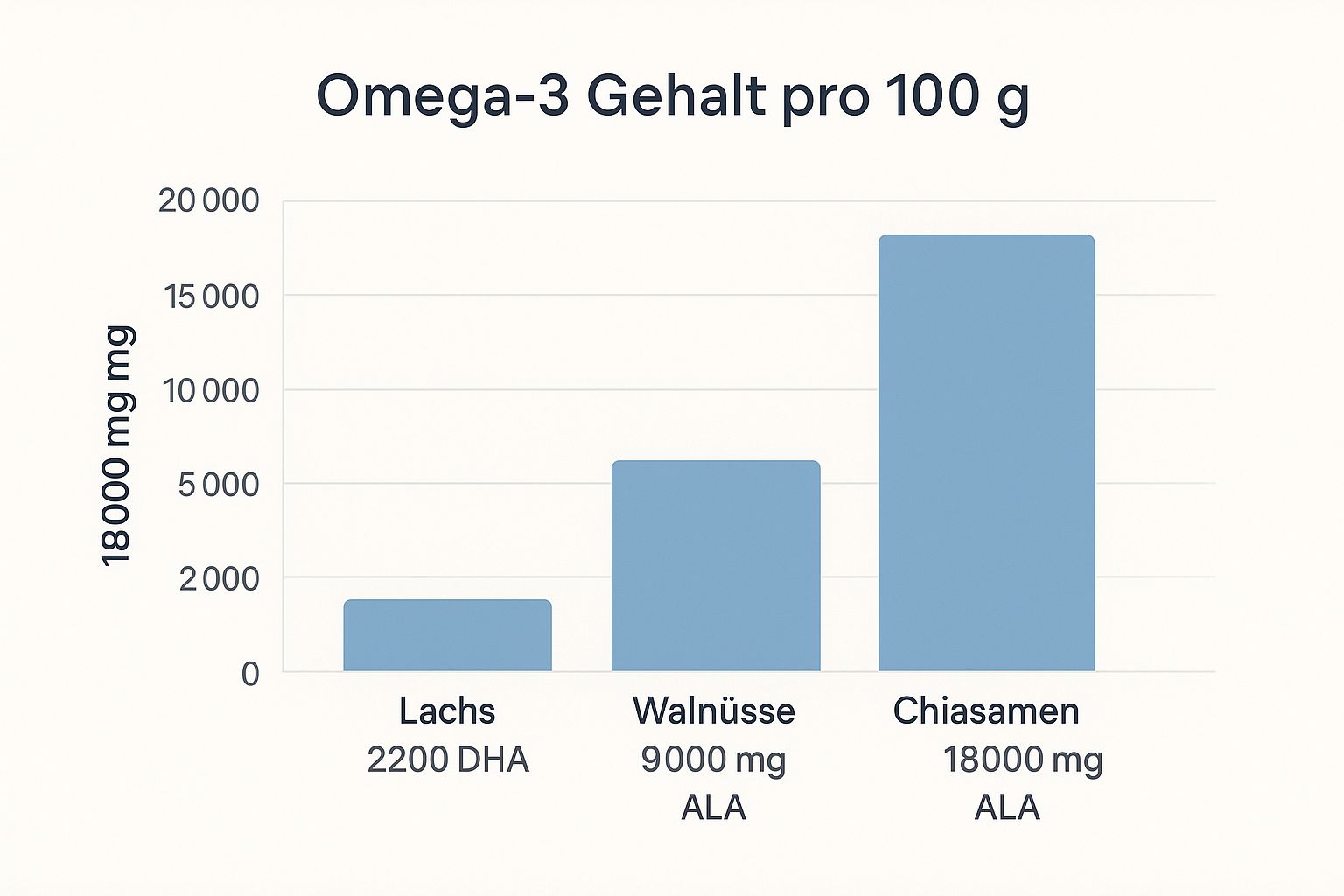
To give you a better overview, the following table shows which foods are particularly rich in the various omega-3 fatty acids.
| The best natural sources of omega-3 at a glance | ||
|---|---|---|
| Food | Type of omega-3 fatty acid | Average content (per 100 g) |
| Fatty salmon | EPA & DHA | approx. 2,200 mg |
| Mackerel | EPA & DHA | approx. 2,500 mg |
| Herring | EPA & DHA | approx. 1,700 mg |
| Sardines (in oil) | EPA & DHA | approx. 1,500 mg |
| Chia seeds | ALA | approx. 18,000 mg |
| Ground flaxseeds | ALA | approx. 22,000 mg |
| Walnuts | ALA | approx. 9,000 mg |
| Flaxseed oil | ALA | approx. 53,000 mg |
These figures illustrate that plant-based sources such as flaxseeds or chia seeds may have impressive amounts of omega-3 on paper, but in the form of ALA. Since our bodies can convert only a limited amount of it, animal-based sources remain the most direct and efficient way to obtain EPA and DHA.
Practical tips for your daily routine
Incorporating a good omega-3 intake into your daily routine is much easier than you might think. Often, even small adjustments can make a huge difference.
Your goal should be to regularly and diversely incorporate omega-3-rich foods into your diet. It’s not about being perfect every day, but about establishing a consistent, healthy habit.
Here are a few simple ideas you can put into practice right away:
- Start the day with power: Add a tablespoon of ground flaxseeds or chia seeds to your muesli, yogurt, or smoothie.
- Enhance your salads: Use walnut or flaxseed oil for your dressing and sprinkle a handful of walnuts on top. This adds great flavor and extra nutrients.
- Plan fish meals: Try to eat fatty fish such as salmon or mackerel once or twice a week. Whether fried, steamed, or canned—every form counts.
- Snack smart: A small portion of walnuts is an ideal, nutrient-rich snack between meals that helps prevent cravings.
Although these tips provide a great foundation, your individual needs may of course differ. Perhaps you're wondering whether you have a deficiency despite eating a healthy diet. If you'd like to find out how you can easily check your current nutritional status, you'll find all the important information in our guide on testing for nutrient deficiencies.
When omega-3 supplements make sense

A balanced diet should always be your first choice for providing your body with valuable omega-3 fatty acids. But honestly, that's not always easy to put into practice in everyday life. Sometimes certain circumstances or dietary choices get in the way. And that's exactly when high-quality supplements can provide really good support.
This isn't about replacing a healthy diet. Rather, supplements fill specific gaps. For example, do you eat little or no fish—whether out of conviction, because of an allergy, or simply because you don't like it? Then it becomes almost impossible to get enough of the important fatty acids EPA and DHA. The same applies during special stages of life, such as pregnancy, or for competitive athletes, when requirements suddenly skyrocket.
When you should consider taking a supplement
There are many situations in which targeted supplementation can really make a difference. However, the decision should always suit you and your life.
Here are a few typical situations in which omega-3 supplements may be worth considering:
- With a vegan or vegetarian diet: Those who avoid fish primarily consume the plant-based omega-3 form ALA. The problem? Its conversion into the active forms EPA and DHA is extremely inefficient. This is where algal oil is a brilliant solution—a direct, purely plant-based source.
- For people with a fish allergy or aversion: Those who cannot or do not want to eat fish miss by far the most important natural source of EPA and DHA. Supplements offer a straightforward alternative here.
- During pregnancy and breastfeeding: During this special time, the body needs large amounts of DHA for the child's brain development. Supplementation is often even recommended to optimally support both mother and child.
- For athletes and highly active people: Those who train a lot put their bodies under stress. Omega-3 fatty acids can help regulate inflammatory responses and speed up recovery after exercise.
- As you age: Nutrient absorption may decline somewhat over the years. However, a good omega-3 supply remains crucial for mental fitness and a healthy heart.
What to look for when choosing
If you decide to take a supplement, quality is essential. The market is huge and often confusing. But don't worry—with a few simple criteria, you can quickly find a good product.
Pay particular attention to these points:
- The source: Choose what suits you. Fish oil is the classic choice. Krill oil is considered particularly easy for the body to absorb. And algae oil is the perfect vegan alternative.
- EPA and DHA content: Don't be misled by the total amount of omega-3. What matters is how much of the active forms EPA and DHA is actually contained in each capsule. That's where the real benefit lies.
- Purity and freshness: Good products are purified of contaminants such as heavy metals. A low TOTOX value is a great indicator of the oil's freshness—and helps ensure that it does not taste rancid.
The right balance is crucial
More is not always better. This is especially true of omega-3 fatty acids. An overdose can also cause unwanted side effects, such as affecting blood clotting. So it is especially important to find a healthy balance and follow the recommended dosages.
An official warning underscores this: In November 2023, the Drug Commission of German Pharmacists (AMK) pointed out that very high doses of omega-3 may increase the risk of atrial fibrillation in people with existing cardiovascular disease. This dose-dependent warning shows how important it is to take omega-3 consciously and in line with your individual needs. You can find more details in the AMK communications.
Your individual needs are the benchmark. It is about ensuring optimal intake without risking an overdose.
And this is exactly where your genetics can play an exciting role. Whether your body may be prone to inflammation or has a particular need for protective nutrients is also encoded in your DNA. The Skincare DNA metabolic analysis from mybody-x can show you, for example, whether your skin could genetically benefit from a targeted intake of anti-inflammatory fatty acids. This allows you to develop a strategy that is truly right for you.
How your genes influence your skin’s needs
Omega-3 fatty acids are no longer a well-kept secret when it comes to a healthy heart or a fit brain. But did you know that they are also true superheroes for your skin? They work from within, strengthen the natural protective barrier, preserve moisture, and can help manage inflammatory skin conditions such as acne, rosacea, or atopic dermatitis. But—and this is the crucial point—a blanket recommendation will only get you so far.
What is a miracle cure for one person may have little effect on another. The reason lies deep within us: in our unique genetic makeup. Your genes are your body’s personal blueprint and significantly determine how your skin responds to nutrients such as omega-3.
Your genetic code for skin health
Each of us is unique, and that is especially true of our skin. This is exactly where the science of nutrigenetics comes in. It deciphers the fascinating interplay between our diet and our genes and helps us understand why some people are naturally prone to dry skin, while others constantly struggle with blemishes.
Think of your DNA as a handbook for your body. It contains invaluable information about your skin’s innate strengths and weaknesses. If you can read this handbook, you can tailor your skincare and diet to it perfectly—and much more effectively than with any superficial cream.
Exactly where do your genes play a role in your skin health? Here are the most important areas:
- Moisture regulation: Your genes determine how efficiently your skin can retain moisture. A predisposition to a weaker skin barrier often means that your skin dries out more quickly and reacts more sensitively to external stress.
- Collagen breakdown: Collagen is the protein that gives your skin firmness and elasticity. However, certain genetic variants can cause your body to break down this structural framework more quickly, visibly accelerating the aging process.
- Inflammatory tendency: Your immune system follows a genetic program. If it tends toward stronger inflammatory responses, this can manifest in skin problems such as acne or eczema. This is precisely where omega-3 fatty acids come into play as natural anti-inflammatory agents.
- Antioxidant protection: Free radicals from UV radiation and environmental toxins attack your skin cells. How well your body's own protective shield works against them is also encoded in your genes.
But these genetic factors are not an unalterable fate. Rather, they are signposts showing you where you can take action to support your skin in a targeted way.
From genetic analysis to a personalized skincare strategy
This is exactly where our Skincare DNA Metabolism Analysis by mybody-x comes in. Instead of fumbling through a fog of general advice, you gain crystal-clear insight into the needs encoded in your DNA. The test precisely shows whether you are genetically predisposed to dry skin, accelerated collagen breakdown, or an increased tendency toward inflammation.
Imagine your analysis revealing that your genes promote low-level inflammation in your body. Suddenly, the importance of an adequate supply of omega-3 fatty acids becomes much more tangible for you. You now know that you're not just doing something good for yourself, but specifically compensating for a genetic weakness.
But the test may also show that your body naturally has a more permeable skin barrier. In this case, omega-3 not only helps combat inflammation, but also strengthens your skin's lipid structure from within, thereby preventing moisture loss.
This is how a simple dietary recommendation becomes a highly effective, truly personal strategy for your skin. You consciously adjust your omega-3 intake—whether by eating more fatty fish, flaxseeds, or targeted supplements—because you now know exactly why it matters so much to you. That's the key to unlocking your skin's full potential and giving it exactly what it really needs.
Everything you've always wanted to know about omega-3
Finally, let's clear up the typical questions we keep receiving about omega-3 fatty acids. This will ensure you're well informed and can easily put any remaining uncertainties to rest.
Can I also meet my omega-3 needs entirely through plant-based sources?
Yes, but it requires a little planning. Plant-based sources such as flaxseeds, chia seeds, or walnuts are great, but they mainly provide the omega-3 fatty acid ALA. Your body first has to convert this into the directly usable forms EPA and DHA—and unfortunately, this process is often far from efficient.
If you want to play it safe, microalgae-based algae oil is the best direct plant source of EPA and DHA. It is the ideal supplement to a vegan or vegetarian diet and ensures that you are optimally supplied.
How quickly will I notice an effect from omega-3 capsules?
The effects of omega-3 are not a sprint but more of a marathon. It is not a painkiller that works after 30 minutes. Rather, the aim is to improve the fatty acid balance in your cell membranes over the long term and gradually reduce low-grade inflammation in the body.
The first positive effects, perhaps on your mood or concentration, may appear after just a few weeks. However, to achieve truly significant changes in the cardiovascular system or in chronic inflammatory processes, you should expect to take it regularly for several months. Patience pays off here!
Fish oil or algae oil—which is the difference?
Both provide the valuable fatty acids EPA and DHA, which is the main thing. The key difference lies in their origin: As the name suggests, fish oil is obtained from oily sea fish. Algae oil, on the other hand, is produced directly from microalgae—the original source from which fish also obtain their omega-3.
Algae oil is therefore the perfect vegan and sustainable alternative. High-quality algae oil is just as effective as fish oil and has the advantage of being free from potential pollutants from the sea.
Are there any side effects I should watch out for?
In general, omega-3 fatty acids are very well tolerated. Only at very high doses can they occasionally cause mild gastrointestinal discomfort or fishy burps. As mentioned, excessive intake can also affect blood clotting.
Important: Simply follow the recommended dosages. If you have pre-existing conditions or take blood-thinning medication, it’s best to briefly consult your doctor before taking it. A balanced intake is the key to success here.
Your genes have a say in how your body processes nutrients and what your skin really needs. With the mybody-x Skincare DNA Metabolism Analysis, you gain in-depth, personalized insights. This allows you to tailor your diet and make your skin glow from the inside out.



Share now:
Step-by-step DNA analysis: Understanding individual health data
Remove varicose veins: For smooth, healthy legs