

What to do about intestinal problems? Your guide to quick relief and lasting solutions
If you suddenly start struggling with intestinal problems, the first rule is simple: Give your stomach a break. Choose tried-and-tested bland foods such as rusks or mild herbal tea, drink plenty of water, and give your body some rest. For now, avoid anything that is difficult to digest, fatty, or heavily seasoned so as not to put additional stress on your digestive system.
Understanding sudden intestinal problems and responding appropriately
A sudden rumbling in your stomach, nasty cramps, or an unexpected sprint to the bathroom—acute intestinal problems usually catch us at the worst possible moment and can throw the entire day's schedule into disarray. But what is actually behind it when your stomach suddenly rebels? Often, the triggers are harmless and easy to identify.
Maybe it was a lavish dinner, a food you are not used to, or simply too much stress that literally upset your stomach. Such factors can temporarily throw your digestive system out of balance. The typical consequences are usually:
- Bloating and an uncomfortable feeling of fullness
- Abdominal cramps or pulling pains
- Diarrhea or, occasionally, short-term constipation
In most cases, this is simply your body's reaction to an irritant. It is trying to get rid of something that is not good for it or signaling that it needs a break.
The most common triggers of acute symptoms
It is not always immediately clear why the intestines are acting up. One of the most common causes is a classic gastrointestinal infection caused by viruses or bacteria. And these infections are anything but rare. In fact, sick notes due to gastrointestinal infections in Germany reached record levels in 2023. An analysis by AOK Rheinland/Hamburg showed an increase from 9.72 to 14.56 cases per 100 insured people compared with the previous year—a trend that has continued over the past two decades.
But your lifestyle also plays a huge role. People who wolf down their food often swallow a lot of air, which can lead to bloating. The same applies to excessive consumption of carbonated drinks. If you would like to explore the topic in more depth and learn how to specifically avoid bloating after eating, we have a more detailed article for you.
This infographic nicely shows how inflammation develops and can spread in the digestive tract—often leading to exactly the symptoms you are experiencing right now.
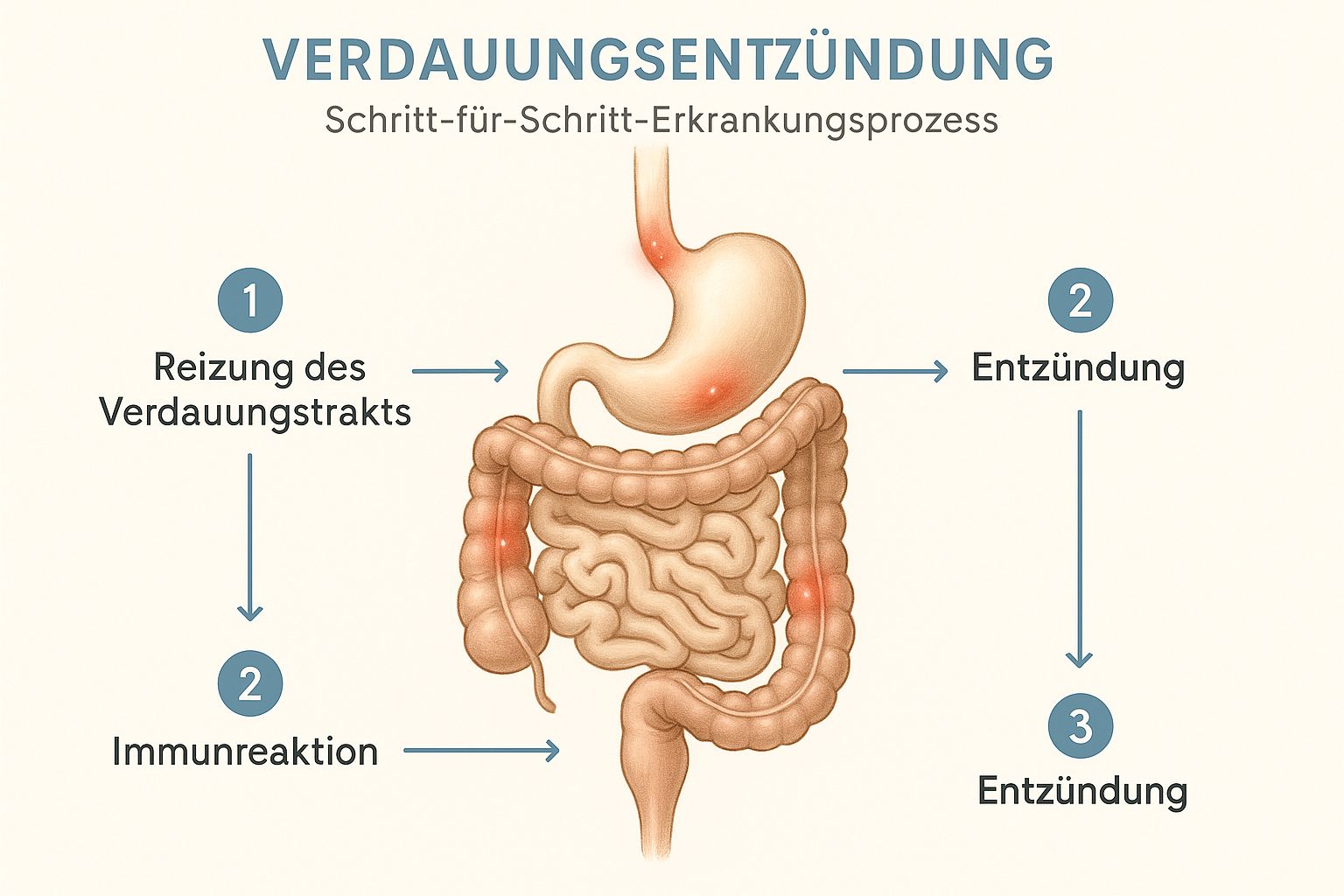
The visualization makes it clear: Acute problems are often local reactions to specific triggers that deliberately irritate the intestines.
Your first step should always be to give your gut a chance to rest. Do not burden it with heavy foods, and give it time to regenerate. This is the most effective immediate relief before you consider further measures.
It is important to understand that your gut is a sensitive ecosystem. If you know the cause of your acute symptoms, you are already halfway there. But if the problems keep recurring, it is worth taking a closer look. A gut microbiome test can help you analyze the composition of your gut flora and uncover possible imbalances that may be behind chronic complaints.
Getting to the bottom of the causes of your gut problems
If bloating, cramps, or irregular bowel movements keep accompanying you, it is time to take a closer look. Such recurring complaints are rarely a coincidence. Rather, they are a clear signal from your body that something inside has become unbalanced.
To solve this mystery, you need to do a little detective work. The good news is that you already hold the most important clues in your own hands. Your daily habits, what you eat, and how you feel are the crucial pieces of the puzzle.
Your lifestyle as the key
Often, it is the small things in everyday life that add up unnoticed. Are you currently under a lot of stress? Do you get enough sleep? Do you exercise regularly? All these factors send signals directly to your digestive system via the so-called gut-brain axis—a kind of direct line between your head and your gut.
Medications such as antibiotics or certain painkillers can also disrupt the delicate balance of your gut flora. A simple but extremely effective first step is to keep a food and symptom diary. Record the following in detail for one to two weeks:
- What do you eat and drink (preferably with the time)?
- When do your symptoms occur?
- How do the symptoms feel (e.g., sharp, dull, bloated)?
- How high was your stress level that day?
After a short time, you will probably start to recognize patterns that you would never have noticed before. Maybe it is the milky coffee in the morning that bothers you, or the raw vegetable salad in the evening that regularly causes bloating.
The microbiome as a key factor
Perhaps the most important player in your gut is your gut microbiome. Trillions of microorganisms live there, regulating not only your digestion but also your immune system and even your mood. When this complex ecosystem becomes unbalanced—we call this dysbiosis—it can lead to a whole range of chronic intestinal complaints.
Such dysbiosis does not develop overnight. It is often promoted by a one-sided, low-fiber diet, chronic stress, or the use of medication. The result: “Bad” bacteria gain the upper hand and displace the beneficial helpers.
Fortunately, analyzing your microbiome is no longer a guessing game. A modern test can show you precisely how your gut flora is composed and exactly where an imbalance exists in your gut.
Instead of stumbling in the dark and trying different diets, you can tackle the root of the problem directly. If you would like to learn more about how such an analysis works and what it can reveal, you will find all the details in our article about the gut microbiome test. This is the decisive step toward finally moving from merely treating symptoms to addressing their underlying causes.
Your path to a healthy gut microbiome
A healthy gut microbiome is your very own foundation for stable digestion and genuine well-being. It is best to picture it as a flourishing garden: Give it the right care and nutrients, and it will thrive. Neglect it, and unwanted guests will quickly take over, throwing the balance off.
But what exactly can you do to deliberately cultivate this inner garden if you keep struggling with gut problems?
The key is to deliberately “feed” and support your beneficial gut bacteria. This is where two important terms that are often confused come into play: prebiotics and probiotics. Although they sound similar, they have very different yet complementary roles in your gut health.

Prebiotics: Food for your beneficial gut bacteria
Prebiotics are essentially nothing more than indigestible dietary fibers. They pass through the stomach and small intestine undigested and serve as food for your beneficial gut bacteria in the large intestine. They therefore promote their growth and activity, naturally helping to keep the “bad” microbes in check.
You can find these valuable helpers primarily in plant-based foods:
- Vegetables: Chicory, artichokes, onions, garlic, and leeks are true powerhouses for your microbiome.
- Fruit & starch: Chilled potatoes or slightly green bananas provide valuable resistant starch that your gut microbes love.
- Whole-grain products: Oatmeal and real whole-grain bread are also excellent and easily accessible sources.
By regularly incorporating these foods into your diet, you create the perfect environment for beneficial microorganisms to multiply and thrive.
Probiotics: The living helpers from outside
Probiotics, on the other hand, are live microorganisms that you introduce directly into your gut. You probably know them from fermented foods such as yogurt, kefir, fresh sauerkraut, or kimchi. These products contain live bacterial cultures that can take up residence in your gut and positively influence the balance of your gut flora.
To make the differences clearer, here’s a brief overview:
Prebiotics vs. probiotics for your gut
A comparison of the two most important building blocks for a healthy microbiome, including practical food examples.
| Characteristic | Prebiotics | Probiotics |
|---|---|---|
| What is it? | Indigestible dietary fibers | Live microorganisms |
| Main function | Food for beneficial gut bacteria | Direct intake of beneficial bacteria |
| Effect | Promotes the growth and activity of the existing flora | Take up residence in the gut and support the flora |
| Examples | Onions, leeks, artichokes, cold potatoes, oats | Yogurt, kefir, sauerkraut, kimchi, kombucha |
So both are important, but they work in different ways. Prebiotics nourish what is already there, while probiotics introduce new, beneficial inhabitants.
The decisive factor for a healthy microbiome is diversity. The more colorful and varied your diet, the more diverse your community of gut inhabitants—and the more resilient your entire system will be.
But what if you continue to struggle with gut problems despite eating a healthy diet? The cause is often a specific imbalance that cannot be corrected through general tips alone. This is where a targeted analysis comes in. Instead of guessing which foods are good for you, you can gain precise insights with a gut microbiome test from mybody-x.com.
Such a scientifically grounded analysis shows you in black and white how your community of gut bacteria is composed. You’ll learn which bacterial strains may be underrepresented in your gut and exactly where you need to take action. This enables you to develop a personalized strategy that goes far beyond general advice.
If you’d like to delve deeper into the subject, you’ll find many more tips in our guide on building your gut flora in a targeted way. With this knowledge, you can specifically support your gut and ensure a calm feeling in your abdomen in the long term.
Long-term strategies for a calm stomach
To get digestive problems under control for the long term, simply changing your diet is often not enough. A calm stomach is the result of a lifestyle in which all the pieces work together. The goal is to create an environment for your body in which your digestive system can truly relax and function optimally.
Genuine, long-term success is built on habits you can actually stick to. Stress management, exercise, and good sleep are at least as important as what ends up on your plate. Think of the following strategies as a kind of toolbox from which you can gradually select the elements that fit your everyday life.
Harness the power of the gut-brain axis
Have you ever noticed that stress goes straight to your stomach? That's no coincidence. Your brain and gut are directly connected through the so-called gut-brain axis—a kind of two-way data highway. Emotional stress can therefore have an immediate effect on your digestion.
Chronic stress can slow intestinal movement, negatively affect your microbiome, and even make the intestinal lining more permeable. The good news is that you can also use this connection to your advantage. Simple relaxation techniques are an extremely effective way to combat stress-related digestive problems.
Just a few minutes of mindful breathing can make a huge difference:
- Breathing exercises: Sit or lie down comfortably. Slowly inhale through your nose for four seconds, hold your breath for four seconds, then slowly exhale through your mouth for six seconds. Repeat this for five to ten minutes.
- Mindfulness & meditation: Short, guided meditations help calm your nervous system and dampen your body's stress response.
These exercises send calming signals to your gut and help it switch from alarm mode to a state of rest and digestion.
Movement as a gentle motor for digestion
Exercise is one of the most important keys to regular, healthy digestion. And don't worry—you don't have to run a marathon. Even moderate, but above all regular, activity can work wonders.
A daily walk of just 20 to 30 minutes gently stimulates peristalsis—the wave-like muscle contractions of your intestines. This helps move food through your digestive tract more efficiently and prevents constipation and bloating. At the same time, exercise promotes blood flow to your abdominal organs and supports a diverse, healthy gut microbiome.
A short digestive walk after eating is more than just an old saying. It has been shown to support intestinal activity and can help reduce fermentation processes and the associated gas production.
The underestimated helpers: sleep and water
Two absolute basics for our health are often completely overlooked when it comes to intestinal problems: sufficient sleep and adequate fluid intake.
While you sleep, your body finally has time for important regeneration and repair processes—and this is especially true for your intestines. Lack of sleep, on the other hand, disrupts your hormone balance, increases stress levels, and thus has a direct negative impact on your digestion.
Water is just as important. Drinking at least 1.5 to 2 liters per day is essential so that fiber can absorb enough water in the intestines and keep stools soft and easy to pass. Without enough fluids, even healthy fiber can have the opposite effect and actually worsen constipation.
When you should seek professional help
You have to take responsibility for your own health. When it comes to intestinal problems, a mindful diet and healthy habits are worth their weight in gold. But it is just as important to know your own limits. Not every stomach issue can be resolved in the long term with tea and a bland diet.
Sometimes persistent symptoms are a clear signal from your body that something more serious may be behind them. This is not about causing panic. Rather, we want to give you the tools you need to manage your health responsibly and safely.

Warning signs you should not ignore
Certain symptoms, known as “red flags,” should never be taken lightly. They require prompt medical evaluation to rule out serious conditions. So listen closely to your body and take action if you notice any of these signs:
- Unexplained weight loss: You are losing weight even though you have not changed your diet or exercise routine.
- Blood in the stool: Whether bright red, dark, or black—this is always a reason to see a doctor. No exceptions.
- Severe, persistent pain: Intense abdominal cramps that simply do not go away or keep coming back are a clear warning sign.
- Changes in bowel movements: A sudden shift between diarrhea and constipation that lasts for weeks, or pencil-thin stools.
- Fever and chills: In combination with abdominal pain, this may indicate acute inflammation.
- Extreme, persistent fatigue: A severe decline in performance that does not improve even with sufficient sleep.
Such symptoms may indicate inflammatory bowel disease (IBD), celiac disease, or other serious diagnoses. To investigate, for example, gluten intolerance, you’ll find helpful information about celiac disease testing in our guide.
The importance of preventive care
Alongside acute warning signs, preventive care also plays a crucial role in your long-term gut health. Yes, we’re talking about examinations such as a colonoscopy. They are extremely important for detecting conditions such as colorectal cancer at an early stage, often before they cause any symptoms at all.
And the figures support this approach: In Germany, the number of deaths from colorectal cancer has fallen by around 17% over the past 20 years. This is largely due to improved early detection programs. To further strengthen preventive care, the age for preventive colonoscopies for women will be lowered from 55 to 50 starting in April 2025.
Your gut feeling is often the best guide. If you feel that something isn’t right, don’t hesitate to seek professional help. It’s better to ask once too often than once too little.
What you’ve always wanted to know about your gut
Bowel problems often raise a lot of questions. So you don’t have to remain in the dark, we’ve collected answers to the most common uncertainties here—short, concise, and to the point.
Intolerance or allergy—which is the difference?
The two terms are often lumped together, but they describe two completely different reactions in your body. It’s important to keep them clearly separate.
A food allergy is an intense defensive reaction by your immune system. Your body mistakenly classifies an otherwise harmless substance, such as a protein in peanuts, as a dangerous intruder. The result is a massive immune response that can range from a skin rash to life-threatening anaphylactic shock.
A food intolerance, also called intolerance, on the other hand, almost always affects the digestive tract. The problem is often a missing enzyme. The best example is lactose intolerance. The enzyme lactase is missing to break down the milk sugar. The consequences are unpleasant—bloating, stomach rumbling, diarrhea—but it is not a systemic immune reaction like an allergy.
How long does it take to build up the microbiome?
Honestly? Building a healthy gut microbiome is not a sprint but rather a marathon. There is no one-size-fits-all answer because the process is highly individual. But you can often feel the first positive changes in your gut flora after just a few weeks if you consistently change your diet.
For truly profound and lasting improvement, however, you should expect it to take around three to six months. Sustainability is the key here. It takes time and patience for the beneficial bacteria to feel at home and multiply permanently in your gut.
Can probiotics cause side effects?
Yes, they can—but don’t worry, this is usually a good sign. When you start taking probiotics, you may experience mild discomfort at first. This generally just means that your gut is getting used to its new inhabitants and your microbiome is currently reorganizing itself.
Typical initial side effects include:
- Mild bloating
- A feeling of fullness
- Changes in bowel movements
These symptoms are almost always harmless and disappear on their own after a few days, once your digestive system has adjusted.
Our advice from experience: Always start with a low dose and increase it slowly. This gives your gut the time it needs to adapt and minimizes the initial discomfort.
What if your digestive problems simply do not get better?
Have you already tried everything, completely overhauled your diet, and optimized your lifestyle, but your stomach simply refuses to cooperate? If your problems are this persistent, it is time to dig deeper. Instead of continuing to guess, a targeted analysis can finally provide clarity.
A gut microbiome test provides a scientifically sound snapshot of your gut flora. It shows you in black and white which bacterial strains are dominant in your gut and where imbalances may be lurking that could be causing your symptoms. With this knowledge, you can finally take targeted action—exactly where your body really needs support.
Do you finally want to know what is really behind your digestive problems? At mybody-x.com, you can gain precise insights into your microbiome through scientifically sound analyses that you can conveniently carry out at home. Discover the causes of your symptoms and receive personalized recommendations for your well-being. Take the first step toward a calmer stomach and learn more about the mybody® health analyses.

Share now:
What is the microbiome? Understand its importance
Get your gut microbiome tested: 12 providers reviewed for 2025