


Get your gut flora tested: how to recognize a good microbiome test
ca. 12 Minuten

Do you often feel tired, have unexplained digestive problems, or simply want to understand what’s going on in your body? Part of the answer may lie in your gut. Your microbiome, the community of trillions of microorganisms in your digestive tract, affects more than just digestion—it also influences your immune system, mood, and body weight.
But how can you find out whether everything is in balance? You can get your gut flora tested easily from home. In this article, we’ll guide you step by step: how to choose the right test, collect a sample at home, and what happens after you send it to the lab. You’ll also learn how to recognize an analysis you can put to use.
Instead of a list of providers, here are the criteria every microbiome test can be measured against: lab, sample type, markers, analysis, data privacy, and price. With these six points, you can assess any offer yourself, even one that doesn’t exist yet. A provider ranking would be outdated in six months, but the criteria will still apply.
How to recognize a good gut flora test
A good gut flora test tells you before you buy who analyzes the sample, what is analyzed, and what you’ll receive at the end. If any of these three details are missing from the product page, they’re usually missing from the report too.
The self-test market has become hard to navigate. Medical diagnostic lab analyses sit alongside wellness products with attractive dashboards and methods whose measurement principles don’t stand up to scientific scrutiny. From the outside, the boxes all look the same. You can tell them apart by six criteria, each of which should be listed on the product page before you buy—or not.
| Criterion | What to look for | Why it matters |
|---|---|---|
| Lab | Does it state who analyzes the sample, which standard they follow, and in which country? | “Certified” without a standard number is a claim, not information |
| Sample type | Stool sample for gut flora, not hair or saliva | The bacteria are in your stool, not your hair |
| Markers | Which bacterial groups, which metrics, how many species? | That’s the only way to know in advance whether your concern is covered |
| Analysis | Sample report available for review; recommendations clearly derived from your results | Numbers without context don’t change anything in everyday life |
| Data protection | Pseudonymization, storage period, and how the sample is handled after analysis | This involves sensitive health data that requires special protection |
| Price | Final price including return shipping and analysis, with the date clearly shown | Additional costs can skew any comparison |
The six points are ranked by importance. Choose the wrong lab or sample type, and you get a result with no solid basis—then even the most polished analysis won’t help.
What level of lab quality is behind the test?
What matters is that a provider names the standard, including its number, scope, and country, as well as the assessing body. Anyone who just writes “certified” hasn’t said anything.
Does “certified” without a standard number mean anything at all? That’s a fair question, and the answer is: not much. Certification always relates to a specific standard, a specific scope, and a body that carried out the assessment. If a product page only says “certified lab,” you can ask which standard they mean. If you don’t get a clear answer, that’s an answer in itself.
A second question concerns how the work is divided. Some providers run their own lab, others work with a partner lab, and still others are purely resellers who pass on a kit from another brand. All three models can work. What matters is knowing which one you’re dealing with, because that determines whom to contact with questions about your results.
Also ask about the analysis method. DNA sequencing is the standard approach for the gut microbiome today: the bacteria’s genetic material is read from the sample and assigned to species. Older methods use culturing on growth media and detect far less, because many gut bacteria are difficult to grow outside the gut. This isn’t a minor detail; it determines how much of your gut microbiome can actually be seen.
What sample does a gut microbiome test require?
For the gut microbiome, the sample is stool. Everything else measures something different.
The sample is collected at home and takes just a few minutes. You place the enclosed paper in the toilet, catch a small amount of stool on it, swipe the tube’s stick over it in several places, close the tube, and send it back in the prepared envelope. No needle, no appointment, no waiting room.
Three things determine whether the sample arrives at the lab in usable condition. First, the shipping day: posting it on Friday evening risks the sample sitting over the weekend. Second, the quantity—too little material leads to a request for more, while too much serves no purpose. Third, the timing in relation to medication. After a course of antibiotics, the gut flora is temporarily altered; if you want to see its normal state, wait a few weeks and keep the time off antibiotics in mind when reading the results.
Hair-based tests, such as those using bioresonance, are offered for gut issues and intolerances. Bioresonance is a complementary medicine method whose effectiveness is not scientifically recognized. If you come across a sample type that doesn’t match the purpose of the test, that’s a deal-breaker, not a minor detail.
Which markers does a microbiome analysis cover?
A gut flora analysis shows which groups of bacteria are present and in what proportions. Depending on the scope, it may also include measurements such as diversity, enterotype, or a FODMAP index.
Diversity describes variety: how many different species are present and how evenly they are distributed. The enterotype classifies your gut flora into a basic pattern that remains relatively stable over the years and is strongly linked to diet. A FODMAP index relates to certain carbohydrates that are fermented by bacteria in the large intestine and can cause gas and pressure in sensitive people. Each of these measurements answers a different question.
That’s why, before buying, you should ask: Does it cover my concern? Someone who suspects certain foods cause bloating needs a different range of tests than someone who wants to take stock after a course of antibiotics. If the product page doesn’t list the number of species or the markers, you won’t know any more afterward. An honest provider states what it doesn’t measure.
Some analyses combine microbiome testing with inflammation or mucosal markers. This is a separate type of test with its own purpose and should be handled by a doctor if symptoms persist. If you suspect you have a leaky gut, you can find out more in our article on how to test for leaky gut.
A warning belongs here. The links between individual bacterial species and diseases are being studied in research and described in studies. No conclusion can be drawn from this for you as an individual. A provider who infers a disease or rules one out based on a bacterial value is promising more than the method can deliver.
How can you tell if an analysis is something you can act on?
A useful report shows three things: your values, the comparison range, and a recommendation that clearly follows from your results.
Are the recommendations really based on my results, or are they the same for everyone? Check the sample report. Reputable providers make one available for review before you buy. There you can see whether dietary recommendations are linked to specific values or whether the same ten tips appear in every report. A sample report available only after purchase is a warning sign.
Also pay attention to how reference ranges are handled. Reference ranges depend on the lab, method, and age. A value marked as low in one report may fall right in the middle of the range at another lab. So comparing reports from different providers is not comparing like with like.
The limits are just as important. A microbiome test does not provide a diagnosis, and an unusual result does not mean you are ill. It shows a state at a particular point in time, which can shift with diet and medication. What you do with it is a matter of diet and lifestyle; if symptoms persist, discuss the findings with a doctor, using them as a starting point. How long it takes to change your gut flora is explained in our article Building up your gut flora: how long does it take.
What happens to your sample and data?
Health data belong to the specially protected categories of data under the General Data Protection Regulation. A provider handling this data can answer three questions for you.
- Pseudonymization: Is the sample tracked by an identification number rather than your name, so nobody in the lab knows who it belongs to?
- Sample after analysis: Is it destroyed or stored, and if stored, for how long and for what purpose?
- Sharing: Is data used for research or advertising, and do you have to actively consent or actively object?
The difference between consent and objection may sound small, but it isn’t: in one case, nothing happens without your action; in the other, your data continues to be used until you stop it. If the privacy policy says nothing about this, it’s fair to ask before buying.
Another point to consider is location. Within the EU, the General Data Protection Regulation applies directly. If the sample is sent to a non-EU country, you’ll want to know the legal basis for doing so and who has access to it there.
How much does a gut flora test cost?
You can only compare prices fairly when return shipping, lab analysis, and results are included. Our two gut tests cost €129.00 and €189.00, respectively, including analysis and results, as of September 20, 2026.
For each offer, check whether return shipping for the sample is included, whether the analysis is covered by the price or sold as an add-on, and whether a consultation about the results costs extra. Three small charges can quickly add up to the difference between two offers that initially looked equally priced.
A guide to help you decide: A test is a one-time expense, while changing your diet costs you weeks. It’s worth knowing what you’re working on rather than cutting out foods for three months and ending up no wiser. It’s just as important to be honest about this: if you’ve never had your symptoms checked by a doctor, start there, not with a test.
Buy a gut flora test: the two tests from mybody®x
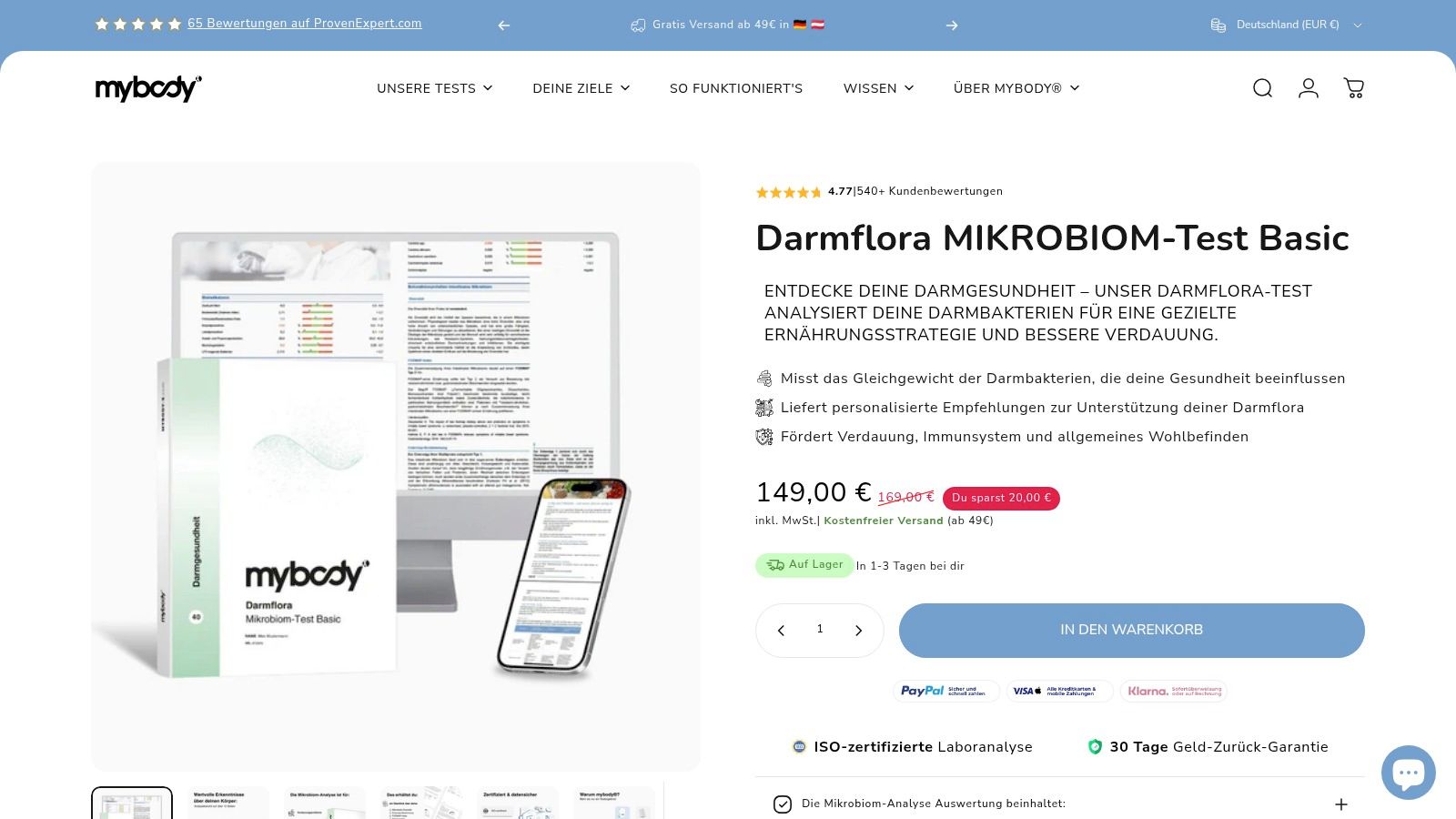
mybody®x (MYBODY Lab GmbH) offers two at-home stool tests. Both use DNA sequencing, and for both, your lab results are ready 5 to 10 business days after the sample arrives. Analysis is performed in a laboratory in Germany certified to ISO 9001 and ISO 13485. Your data is processed in accordance with ISO 27001 and the GDPR.
| Test | What it shows | Price (as of September 20, 2026) |
|---|---|---|
| Gut Microbiome Test | Complete | Over 1,500 bacterial species, plus diversity, enterotype, and FODMAP index | 189,00 € |
| Gut Flora Microbiome Test | Essential | An overview of your gut flora composition | 129,00 € |
The process is the same for both: order a test kit, discreetly collect a stool sample at home, mail it back postage-free, and access your results report online. The report lists your values, compares them with a reference range, and uses them to make dietary recommendations. For a detailed look at how the process works, see our post about the at-home stool test.
What these tests can’t do belongs here too: they don’t diagnose illness, replace a colonoscopy, or tell you whether you tolerate a particular food. Our products are not intended to diagnose, treat, cure, or prevent any disease. The content of this article is for general information and does not replace medical advice, diagnosis, or treatment.
What happens with the results
Getting your gut flora tested is easier and more accessible today than it was just a few years ago. But the value of a test like this doesn’t lie in the data; it lies in what you do with it. A detailed report is the compass, and the recommendations are the map. You have to walk the path in everyday life.
Your choice depends on what you want to find out. Ask yourself honestly: What do you want to achieve?
- For a comprehensive introduction: If you’re looking for a detailed overview of your microbiome and recommendations for diet and lifestyle, choose the test with the broader analysis. More metrics mean more potential starting points.
- For an initial assessment: If you want to find out how your gut flora is composed, for example a few weeks after antibiotic treatment, the smaller test is enough as a starting point.
- For symptoms that may indicate illness: Blood in your stool, unintentional weight loss, fever, or persistent pain should be assessed by a doctor first. A microbiome test can help prepare you for that conversation, but it cannot replace it.
Ultimately, the quality of the analysis is what matters. A good test provides data and explains in plain language what it means for you and what the next sensible step is. A bad one leaves you alone with a chart.
Are you ready to get a picture of your gut? The Microbiome Gut Test | Complete from mybody®x analyzes your gut ecosystem and translates the results into clear, actionable recommendations. If you’d like to talk first: the consultation is free, and it won’t try to sell you anything.


