
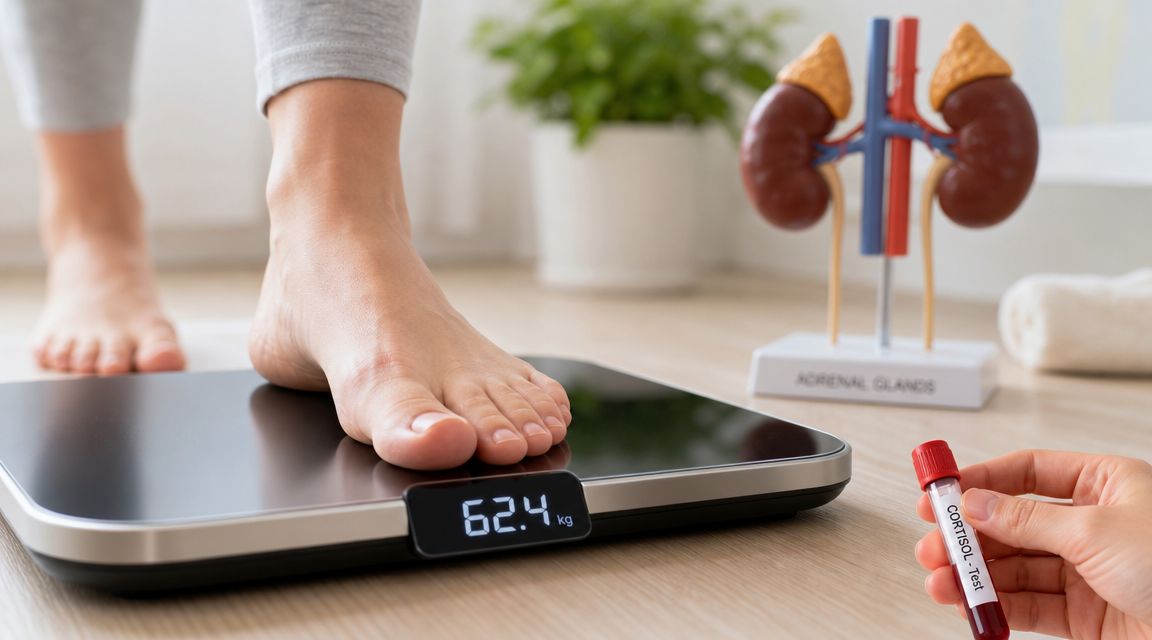
Your cortisol deficiency weight gain: causes & test
You pay attention to your diet. You may even get enough sleep. Yet you feel as if you have been run over in the morning, your mind feels foggy during the day, and the scale is moving in the wrong direction. Then the thought is understandable: Maybe it is cortisol. Maybe even a cortisol deficiency.
This is exactly where things often become confusing online. Many sources lump cortisol deficiency, stress, adrenal problems, and weight gain together. At first, that sounds logical. If the stress hormone becomes imbalanced, it must surely have something to do with energy, appetite, and body fat.
Yes, it does. But not as simply as it is often portrayed.
When you search for cortisol deficiency weight gain, you are usually not looking for theory. You want to know why your body feels different from before. Above all, you want an honest answer—without wellness myths and without trial & error. That is exactly what this is about.
Unexplained weight gain and fatigue? The mystery of cortisol
Many people arrive at this topic for the same reason. They notice that something is wrong but cannot clearly make sense of it.
Maybe your everyday life looks like this: You have a hard time getting going in the morning, need a long time before you feel reasonably awake, and your energy drops again in the afternoon. Exercise takes more effort than it used to. In the evening, you are exhausted but still not truly relaxed. At the same time, you wonder why you are gaining weight or why your midsection, in particular, stubbornly refuses to change.
Why the confusion is so understandable
The term cortisol now appears everywhere: on social media, in podcasts, and in guides about stress-related belly fat, sleep problems, or hormones. The problem is not that people talk about cortisol. The problem is that they often mean different things.
Some people talk about true cortisol deficiency as a medical disorder. Others actually mean stress dysregulation—a daily rhythm that is no longer functioning properly. For those affected, both can feel similar. Fatigue, exhaustion, cravings, poor recovery, and weight problems seem to fit everything.
If you feel confused by contradictory statements, that is not a sign that you have failed to understand. The topic is often explained imprecisely.
The crucial question
The core question is not simply: “Is cortisol to blame?”
It is more like this:
- Is it a genuine hormone deficiency?
- Is it chronic stress with impaired regulation?
- Or could the cause lie somewhere else, such as sleep, diet, metabolism, or other hormones?
This distinction is important. Because it changes everything. Especially the answer to the question of whether cortisol deficiency adequately explains weight gain at all.
Many people are therefore on the right track with their suspicion. They sense that their body is sending signals. The direction just needs to be more precise. And that first requires a clear understanding of what cortisol actually does.
What cortisol really does in your body
Cortisol is not simply the “stress hormone.” That is an oversimplification. A better way to think of it is: Cortisol is an energy manager.
It helps your body provide energy at the right time. It affects blood sugar, circulation, and the response to physical or psychological stress. Without cortisol, the body's internal daily organization does not function properly.

Cortisol follows a daily rhythm
In a healthy rhythm, cortisol mainly helps you get going in the morning. It then declines over the course of the day, making rest and sleep possible.
If you view cortisol only as “too much stress,” you miss an important point: It is not just the amount that matters. The timing matters too. A level may be too low in the morning, inappropriate at midday, or too high in the evening. Then the entire day can feel out of sync.
Anyone who wants to better understand the basics can find a simple introduction in the article What Is Cortisol.
Why cortisol may be linked to weight
Cortisol does not directly influence every instance of weight gain. But it affects processes that help regulate your weight. These include appetite, energy availability, sleep quality, and fat metabolism.
Researchers from the Universities of Ulm and Vienna described how stress hormones such as cortisol can influence fat metabolism in ways that accelerate weight gain and increase the risk of diabetes. In their study, mice with blocked stress signaling were significantly slimmer than the comparison group, with smaller fat deposits and less fat accumulation in the liver, as reported by the University of Ulm in its research on stress hormones and obesity.
This is important because it highlights a common reasoning error: Cortisol is not automatically “too low” just because you feel exhausted.
Key point: Fatigue plus weight gain sounds like a hormonal issue. But you cannot determine from the feeling alone what kind of hormonal issue is behind it.
Three functions that are often underestimated
-
Regulating blood sugar
Cortisol helps make energy available. When this regulation goes awry, cravings, drops in performance, and unsettled days can follow. -
Keeping circulation stable
The hormone supports blood pressure. That is why people with genuine disorders sometimes feel weak or dizzy. -
Responding to stress
The body and brain use cortisol to respond to demands. Chronic stress can disrupt this system even without a classic deficiency.
The myth of cortisol deficiency and weight gain
This is the most important point of the entire topic: True clinical cortisol deficiency typically does not cause weight gain.
This contradicts much of what is claimed online. Medically, however, the situation is clearer than many people think.

What is more typical of true cortisol deficiency
Clinical cortisol deficiency generally causes weight loss, loss of appetite, and low blood pressure. Weight gain, especially around the trunk, is more characteristic of cortisol excess, as seen in hypercortisolism or Cushing’s syndrome, as described in the DocCheck Flexikon article on cortisol.
This is the point at which many readers breathe a sigh of relief while also feeling confused. They think: “But I’m tired, stressed, and gaining weight. Cortisol must have something to do with it.”
Yes. But in most cases, it is not a classic deficiency but rather dysregulation.
Where the myth comes from
The misunderstanding often arises like this:
- You feel exhausted and unable to cope with much.
- You read that cortisol plays a role in stress.
- You conclude from this that your cortisol must be too low.
- You interpret the weight gain as evidence.
The catch is that exhaustion alone does not prove cortisol deficiency. Especially with chronic stress, the system can become unsettled, disrupted, or contradictory. In the morning, you struggle to get up. During the day, you reach for quick snacks more often. In the evening, you are tired yet simultaneously overstimulated. This can indirectly lead to weight gain.
How stress-related dysregulation can contribute to weight gain
This is less about a single “deficiency” and more about a poorly timed system.
-
More cravings for quick options
When people lack energy, they are more likely to reach for sweet or salty foods. -
Less everyday movement
When even the morning takes a toll, spontaneous activity often declines automatically. -
Poorer sleep
Poor sleep changes eating habits, recovery, and resilience. -
More inner restlessness
Persistent stress makes decisions more difficult and makes consistent routines harder.
The feeling “My cortisol is at rock bottom, and that’s why I’m gaining weight” is often an imprecise description of something more complex.
If you encounter similar patterns with other hormones, the article on estrogen deficiency and weight gain can help you better understand the differences.
The clear distinction
This distinction is crucial for your next step:
| Situation | Typical direction of weight change |
|---|---|
| Genuine clinical cortisol deficiency | more likely to involve weight loss |
| Excess cortisol | more likely to involve weight gain, especially around the torso |
| Stress-related dysregulation | Weight can increase indirectly through behavior, sleep, and metabolic rhythms |
This is not a minor detail. It determines whether you follow the right lead or unnecessarily lose time on speculation.
Additional symptoms of a cortisol imbalance
When people immediately think of cortisol in response to fatigue and changes in weight, they are often looking for a single, clear signal. That is exactly what makes this topic so tricky. A cortisol imbalance rarely appears like a warning light in a car. It is more like a thermostat set incorrectly. The whole room feels wrong, but the problem is not immediately obvious.
With genuine clinical cortisol deficiency, signs often take center stage that many people do not associate with the hormone. Weakness, low blood pressure, dizziness, nausea, abdominal discomfort, or a significant decline in performance are more common. The German Society for Endocrinology’s expert information on adrenal insufficiency describes exactly this picture. This also aligns with the article’s central clarification. Genuine cortisol deficiency typically leads to weight loss rather than weight gain.
That is precisely why so much confusion arises.
Many complaints overlap with sleep deprivation, iron deficiency, thyroid problems, depressive episodes, or chronic overload. Self-observation can then quickly lead to labels such as “too little cortisol” or “adrenal fatigue,” even though the symptoms alone do not support that conclusion.
Typical questions include:
- Why am I so exhausted in the morning
- Why do I sometimes feel dizzy when I stand up
- Why do I have periods of brain fog or inner emptiness
- Why does my appetite fluctuate so much
- Why do I feel tired and tense at the same time
These are meaningful questions. They show that your body is sending signals. But they do not yet answer whether a true deficiency, an excess, or stress-related dysregulation is behind them.
Symptoms compared
| Symptom | Typical of cortisol deficiency | Typical of excess cortisol |
|---|---|---|
| Marked weakness | yes | can occur |
| Low blood pressure | yes | rather atypical |
| Dizziness when standing up | frequent | rather atypical |
| Loss of appetite | rather typical | rather atypical |
| Weight loss | rather typical | rather atypical |
| Weight gain around the trunk | rather atypical | typical |
| Elevated blood sugar levels | rather atypical | typical |
| Thinner muscles and altered body composition | rather atypical | typical |
Where the confusion often arises
People with chronic stress often partially recognize themselves in both columns. They are exhausted, sleep poorly, struggle to function, and still gain weight. It feels like a contradiction. Medically, it is not. True cortisol deficiency and dysregulated stress regulation are not the same thing.
The confusion in everyday life often goes like this: Someone feels empty, drained, and barely able to cope in the morning. At the same time, cravings, less physical activity, and restless sleep set in. The number on the scale goes up. It is easy to conclude that “too little cortisol makes you gain weight.” More often, however, this does not describe a clinical deficiency but rather a stress system that has fallen out of balance.
Three patterns you should be able to distinguish
-
Classic cortisol deficiency
More commonly associated with weakness, low blood pressure, dizziness, gastrointestinal problems, and weight loss. -
Excess cortisol
More commonly associated with central weight gain, elevated blood sugar, and visible metabolic changes. -
Stress-related dysregulation
Often diffuse. Fatigue, sleep problems, fluctuating appetite, irritability, brain fog, and the feeling of never fully recovering.
This is exactly where relying solely on symptoms falls short. It helps with categorization, but not with a reliable diagnosis. If you want to understand which pattern applies to you, you need a measurement that takes cortisol’s daily rhythm into account. The article how to measure cortisol levels meaningfully explains how this works in practice.
Gaining clarity on how to test your cortisol levels correctly
If you've followed along this far, you've probably already realized: guessing costs time. And most of the time, it also costs you nerves.
Many people first try everything imaginable. Less coffee. More supplements. Harder training. Yet another diet. Yet another evening routine. The problem is not that these things are always wrong. The problem is that without a sound data basis, they often miss the actual issue.
The most important point when testing
Cortisol is strongly dependent on the time of day. The analysis must therefore be performed at the right time for the result to be meaningful. Incorrect sample collection can be misleading, as emphasized in the technical information on the delicate balance of the stress hormone cortisol.

This is why any random single value can quickly be misinterpreted. Measuring in the morning, at midday, or in the evening produces different results. Without the right context, the number says little.
What a useful test should do
A good approach doesn't have to be complicated. However, it should take these points into account:
-
Take the timing seriously
The test must be adapted to the daily rhythm. -
Choose the right method
Depending on the question, a blood test or saliva test may be useful. -
Be able to put the result into context
A value without context is of little use. Interpretation is what matters. -
Follow up with a doctor if anything is abnormal
A self-test can provide guidance. It does not replace medical evaluation.
Anyone who wants to take a closer look at the measurement methods will find the basics well explained in this overview of how to measure cortisol levels.
When a home test makes sense
A home test is especially practical when you no longer want to grope around in the dark and first want to clarify whether your suspicion is heading in the right direction at all. In the context of products for use at home, a mybody x blood test or hormone test is one possible option for systematically measuring cortisol and using the results as a basis for deciding what to do next.
This isn't a shortcut around medical care. It's a way to make the next step more precise.
Others have long since stopped optimizing blindly and instead base their approach on their values. You don't have to try everything to realize that many things aren't right for you.
Why this is more efficient than trial and error
If you simply act “just in case” when you are tired and gaining weight, you often adjust the wrong levers. A test does more than save time. It also protects you from overlooking a genuine hormonal disorder or confusing stress-related dysregulation with a clinical deficiency.
Understand your test result and plan the next steps
The most important point comes first: A cortisol level does not just answer the question, “Is there something?” Above all, it helps answer the much more important question: What exactly is it?
This is exactly where confusion often arises. Many people search for “cortisol deficiency and weight gain” and expect simple confirmation. But biology is more complicated. A true clinical cortisol deficiency is more likely to be associated with weight loss, weakness, and significant physical strain. When weight gain is the main issue, it more often points to stress dysregulation involving a shifted rhythm, low energy, and cravings. A test distinguishes between these two possibilities.

When the level is clearly abnormal
Then you need medical assessment. Not because every abnormal result automatically means a serious illness, but because true cortisol deficiency requires clear evaluation. Information from the German Society for Endocrinology on adrenal insufficiency makes clear that underactive adrenal glands are medically significant and must be treated.
In practical terms: Please do not draw conclusions based solely on symptoms or forum posts. Doctors look at the overall picture, including symptoms, the course of the day, other laboratory values, and, if necessary, additional diagnostic tests.
When the level is more consistent with dysregulation
That is not proof of a “deficiency,” but rather an indication of dysregulated control. It works a bit like a thermostat that isn’t broken but is responding incorrectly. The heating then switches on or off at the wrong time. With cortisol, this may show up in daily life as morning fatigue, an afternoon slump, a late surge of energy, cravings, or the feeling that you cannot properly get going despite your efforts.
A clear-eyed look at patterns is worthwhile here:
-
Check your sleep and daily rhythm
Don’t just count the hours. It also matters when you sleep, how regular your rhythm is, and whether you’re still feeling wired in the evening. -
Adjust your workload appropriately
Hard training, constant tension, and too little recovery can further worsen your energy levels. -
Take meal patterns seriously
Recurring intense hunger is often a biological signal, not a character flaw. -
Consider values in context
Depending on your symptoms, it may be useful to consider additional hormones or nutrient levels.
If you want to understand which findings are useful when a deficiency is suspected, the overview of the cortisol deficiency test and the next diagnostic steps provides useful guidance.
You do not have to guess whether your body is “simply difficult.” You need a clear distinction between myth, stress patterns, and a genuine hormonal disorder.
How to derive sensible next steps
A result is most helpful when you use it like a map. It does not show the entire terrain. But it does show you which direction is plausible.
| Situation after the test | Next sensible step |
|---|---|
| clear abnormality | medical evaluation and confirmation through appropriate diagnostic testing |
| unclear borderline values | assess the progression, daily profile, symptoms, and possible influencing factors together |
| no clear cortisol abnormality | specifically investigate other causes of weight gain and fatigue as well |
This often provides more relief than any self-diagnosis. You do not have to solve everything right away. You only need to take the next right step.
FAQ about cortisol deficiency and weight gain
Can chronic stress lead to both high and low cortisol?
Chronic stress can disrupt regulation. In everyday life, this often does not look like a consistent long-term increase, but rather like a shifted rhythm. That is precisely why self-diagnosis is so unreliable.
How quickly can cortisol be brought back into balance?
That depends on what is going on. A genuine clinical deficiency should be medically evaluated and treated. In stress-related dysregulation, sleep, stress load, nutrition, and daily structure often play a role. Without testing, however, it remains unclear which approach is appropriate.
Are there foods for cortisol deficiency or cortisol dysregulation?
No food can replace diagnostic testing. Eating can help stabilize everyday life, for example through more regular meals and less energy chaos. But no shopping list can tell you whether you actually have a cortisol problem or what type it is.
If you no longer want to guess about weight gain from cortisol deficiency, get a reliable basis. Only the right test can give you a reliable answer. With a mybody x blood test, you can conveniently check important values at home, avoid trial and error, and plan your next steps based on evidence.



Share now:
Allergy test: Allergy test 2026
Vitamin D deficiency and skin problems: Symptoms & solutions 2026