
Sleep disorders during menopause: which causes are genuinely possible
The essentials at a glance
Sleep disorders during menopause rarely have just one cause. Hormonal changes are one of them, and they are the best-known. Other factors include night sweats, mood changes, breathing pauses during sleep, restless legs, the thyroid, medications, and age itself. No single number can determine which factor is affecting you.
This article breaks down the possible causes instead of reducing them to two hormones. Every figure is accompanied by the institution and year. Where a figure is unavailable, that is stated as well. The text does not assess any treatment or make its own recommendation regarding hormone therapy, melatonin, or sleeping pills; it reports what professional societies have published on the subject.
You will first read what the term actually means, how common poor sleep is in Germany, and what sleep medicine establishes on the subject. This is followed by the individual possible causes, a comparison of them in a table, signs that warrant medical evaluation, and an honest answer to the question of what a hormone level can contribute here.
What to expect in this article
1. What exactly sleep disorders during menopause mean
2. How common poor sleep is in Germany
3. What sleep medicine establishes about treatment
4. What hormones explain and what they do not
5. Three common assumptions put to the fact check
6. Night sweats and the question of sequence
7. Mood, rumination, and tension as a distinct cause
8. Six possible causes compared
9. When persistent insomnia should be medically evaluated
10. Thyroid, iron, and medications: the silent contributors
11. What a hormone level can contribute to answering this question
12. What you can have measured at home on this topic
13. What two weeks of recording can reveal
14. Limitations: what this text and this test cannot clarify
15. What ultimately matters
Frequently asked questions
Sources
What exactly sleep disorders during menopause mean
The search term already contains an attribution. It links a symptom to a stage of life, thereby suggesting that the stage is the cause. This is precisely where the text needs to be careful.
Menopause is a period of time, not a diagnosis. Poor sleep is common during this period. However, it does not follow that every bad night during this period has a hormonal cause.
Sleep medicine draws a time limit. The Institute for Quality and Efficiency in Health Care states in its information on sleep problems: “Experts speak of a sleep disorder when the problems persist for longer than one month” (IQWiG, 2024). Accordingly, two restless nights after a strenuous day are not a clinical finding.
Key message
Menopause is the period during which the complaints occur. It is not automatically their cause.
Falling asleep and staying asleep are two different complaints
Someone who lies awake for an hour in the evening has a different problem from someone who wakes at three o’clock and cannot fall asleep again. Both fall under the same search term and lead to different questions in a medical practice.
Population research figures also distinguish between the two forms. The Robert Koch Institute records them separately because they occur with different frequencies and have different causes.
For you, this means: Note which of the two forms predominates for you before reading on. This one detail provides structure for the following chapters.
Why women are more often affected in this regard
In 2024, IQWiG stated that sleep disorders are more common in women than in men. This statement applies across all age groups, not only from the fifth decade of life onward.
This is an important qualification to the obvious narrative. If a sex difference already exists before menopause, hormonal changes alone cannot explain it.
How common poor sleep is in Germany
Figures are helpful here because they dispel the feeling of being alone. But they are useful only when it is clear who collected them and when.
In the “Health in Germany” panel, 16.3 percent of respondents reported difficulty falling asleep and 31.7 percent difficulty staying asleep, referring to the four weeks before the survey (Robert Koch Institute, 2024 survey, published in 2026). A total of 27,038 people took part in the survey.
Accordingly, difficulty staying asleep is almost twice as common as difficulty falling asleep. In the same publication, the Robert Koch Institute points out that differences exist by sex, age, and education, and that women are affected more often.
IQWiG arrives at a similar order of magnitude by a different route: “About one third of people have problems falling asleep or staying asleep” (IQWiG, 2024). The same source distinguishes the form requiring treatment from this—according to it, about 6 in 100 people in Germany have a sleep disorder in the narrower sense.
What these figures do not say
None of these surveys indicates what proportion of the complaints is attributable to hormonal changes. They count complaints; they do not assign causes.
Anyone who reads percentages online that claim exactly that—for example, a fixed proportion of hormonally induced sleep disorders in postmenopause—should look for the institution and the year. The source material reviewed here contains no reliable figure for such a breakdown.
This gap is not filled here with an estimate. An invented number would be the worse error.
What sleep medicine states about treatment
There is a separate guideline in Germany for persistent difficulties falling asleep and staying asleep. It comes from the German Society for Sleep Research and Sleep Medicine and treats insomnia in adults as an independent disease, regardless of the stage of life.
This is more important to this topic than it may initially sound. When a professional association recommends a treatment for every age group, the stage of life is not the decisive organizing principle.
Documented source
“Cognitive behavioral therapy for insomnia should be provided as the first treatment option for insomnia in adults of every age (A).”
German Society for Sleep Research and Sleep Medicine (DGSM)
S3 Guideline on Nonrestorative Sleep/Sleep Disorders, chapter “Insomnia in Adults,” AWMF register number 063-003, published in Somnologie in 2017
This sentence is a treatment recommendation from a professional association, not a recommendation from this article. Whether and in what form such treatment is appropriate for you is decided by a medical or psychotherapeutic practice.
The second statement in the same guideline is noteworthy. For diagnostic purposes, it states that a sleep-lab examination should be used when there is reasonable suspicion to rule out organic sleep disorders; periodic limb movements during sleep and sleep-related breathing disorders are mentioned (DGSM, 2017).
The guideline itself therefore states what this article expands on in the following chapters: Before a cause is established, other causes are ruled out. A blood test is not among the procedures mentioned for this purpose.
What the gynecological guideline adds
The S3 guideline on peri- and postmenopause addresses sleep disorders as a separate topic. In the summary, current as of June 2026 and listed under AWMF register number 015-062, it contains a recommendation that menopausal hormone therapy may be used for newly occurring sleep disorders—and it is preceded by a condition: “after excluding other causes.”
These four words are the core of this article. They appear in a guideline that one would most suspect of favoring the hormonal explanation.
The same summary also lists cognitive behavioral therapy as an option for treating sleep disorders during this stage of life. Both approaches appear side by side, both as recommendations that something may be done, and both as matters for a doctor to decide. This text does not assess them.
What hormones explain—and what they do not
The hormonal transition is a real thread, and it is not downplayed here. The IQWiG puts it simply: The hormonal transition can lead to problems falling asleep or staying asleep (IQWiG, 2023).
The verb in this sentence carries all the caution. It says “can,” not “causes.” A possibility is not an attribution in an individual case.
Estradiol and temperature regulation
Estradiol is the most important estrogen during the reproductive years. Its level fluctuates more during perimenopause before declining, and this fluctuation is linked to the regulation of body temperature.
This gives rise to the best-known connection with sleep: hot flashes and sweating episodes. IQWiG calls them the most common complaints of this phase and notes that they can also disrupt sleep at night (IQWiG, 2023).
What does not follow from this is that every episode of night sweats is a hot flash. Chapters 6 and 8 examine this distinction because it determines the right evaluation.
Progesterone and the question of calmness
Progesterone is produced after ovulation. If ovulation does not occur in individual cycles, which is more common during perimenopause, production is lower in that cycle.
A fixed attribution circulates online: progesterone is said to be the relaxation hormone, and its decline is said to explain the inability to switch off in the evening. This wording is catchy, but it is not supported as an explanation for an individual case.
The gynecological guideline takes the opposite approach. It discusses progesterone in connection with treatment, not as an explanation for a symptom—and even there only after other causes have been ruled out (AWMF registry number 015-062, short version as of June 2026).
Why a hormone level does not explain the night
A blood value describes a concentration at the time the sample is taken. Sleep unfolds over six to eight hours. Between the two is a gap that no measurement can close.
Then there is the variation. As long as menstrual cycles continue, estradiol, progesterone, FSH, and LH fluctuate so much over the course of a month that the same value can support two different interpretations on two different days.
What a value can tell you is covered in Chapter 11. What it cannot tell you is already stated here: It does not answer why you lay awake tonight.
Three common assumptions put to the fact check
The following three statements appear in this form or a similar one in many informational texts. They are not foolish; they are simplified—and that simplification leads to an incorrect evaluation.
Assumption and evidence
Commonly claimed
“Night sweats at this age are a hot flash.”
Substantiated
Night sweats are also among the signs of obstructive sleep apnea, along with loud snoring, pauses in breathing, morning headaches, and severe daytime sleepiness (IQWiG, as of 2026).
Commonly claimed
“The hot flash wakes you up.”
Substantiated
The US National Institute on Aging, part of the National Institutes of Health, notes that research now suggests that waking itself could trigger a hot flash rather than the other way around (NIA/NIH, as of 2021).
Commonly claimed
“A hormone test shows whether menopause is to blame.”
Substantiated
The S3 Guideline on Peri- and Postmenopause uses FSH and AMH levels to determine the stage only in women without an interpretable bleeding pattern, not to explain individual symptoms (AWMF 015-062, short version, status June 2026).
The third line is the most expensive of the three. Anyone who follows it buys a test that answers a different question from the one they came with.
Night sweats and the question of sequence
The usual story is simple: The hot flash comes, you wake up, and your sleep is ruined. This sequence sounds so plausible that it is rarely examined.
The National Institute on Aging described it differently in 2021. In its information on sleep problems and menopause, it states that research now suggests waking may trigger the hot flash, rather than the other way around.
The usual story is simple: The hot flash comes, you wake up, and your sleep is ruined.
In practice, this reversal changes more than it may seem. If waking comes first, the hot flash is a companion symptom rather than the trigger—and the question of why the waking occurs remains open.
The same institute also names changes in mood, specifically depression, as contributing to poor sleep during this phase (NIA/NIH, 2021). Thus, two threads stand side by side, not one.
This note is not intended as reassurance. Night sweats are burdensome, and IQWiG listed them in 2023 as the most common complaint during this phase. The point is different: The burden does not establish causation.
Mood, rumination, and tension as a separate thread
The second thread in the NIA information is the more uncomfortable one. According to this source, mood changes—specifically depression—contribute to poor sleep (NIA/NIH, 2021).
This thread is often skipped in advice articles because it is harder to translate into a measurement. That is precisely what makes it important.
The direction is not fixed here either
Poor sleep worsens mood, and low mood disrupts sleep. The National Institute on Aging explicitly describes one direction: sleep deprivation can make people irritable or depressed and increase forgetfulness (NIA/NIH, 2021).
Anyone who reads only the second direction arrives at treating the mood, even though the night was the starting point. Anyone who reads only the first arrives at the opposite conclusion. Both approaches are guesses without proper assessment.
Why life circumstances at this age play a role
The years around turning fifty often bring a particular accumulation of responsibilities: children becoming independent, parents needing increasing support, and a career in its most demanding phase.
This situation cannot be measured, nor does it disappear when a hormone level is unremarkable. Nevertheless, it belongs on the list of explanations, because otherwise it would be attributed to the hormonal pathway.
In its 2026 fact sheet, the Robert Koch Institute points to educational differences in difficulty falling or staying asleep. This is also an indication that living conditions play a role in this issue.
Comparison of six causal pathways
The following table places six pathways side by side using the same four questions. It does not replace an evaluation; it simply sorts out which question belongs to which method.
The last column is the most honest one in the entire article. For each pathway, it answers what a hormone level from capillary blood contributes.
| Causal pathway | Typical sign at night | How it is evaluated | What a hormone level contributes |
|---|---|---|---|
| Hormonal transition | Difficulty falling or staying asleep in temporal connection with changes in bleeding (IQWiG, 2023) | Course of bleeding and symptoms, medical consultation | Describes the phase's status, not the cause of the night |
| Nighttime hot flashes | Feeling hot and sudden sweating, the most common complaint during this phase (IQWiG, 2023) | Description of symptoms, recording over several nights | Nothing about the frequency or severity of the episodes |
| Mood and tension | Racing thoughts when falling asleep, early awakening, low mood during the day (NIA/NIH, 2021) | Medical or psychotherapeutic consultation, questionnaires | Nothing. This pathway is not captured through blood values |
| Obstructive sleep apnea | Loud snoring with breathing pauses, night sweats, daytime sleepiness (IQWiG, 2026) | Medical examination; if suspected, a sleep laboratory (DGSM, 2017) | Nothing. Breathing is not measured through blood values |
| Restless legs syndrome | An urge to move and an unpleasant sensation in the legs in the evening and at night while at rest (IQWiG, 2024) | Medical evaluation; if suspected, a sleep laboratory (DGSM, 2017) | Nothing from cycle hormones; iron levels are part of the medical evaluation |
| Thyroid | Restlessness or exhaustion that does not match the length of the night, often accompanied by other signs | Medical evaluation, laboratory values interpreted in context | TSH is the only value in this table covered by an at-home hormone test |
Five of the six lines end with a limitation in the last column. This is not a mistake in the table but the result of the research.
There are documented figures on the prevalence of both organic pathways. According to estimates cited by IQWiG in 2026, around 10 percent of adults have obstructive sleep apnea; it is more common in men than in women, and the likelihood steadily increases from age 45 onward.
For restless legs syndrome, the same institute cites 3 to 10 percent of people in Europe and North America; in about 1.3 percent of all adults in Germany, the symptoms are severe enough to impair daily life (IQWiG, 2024). Accordingly, women are affected approximately twice as often as men, and the prevalence increases with age.
Both pathways therefore become more common during the same decade of life in which menopause also occurs. Anyone who assigns the cause based solely on timing is assigning it incorrectly.
When persistent insomnia should be medically evaluated
Before considering any measurements, compare your situation with the following list. If any item applies, making an appointment at a doctor’s office is the next step, not ordering a test.
These signs should be assessed by a doctor
The problems last longer than a month
after this duration, professionals refer to it as a sleep disorder (IQWiG, 2024)
Loud snoring with observed breathing pauses
Pauses lasting more than ten seconds, often noticed by bed partners, are among the signs of obstructive sleep apnea (IQWiG, 2026)
Severe daytime sleepiness despite spending enough time in bed
especially while driving or during simple activities during the day
An urge to move the legs in the evening and at rest
with pulling sensations, tingling, or pain that improves with movement (IQWiG, 2024)
Low mood, lack of drive, or anxiety lasting for weeks
Mood changes contribute to poor sleep and should themselves be evaluated (NIA/NIH, 2021)
Waking at night with a racing heart or shortness of breath
is among the signs that IQWiG lists for obstructive sleep apnea in 2026
No sentence in this article qualifies this list. There is no situation in which a test based on a self-collected sample replaces any of these steps.
IQWiG states the route to finding the cause plainly: “A visit to a doctor’s office can help identify the causes of sleep problems and disorders” (IQWiG, 2024).
Thyroid, iron, and medications: the quiet contributors
Three other pathways do not appear as separate rows in the table because they cannot be captured by a typical nighttime sign. They are not being overlooked.
The thyroid causes similar symptoms
An overactive or underactive thyroid can cause restlessness, palpitations, fatigue, and changes in temperature sensitivity. It therefore overlaps in several respects with what is commonly attributed to menopause.
The product page for the test presented below explicitly identifies this overlap and therefore includes TSH in the range of markers. This is the only point in this article at which an at-home test touches on one of the causal pathways mentioned.
The same boundary from Chapter 4 applies here: A single laboratory value is a starting point for a conversation. Interpreting an abnormal TSH value belongs in a medical practice, where additional values and the clinical context are taken into account.
Iron is part of the assessment for restless legs
For restless legs syndrome, iron status is part of the medical assessment. This value is not included among the markers in a menopause hormone test, nor is it presented here as something that test provides.
Anyone who suspects restless legs will reach their goal faster with a medical appointment than with self-measurement. In this case, the description of the symptoms is more informative than any number.
Medications and habits come first in any assessment
The DGSM guideline places a comprehensive medical history at the beginning of the diagnostic process, including the assessment of physical and mental illnesses, along with a physical examination, sleep questionnaires, and sleep diaries (DGSM, 2017).
This medical history covers things that no laboratory test can capture: medications and supplements taken, alcohol in the evening, caffeine in the afternoon, shift work, pain, and the need to urinate at night. They do not come at the end of the list but at the beginning.
This article does not make its own recommendation on this. It merely records the sequence specified by the medical society.
What a hormone level can do in this context
Now for the honest answer to the question that brings many people to this page. A hormone level does not answer why you lie awake at night.
The S3 guideline on perimenopause and postmenopause uses FSH and AMH levels to determine the phase only when no usable bleeding pattern is available and typical symptoms are present; in cases of uncertainty, measuring estradiol may be useful (AWMF 015-062, short version as of June 2026). This is a statement about classifying the phase of life, not about the cause of a symptom.
IQWiG takes the same position. For the practical questions of this phase of life, it sees no value in determining hormone levels; what matters is the course of the bleeding and the symptoms themselves (in essence, according to IQWiG, 2023).
This leaves a narrow but real benefit for a hormone level in this specific context: It describes a status when you need it for a consultation. It does not describe a cause or a night.
Useful for you if …
your bleeding has changed and you want to bring a documented baseline to your next consultation.
none of the signs from Chapter 9 apply to you and you want to consider the hormonal phase as one of several open questions.
you are prepared to record the cycle day, time of day, and medications or supplements taken, because the value is difficult to interpret without these three details.
Probably not if …
you are looking for an explanation for your sleepless nights. No hormone value answers this question, and the test is the wrong tool for it.
snoring, witnessed pauses in breathing, daytime sleepiness, or an urge to move your legs are present. These suspicions should be medically evaluated.
the symptoms persist for more than a month. Then evaluation takes priority, regardless of whether a value is available.
The right-hand column is longer than any provider might like. It is nevertheless correct, which is why it appears before the product chapter rather than after it.
What you can have measured at home on this topic
mybody®x (MYBODY Lab GmbH) offers a capillary blood test for the hormonal phase. Here, it answers a narrow sub-question, not the question addressed by the article.
This distinction is stated openly here because otherwise it would disappear between the marker list and the price. The test measures neither sleep, breathing, nor leg movements.
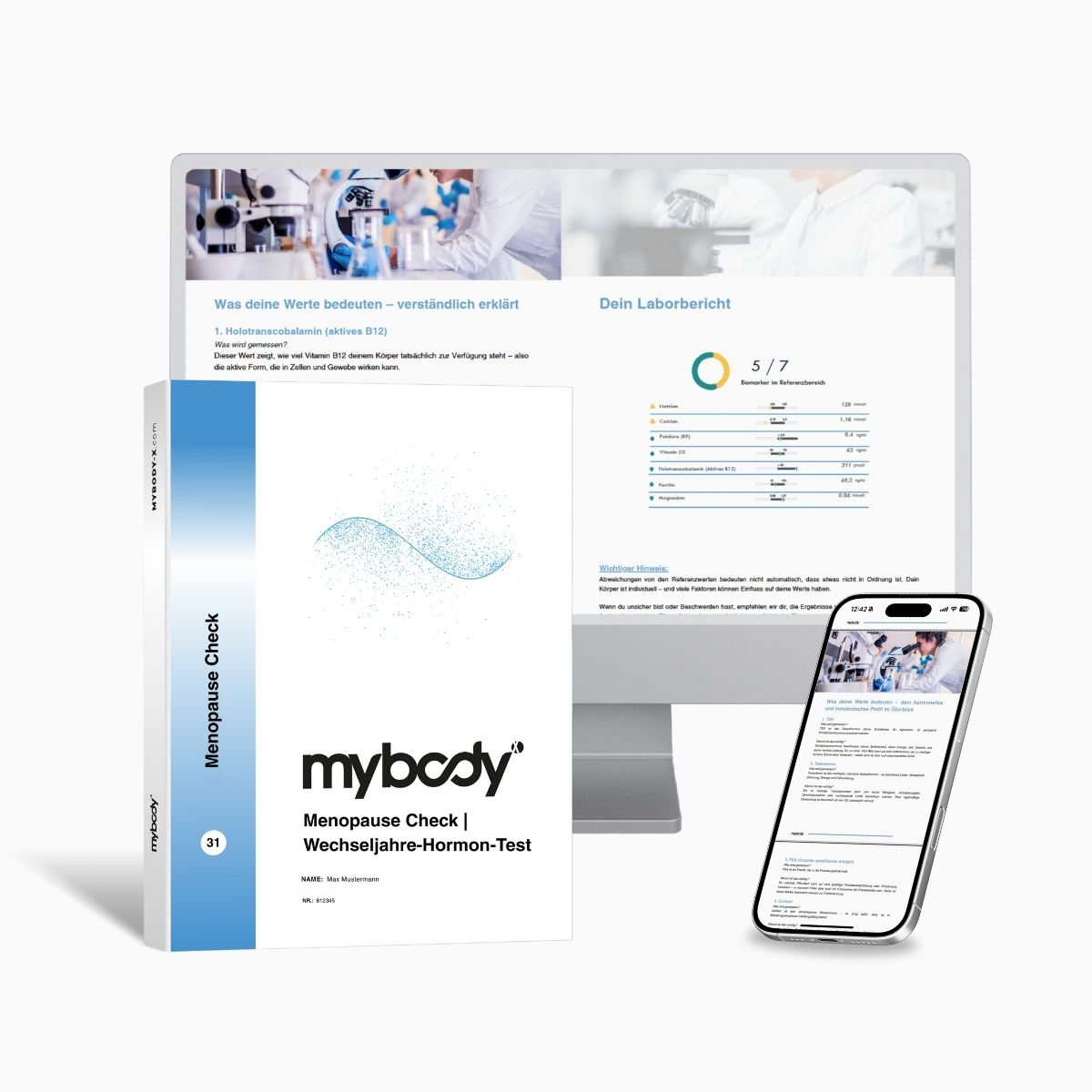
Blood test from capillary blood
Menopause Check | Menopause Hormone Test
Eight values from a blood sample: progesterone, estradiol, FSH, LH, testosterone, DHEA-S, SHBG, and TSH. What the test cannot do in relation to this article’s question: it measures neither sleep, breathing, nor leg movements, and it does not assess iron status or cortisol. Of the six causal pathways from Chapter 8, it touches exactly one—the thyroid—via the TSH value. The product page itself points out that estradiol, progesterone, FSH, and LH fluctuate considerably throughout the cycle and that the cycle day must be recorded as long as a cycle is present. An abnormal result should be medically evaluated.
Laboratory analysis 3–5 working days after receipt of the sample
Information from the product page, accessed 27 August 2026
The product page itself states the limitation more clearly than most advice articles. It notes that the test does not answer how you are feeling, but where your body currently stands (mybody®x product page, accessed on 27 August 2026).
As for the question of the test category itself—test types, sample types, reference ranges, and the assessment by the endocrinology society—the article Hormone Test at Home covers it. This text here stays focused on the symptom.
The laboratory operates in compliance with the GDPR, transmission of the results is encrypted, and the samples are processed using pseudonymization. The product page does not state the laboratory location; therefore, it is not included in the card above.
What two weeks of recording can reveal
The DGSM guideline lists sleep diaries as part of the diagnostic process (DGSM, 2017). They are therefore not a substitute for an evaluation, but preparation for it.
Four pieces of information are enough. Anyone who records them for two weeks comes to the medical practice with information instead of a feeling.
Record the times
When you went to bed, when you fell asleep, and when you got up. Estimates are sufficient.
Record the reason for waking
Feeling hot, an urge to urinate, racing thoughts, pain, restless legs, or no identifiable reason. This exact distinction will otherwise be missing from the later conversation.
Add daily information
Medications and supplements with dosage and time, alcohol, caffeine after midday, shift work. Also any bleeding, for as long as it continues.
Ask the person sleeping beside you
You do not notice your own snoring or breathing pauses. A single question for the person beside you can change the direction of the evaluation.
Step 4 is the least conspicuous and often the most informative. Some of the signs of obstructive sleep apnea cited by IQWiG in 2026 are things that only other people can observe.
After two weeks, a pattern will emerge—or it will not. Both outcomes are information, and both are more useful than remembering one particularly bad night.
Chapter at a glance
A sleep diary kept for two weeks records four things: times, reasons for waking, medications and supplements, and observations by the person sleeping beside you. In 2017, the German Society for Sleep Research and Sleep Medicine listed sleep diaries as part of the diagnostic process. The records do not replace medical evaluation; they prepare for it. Their greatest value lies in distinguishing the reasons for waking, because this distinction determines the next steps.
Limitations: what this text and this test cannot clarify
This article categorizes causal pathways. It does not make a diagnosis or draw any conclusions about your individual case.
He does not present any treatment as his own recommendation. Where a treatment is mentioned, it is attributed to a professional society and supported by a year; the decision is made in a medical practice.
There is no reliable figure for the distribution of the causes. The reviewed source material does not state what proportion of sleep problems in this stage of life is attributable to which causal pathway. This gap remains open and is not estimated.
The test presented has a hard limit: It measures eight hormone levels in the blood. It does not capture sleep, breathing, leg movements, iron status, or mood, and none of these five points can be inferred from its results.
The timeline is also a boundary. A value describes the moment the sample was taken; it says nothing about the course of a night or a week.
What matters in the end
The most important sentence in this article appears in a gynecological guideline and is four words long: after ruling out other causes. It appears there before hormonal treatment, and it applies just as much before a hormonal explanation.
This leads to an order that differs from the usual one. Do not measure and then interpret—observe, seek medical clarification, and only afterward decide whether a number adds anything.
For the next two weeks, this means four entries each night, one question for the person beside you, and an appointment as soon as the problems last beyond a month or one of the points in Chapter 9 applies.
It began with the question of whether menopause is robbing you of sleep. It may be a contributing factor. Whether it is in your case is not determined by the stage of life you are currently in.
Frequently asked questions
How can I tell whether my sleep problems are caused by menopause?
Not based on any single feature. In 2023, the IQWiG stated that hormonal changes can cause problems falling or staying asleep; this does not establish the cause in an individual case. The context is more informative: changed bleeding patterns, nighttime hot flashes, and a timeline that fits these changes. Observed pauses in breathing, pronounced daytime sleepiness, or an urge to move the legs argue against a hormonal explanation. The S3 Guideline on Peri- and Postmenopause explicitly recommends ruling out other causes before hormonal treatment of these symptoms (AWMF 015-062, short version, status June 2026).
When should I have sleep problems medically evaluated?
At the latest, when the problems persist for longer than a month—that is the duration at which experts speak of a sleep disorder (IQWiG, 2024). Make an appointment sooner if snoring has been observed together with pauses in breathing, if pronounced daytime sleepiness affects you in everyday life or while driving, if an urge to move your legs occurs in the evening, or if your mood and drive have been low for weeks. The IQWiG states the next step plainly: a visit to a doctor’s office can help identify the causes. Nothing in this article limits that recommendation.
Can an at-home hormone test explain my sleep problems?
No. A hormone test measures concentrations in the blood at the time the sample is taken, not the course of a night. Of the six possible causes from Chapter 8, the Menopause Check addresses exactly one—the thyroid—through the TSH value. Breathing, leg movements, mood, iron status, and sleep itself are not included among its markers. For the practical questions of this stage of life, IQWiG does not consider hormone-level testing useful in any case (in essence, according to IQWiG, 2023). What the test provides is a documented baseline for a discussion.
I wake up drenched in sweat at night—is it always a hot flash?
No, and this distinction is the most important point of the article. Night sweats are also one of the signs of obstructive sleep apnea, which IQWiG lists in 2026 alongside loud snoring with pauses in breathing, morning headaches, dry mouth, and severe daytime sleepiness. According to estimates cited by the same institute, around 10 percent of adults have obstructive sleep apnea, and the likelihood increases from age 45 onward. If any of these additional signs occur, the concern belongs in a medical practice, not in a blood test.
How long do sleep problems last during menopause?
The source material reviewed here does not provide a reliable timeframe, and no estimate is made at this point. One other figure is reliable: If the problems last longer than a month, experts refer to this as a sleep disorder (IQWiG, 2024). This threshold is more useful in practice than a figure in years because it marks the point for taking the next step. What comes next depends on which possible cause is confirmed during the assessment.
Next step
The recording comes first, then the question of a number
If none of the signs from Chapter 9 apply to you and you want to consider the hormonal phase as one of several open questions, the Menopause Check covers the eight values related to menopause. The linked article explains what else can cause night sweats.
View the Menopause Check Causes of night sweatsRead more
You might also be interested in this
The section from Chapter 6, examined in detail and beyond menopause.
For when the symptoms persist even though the phase has long since passed.
Sources
- German Society for Sleep Research and Sleep Medicine (DGSM): S3 Guideline on Non-Restorative Sleep/Sleep Disorders, chapter “Insomnia in Adults,” in: Somnologie 2017, 21:2–44 – dgsm.de
- Institute for Quality and Efficiency in Health Care (IQWiG): Sleep problems and sleep disorders (insomnia), as of 2024 – gesundheitsinformation.de
- German Society of Gynecology and Obstetrics et al.: S3 Guideline on Peri- and Postmenopause—Diagnostics and Interventions, abridged version, AWMF Registry No. 015-062, as of June 2026 – register.awmf.org
- Robert Koch Institute: Difficulty falling asleep and staying asleep in adults, fact sheet from the “Health in Germany” panel, Journal of Health Monitoring, 2024 survey, published in 2026 – rki.de
The verbatim quotation on cognitive behavioral therapy, the information on diagnostics, and the reference to sleep diaries are taken from source [1]. The one-month threshold, the figure of one-third of people with difficulty falling asleep or staying asleep, the number of approximately 6 in 100 people with a sleep disorder, and the statement about visiting a doctor's office are based on [2]. The statements on hormone testing using FSH and AMH, as well as the condition “after ruling out other causes,” are taken from [3]. The percentages 16.3 and 31.7 and the number of participants, 27,038, are taken from [4]. The information on obstructive sleep apnea (as of 2026), restless legs syndrome (as of 2024), and menopausal symptoms (as of 2023) comes from three other publications by the same institute; they are attributed in the body text with the institution and year and are therefore not included in this list. The same applies to information from the National Institute on Aging of the U.S. National Institutes of Health (as of 2021). Information on the price, markers, sample type, and laboratory comes from the mybody®x product page, accessed on 27.08.2026; processing times follow the central specifications for blood tests. All sources were accessed and reviewed on 27.08.2026.

mybody®x editorial & expert team
Women's health Hormone diagnostics Laboratory diagnostics Blood analysis interpretation
This article was created by the mybody®x editorial and expert team. The team combines laboratory diagnostics, blood analysis interpretation, and nutritional science. Those who contribute to it are listed on the authors page.
Published on 04.01.2026 · Last updated on 27.08.2026
The content is intended for general information and does not replace medical advice, diagnosis, or treatment. Reference ranges depend on the laboratory, method, and age—what matters is always the information on your test report.


Share now:
The real causes of night sweats and what you can do about them
Losing Weight Despite Hypothyroidism: Your Practical Guide to Success