

Micronutrient analysis: Find out what your body is really lacking
A micronutrient analysis is a specialized blood test that precisely measures the concentration of essential vitamins, minerals, and trace elements in your body. It uncovers hidden deficiencies or imbalances that are often the true cause of symptoms such as persistent fatigue or difficulty concentrating . With this analysis, you gain a clear picture of your individual nutritional status and can take targeted steps to improve your health.
What a micronutrient analysis really reveals
Do you often feel tired, even though you're getting enough sleep? Or do you have a vague feeling that something isn't quite right in your body? The answer could be hidden in the smallest building blocks of your diet – the micronutrients.
The invisible helpers in your body
Think of micronutrients – vitamins, minerals, and trace elements – as the spark plugs of your metabolism. They are essential for countless processes in the body and ensure that everything runs smoothly. Without them, your cells couldn't produce energy, your immune system couldn't protect you effectively, and your hormones could become unbalanced. A deficiency therefore often manifests itself through very nonspecific symptoms that you might not initially connect to your diet.
This is precisely where a micronutrient analysis comes in. It's much more than just a general examination, as it provides you with precise insights into your individual nutrient status. Unlike a comprehensive blood test, which focuses primarily on blood cells and general health markers, this analysis specifically examines essential nutrients. If you'd like to know more about what's examined in a comprehensive blood test , you can find valuable information here.
A micronutrient deficiency often develops gradually over months or even years. An analysis helps you detect a deficiency before it develops into a real health problem.
With the mybody-x nutrient test, you can conveniently perform this important health check from the comfort of your own home. You'll receive an easy-to-understand report that not only shows you your results but also explains what they mean for you and your body. This way, you take control of your health and create a solid foundation for specifically improving your diet and well-being.
Correctly interpreting the signs of a micronutrient deficiency
Your body is constantly communicating with you. Most of the time, however, these are subtle signals that we easily overlook in the hustle and bustle of everyday life or simply dismiss as stress. Does this sound familiar? Persistent fatigue, difficulty concentrating, or that feeling of simply not being able to get going – these can be early signs of a nutrient deficiency.
Sometimes, however, a deficiency manifests itself through very specific physical changes. These symptoms are like small signposts, giving you a clue as to which important building block in your system might currently be missing.
Specific signals from your body
Micronutrient deficiencies rarely develop overnight. They are more often a gradual process, manifesting through various, often nonspecific, symptoms. It's important to understand that these symptoms aren't always clear-cut, but they are frequently the crucial impetus for further investigation.
A few typical examples of such signals are:
- Brittle nails and hair loss often indicate a deficiency in biotin (vitamin B7) or zinc . Both are essential for the formation of keratin, the basic building block of our hair and nails.
- Cracked corners of the mouth (rhagades) can be a classic sign of a deficiency in iron or B vitamins , especially riboflavin (vitamin B2).
- A high susceptibility to infections can indicate a weakened immune system, which may be lacking in vitamin C , vitamin D or zinc .
These signs are ultimately your body's attempt to draw attention to an internal imbalance. A micronutrient analysis helps you not only to perceive these signals, but also to specifically uncover and address their cause.
The following table serves as a quick reference to link common physical signs with potentially deficient micronutrients.
Typical symptoms and possible nutrient deficiencies
| symptom | Micronutrient potentially involved | Function of the nutrient |
|---|---|---|
| Fatigue, paleness | Iron, vitamin B12, folic acid | Important for blood formation and oxygen transport |
| Brittle nails, hair loss | Biotin, zinc, selenium, iron | Involved in the formation of keratin and cell growth |
| Muscle cramps, twitches | Magnesium, calcium, potassium | Essential for nerve and muscle function |
| Frequent infections | Vitamin C, Vitamin D, Zinc, Selenium | Strengthening the different areas of the immune system |
| Torn corners of the mouth | Riboflavin (B2), iron, B vitamins | Important for skin and mucous membrane health |
| Visual disturbances (especially at night) | Vitamin A | Crucial for the function of the retina |
| Bleeding gums | Vitamin C | Necessary for collagen formation and healthy gums |
Please note that this table is for guidance only. The exact cause should always be determined by a professional analysis, as symptoms are often complex.
How common are defects really?
Certain nutrient deficiencies are actually widespread in our society and often go unnoticed for a long time. The following graphic gives you a quick overview of the most common micronutrient deficiencies.
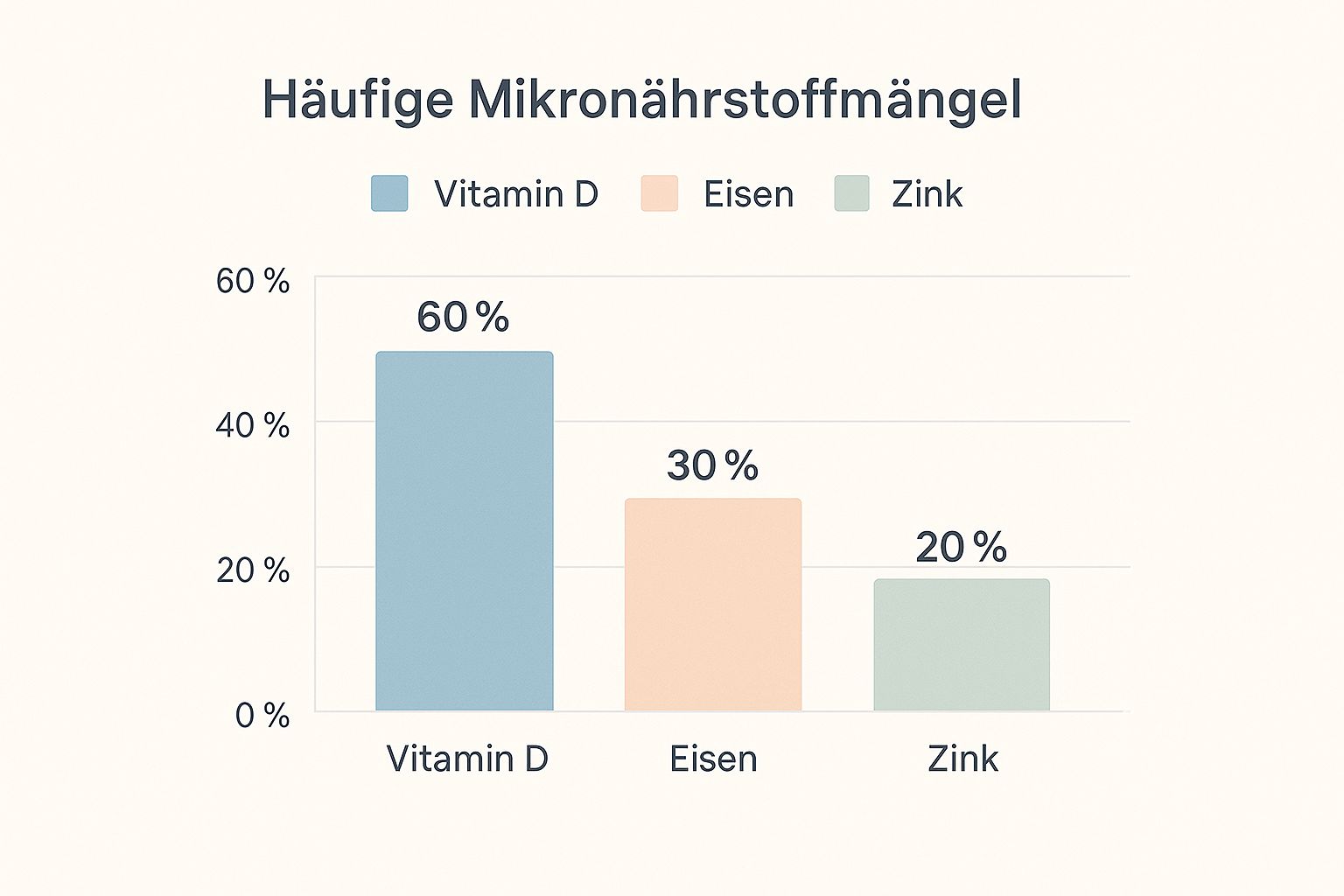
The data clearly show that vitamin D levels are critically low in a large part of the population. But other levels are also often below optimal.
The problem is that many of these symptoms can also have other causes. We often attribute fatigue to overwork and bad skin to improper skincare. In our follow-up article, you can learn more about the various nutrient deficiency symptoms and their possible connections.
The key advantage of a targeted blood analysis is clarity. Instead of guessing, you receive measurable facts about your body and can address the root causes instead of just treating the symptoms.
A mybody-x nutrient test offers you precisely this clarity. It provides you with a precise evaluation of your current status, giving you the opportunity to proactively and knowledgeably take control of your health.
For whom an analysis is particularly worthwhile
Every body is different. Depending on life stage and daily routine, each of us has very different nutritional needs. While some are perfectly well supplied with a balanced diet, there are certain groups for whom a micronutrient analysis can be particularly valuable in order to specifically prevent deficiencies.
Your personal need for vitamins and minerals isn't fixed. It fluctuates and is influenced by factors such as age, exercise, diet, or specific life stages like pregnancy. Do you belong to one of the following groups? Then a closer look at your levels could be crucial for your well-being.
Life stages and lifestyles with special needs
Certain life situations and dietary habits clearly increase the risk of nutrient deficiencies. An analysis gives you the chance to counteract this in time – ideally before deficiencies even become noticeable through symptoms like constant fatigue.
An analysis is particularly worthwhile for:
-
Athletes and physically active people: Those who train intensively burn more energy. Through sweating and a boosted metabolism, you lose important minerals like magnesium and zinc. A targeted analysis helps you optimally replenish your stores and thus improve your recovery.
-
Pregnant and breastfeeding women: During this special time, you're not only providing yourself but also your child with everything they need. Your requirements for folic acid, iron, and iodine increase dramatically. A check-up gives you the peace of mind that your baby is getting the best possible nutrition and that you're feeling well too.
-
Vegans and vegetarians: A purely plant-based diet can be incredibly healthy, no question. But you need to take a closer look at certain nutrients like vitamin B12 , iron, zinc, and omega-3 fatty acids. Regular micronutrient analysis provides clarity and shows you where you might be able to optimize your diet.
Whether young or old, chronically ill or in particular phases of life – vulnerable groups often exhibit significantly lower micronutrient levels. Studies show that even in well-nourished countries like Germany, specific risk groups exist. Learn more about micronutrient status in the population at burgerstein-foundation.ch .
Overview of other risk groups
Besides these well-known groups, there are other factors that make checking your nutrient status worthwhile. Often, it's gradual changes in your daily routine that alter your body's needs without you immediately noticing.
This includes, above all:
-
Older people: As we age, the body changes. The ability to absorb nutrients from food can decline. At the same time, appetite often changes, which further complicates adequate intake.
-
People with chronic illnesses or digestive disorders , such as Crohn's disease or celiac disease, can significantly disrupt nutrient absorption in the intestines. An analysis provides the necessary clarity to counteract this.
-
People with persistent stress: Chronic stress is a real nutrient robber. Your body consumes vast amounts of B vitamins, magnesium, and vitamin C to cope with the constant tension.
Do you often feel inexplicably exhausted and drained? Read our article to find out which vitamins you might be lacking when experiencing fatigue and how to get to the bottom of the cause. The mybody-x nutrient test provides you with a clear picture and helps you take proactive steps to improve your health.
Understanding and correctly interpreting your results

The big moment has arrived: your micronutrient analysis results report is in. At first glance, such a document full of numbers and technical terms can seem quite overwhelming. But don't worry, we're not leaving you to figure it out alone. We've specially prepared your mybody-x report so that you can understand it immediately and use it to your advantage.
We translate complex lab data into clear, understandable language. Thanks to clear graphics and concise explanations, you can immediately see where you stand. This transforms a lab report into a real tool for your health.
Correctly classifying the reference ranges
To decipher your results, the reference ranges are key. These are scientifically established values that show how your result compares to medical recommendations. Your mybody-x report makes it easy for you with a simple traffic light system.
-
Green Zone (Optimal Zone) Everything is in the green zone! Your values are exactly where they should be for optimal health and well-being. This is the goal you can work towards.
-
Yellow zone (gray area/trend): Nothing is critical yet, but it's no longer ideal either. Consider it an important early warning. You now have the chance to counteract this with small adjustments to your diet before a real deficiency develops.
-
Red zone (deficiency or excess): You should take action here. A value in the red zone indicates a significant deficiency or a potentially harmful oversupply that can noticeably impair your health.
This clear structure helps you to set priorities and identify where to start.
From value to meaning for you
Numbers are one thing, but what do they really mean to you? Your test results tell you not only what your value is, but above all, what that means for you .
Imagine your report says:
Your vitamin D level is 25 ng/ml . The optimal range is between 40 and 60 ng/ml . Your level is therefore deficient.
This concrete classification makes the data tangible. You immediately see that your vitamin D level is too low and that you should do something about it. The report then also explains why this value is so important – for example, for a strong immune system and healthy bones.
Important to know: A micronutrient analysis is a snapshot in time, much like a comprehensive blood test. If you're interested in which diseases can be detected through a comprehensive blood test , you can find more information on our blog.
A single value rarely tells the whole story. Many nutrients work together in the body. For example, an iron deficiency can be exacerbated by a lack of vitamin C or copper, because both are crucial for iron absorption. Your test results will help you understand these connections and view your health holistically.
Derive concrete measures from your analysis
You're holding your results report in your hands – great! But don't just see it as a collection of data. Consider it your very own roadmap to greater well-being. Knowledge is the first step, but only implementation will truly move you forward. Now it's about turning your insights into concrete, practical actions for everyday life.
A diagnosed deficiency is not a cause for concern, but rather a huge opportunity. You now know exactly where your body needs a little extra support. The good news: You can specifically address these deficiencies, usually through a tailored diet and, if necessary, with high-quality nutritional supplements.
Specifically address deficiencies through diet
The most natural and effective way to replenish your nutrient stores is directly through your diet. Often, small adjustments to your daily routine are enough to make a big difference. So you don't have to completely overhaul your diet – it's more about cleverly expanding it.
Here are a few practical examples of how you can address specific shortcomings:
-
If you have an iron deficiency, you don't have to reach for a steak. Plant-based sources like lentils, pumpkin seeds, and oatmeal are also excellent sources. The trick is to always combine them with vitamin C – for example, by drinking a glass of orange juice or adding bell peppers to your food. This greatly improves absorption in the body.
-
If you have a magnesium deficiency , whole grain products, nuts (especially almonds), bananas, and dark chocolate are your friends. Even a handful of nuts a day can make a noticeable difference.
-
If you have a zinc deficiency , you should include oatmeal, cheese (like Emmental), lentils, and beef in your diet more often. Zinc is a true all-rounder for your immune system and healthy skin.
Always remember: A diverse and colorful diet is the best basis for being well supplied with all important micronutrients.
Using dietary supplements wisely
Sometimes, diet alone isn't enough to quickly address a more serious deficiency. This is precisely where high-quality nutritional supplements can provide sensible and effective support. But be aware: quality is clearly more important than quantity.
When choosing supplements, you should pay attention to a few important points so that your body can actually absorb and utilize the nutrients.
Pay attention to high bioavailability . This sounds complicated, but it simply means that the nutrient is in a form that your body can easily absorb. For example, magnesium citrate is often more bioavailable than the cheaper magnesium oxide.
Furthermore, be sure to strictly adhere to the dosage recommendations to avoid overdosing. More isn't always better – an excess can be just as problematic as a deficiency. Your micronutrient analysis provides the perfect basis for a safe dosage that precisely matches your needs.
The targeted supplementation of nutrients is no longer a niche topic in Germany. In 2022, there were already 62 manufacturers of dietary supplements, 10 more than in 2019. Approximately 29.1% of the population regularly uses such products. This shows how established targeted nutrient intake already is. You can learn more in this study on the prevalence of dietary supplements in Germany .
Your mybody-x nutrient test is therefore the ideal starting point to improve your nutrition not with a scattershot approach, but in a targeted and fact-based way. This way, your lab results become a clear, actionable plan for a noticeably better feeling of well-being.
Why dietary supplements alone are often not the solution
Sure, dietary supplements can be a great help in specifically addressing a deficiency. But they're not a miracle cure that simply fixes an unbalanced diet. Reaching for a pill or powder may promise a simple solution, but what's happening in our bodies is usually much more complex.
The idea that "more is better" can seriously backfire here. If you don't know exactly what your body really needs, you're essentially just pouring nutrients into yourself indiscriminately. This is not only ineffective, but can also seriously disrupt your body's delicate balance.
The interplay of nutrients is crucial.
One often overlooked point is the interaction between micronutrients. Don't think of your body as an empty warehouse that you simply need to refill. It's a sophisticated system in which vitamins and minerals must work together perfectly, like teammates.
-
For example, iron and zinc: If you take high doses of zinc as a single supplement, it can block the absorption of iron in the intestines. This could lead to an iron deficiency in the long run, even though you only wanted to optimize your zinc levels.
-
For example, calcium and magnesium: these two minerals are natural antagonists. A large excess of calcium can interfere with the absorption of magnesium – which can then manifest itself, for example, in muscle cramps.
These examples clearly demonstrate how quickly the uncontrolled intake of individual medications can lead to new problems.
Bioavailability: The key lies in what actually gets absorbed.
Another crucial factor is bioavailability . This term describes how well your body can actually absorb and utilize a nutrient you ingest. Just because a supplement is highly dosed doesn't necessarily mean that the active ingredient actually reaches your cells.
A professional micronutrient analysis is the best basis for effective and, above all, safe supplementation. It protects you from uncontrolled intake and ensures that you supplement exactly what you are truly lacking.
The National Nutrition Survey II clearly demonstrates that many people do not reach the recommended levels despite supplementation. This underscores the gap between what is ingested and what the body actually needs and absorbs. Those wishing to delve deeper will find fascinating insights into micronutrient intake in Germany at the Max Rubner Institute.
The safest and most sustainable way to your well-being is therefore always a holistic approach: a sound analysis such as the mybody-x nutrient test, combined with a balanced diet and a healthy lifestyle.
Your most frequently asked questions about micronutrient analysis
You now have a good overview of how a micronutrient analysis can help you take control of your well-being. Nevertheless, a few specific questions often arise that you might be wondering about. Here we answer the most frequently asked questions so you can clear up any remaining uncertainties.
It's perfectly normal to have questions when you decide to take proactive steps for your health. We want you to feel well-informed and confident before taking the next step.
How often should I have an analysis done?
There's no one-size-fits-all answer here, as the right time for a micronutrient analysis depends entirely on your personal situation. Your diet, your lifestyle, and of course your current state of health all play a crucial role.
As a rough guide, you can use the following as a reference:
- For annual check-ups: An annual check-up is a great preventative measure. This way you can keep an eye on your health and detect gradual changes early, before they become a problem.
- If you experience new symptoms: Do you feel constantly tired, suffer from hair loss, are more susceptible to infections, or have other complaints that you can't explain? An analysis can provide valuable clues to the cause.
- If you've made lifestyle changes: Have you changed your diet, for example to vegan, or are you starting intensive exercise? Then an analysis after a few months is perfect to check if your nutritional levels are still adequate.
A follow-up test is also invaluable for monitoring the success of your measures. If you have adjusted or specifically supplemented your diet due to a deficiency, a re-analysis after approximately three to six months will show you in black and white whether your levels are back within the normal range.
Will the health insurance cover the costs?
That's a perfectly valid question. Home tests like the nutrient test from mybody-x are generally not covered by insurance . Health insurance companies usually only cover the costs if there is a well-founded medical suspicion of a deficiency and the test is ordered by a doctor.
Don't view the cost of a micronutrient analysis as an expense, but rather as one of the best investments you can make in your health. You're taking active control and can prevent potential problems before they even arise.
By taking a proactive approach, you not only improve your well-being but can also avoid higher healthcare costs in the long run. It's an act of self-care that puts you in control of your health.
What is the difference compared to a test performed by a doctor?
The biggest difference usually lies in accessibility and focus. While a doctor's visit is essential if you're already experiencing serious symptoms, a home test offers a straightforward way to proactively and independently check your health. You don't have to wait weeks for an appointment and can do everything conveniently from home.
There are various analytical methods, such as measuring serum (the liquid part of the blood) or whole blood. Both methods have their merits. Serum tests often provide good insight into acute blood supply, while whole blood analysis can also show how well certain nutrients are stored in the blood cells in the long term.
The mybody-x test uses a proven and scientifically validated method to provide you with meaningful and reliable insights into your nutritional status. The analysis takes place in a certified specialist laboratory, so you can fully rely on the accuracy of the results. At the end, you receive a clearly presented report that not only provides you with the raw data but also helps you to correctly interpret the values and derive concrete steps for yourself.
Are you ready to finally gain clarity about your nutrient intake and take your health to the next level? With the mybody-x nutrient test, you'll receive a clear picture of your body and concrete recommendations to unlock your full potential.
Share:
Nutrient Deficiency Test: Your Path to More Energy and Clarity
What is normal blood pressure? Your comprehensive guide