
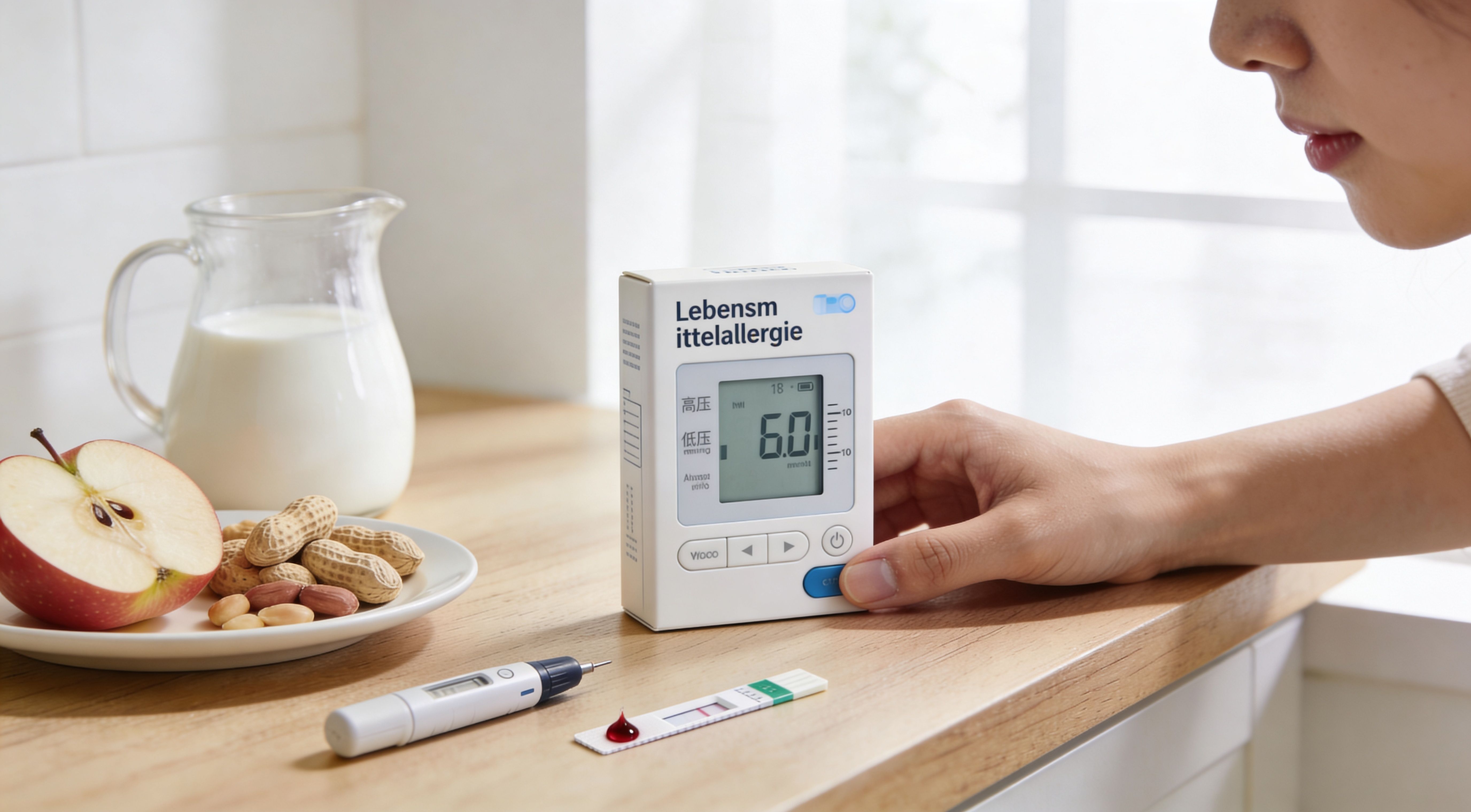
Food Allergy Test: Your Guide to Clarity
After eating, your skin suddenly feels tight. Or your stomach reacts every time you eat seemingly “healthy” meals. Perhaps your mouth itches after eating nuts, dairy products make you uneasy, or you have already started cutting out entire food groups without really knowing whether that is necessary at all.
This is exactly when many people start looking for a food allergy test. Not out of curiosity, but because they finally want to understand what is happening in their bodies. That makes sense. But it is also the point at which a great deal of confusion arises. Allergy, intolerance, sensitization, IgE, IgG, self-test, laboratory test. Many terms sound similar but do not mean the same thing.
If you are currently stuck between worry, self-observation, and contradictory information, you need one thing above all: a clear, matter-of-fact guide.
You suspect you have a food allergy
You eat a salad with feta, nuts, and dressing for lunch. Shortly afterward, your stomach starts to rumble. In the evening, a rash appears as well. The next day, you cut out milk. Then wheat. Then nuts too, just to be safe. Suddenly, every meal becomes a small risk.

This is how it starts for many people. The symptoms are often nonspecific. Skin reactions, itching, stomach problems, or swelling can be worrying. In addition, some symptoms appear immediately, while others are only noticed later. It is then easy to assume that “something in the food” must be responsible.
Why so many people misinterpret their symptoms
The problem is not that you listen to your body. The problem is that symptoms alone are not yet a diagnosis. According to the AOK on self-tests for food intolerance and allergy, about 4% of the population in Germany have a true food allergy, while around 30% of people believe they have one.
This gap is huge. It shows how quickly harmless, nonspecific, or entirely different symptoms can be interpreted as an allergy.
Practical perspective: A symptom after eating is a clue. It is not yet proof.
What often characterizes true allergies
A true food allergy often involves common triggers such as milk, eggs, wheat, peanuts, or fish. Typical symptoms may include skin reactions such as hives, angioedema, or gastrointestinal symptoms. However, this does not mean that every reaction to one of these foods is automatically an allergy.
That is why it is helpful to first take a simple look at the pattern:
- When does the reaction begin after eating?
- What exactly did you eat, including sauces, spices, and snacks?
- What symptoms occur, such as skin, stomach, mouth, breathing, or circulatory symptoms?
- Does it happen repeatedly after eating the same food, or only once?
If you want clarity at this point, a test is often useful. But choosing the right test is crucial. Otherwise, you are merely exchanging uncertainty for new confusion.
Allergy or intolerance – the crucial difference
Many people mean completely different things when they say, “I can’t tolerate that.” This is exactly where most misunderstandings arise.
Two different mechanisms
An allergy is, simply put, a misdirected immune response. The body classifies a substance that is actually harmless as a threat and reacts to it. Food allergies often involve IgE antibodies.
An intolerance is something different. The immune system is not primarily misdirected; rather, the body has a problem with processing, digestion, or the load. It can feel similar, but it is not the same.
A simple analogy often helps:
- With an allergy, your immune system behaves like an overzealous bouncer who throws out the wrong person.
- With an intolerance, the problem is more likely in the kitchen. The food is not processed properly, even though nobody should have to sound the alarm.
If you want to better sort out this distinction, you will find a good foundation in the article on the difference between allergies and intolerances.
Why IgG often causes confusion
Many tests promising to identify “food reactions” are available online. It is worth taking a close look. The key question is which antibody is actually being measured.
The Spiegel summary of the criticism of IgG tests notes that experts such as the German Society for Allergology criticize IgG tests as useless for allergy diagnosis because they only show a normal immune response to foods, not a pathological reaction. A true IgE allergy cannot be detected with them.
A positive IgG result does not automatically mean that a food is making you ill. It often only shows that your body has been exposed to it.
What this means for you in practice
If you are looking for a food allergy test, pay attention to the method first. For evaluating a classic immediate-type allergy, an IgE-based test is relevant. An IgG test does not answer this question.
This not only saves money but also avoids unnecessary lists of prohibited foods. Anyone who avoids many foods based on an unsuitable test ultimately risks having a diet that is unnecessarily restrictive and unbalanced.
Common testing methods in a medical overview
If you ask a doctor or laboratory about an evaluation, several methods are usually possible. They do not all serve the same purpose. Some are suitable for initial screening, while others are used for more precise confirmation.

The quick comparison
| Method | How it works | What it is good for | Limitation |
|---|---|---|---|
| Skin prick test | Allergens are applied to the skin and tested superficially | Quick initial indication of sensitization | Not every skin responds well, and a positive result is not yet a confirmed clinical allergy |
| IgE blood test | A blood sample is tested for specific IgE antibodies | Useful when skin tests are unsuitable or as a structured first step | Shows sensitization, not necessarily symptoms |
| Oral food challenge | The suspected food is administered under medical supervision | Used for confirmation when it is unclear whether the reaction is clinically relevant | Time-consuming and only useful with professional guidance |
| Elimination diet | Suspected foods are temporarily eliminated and then deliberately reintroduced | Helps reveal patterns in everyday life | Not conclusive on its own and prone to misinterpretation |
| Screening test | Several common allergens are tested together | A good starting point when the trigger is unclear | An abnormal result often requires further assessment |
What a screening test can do
Especially if you do not yet know which food might be involved, screening can be useful. According to the article by the Institute of Human Genetics Ulm on prevalence, symptoms, and diagnosis, the prevalence of true food allergies is 4.2% in children and 3.7% in adults. It also explains that screening tests such as fx5 can detect several common allergens together.
This is helpful when the possible cause is still broad. However, it does not replace interpretation alongside symptoms and their progression.
Sensitization is not the same as disease
One point is often overlooked. A test can show that your immune system reacts to a food without you actually experiencing symptoms from it in everyday life. That is precisely why good diagnostics and good advice always consider both: the laboratory result and everyday reality.
A result only becomes truly useful when it matches your symptom diary.
When each approach makes sense
Not everyone needs the full diagnostic workup at a specialist clinic right away. For many people, a step-by-step approach makes sense:
- Monitor your symptoms and record them as specifically as possible.
- Choose the right initial test for the question you want answered.
- Have unusual results checked instead of prematurely avoiding everything.
- Avoid only confirmed triggers in the long term.
If you are wondering where testing is available, the overview where to get an allergy test provides useful guidance on choosing between a doctor's office, laboratory, and home test.
Modern component-resolved diagnostics explained simply
A standard blood test sometimes only says: There is a reaction to a food. Component-resolved diagnostics goes deeper. It looks not only at the whole food, but at individual protein components within it.

The HD version of the allergy test
Imagine that an ordinary test only says: “You react to milk.” Component-resolved diagnostics asks more precisely: Which protein in the milk are you actually reacting to?
This is important because not every reaction carries the same risk. Some protein components are heat-sensitive, while others are stable. Some are more indicative of harmless cross-reactions, while others suggest a higher risk in genuine allergies.
The overview of allergy diagnostics from Augsburg states that allergen component testing can simultaneously test 112 allergen components from 52 allergen sources. It also gives the example that, in cow's milk allergy, heat-stable casein (Bos d8) can be identified as a risk marker for more severe reactions.
Why this level of detail can help you
This level of detail can prevent unnecessary restrictions. When it becomes clearer exactly what your immune system is reacting to, some findings can be interpreted more effectively. This is especially helpful if you already avoid many foods as a precaution or if it is unclear whether a true allergy or a cross-reaction is behind your symptoms.
You can also read more about how such mix-ups occur in the article on cross-allergies and their connections.
The more precisely the test asks questions, the more specifically you can decide what you really need to avoid and what you do not.
Food Allergy Test for Home Use – What You Need to Know
A home test initially sounds like the simplest solution. No waiting room, no coordinating appointments, no long journey. That can be a real advantage in everyday life. Especially if you have been experiencing symptoms for some time but finally want to take the first concrete step.

What a home test is suitable for
A reputable home test can give you a first laboratory-based indication. It is particularly useful if you observe recurring symptoms and want to narrow down whether an IgE-mediated reaction is even a possibility.
What matters most in practice is:
- You can get started easily without having to arrange an appointment first.
- Sample collection is discreet and fits more easily into your everyday life.
- You get a structured starting point for your next conversation with a doctor or nutrition professional.
Where you should be critical
A home test only becomes useful when the method is right. With a food allergy test for home use, it is therefore not the most attractive packaging design that matters, but these points:
- IgE instead of IgG when it comes to the question of a classic food allergy
- Laboratory analysis instead of purely app-based evaluation
- Clear information for interpretation, meaning no promises of a definitive diagnosis
- Data protection and transparent processes for samples, shipping, and results
What a home test cannot do
It does not replace an overall clinical assessment. If you have severe reactions, notice breathing difficulties, swelling, or circulatory problems, a home test is not sufficient. You then need direct medical evaluation.
Even with milder symptoms, the same applies: A positive result is one piece of the puzzle. It must fit your symptoms. Conversely, a negative result does not rule out every form of symptom. Some problems are more likely to involve intolerances, cross-reactions, or entirely different causes.
Responsible use at home
If you want to use a home test, it should be understood as a starting point, not a final verdict. That is where it is most valuable: as an organized first step before eliminating many things on suspicion.
Anyone who wants more detailed information can find practical guidance on the process in the article Do an allergy test yourself. As a specific option in the field of at-home diagnostics, mybody x blood test offers IgE-based blood tests for home use, in which a small sample from the fingertip is analyzed in a laboratory. However, careful interpretation of the result remains crucial there as well.
Your path to testing – understanding preparation and results
Many people make the mistake of looking directly at the test and blocking out everything else. But good diagnostics begin even before the blood sample is taken.
How to prepare properly
A brief food and symptom diary is often more helpful than many people think. For a while, write down what you eat, when symptoms occur, and what they are like. It does not need to be literary. Bullet points are enough.
Pay particular attention to:
- Timing of the reaction after eating
- Amount and composition of the meal
- Accompanying factors such as exercise, alcohol, or stress
- Repetition of similar reactions to the same foods
If you are taking medication or are already undergoing medical evaluation, that is also part of the assessment. A test result without context can quickly lead you in the wrong direction.
How to read findings correctly
The most important sentence is: A positive test alone does not yet prove a clinically relevant allergy.
The verified diagnostic data show that only about 50% of sensitizations actually lead to symptoms. That is precisely what makes interpretation so important. A laboratory can show that your immune system responds to an allergen. Only the connection with your history reveals whether this allergen really causes symptoms in everyday life.
A good finding never answers only the question “Is something measurable?” but also “Does it fit what I am experiencing?”
A simple action plan based on the result
If the test shows no abnormalities:
Then the search is not automatically over. Your symptoms may still be real. It is worth looking at other causes, such as intolerances or another digestive issue.
If the test shows an abnormal result and matches your symptoms:
Then it is a strong indication that you should have it professionally assessed, especially before eliminating foods over the long term.
If the test shows an abnormal result but you do not have any clear symptoms:
Then you need to exercise restraint. Not every laboratory finding calls for a strict diet.
This is why follow-up is important, especially with at-home blood tests. Whether through medical support or professional consultation, otherwise you are left alone with numbers without knowing what they mean in practical terms.
Frequently asked questions about the food allergy test
Can a food allergy change over time
Yes, that can happen. Some allergies persist, while others change. Therefore, an older assessment is not automatically valid forever. If your symptoms have changed, a new professional evaluation is advisable.
What if my test is negative but I still have symptoms
Then the test still was not “for nothing.” It helped make a particular cause less likely. After that, it is worth looking at intolerances, cross-reactions, digestion, dietary patterns, or other medical issues.
Should I completely eliminate suspected foods until I get the results
Only if you clearly and repeatedly react to it, or if medical advice has already been given. Avoiding large numbers of foods on suspicion often makes your diet unnecessarily complicated and risks deficiencies or uncertainty in everyday life.
Is a home test sufficient on its own
Often, yes, for an initial indication. Not always for a definitive diagnosis, however—especially not when reactions are pronounced, new, or burdensome.
When should I seek medical help immediately
In the case of stronger reactions, swelling, breathing problems, circulatory problems, or if you feel acutely ill overall after eating. This is not something to monitor at home; it requires medical attention.
If you want to take a first lab-based step from home, take a look at the mybody x blood test. What matters is not only that testing is done, but that you interpret the results correctly and use them as part of a clear, responsible decision-making process.



Share now:
Blood allergy test: Get clarity about your symptoms
Your food allergy test: Find clarity now!