
Getting an allergy test: Diagnostic options in 2026
You wake up with a stuffy nose. After breakfast, your stomach starts rumbling. Later, your eyes itch, and in the evening your skin reacts to a cream you've always tolerated. This is often how allergies begin. Not with one clear signal, but with many small disturbances that make your everyday life unnecessarily complicated.
If you're currently wondering whether you should finally get an allergy test, you're on the right track. Not because you're exaggerating, but because unclear symptoms rarely improve when you ignore them. Trial and error costs time, energy, and often quality of life, too. A proper test brings order to the chaos.
Constant sneezing, itching, or stomach rumbling? You're not alone
Monday morning. The window is open, and you sneeze several times in a row. At lunchtime, you have a salad with nuts, and afterward your stomach feels strange. In the evening, you wear a new necklace, and suddenly the skin on your neck turns red. The problem is not just the symptom. The problem is the uncertainty.
Many people attribute these symptoms to stress, the weather, sensitive skin, or “something they ate.” Understandably so. Allergy symptoms are often vague and vary depending on the trigger, season, and everyday situation.

Why so many people are affected
This is not a fringe issue. In Germany, over the course of their lives, more than 20 percent of children and more than 30 percent of adults develop at least one allergic disease. Among adults, women are affected more often than men: 35 percent compared with 24 percent. These figures come from a publication by the Statistical Library on the prevalence of allergic diseases in Germany.
That explains why so many people eventually ask themselves the same question you do: What is really behind my symptoms?
You don't have to be severely restricted before seeking clarity. Understanding things early is often the more sensible approach.
Typical situations in which an allergy test makes sense
Not every runny nose is an allergy. But you should take certain patterns seriously:
- Seasonal symptoms such as sneezing, watery eyes, or pressure in the sinuses, especially when the weather changes or in spring
- Reactions after eating, such as itching in the mouth, skin reactions, or digestive problems
- Recurring skin problems after using cosmetics, wearing jewelry, or coming into contact with latex or cleaning products
- Unclear symptoms at home, such as a blocked nose in the morning or an irritating cough at night
If any of this sounds familiar, self-observation alone will only get you so far. It is a start, but not an answer. Others are already testing more selectively instead of puzzling over it for months. That ultimately saves time.
Why your body rebels - The science behind allergies
An allergy is not your body being temperamental. It is a misjudgment by your immune system. Its actual purpose is to protect you. With an allergy, it classifies harmless substances such as pollen, animal dander, or certain foods as threats.
You can think of your immune system as an overzealous security service. Instead of stopping only genuine intruders, it sounds the alarm even when harmless visitors arrive. This causes symptoms such as sneezing, itching, skin reactions, or gastrointestinal problems.
The role of IgE
The central term here is IgE, or immunoglobulin E. These are antibodies that your body produces against specific allergens. This is precisely where a blood test comes in.
A blood test for specific IgE antibodies measures the level of these antibodies in your blood. This makes it possible to determine which substances your immune system is sensitized to.
The second part is important. A positive test does not automatically mean that you have a clinically relevant allergy. It initially indicates sensitization. Whether this actually causes symptoms in everyday life must always be assessed together with your symptoms and medical history.
Why blood tests are so useful
A blood test is therefore valuable because it does not guess but looks directly at the immunological evidence. It does not just ask, “When did you have symptoms?” It checks whether your body is measurably reacting to specific allergens.
This is particularly helpful when:
- your symptoms are diffuse, meaning they do not clearly affect only the skin, respiratory tract, or stomach
- you have several suspected triggers, such as pollen, food, and contact with animals
- you want to get started in a structured way, instead of eliminating many things at once
If you want to understand how it develops even better, you’ll find an easy-to-understand explanation at mybody-x on how an allergy develops.
Practical rule: Symptoms tell you that something is wrong. IgE tells you what your immune system reacts to. Only together do they become truly useful.
Sensitization is not the same as disease
This is where many people make a thinking error. They see a positive result and immediately eliminate foods, personal care products, or entire areas of their lives. This is often unnecessary.
The better order is clear:
- Recognize patterns in everyday life
- Use a blood test as an objective measurement
- Interpret the result together with your symptoms
This turns a suspicion into reliable evidence. That is exactly why evidence-based diagnostics are better than randomly eliminating things.
Pollen, peanuts, or nickel? Find your potential trigger
“Allergy” sounds like a single thing. In reality, it encompasses very different reaction patterns. If you want to take an allergy test, a rough classification can help. Not for self-diagnosis, but so you can think more specifically.
Inhalant allergies
This is the classic area. Pollen, house dust mites, animal dander, or mold spores enter the body through the airways. Typical symptoms include itchy eyes, sneezing, a runny or blocked nose, and sometimes coughing.
A typical pattern is: worse outdoors than indoors, more severe in the morning than in the evening, or clearly recurring seasonally. If you react to birch, grasses, or herbs, it is also worth looking into cross-allergies and related reactions, because some people also react to certain types of fruit or vegetables.
Food allergies
This is where things get more complicated, because true allergies and intolerances often feel similar. With an allergy, the immune system reacts. This can manifest as itching in the mouth, a skin reaction, swelling, or gastrointestinal symptoms.
The pattern is important. If the reaction occurs repeatedly after eating a particular food, an IgE-based blood test is much more useful than blindly eliminating foods.
Contact allergies
If jewelry, cosmetics, fragrances, latex, or certain ingredients cause skin problems, it is often a matter of contact allergies. Typical symptoms are redness, itching, eczema, or small blisters at the site of contact.
This question can help: Does my body react where something rests, seeps in, or rubs? If so, that is a different mechanism from reactions to pollen or peanuts.
Insect venom allergies
Some reactions are unmistakable. After a sting, there is not only localized swelling but also a significantly stronger general reaction. In that case, this is not something to observe for a long time, but something that requires clear medical evaluation.
A rough way to assess your symptoms
A simple self-assessment can help:
- More respiratory symptoms? Think first of pollen, mites, or animal dander.
- More symptoms after meals? Consider the area of food allergies.
- Mainly skin at a contact site? Contact allergy is an obvious possibility.
- Severe reaction after a sting? This should be taken seriously from a medical perspective.
If you recognize several categories at the same time among your symptoms, that does not mean you are “complicated.” It means that a proper test will be more helpful than continuing to guess.
The path to a diagnosis - What testing methods are available?
Once you have decided to take an allergy test, the next question arises. Which test will really give you a useful answer? Not every method is suitable for every set of symptoms. And not every method is equally practical in everyday life.

Skin tests at the doctor’s office
The best-known approach is the skin test. The medical practice applies small amounts of potential allergens to or into the skin and observes the reaction.
The prick test is the standard for many immediate-type allergies. It is widely used, but not always the most comfortable or practical solution, especially if you need several appointments or have skin problems.
The intradermal test goes deeper. According to NetDoktor’s information on intradermal testing, it is more sensitive than the prick test and can also detect weaker allergens, such as house dust mites, more effectively. However, a doctor must inject allergen extracts directly under the skin and assess the reaction after a short time. This makes medical sense, but it is clearly not a procedure for home use.
The patch test for contact allergies
If you are thinking more about nickel, fragrances, cosmetics, or latex, the patch test is often suitable. Patches containing test substances are applied to your back.
According to the allergy guide on patch testing, you wear these patches for one to two days, and delayed-type reactions are evaluated after two to three days. That is exactly what shows the disadvantage in everyday life. You need time, patience, and usually several appointments.
Skin tests can be medically useful. In practice, however, they are often inconvenient, especially if you first want a broad, quick overview.
The blood test for specific IgE
The blood test follows a different logic. Instead of triggering a skin reaction, it measures specific IgE antibodies in the blood. For many people, this is a more efficient starting point because the method does not depend on whether the skin is currently irritated or whether a multi-day testing protocol fits into their daily routine.
Especially if you have diffuse symptoms, suspect multiple triggers, or want to get started without first dealing with medical-practice logistics, this is often the most straightforward approach. You can also find a helpful guide to deciding at mybody-x on where to get an allergy test.
Allergy tests at a glance
| Test method | What is tested? | Procedure | Advantages | Disadvantages |
|---|---|---|---|---|
| Prick test | Immediate reactions to typical allergens | Allergens applied to the skin, brief observation at the practice | Well known, directly integrated into medical care | Practice visit required, not ideal for certain skin conditions |
| Intradermal test | More sensitive detection of weaker allergens | Allergen injected under the skin, evaluation after a short time | Higher sensitivity for certain questions | Specialist medical infrastructure required |
| Patch test | Delayed-type reactions in contact allergies | Patch on the back, evaluation after several days | Useful for contact allergies | Several days of effort, multiple appointments |
| IgE blood test | Specific IgE antibodies against allergens | Blood sample, laboratory analysis | Objective laboratory measurement, also conveniently available from home | Results must be interpreted in conjunction with symptoms |
My clear recommendation
If your symptoms are acutely dangerous, involve severe swelling, or you have breathing difficulties, seek medical care immediately. This is not a situation for a home test.
But if what you mainly want is clarity, you have several possible triggers in mind, and you do not want to go through the entire medical-practice process first, a blood test for specific IgE is the most sensible starting point. It saves you trial and error and provides a reliable basis for the next steps.
Stop guessing—your at-home blood test
The weakness of the traditional system is not that diagnostics are unavailable. The weakness is the process of getting there. Unclear responsibilities, waiting times, multiple appointments, and then observing instead of measuring after all. That is exactly why many people are looking for a more efficient solution.

Why at-home tests are particularly relevant right now
There are real gaps in allergy care. A summary on Gesundheitsinformation.de states that blood tests are often neglected in allergy diagnostics and that 88.5 percent of clinics rate allergy care as in need of improvement. This is not a minor detail. It explains why many people affected remain stuck between suspicion and clarity.
There is also a digital gap. Anyone who wants to actively manage their health today expects a process that fits into everyday life. Not three phone calls, two waiting rooms, and half a week of organizing.
What makes an at-home blood test better
An at-home test does not solve every medical problem. But it does solve a very real everyday problem. You can get started in a structured way without first having to navigate the entire healthcare system.
This is especially useful if you:
- You want to proceed discreetly without booking several appointments right away
- You want to make sense of vague symptoms before eliminating anything or trying medication
- You want data instead of guesswork to choose your next step wisely
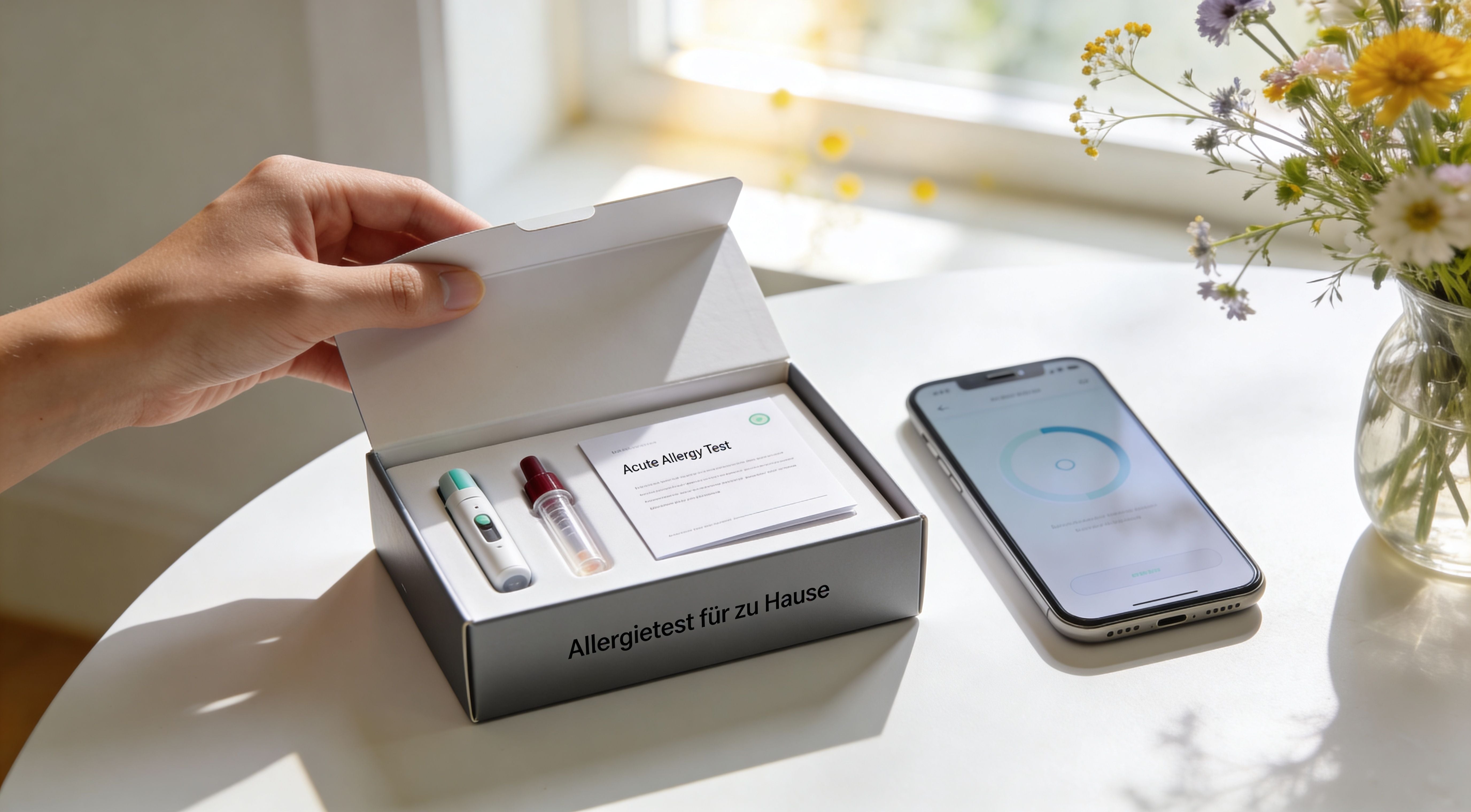
For this purpose, there is the mybody-x at-home IgE allergy blood test. You can also find other suitable options in the overview of mybody-x intolerance and allergy tests.
If you first want to understand what the process at home looks like, the guide to doing an allergy test yourself is a good place to start.
You are not too late. You are at the point where a short, reliable test can do more for you than another month of guesswork.
My recommendation as a health advisor
If your symptoms are mild to moderate, there is no acute emergency, and you mainly want to know which direction makes sense at all, start with a blood test. Not just for convenience, but for efficiency.
Others have long been optimizing their blood values, symptoms, and everyday decisions based on data. The same applies to allergies. The sooner you switch from guessing to measuring, the sooner you can take meaningful action.
Your result is here – From knowledge to action
Now this is important. Your result is neither a label nor a prohibition sign. It is a dataset about your body. Nothing more, but nothing less.
A positive IgE result initially indicates sensitization. You can only determine whether this amounts to a clinically relevant allergy by considering it together with your actual symptoms. That is precisely why the best way to use a test result is not to panic, but to put it into context.
How to deal with the findings sensibly
Work step by step:
-
Compare the result with your everyday life
Do you really react when the identified trigger appears? -
Do not immediately eliminate everything indiscriminately
Just because a value is abnormal does not mean you have to overhaul your entire life. -
Document reactions systematically
Note down foods, contacts, time of day, surroundings, and symptoms. -
Use the result as a basis for discussion
When medical assessment is advisable, you go in prepared rather than with a vague gut feeling.
Why digital options help here
Especially outside major cities, accessing allergy care is often difficult. The Hautsache website identifies a lack of digital services and inadequate care in rural regions as key problems in allergology. Digital blood tests followed by consultation can provide a useful supplement to bridge this gap.
This concerns not only the test itself, but also how understandable the results are afterward. Good results need to be readable, easy to interpret, and usable in everyday life. By the way, this applies not only to diagnostics, but also to healthcare products in general. Anyone interested in how strongly clarity and trust depend on comprehensible design can find useful insight into the role of guidance and user experience in Echt AG’s article on packaging design in the pharmaceutical sector.
A good test result does more than answer a single question. It improves your next decisions.
What matters now
Take the findings seriously, but not as absolute. If a trigger matches your symptoms, you can test, observe, and adjust more purposefully. If something does not fit, you need context instead of rash conclusions.
That is how genuine self-determination emerges. Not by Googling until midnight, but through a clear result and smart next steps.
If you no longer want to guess, start with a mybody x blood test. This gives you an evidence-based foundation for accurately interpreting symptoms and tailoring your everyday life more precisely to your body.



Share now:
Blood allergy levels: The meaning of IgE levels explained
Allergy and intolerance test: Find the cause