
Allergy test: Your guide to skin, blood & at-home tests
You may know the feeling: After breakfast, your stomach rumbles; while out for a walk, your nose starts running; and in the evening, your skin suddenly itches. None of this seems dramatic enough to be an emergency. But taken together, it feels as though your body is constantly sending you small warning signals.
What is frustrating about it is not just the symptom itself. It is the uncertainty. Was it the bread roll, the birch tree outside the window, the cat at a friend’s house, or simply stress? This is exactly where an allergy test can help. Not as a magical instant answer, but as a sensible first step toward greater clarity.
Itching, sneezing, stomach rumbling – Could an allergy be behind it?
Many people put off dealing with these symptoms for a long time. They try this and that, eliminate individual foods, or spontaneously buy anti-allergy medication. It may help in the short term. But the underlying question remains unanswered.
You are not alone. In Germany, more than 30% of the population develop an allergic disease over the course of their lives. At the same time, data shows that almost half of all adults are sensitized to at least one substance, even though a clinically relevant allergy is diagnosed in only about 30%. This gap matters because an abnormal test result does not automatically mean that your symptoms are actually caused by an allergy (background information and facts from the BfR).
Why vague symptoms are so confusing
Allergies are not always clear-cut. For some people, the nose is most affected; for others, it is the skin or the gastrointestinal tract. In addition, the reaction is not always equally severe.
An everyday example: You eat an apple and notice only a slight tingling in your mouth. Another time, nothing happens at all. Without testing and context, this is difficult to interpret. That is exactly why it is worth looking at the basics. Once you understand what an allergy actually is, it becomes much easier to interpret test results later.
Recurring symptoms deserve clarity. Not so that you worry yourself sick, but so that you can take more targeted action.
What an initial test can do
A good allergy test does not replace observing your own body. It complements it. It can provide clues about which substances your immune system reacts to and whether it is worth taking a closer look.
This is often an enormous relief. Instead of eliminating things at random, you can take a more structured approach. And that is usually the point at which concern finally turns into clarity.
What an allergy test measures in the body
An allergy test does not directly look for your sneezing, itching or stomach ache. It looks at your immune system's response. More precisely, it looks for IgE antibodies, immune proteins your body produces when it mistakenly classifies harmless substances as a threat.
You can think of your immune system as an over-sensitive security system. A pollen grain or a food protein comes along, and instead of staying calm, the system raises the alarm. This state of alert can be measured.
IgE, sensitisation and an actual reaction
If a test finds IgE against a specific allergen, this initially means only that your body has recognised this substance and prepared a defence response. This is called sensitisation.
The second step is important. A true allergy is only likely when this sensitisation is accompanied by corresponding symptoms. A positive result plus matching symptoms is more meaningful than a laboratory value alone.
Key point: A test measures the readiness to react. Only the connection with your symptoms shows whether this actually leads to symptoms in everyday life.
An allergy is not the same as an intolerance
This is where confusion often arises. An allergy is a reaction of the immune system. An intolerance generally affects digestion or metabolism and does not follow the same pattern.
This brief comparison can help you get your bearings:
| Topic | Allergy | Intolerance |
|---|---|---|
| What is involved | Immune system | Digestion or processing of substances |
| Typical reaction | e.g. itching, swelling, sneezing | e.g. bloating, abdominal pressure, diarrhoea |
| What an IgE test checks | Immune reaction to allergens | not the classic target |
If you want to understand more deeply where the difference between an allergy and an intolerance lies, this will help you enormously when choosing the right test.
Why this knowledge is so important
Many people expect an allergy test to provide a simple yes-or-no answer. Unfortunately, that is not how diagnostics work. The test is more like a good signpost. It points to possible directions, but it does not take away the need for you to think critically.
That is precisely why basic knowledge is not a minor matter. It protects you from overestimating harmless abnormalities or overlooking genuine indications.
Skin test at the doctor’s office versus blood test: a comparison
When people think of an allergy test, they often first mean the classic skin test at an allergist’s office. Alongside this, there is the IgE blood test, which is analyzed in a laboratory. Both methods have their place. However, they do not answer exactly the same question in the same way.

How the prick test works
During a prick test, the doctor applies small amounts of various allergen solutions to your skin, usually on your forearm. The skin is then lightly pricked. If your immune system reacts immediately, this usually becomes apparent within 20 minutes. The test is quick and easy to understand. You can see the reaction directly on your skin.
How the IgE blood test works
In an IgE blood test, a blood sample is analyzed in a laboratory for specific antibodies. Values below 0.35 kUA/L are considered negative, while values from Class 2 (0.70 kUA/L) are considered positive. At the same time, the following applies: These values do not necessarily correlate with the severity of your symptoms (explanation of prick tests and IgE values from Spiegel Wissen).
Direct comparison in everyday life
| Criterion | Prick test | IgE blood test |
|---|---|---|
| Location | Doctor’s office | Laboratory analysis after blood collection |
| Time until the first reaction | quickly visible | Result after analysis |
| What is tested | Skin reaction to applied allergens | Antibodies in the blood |
| Factors that can affect the result | may be complicated by skin condition or medications | independent of a skin reaction on site |
| Suitable for | acute immediate-type reactions, when visiting a medical practice is feasible | broader laboratory analysis, which can also be initiated at home |
Where people often take a wrong turn
Many people consider the skin test the “more authentic” test because you can see something directly. That is understandable. What is visible feels convincing. But visibility does not automatically mean better interpretation.
A blood test is especially advantageous when you want to check many possible triggers at once or when skin problems, medications, or logistical obstacles make a skin test impractical. If you are wondering how to prepare for an allergy test and what antihistamines can change in the process, it is worth taking a look at this beforehand.
A test is not better simply because it is faster. It is better when it matches the question you want to answer.
When each method may be useful
A skin test is a good fit if you are at a medical practice with typical immediate reactions and a doctor wants to test only a few specific suspects. A blood test often seems more practical when your symptoms are broader or you would first like to start calmly at home.
What matters is not choosing one or the other. What matters is understanding which information you need right now. That makes the subsequent interpretation much more reliable.
The allergy test at home – Your modern option
Not everyone wants to organize an appointment right away, sit in a waiting room, and coordinate multiple trips for the first step. An allergy test at home is therefore the more suitable starting point for many people. It removes that hurdle without making the issue seem unimportant.

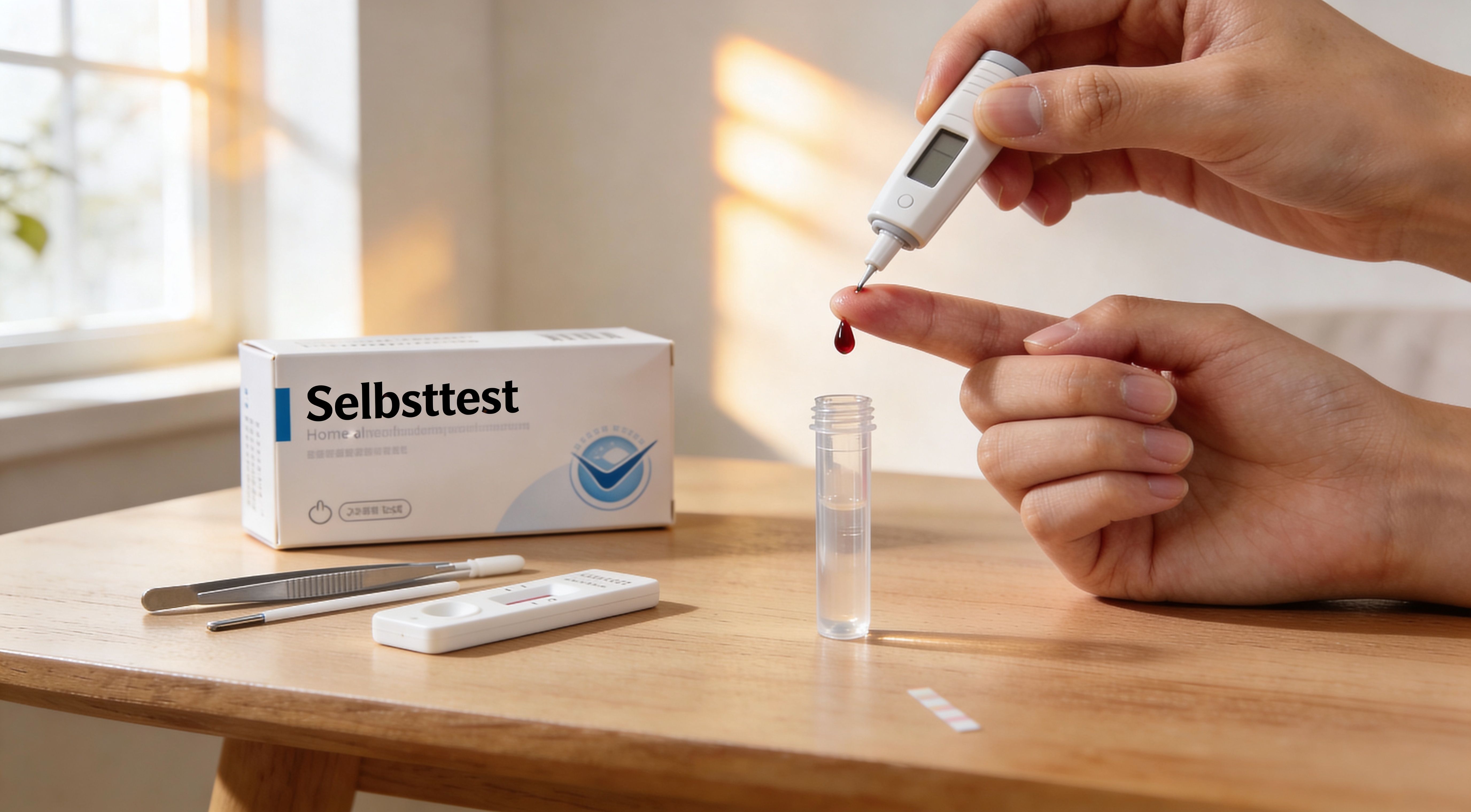
How a home test works in practice
The process is usually straightforward and well guided:
-
Choose a test
You choose a blood test that matches your concerns, for example if you suspect pollen, pet dander, house dust, or food allergens. -
Collect the sample at home
A few drops of blood from the fingertip are usually enough. For many people, this is much more practical in everyday life than an additional visit to a medical practice. -
Send the sample to the laboratory
The sample is sent to a specialized laboratory, where the actual analysis is carried out. -
View results in a structured way
You do not receive a raw list of numbers without context, but an evaluation that helps you identify patterns more easily.
What builds trust
Two points are particularly important for a medical home test: laboratory quality and data protection. If certified German laboratories are used and data is processed according to GDPR standards, this creates a completely different level of security than some rapid test with no verifiable background.
In this context, mybody x Blood Test is a home testing option. According to the provider, blood self-tests are combined with German laboratories, ISO standards, and GDPR-compliant processing. This is particularly relevant for people who want to approach the first diagnostic step discreetly and in a way they can plan.
Who this is particularly practical for
A home test may be a good fit if you:
- have little time and want to start without dealing with a medical practice at first
- want to systematically sort your symptoms instead of just guessing
- feel more comfortable having your blood drawn at home than attending a doctor's appointment
- are looking for an initial data basis for a discussion with specialists
The advantage of a home test is not limited to convenience. It lies in helping you move from worrying to structured investigation sooner.
What a home test should not replace
A home test is not a substitute for medical assistance in cases of severe or life-threatening reactions. If you notice shortness of breath, circulatory problems, severe swelling, or intense reactions after eating a food, you should seek medical evaluation.
For many other situations, however, the test is a sensible starting point at home. Not as an endpoint, but as a basis for further investigation.
Use component-resolved diagnostics for expert insights
Sometimes it is not enough to know that your immune system is reacting to something. You want to know exactly what it is reacting to. This is where component-resolved diagnostics comes in. It looks not only at an entire allergen such as “birch” or “milk,” but at its individual components.

Why this brings greater clarity
A standard test can show that you react to birch. Component-resolved diagnostics can help determine whether this is more likely to be a classic birch allergy or a cross-reaction that manifests after eating certain foods.
This is extremely helpful in everyday life. Otherwise, you can quickly get the impression that you need to avoid several foods, even though the actual situation is more nuanced. If you want to better understand cross-reactions, you can find a good overview in this information on cross-allergies.
What modern multiplex tests can do
Modern multiplex blood tests such as the ALEX test simultaneously analyze the reaction to up to 295 allergen extracts and molecular allergen components. This form of component-resolved diagnostics (CRD) helps distinguish genuine allergies from cross-reactions with a high degree of specificity. According to the technical information provided, this is not possible with skin tests, and the method is well suited to home testing because it is not affected by medications (technical information on allergy diagnostics from Labor Augsburg MVZ).
Total IgE and specific IgE
This distinction helps put things into context:
| Term | What it broadly shows | What it is useful for |
|---|---|---|
| Total IgE | Overall amount of IgE in the blood | General overview |
| Specific IgE | Reaction to individual allergens | More targeted classification |
| Component analysis | Reaction to individual allergen components | More precise risk assessment |
A practical example
If someone reacts to birch pollen and also feels a tingling in the mouth after eating an apple, the key question is not just, “Am I allergic to apples?” The more important question is often: Is this an independent, clinically relevant food allergy or a pollen-associated cross-reaction?
This finer distinction is exactly what makes modern blood diagnostics valuable. It does not prevent every uncertainty, but it significantly reduces blind trial and error.
The more precisely a test can distinguish between a primary allergen and a cross-reaction, the lower the risk of unnecessarily eliminating entire food groups.
Your results are here – What now?
The moment you receive your results is often more emotional than expected. Many people immediately look at the highlighted values and search only for a clear verdict. Positive or negative. Allowed or forbidden. The catch is that an allergy test usually cannot be interpreted quite so simply.

A positive result initially only means sensitization
Especially with food allergy tests, the most common misinterpretation is to immediately equate a positive result with a confirmed allergy. Experts estimate that around half of positive IgE results in food allergy tests are clinically irrelevant and represent silent sensitization. Therefore, a positive result must always be assessed together with symptoms and a professional medical history to prevent unnecessary elimination diets.
Three sensible next steps
If your result is abnormal, these steps are more helpful than hasty prohibitions:
-
Stay calm
A positive value is an indication, not an automatic verdict. Do not reflexively eliminate foods entirely from your diet. -
Keep a symptom diary
For a while, write down when symptoms occur, how severe they are, and what you have eaten or inhaled. This makes it easier to recognize whether the laboratory finding is actually noticeable in everyday life. -
Discuss the result with a medical professional
Especially when several values are abnormal, they need to be put into context. Patterns matter, not individual fields highlighted in red.
What you should avoid doing
Many people, out of concern, take exactly the steps that later create problems. These include:
-
Eliminating many foods on your own
This can unnecessarily restrict everyday life and make the diet unbalanced. -
Interpreting every symptom as an allergy
Not every stomach rumble or skin irritation has an allergic cause. -
Treating the test as a definitive diagnosis
The result is part of the puzzle, not the whole picture.
Important next step: Do not just ask, “What do I react to in the test?” Also ask, “When do I actually react in real life?”
When you should definitely seek further medical advice
If you have ever experienced severe swelling, breathing difficulties, circulatory reactions, or severe reactions after eating certain foods, self-interpretation is not sufficient. In that case, evaluation by a specialist is essential.
Professional guidance is also advisable for children, multiple results that are abnormal at the same time, or very ambiguous symptoms. A good result is not just a sheet of paper. A good result is a finding that you understand correctly.
Conclusion: Take your health into your own hands
An allergy test can help you turn vague guesswork into an organized process. You now have a clear picture of what is measured in the body, how skin tests and blood tests differ, and why a home test is a practical first step for many people.
But something else is even more important: You now know that a positive result does not automatically mean a confirmed allergy. This distinction between sensitization and clinically relevant allergy protects you from unnecessary anxiety and from prematurely banning foods or activities from your everyday life.
Taking responsibility for your health does not mean having to make every decision alone. It means asking better questions, collecting good data, and interpreting the results wisely. A blood test at home is often useful for precisely this purpose. It is accessible, structured, and practical for everyday life.
If you have been observing symptoms for some time, you do not have to remain in the dark. The first step is not perfection. The first step is clarity.
If you want to assess your symptoms systematically, a mybody x blood test can be a sensible first step. You can start comfortably from home, receive a laboratory analysis as a basis, and then assess your results specifically instead of continuing to guess.



Share now:
What can be detected in the blood?
Allergy Test: Find clarity about your symptoms