
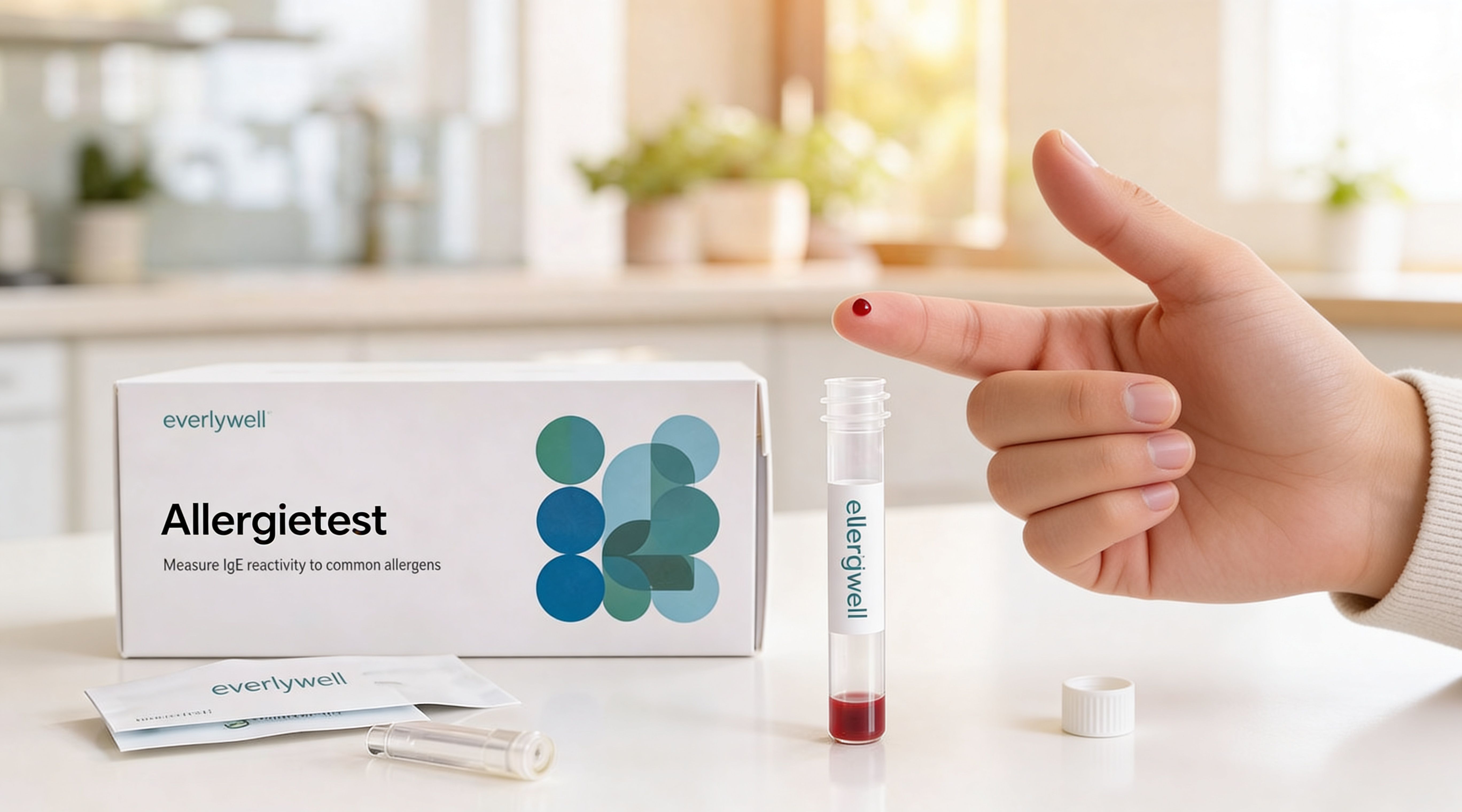
At-home allergy blood test: Your path to certainty
Maybe this sounds familiar. Your nose keeps running even though you are not actually suffering from a cold. Your mouth itches after certain meals. Your skin suddenly becomes sensitive. Or you simply do not feel quite right, and despite keeping a food diary, using apps, and monitoring yourself, you cannot identify a clear trigger.
This is exactly where many people get stuck. The symptoms are real, but they do not fit neatly into a single category. That is when the typical trial and error often begins. Eliminating foods, changing detergents, checking pollen apps, suspecting pets, then reversing everything again. This takes time, causes frustration, and often affects your quality of life.
If you want to understand your body better, you are already on the right track. An allergy blood test can make this process more precise. Instead of simply guessing, you work with measurable indicators from your blood. This is not a trend, but an established part of allergy diagnostics.
Sneezing, itching, discomfort – could an allergy be behind it?
Anna notices it every spring. In the morning, she sneezes several times in a row, her eyes burn, and she feels tired and unfocused while working from home. At first, she thinks it is stress or dry air. A few weeks later, it gets better. The following year, it all starts again.
Tom’s situation is different. He does not have a classic “hay fever history.” Instead, his throat sometimes feels scratchy after eating certain types of fruit, and his nose is congested in the evenings. Nothing dramatic, but it happens often enough for him to wonder whether his body is reacting to something.
Such symptoms are tricky because they can seem nonspecific. A runny nose, itchy skin, coughing, gastrointestinal problems, or vague fatigue can have many causes. An allergy is only one possibility. But it is one that can be specifically investigated.
Many people first try to identify triggers in their everyday lives. That is understandable. However, without laboratory data, it is often difficult to clearly attribute a reaction.
Especially when symptoms come and go, self-observation quickly becomes unreliable. You do not eat the same thing every day, pollen levels fluctuate, you may not consciously notice dust mites, and skin reactions can occur with a delay. As a result, you are often left feeling uncertain.
It is helpful to approach the issue systematically. If you first want to understand what actually qualifies as an allergy, this article about allergies and their basics offers a good starting point.
What many people think of first, even though it is often not enough
- Food diary: Can reveal patterns, but cannot prove whether an IgE-mediated allergy is actually present.
- Symptom tracking: Helps with preparation, but quickly becomes confusing when several triggers come together.
- Avoidance based on suspicion: May provide short-term relief, but often leads to unnecessary restrictions.
If you want clarity, the next logical step is to establish a data basis. Others have long been optimizing their sleep, nutrients, or training using measurable values. The same logic applies when an allergy is suspected.
What happens in your body during an allergy
An allergy does not begin where you sneeze or feel itching. It begins in the immune system. It classifies a substance that is actually harmless, such as pollen or house dust mites, as a threat and initiates an immune response.
In Germany, estimates suggest that more than 30% of people develop at least one allergic disease during their lifetime. For Germany, 20 to 30 million affected people are cited. The blood test measures specific IgE antibodies and is an established component for detecting such sensitizations, as described by the German Federal Institute for Risk Assessment in its information on allergies and facts.

The IgE alarm system explained simply
Think of your immune system as an alarm system. Normally, it recognizes genuine dangers. With an allergy, it is set too sensitively. It reacts to something that is harmless to most people.
IgE plays the main role here. These are antibodies directed against specific allergens. When your body comes into contact with this allergen again, the reaction is triggered. Messenger substances are then released, causing typical symptoms such as sneezing, itching, swelling, or breathing problems.
Why the blood test focuses on this
An allergy blood test does not simply look for an intolerance “somewhere.” It specifically measures whether your body has produced specific IgE against certain allergens. This provides an important indication of what your immune system is sensitized to.
An important point is often misunderstood: A positive IgE result initially indicates sensitization. It does not automatically prove that you will always develop clinically relevant symptoms upon contact. That is why the combination of laboratory results and your personal history of symptoms is ultimately what matters.
Practical rule: Symptoms tell you that something is going on. IgE levels help you determine which direction you should really investigate.
If you want to understand more deeply how this reaction actually develops, the article How Does an Allergy Develop? explains the process again in practical, everyday terms.
The most common types of allergies at a glance
Not every allergy looks the same. Some mainly affect the eyes and nose, others the skin, and still others occur after eating or following an insect sting. That is precisely why it is useful to know the typical patterns.
Inhalant allergies
Sabrina wakes up in the morning with a blocked nose. It gets worse outdoors in spring, but somehow also in the bedroom. This could indicate a pollen allergy, but it could also be a reaction to house dust mites.
Typical symptoms include sneezing, watery eyes, coughing, or a feeling of pressure in the airways. Many initially classify this as “sensitive mucous membranes.” Only on closer examination does it become clear that the symptoms occur seasonally or in specific rooms.
Food allergies
Felix tolerates most meals well. But with certain foods, his mouth tingles shortly after eating, sometimes accompanied by itching. Others mainly report nausea, skin reactions, or a feeling of tightness.
This is where confusion with intolerances is particularly common. The important difference is that a true allergy involves the immune system. That is why suspected allergies require targeted evaluation rather than blanket avoidance.
Animal allergies
When visiting friends with a cat, Jana quickly starts sneezing. Sometimes her eyes begin to itch after only a short time. Such reactions are often colloquially called “pet hair allergies,” even though various animal-derived components may be relevant in practice.
The difficult part is that people who rarely have direct contact often recognize the pattern late. The symptoms then seem random, even though they reliably recur during certain visits.
Contact allergies
Some reactions occur where the skin comes directly into contact with a substance. Jewelry, cosmetics, fragrances, or other everyday products may play a role. Typical symptoms include redness, burning, itching, or eczema exactly at the contact site.
The key here is putting things into context: Not every contact reaction is suited to an IgE-based allergy blood test. That is precisely why the type of symptoms is so important.
Insect venom allergies
A sting, severe swelling, circulatory problems, or breathing difficulties. This is a different area from seasonal sneezing and requires special attention. Here too, targeted diagnostics may be important to better assess the relevance of a trigger.
A first point of orientation for you
You may recognize yourself in one of these patterns:
- Mainly outdoors and seasonally: Think of pollen.
- Especially in the morning or indoors: Dust mites may be a factor.
- Directly after certain foods: Food allergies should be investigated.
- When in contact with animals: Animal allergens may be involved.
- Only on areas of skin with direct contact: This points more toward a contact reaction.
This assessment does not replace a diagnosis. But it makes your next steps much more targeted.
Allergy blood test or skin test: Which is the right choice for you?
You have symptoms, but the trigger remains unclear. Maybe your eyes itch after a walk. Maybe your skin reacts quickly, or you are already taking antihistamines. Then the question is often not only whether you have an allergy, but also which testing method will give you the clearest answer.
Both procedures pursue the same goal. They check whether your immune system reacts to specific allergens. The difference lies in how the measurement is taken. The skin test shows a visible reaction directly on the skin. The blood test examines in the laboratory whether specific IgE antibodies against certain triggers are detectable. So you either measure the reaction at the surface or the immunological trace in the blood.
When a skin test is a good fit and when a blood test has advantages
A prick test at the doctor’s office can be useful when a direct skin reaction can be assessed reliably. This works especially well when the skin is calm and no factors distort the result.
It becomes more difficult with eczema, severely irritated skin, or when medication may influence the skin reaction. In such situations, a blood test is often easier to interpret because the sample is analyzed in the laboratory independently of the skin.
For many people, this is also relevant in everyday life. A blood test from home can be easier to plan if you want to avoid appointments or initially clarify your symptoms in a structured way.
Direct comparison in everyday life
| Feature | Allergy blood test (e.g. mybody-x) | Skin test (prick test) |
|---|---|---|
| Procedure | Blood sample, laboratory analysis | Reaction directly on the skin |
| Location | Also possible from home | At the doctor’s office |
| For skin problems | Often well suited | May be more difficult |
| For unclear skin reactions | Helpful addition | Sometimes difficult to interpret |
| Type of result | Detection of specific IgE antibodies | Visible skin reaction |
| Practical for everyday life | Easy to schedule, without waiting rooms | Appointment-dependent |
It is important to have the right expectations: No test answers every question on its own. A positive blood test initially shows that your immune system is sensitized to a substance. Whether that substance actually explains your symptoms only becomes clear in the context of your symptoms. That is precisely why a good test is not merely a yes-or-no tool, but a precise instrument for deriving concrete next steps from nonspecific symptoms.
If you are first looking for an overview of the available options, the article where you can get an allergy test clearly explains the most important options.
The right choice does not depend on a general rule. It depends on which method provides the most reliable and practical information in your situation.
Your path to certainty: the mybody-x allergy blood test
Anyone who has lived with unclear symptoms for a long time knows the problem. You change something, wait, observe, and start doubting again. This is exactly where a structured blood test often saves the most effort. Not because it answers everything on its own, but because it turns suspicions into verifiable clues.
Laboratory diagnostics for allergies are firmly established within Germany’s healthcare system. Statutory health insurance covers 8 specific IgE tests per quarter, and a specific IgE test costs €16.76 under the German Medical Fee Schedule (GOÄ). In addition, according to German-language specialist information, up to 700 different allergens can be tested. This demonstrates the diagnostic scope of the method, as described in Thermo Fisher’s FAQ on allergy blood testing.

How the process works at home
The process is deliberately kept simple:
-
Select test
You choose a suitable at-home allergy IgE test. -
Collect sample
The blood sample is collected with a finger prick. For many people, this is much easier to manage in everyday life than additional trips and appointments. -
Send in sample
The sample is then sent to a specialist laboratory in Germany. -
Receive results
You receive a structured report that you can compare with your symptoms and discuss with a doctor if needed.
Why this is the more efficient approach for many
The real benefit lies not only in convenience. It lies in clarity. Instead of changing your diet, indoor climate, or daily routines on suspicion for weeks, you get a scientifically sound data basis.
This is especially valuable if you want to optimize your health consciously rather than only reactively. People who know their triggers often make better decisions in everyday life—when shopping, traveling, interacting with pets, maintaining indoor hygiene, or visiting restaurants.
If you want to take this step, the practical conclusion is: Get a reliable answer only with blood tests—find out now what is behind your symptoms with the Allergy IgE Blood Test for Home Use or discover our other intolerance and allergy tests.
Understanding your result and planning the next steps
For many people, the moment after receiving the result is almost more difficult than the test itself. There are allergens, values, and interpretations. But the real question is: What does this mean for your everyday life?
A central principle is the distinction between sensitization and clinically relevant allergy. A positive IgE result shows that your immune system has reacted to an allergen. Whether this actually causes symptoms can only be determined together with your symptom history.

What a positive result means
A positive result does not automatically mean: strictly avoid it for the rest of your life from now on. It means first: there is a measurable indication here. If this exact allergen fits the timing of your symptoms, the result becomes particularly relevant.
If, on the other hand, you see a positive result for something you tolerate without any problems, it needs to be interpreted carefully. What is needed then is not activism, but context.
What modern diagnostics can additionally do
Allergy blood diagnostics are much more precise today than they used to be. Component-resolved diagnostics can access 117 allergen extracts and 178 molecular allergens from 165 allergen sources—in other words, more than 200 test elements. This high resolution improves risk assessment and helps distinguish cross-reactions, as explained in the allergy diagnostics test catalog from Labor Augsburg MVZ.
This is useful when your test result initially seems confusing. Especially with pollen and food combinations, similar protein structures can trigger reactions that have different relevance in everyday life.
How to proceed sensibly
- Consider your symptoms alongside it: Do not look only at the laboratory value, but at how it relates to your everyday life.
- Do not eliminate everything too hastily: Especially with foods, any change should be justified.
- Discuss it with a doctor: Medical interpretation is important for unusual results or stronger reactions.
- Recognize patterns: Recurring situations are often more informative than isolated events.
A result is most useful when you do not read it in isolation, but use it as a basis for deciding on the next sensible steps.
If you want to better understand common terms used in test results, the article on allergy levels in the blood provides additional guidance.
Your data is safe: highest quality and data protection
Health tests are not only about accuracy. They are also about trust. Your blood values, symptoms, and personal information are among the most sensitive data there is.
That is why laboratory quality is so important. When a sample is analyzed in an ISO-certified specialist laboratory in Germany, this means one thing above all for you: standardized processes, traceable procedures, and a reliable basis for your results.
How your data is handled is just as important. Data protection is not a secondary issue; it is part of healthcare quality. You should be able to clearly see who processes your data, how it is protected, and for what purpose.
What to look for in a provider
- Laboratory standards: The analysis should be carried out in a qualified specialist laboratory.
- Data protection framework: Make sure the processes comply with the GDPR.
- Transparency: Good providers clearly explain how samples, results, and data flows are organized.
When you test your health at home, you want two things at once: convenient processes and professional standards. This combination is what determines whether a home test is truly useful.
Frequently asked questions about allergy blood tests
You have symptoms, but no clear pattern. Sometimes your eyes itch, sometimes your stomach reacts, and sometimes your nose is blocked. In situations like these, clear answers can help, because an allergy blood test does more than investigate a suspicion—it can translate nonspecific symptoms into a measurable direction.

Is an IgE test the same as an IgG test?
No. Both tests measure different antibodies and therefore answer different questions.
The IgE test is used when a classic allergy is suspected, meaning an immediate-type reaction. Examples include symptoms after contact with pollen, animal dander, house dust mites, or certain foods. The IgG test has a different medical basis and is not a substitute for an allergy test.
This is a common stumbling block. Anyone who wants to make sense of diffuse symptoms should first clarify which type of reaction is actually suspected. Only then can the appropriate test be truly helpful.
How quickly will the results arrive
The result of a specific IgE blood test is usually available after a few days. The exact time depends on the laboratory and the scope of the test.
For many people, this is a practical advantage. You no longer have to simply monitor your symptoms; instead, you get an objective basis for planning your next steps more effectively.
Does a positive result automatically mean an allergy
A positive result initially means that your immune system has reacted to a substance and that specific IgE antibodies are detectable. This is called sensitization.
Whether this indicates a relevant allergy can only be determined by comparing it with your symptoms. A laboratory result serves as a guide, not a final verdict. For example, if a test for birch pollen is positive and your symptoms occur every spring, the findings together form a consistent picture. If there are no corresponding symptoms, the result must be interpreted with caution.
Should I take the results to the doctor
Yes, especially in cases of severe symptoms, breathing difficulties, reactions to insect bites, or suspected food allergies. The findings help make the conversation with your doctor more specific, but they do not replace a medical diagnosis.
Medical interpretation is also useful when the results are unclear. A blood test shows where closer examination may be worthwhile. The diagnosis is based on the test, symptoms, and medical history together.
Anyone who also wants to learn more about how sensitive health data should be handled will find useful guidance in this privacy information.
If you want to assess your symptoms more precisely instead of merely suspecting their cause, a mybody x blood test is a sensible next step. You test from home, receive laboratory-based results, and can then make more targeted decisions about what to avoid, monitor, or have further assessed by a doctor.



Share now:
What happens with a vitamin B deficiency: symptoms and help
Allergy test: Allergy test 2026