
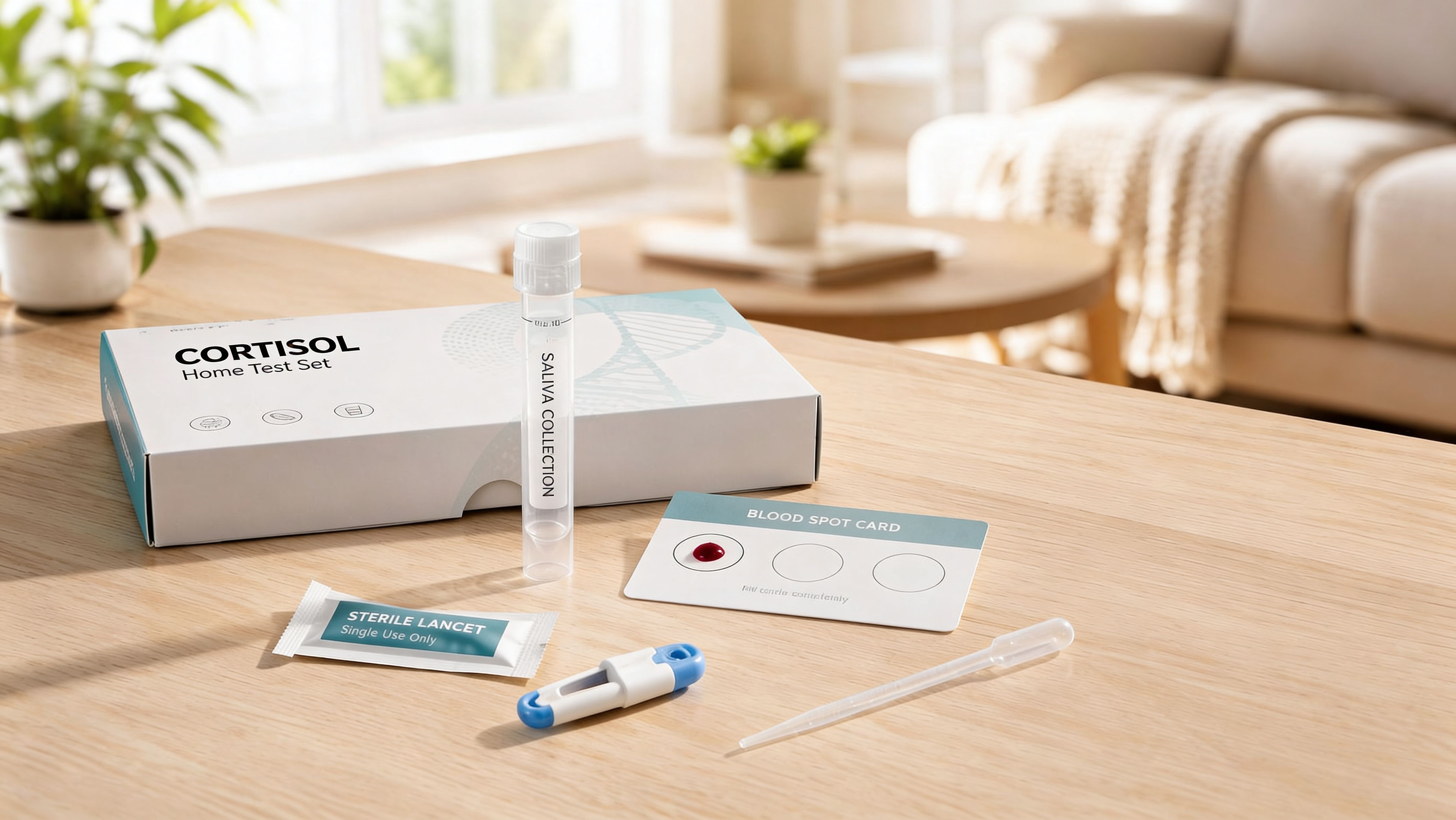
Measuring Cortisol at Home: Methods, Sampling & Values 2026
You function during the day, but only just. You struggle to get going in the morning, your energy dips in the afternoon, and then suddenly you're wide awake again in the evening. Or you feel internally wired, even though all you want is peace and quiet. This is precisely where many people who search for "measuring cortisol at home" find themselves.
This isn't a sign that you're imagining things. It's often simply the moment you realize that well-being doesn't just depend on sleep, nutrition, or motivation, but also on your biological rhythm. A home test can help make patterns visible, rather than continuing to live in trial-and-error mode.
Do you often feel stressed? Why cortisol can be an answer
Cortisol has a bad reputation. Yet, it's not your enemy, but a central regulatory hormone. It helps your body get started in the morning, provides energy, and responds to stress. It only becomes problematic when the rhythm no longer matches your daily life.
Many notice this not through a single symptom, but a combination: You sleep, but don't feel rested. You're more irritable than usual. You feel constantly "on" or exactly the opposite, namely empty and listless. Such conditions are non-specific, but they are real.

Why a single feeling is often not enough
Anyone who wants to understand their stress levels needs more than gut feeling. In Germany, cortisol determination is not part of routine standard diagnostics but is specifically ordered by a doctor. Laboratory analysis has long worked with diurnal dynamics because single values are often not very meaningful. This is precisely the logic that home tests with daily profiles adopt, as described by Femna for the cortisol daily profile.
This is the crucial point. Not just "how high" your cortisol is, but when it is high or low, makes the difference.
When a home test can be useful
A home test does not replace a diagnosis. However, it can help you make patterns tangible if you want to know if your experience matches your daily rhythm.
This is particularly useful if you:
- struggle to get going in the morning, even though you've had enough sleep
- can't switch off in the evening, even though you should be tired
- notice significant performance dips throughout the day
- want more clarity instead of assumptions
A good test doesn't answer the question "Am I stressed?" but rather "How does my body react throughout the day?"
If you want to better understand the basics of the hormone, this article on What is Cortisol provides a good introduction.
Your body in its daily rhythm – What your cortisol level reveals
Cortisol doesn't work uniformly. Your body uses it more like a built-in daily regulator. In the morning, it's meant to activate you, then slowly wind you down later, and create space for recovery in the evening. That's why a daily profile is often much more helpful than any single value.
This image of the natural course can help you orient yourself:

This is what a typical rhythm looks like
In a healthy course, cortisol is higher in the morning and then decreases throughout the day. In the evening, the level should be significantly lower than in the morning. This supports rest, relaxation, and readiness for sleep.
You can remember it simply like this:
| Time of day | What the body needs | What a suitable cortisol curve supports |
|---|---|---|
| Morning | Activation | Wakefulness and initial energy |
| Midday | Stability | Focus and resilience |
| Afternoon | Transition | Decreasing activation |
| Evening | Rest | Relaxation and falling asleep |
What deviations in everyday life can mean
If someone can barely get up in the morning, I'm almost always interested in their start to the day. Not as a diagnosis, but as a pattern question. A too flat morning curve can match a feeling as if the body isn't starting up properly.
Conversely, I often see the constellation: exhausted during the day, suddenly awake in the evening. Then it's worth looking at a missing drop in the evening. Because precisely this pattern can explain why rest sounds reasonable, but the body doesn't comply.
Your perception is often the first clue. The daily profile shows whether the rhythm matches.
Not every test answers the same question
Those who only want to know what the value looks like at that moment often think of a snapshot. Those who want to understand sleep problems, afternoon dips, or the feeling of a shifted daily rhythm rather need the course. Technically, this distinction is important: Blood rather shows a momentary value, saliva rather the diurnal course, and urine rather the total excretion. This is well explained by Apoverum for classifying various cortisol measurements.
If you want to understand what cortisol specifically does in the body under stress, this article on Cortisol in the body under stress is a useful addition.
The methods for home use – Saliva, blood, and what suits you
Most people make the same mistake at the beginning. They look for "the best test." But practically, another question is more important: Which test suits your goal? If you choose the wrong method, you will get a result, but not necessarily a useful answer.
For measuring cortisol at home in Germany, the saliva test is the most established method because it allows for easy collection of multiple samples throughout the day. Providers often work with several measurement points, for example, 8 AM, 12 PM, and 8 PM, to make the physiological rhythm visible. This is described by Ferna rzt for the cortisol self-test.

Cortisol home tests compared
| Method | What is measured? | Ideal for... | Advantages | Disadvantages |
|---|---|---|---|---|
| Saliva test | free cortisol throughout the day | Sleep problems, energy dips, rhythm questions | multiple measurement points, easy, no prick | timing and preparation are crucial |
| Dried blood test | rather a punctual blood measurement | snapshot, supplementary classification | stable sample, good shipping | no real daily profile, small prick necessary |
When saliva is the better choice
If you are mainly interested in your daily pattern, saliva is usually the more sensible method. This applies especially to:
- Sleep problems, if you can't wind down in the evening
- Afternoon dips that recur almost daily
- Restless energy fluctuations, instead of clear resilience
- Suspected shifted rhythm, for example, with changing daily routines
A saliva test is also suitable for everyday use. You take the samples at home at specified times and send them to the laboratory. That's why it's the more practical solution for many.
When blood can be useful
A dried blood spot test is more interesting if you are looking for a one-time assessment. However, it does not answer the same question as a daily profile. This is not a disadvantage of the method, but simply its area of application.
Choosing the right method saves you not only money but, above all, misinterpretations.
If you want to understand the differences between the two types of samples more precisely, this comparison of blood test and saliva test in practice will help you.
Among the available offers, the mybody x blood test or the test portfolio from mybody x blood test is also relevant, as it offers self-tests for home use in various health areas, including hormone-related analyses. However, regardless of the provider, the decisive factor remains: choose the method that matches your question, not just the product.
Your Sampling – Step-by-step to accurate results
A good test can become almost worthless due to poor sampling. This sounds harsher than it is. In practice, a clean procedure, good timing, and a normal everyday life without avoidable interfering factors are sufficient.
For orientation, you can adhere to this procedure:

Before the test day
Read the instructions completely before you start. Not casually, not just with the first sample. Prepare everything and plan the day so that the measurement times can be realistically adhered to.
A simple preliminary check is helpful:
- Check kit. Are all tubes or materials present?
- Set times. Set reminders for each sample.
- Choose a normal day. No extreme day with travel chaos or exceptional program.
- Consider shipping. Check beforehand how you will send the sample promptly.
During collection
For saliva tests, consistency is paramount. Adhere strictly to the specified times. If a test requires multiple samples, its validity depends on these samples truly reflecting the course of the day.
For finger-prick blood tests, additionally ensure clean work, wash hands, prepare materials properly, and apply the sample completely according to instructions.
Practical rule: If you improvise during sampling, you will also improvise during interpretation later. Both are unnecessary.
How to avoid diluted results
Make it easy for yourself and consciously keep the hour before the sample free. No snack, no hectic coffee on the go, no quick teeth cleaning just before. This is particularly relevant for saliva, as small deviations can quickly affect the sample.
This short sequence works well in everyday life:
- Reminder rings
- briefly check if you have eaten, drunk, or smoked recently
- wait if necessary, instead of submitting a questionable sample
- Collect sample cleanly
- Note time and seal securely
After collection
Label each sample correctly immediately. This sounds trivial, but it is one of the most common avoidable errors in home tests generally. Afterwards, pack everything exactly according to the instructions and send it to the laboratory without unnecessary delay.
If you want to measure cortisol at home, then: The quality of the result does not begin in the laboratory, but with you at the kitchen table.
Avoid common mistakes and choose the right provider
Most unusable results don't occur because the test is "bad." They arise because daily life and instructions weren't properly reconciled. With cortisol, this is particularly important because timing and preparation directly affect the validity of the results.
The reliability of a cortisol home test strongly depends on the preparation. Eating, drinking, smoking, or brushing teeth can influence the values. Serious providers therefore recommend at least an hour's distance before sampling. Even small deviations can distort the interpretation, as explained by MeinLabTest on the cortisol test.
These are the most common mistakes I see
Some errors seem small, but make a noticeable difference:
- Too imprecise timing. A daily curve relies on comparable time points.
- Sample taken after eating or drinking. This easily distorts saliva samples, especially.
- Brushing teeth shortly beforehand. Sounds harmless, but is unfavorable for the sample.
- Testing on an exceptional day. A chaotic travel day won't show you your normal rhythm.
- Reading the result in isolation. Looking at values without considering everyday life, sleep, and complaints quickly leads in the wrong direction.
How to recognize a reputable provider
Not every home test is automatically equally useful. Pay attention to a sober, factually accurate presentation and not to wellness language with grand promises.
A good checklist is:
| Criterion | How you recognize it |
|---|---|
| Clear instructions | Measurement times, preparation, and shipping are clearly explained |
| Laboratory reference | The sample goes to a specialized laboratory, not just an app |
| Clean classification | The result is not presented as a diagnosis |
| Data protection | Information on data processing is transparent |
| Support | Help is available for questions about application or findings |
If a provider only promises quick answers but barely explains how to measure correctly, caution is advisable.
Especially in healthcare, less marketing and more precision are worthwhile. You are on the right track. A carefully selected test simply makes it more precise.
From result to action – Your path to more balance
Once your result is available, the truly useful part begins. Not just looking at the values, but interpreting them. A cortisol profile is not a label for you, but a data point about your current rhythm.
The result only becomes interesting when combined with your daily life. Does a lower starting value match your morning tiredness? Does a lack of decline in the evening match your difficulty falling asleep? Such connections are often much more helpful than trying to evaluate a single value alone.
What you can do with the result
Depending on the pattern, the next steps are different. Sometimes it's about sleep hygiene, sometimes about daily structure, sometimes about recovery, sometimes about having symptoms checked by a doctor. A home test does not replace this clarification but can make the conversation much more concrete.
This approach is often useful:
- Don't read the finding in isolation, but compare it with sleep, energy, and stress
- note conspicuous patterns, instead of just looking at "high" or "low"
- discuss with a doctor for significant complaints, especially if the result matches your symptoms
- make targeted changes, instead of trying to change everything at once
If you want to adjust your daily routine based on the results, you'll find practical approaches in this article on naturally lowering cortisol.
A good test won't eliminate all uncertainty. But it will save you a lot of guesswork. And that's often the biggest benefit: You're no longer acting blindly, but based on a comprehensible pattern.
If you no longer want to guess but instead want to measure specifically, you'll find at-home self-tests at mybody x Blood Test that allow you to collect health data in a structured way. For the topic of cortisol, it's particularly important that the method, instructions, and question align. Then curiosity turns into real guidance.

Share:
What Happens in Vitamin B Deficiency: Symptoms and Help
At-home allergy blood test: Your path to certainty