

Vitamin Selenium: Effects, Requirements, and Dosage
Selenium is often searched for as “vitamin selenium,” but it is not a vitamin; it is an essential trace element. The difference may sound like nitpicking, but it is important: Your body cannot produce selenium itself and must obtain it from food every day. Selenium performs functions that hardly any other mineral takes on so directly: cell protection, thyroid function, and immune defense. At the same time, the safety margin between adequate intake and overdose is narrower than for most other nutrients. Find out here what you really need to know.
Table of Contents
- Key Findings
- What Is Vitamin Selenium? Biological Function in the Body
- Selenium deficiency: requirements, symptoms, and risk groups
- Selenium foods: How to meet your requirements
- Selenium as a dietary supplement: Dosage and risks
- My assessment of selenium in everyday life
- Determine Your Selenium Status with mybody x
- FAQ
Key Findings
| Point | Details |
|---|---|
| Selenium Is Not a Vitamin | Selenium is an essential trace element that must be obtained from food every day. |
| Recommended Daily Intake | Adults need approximately 55 µg of selenium daily; the safe upper limit is 400 µg. |
| Know the at-risk groups | Vegans, dialysis patients, and people with malabsorption are more frequently affected by selenium deficiency. |
| Brazil Nuts in Moderation | A maximum of 2 to 3 Brazil nuts per day is enough to meet your needs without taking risks. |
| Use supplements selectively | Selenium supplements are useful in cases of confirmed deficiency, not as a blanket high-dose treatment. |
What Is Vitamin Selenium? Biological Function in the Body
Selenium acts in the body almost exclusively through so-called selenoproteins. These are proteins into which the amino acid selenocysteine is incorporated. This incorporation follows a special genetic mechanism that differs from that of all other amino acids. That is precisely why not every form of selenium is equally effective: How well selenium is absorbed and utilized by the body depends largely on its chemical form and the pathway by which it is incorporated into these enzymes. The biological effect of selenium therefore cannot be explained by amounts alone.
What exactly do these selenoproteins do?
- Antioxidant protection: Enzymes such as glutathione peroxidase neutralize free radicals and protect cells from oxidative stress.
- Thyroid function: Selenoproteins are directly involved in the conversion of thyroid hormones. Without enough selenium, this process does not run smoothly, affecting metabolism and energy.
- Immune defense: Selenium supports the activity of immune cells and contributes to the regulation of inflammatory responses.
- Reproduction and cell protection: Selenium protects sperm from oxidative damage and is involved in DNA repair.
The term “soul vitamin” sometimes appears in popular usage and refers to selenium’s mood-enhancing or generally strengthening effects. This has not been directly scientifically proven, but the connection with the thyroid and energy metabolism makes the term at least understandable.
Pro tip: If you take selenium as a dietary supplement, look for organic forms such as selenomethionine. These are better absorbed by the body than inorganic sodium selenite.
Selenium deficiency: requirements, symptoms, and risk groups
How much selenium do you need daily?
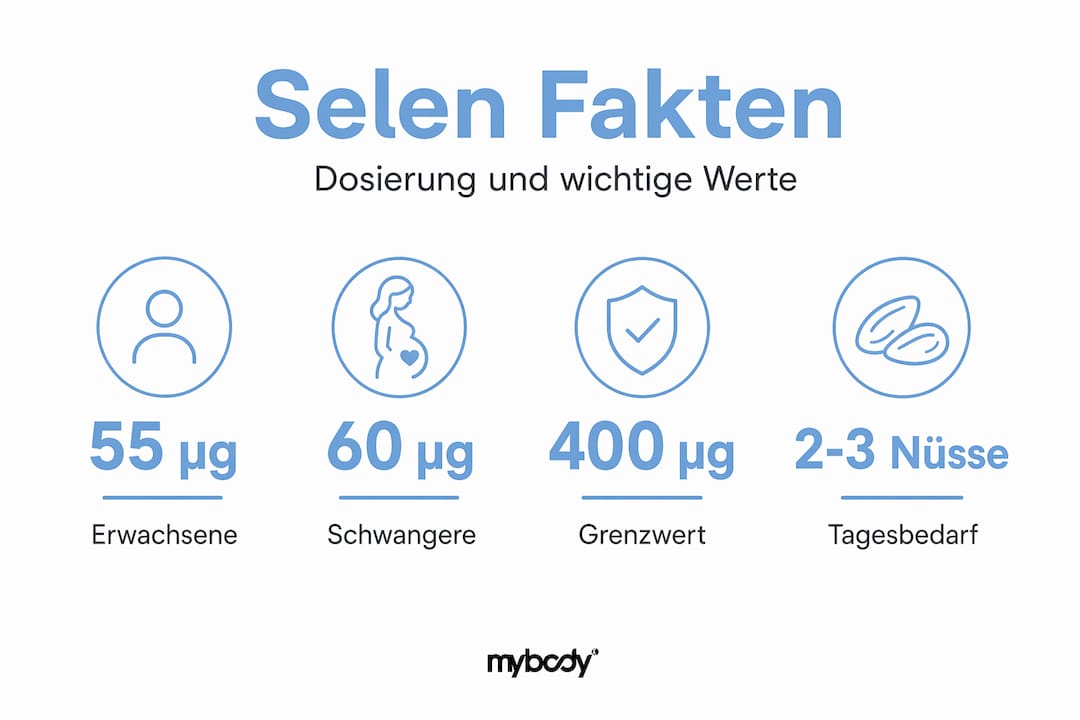
The recommended daily intake for adults is approximately 55 micrograms. A slightly increased intake of 60 to 70 µg is recommended for pregnant and breastfeeding women. Depending on their age, children need between 15 and 45 µg per day. The so-called Tolerable Upper Intake Level, meaning the safe upper limit, is 400 µg per day for adults.
| Group | Recommended intake (µg/day) |
|---|---|
| Adults (aged 19 and over) | 55 µg |
| Pregnant women | 60 µg |
| Breastfeeding women | 70 µg |
| Children (7 to 10 years) | 30 µg |
| Adolescents (14 to 18 years) | 45 µg |
Who is particularly at risk?
In Germany and Europe, true selenium deficiency is comparatively rare. The soils in Central Europe contain less selenium than those in North America, for example, but food supplies largely compensate for this through imports. Nevertheless, there are risk groups for selenium deficiency who should take a closer look:
- Vegans and vegetarians: Plant-based foods contain less selenium than animal products, especially when the soil they are grown in is low in selenium.
- Dialysis patients: Selenium is lost during dialysis, increasing the requirement.
- People with malabsorption: Conditions such as Crohn’s disease or celiac disease impair the absorption of trace elements.
- People with a very limited diet: Those who eat little fish, meat, or nuts often consume too little selenium.
Recognizing selenium deficiency symptoms
The signs of a deficiency are nonspecific and are therefore often not immediately associated with selenium. Typical selenium deficiency symptoms include:
- Hair loss and brittle nails
- Muscle weakness and exhaustion
- Frequent infections due to a weakened immune system
- Underactive thyroid or worsened thyroid function test results
- Concentration problems
In areas with extreme deficiency, historically especially in parts of China, so-called Keshan disease occurred. This is a severe heart muscle disease directly associated with severe selenium deficiency. This is not a relevant scenario in Europe today, but it shows how important an adequate supply is in the long term.
Pro tip: A blood test gives you clarity about your actual selenium status. It should measure not only the selenium concentration in your blood, but ideally also the activity of glutathione peroxidase, as this functionally shows how well your body uses selenium.
Selenium foods: How to meet your requirements
The best sources of selenium at a glance
The selenium content of foods varies widely because it depends directly on the selenium content of the soil in which plants are grown or where animals graze. This makes general statements difficult, but the following foods are reliably among the best sources:
- Brazil nuts: At around 103 µg per 100 grams, they are the richest natural source of selenium of all.
- Tuna: Approximately 82 µg per 100 grams, and also rich in omega-3 fatty acids.
- Veal liver: Approx. 22 µg per 100 grams, and also a good source of B vitamins and iron.
- Eggs: Around 10 to 15 µg per egg, depending on the farming method and feed.
- Mushrooms: Mushrooms, especially button mushrooms and porcini, contain noteworthy amounts.
- Legumes and cabbage: Lentils, beans, and broccoli provide relevant amounts for plant-based diets.
| Food | Selenium content (µg/100 g) |
|---|---|
| Brazil nuts | approx. 103 µg |
| Tuna | approx. 82 µg |
| Veal liver | approx. 22 µg |
| Mushrooms | approx. 10 µg |
| Lentils (cooked) | approx. 6 µg |
| Broccoli | approx. 3 µg |
The special case of Brazil nuts
Brazil nuts are temptingly simple: Two to three nuts a day easily cover an adult’s daily requirement. But caution is advised. Brazil nuts absorb not only selenium from the soil but also naturally occurring radium, which accumulates in the shell and the nut meat. A maximum of 2 to 3 Brazil nuts per day is considered harmless. Regular consumption is not recommended for pregnant women, children, and adolescents.

People who follow a vegetarian or vegan diet should specifically choose selenium-rich foods, preferably mushrooms, legumes, and grain products from selenium-rich growing regions. Imported grain from North America often contains more selenium than European products.
Selenium as a dietary supplement: Dosage and risks
When are selenium supplements useful?
Taking selenium as a dietary supplement makes sense in cases of a confirmed deficiency or increased need. Taking high doses as a general precaution, however, is not a good idea. Hopes that selenium supplements could protect against cancer or heart disease have not been confirmed in robust studies. The clear benefit lies in preventing a genuine deficiency, not in high-dose supplementation when selenium levels are already sufficient.
Practical steps when taking supplements:
- Have your selenium status determined: Take a blood test before using a supplement to determine your actual needs.
- Keep track of the total amount: Many multivitamins, thyroid medications, and sports nutrition products already contain selenium. Combining several products can quickly exceed the safe limit.
- Adjust the dosage to your needs: Standard supplements provide 50 to 200 µg per daily dose. This is sufficient for most people.
- Do not give children adult doses: Children have significantly lower upper limits; children’s supplements should only be used after consulting a doctor.
- Medical supervision for at-risk groups: Dialysis patients or people with malabsorption need an individual dosage guided by laboratory values and medical advice.
The risk of selenosis
An overdose of selenium leads to what is known as selenosis. The symptoms of an overdose are characteristic:
Brittle hair and nails, nausea, gastrointestinal problems, a garlic-like body odor, and, in severe cases, neurological disorders. The tolerable upper intake level is 400 µg per day for adults. At significantly higher doses, acute toxicity can occur.
The narrow safety margin of selenium is the key difference compared with many other trace elements. While a moderate excess of magnesium or zinc is usually well tolerated, the body reacts more sensitively to selenium.
Interactions with other nutrients
Not every combination is ideal. Vitamin C can inhibit selenium absorption, so you should not take selenium supplements at the same time as high-dose vitamin C products. Vitamin A, on the other hand, promotes selenium’s bioavailability. Anyone who takes selenium supplements for a specific purpose should consider these interactions when planning their intake.
Pro tip: It’s best to take selenium supplements in the morning with a meal, but not together with high-dose vitamin C. Leaving an interval of two to three hours is enough to optimize absorption.
My assessment of selenium in everyday life
In my work with health data, I keep seeing the same pattern: people who regard selenium as a cure-all and take it in high doses without knowing their actual levels. That’s risky. Selenium is one of the few trace elements where the line between enough and too much is genuinely narrow.
What I’ve learned: Most people in Germany get enough selenium if they eat a varied diet. Those who regularly eat fish, meat, and eggs and occasionally have a Brazil nut generally don’t need a supplement. The situation is different for vegans, people with intestinal diseases, or those who have eaten an unbalanced diet for a long time.
What fascinates me about selenium is its connection to the thyroid. I often see people with thyroid problems and, at the same time, low selenium levels report that their levels improve after targeted supplementation. This is consistent with what the science shows: Selenium is essential for thyroid hormone metabolism.
My practical advice: Have your selenium status measured once before you start taking supplements. Then you’ll know whether you really need them and can take targeted action instead of feeling your way in the dark.
— MYBODY X
Determine Your Selenium Status with mybody x
Anyone who wants to know whether their selenium intake is truly sufficient does not need to rely on guesswork. mybody x offers certified laboratory analyses that precisely measure your nutrient status and translate it into a personalized report. You learn not only your selenium level, but also what it specifically means for your health and which next steps make sense.

What makes it special: All tests can be conveniently performed at home. No doctor’s appointment, no waiting. The results come with specific dietary and supplementation recommendations tailored to your individual profile. More than 11,300 customers already trust mybody x’s ISO-certified analyses. Take a look at the nutrient analyses on mybody-x.com and find out where you really stand.
FAQ
What is selenium, and why do I need it?
Selenium is an essential trace element that the body cannot produce itself. It is obtained through food or supplements and is indispensable for cell protection, thyroid function, and immune defense.
How much selenium should I consume daily?
Adults need around 55 µg of selenium daily. The safe upper limit is 400 µg per day. Exceeding this amount can lead to selenosis, with symptoms such as brittle hair and gastrointestinal problems.
Which foods contain particularly high amounts of selenium?
Brazil nuts, tuna, calf’s liver, and eggs are among the richest sources of selenium. Due to their natural radioactivity, Brazil nuts should be limited to a maximum of 2 to 3 per day.
Who has an increased risk of selenium deficiency?
Vegans, dialysis patients, and people with intestinal diseases such as Crohn’s disease or celiac disease are more frequently affected. A very one-sided diet without fish or meat can also lead to a deficiency.
Can I simply take selenium as a dietary supplement?
Selenium supplements are useful when a deficiency has been confirmed, but not as a blanket high-dose treatment. Many multivitamin products already contain selenium, so you should keep an eye on your total intake to avoid exceeding the safe upper limit.


Share now:
Selenium: Effects, Dosage, and the Best Sources
Vitamin K3: What you really need to know