

Selenium: Benefits, dosage, and the best sources
Selenium is one of the trace elements that many people know little about, even though the body needs it every day. There are surprisingly many misconceptions surrounding this mineral: Some people carelessly take high-dose supplements, while others wonder whether their diet provides enough. As is so often the case, the truth lies somewhere in between. This article explains how selenium works in the body, how much you really need, which foods provide a reliable supply, and when supplementation is—and is not—useful.
Table of contents
- Key findings
- Selenium in the body: How the trace element really works
- How much selenium per day? Reference values and limits
- Selenium-rich foods: Animal-based, plant-based, and regional
- Using selenium wisely: Diet and supplementation
- My assessment of selenium in everyday life
- Optimize your selenium intake with mybody x
- FAQ
Key findings
| Point | Details |
|---|---|
| Selenium is not a cure-all | It acts as a building block of selenoproteins, not as a general health booster. |
| Dosage determines benefit or harm | Too little is harmful, but so is too much: The gap between the required amount and an overdose is narrow. |
| Animal sources provide the most reliable supply | Fish, meat, and eggs provide highly bioavailable selenium, regardless of the soil. |
| Brazil nuts are not an everyday snack | Just two or three nuts can exceed the daily requirement. |
| Supplements only when genuinely needed | In most cases, people who eat a balanced diet do not need an additional supplement. |
Selenium in the body: How the trace element really works
Selenium is neither a vitamin nor a mineral in the classical sense. It is a trace element that the body cannot produce itself and must therefore be consumed regularly through food. What makes it special is that selenium is incorporated directly into proteins as an amino acid called selenocysteine. This incorporation occurs through a unique, genetically encoded mechanism not found with any other amino acid.
The result is what are known as selenoproteins. The body produces at least 25 of these proteins, which perform antioxidant and thyroid-regulating functions. Among the best known are glutathione peroxidases, which protect cells from oxidative stress, as well as thioredoxin reductases and iodothyronine deiodinases. The latter are essential for the conversion of thyroid hormones.
Anyone who wants to learn more about the connection between selenium and the thyroid will find an in-depth overview there. This connection is often underestimated: A poorly nourished thyroid can function like an engine without oil, even with normal iodine levels.
The benefits of selenium arise primarily from its availability for incorporation into functional selenoproteins, not from a simple antioxidant effect. This is an important distinction. Selenium is not a miracle substance that you can simply take in high doses to achieve greater effects. Above a certain level of selenium status, all selenoproteins are saturated. More does not help then; it can cause harm.
Pro tip: Serum selenium levels alone do not always show whether you are optimally supplied. Functional markers such as selenoprotein P are considered more informative in research because they directly reflect tissue selenium status.
The link between selenium and the immune system is also well established. Selenoproteins regulate inflammatory responses and support the activity of immune cells. This makes the trace element a relevant factor in defending against infections, without implying that high doses are automatically safe.
How much selenium per day? Reference values and limits
This is where things get concrete, and where most people make mistakes. The question “How much selenium per day?” has a clear answer, but it has two sides: a target value and an upper limit.
The D-A-CH reference values recommend the following daily selenium amounts for healthy adults:
- Men: 70 micrograms per day
- Women: 60 micrograms per day
- Breastfeeding mothers: 75 micrograms per day
These reference values are considered target values for healthy people and reflect the average requirement. They are not a minimum that you must meet exactly every day, but rather a useful guideline.
The other side is the safety limit. EFSA sets the maximum total intake for adults at 255 micrograms per day, including all sources from food and supplements. This limit also applies during pregnancy and breastfeeding.
What happens if you consistently consume too much? The answer is unpleasant. A chronically high selenium intake can cause symptoms such as hair loss, brittle nails, garlic-like breath odor, and neurological problems. This condition is called selenosis and is almost always caused by uncontrolled supplementation, not diet alone.
Important: The gap between the recommended daily requirement (60 to 70 µg) and the safe upper limit (255 µg) may sound large. However, anyone who takes a 200 µg supplement and also eats selenium-rich foods can exceed this limit sooner than expected.
Selenium deficiency is comparatively rare in Europe. It occurs more frequently with a vegan diet, certain illnesses, or malabsorption. Typical symptoms of selenium deficiency include fatigue, muscle weakness, a weakened immune system, and, in the worst case, heart problems. Anyone who notices such symptoms should see a doctor first before starting supplements independently.
Pro tip: Before buying a selenium supplement, add up the amount from your diet and the planned supplement. High-dose supplements containing 200 µg should only be taken after consulting a doctor or nutrition professional.
Selenium-rich foods: Animal-based, plant-based, and regional
The presence of selenium in food is anything but uniform. The selenium content of a food depends greatly on how much selenium was present in the soil where a plant grew or where an animal lived. Central Europe is one of the regions with rather selenium-poor soils, making plant-based sources less reliable than animal-based ones.

Comparison: Selenium content in common foods
| Food | Selenium content (approx.) | Special feature |
|---|---|---|
| Brazil nuts (2 nuts) | 100 to 200 µg | Highly variable, overdose possible |
| Haddock (100 g) | 30 to 50 µg | Reliable, widely available source |
| Tuna (100 g) | 80 to 100 µg | High content, but heavy metal exposure should be taken into account |
| Chicken egg (1 egg) | 10 to 15 µg | Good everyday source, easy to combine |
| Beef (100 g) | 10 to 30 µg | Varies depending on feed |
| Lentils (100 g, cooked) | 2 to 5 µg | Highly dependent on soil |
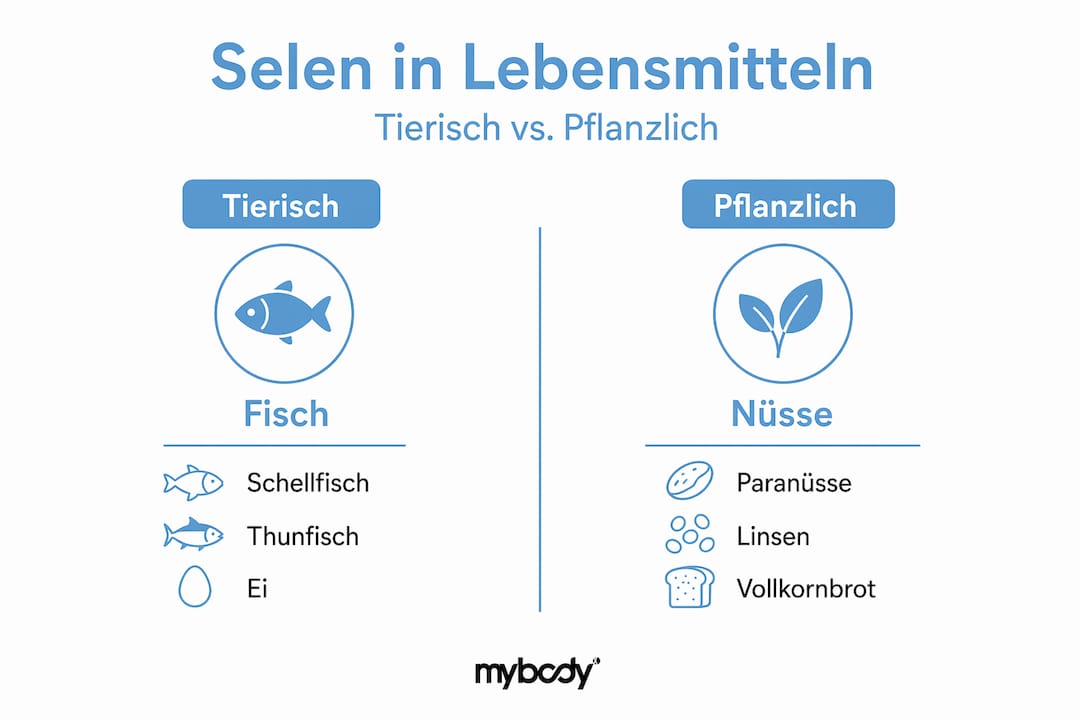
Selenium in haddock is one of the most reliable sources available. Marine fish absorb selenium directly from seawater, independently of the soil. This makes them a stable option, especially for people who eat little red meat. Those who regularly eat fish are generally well supplied.
Brazil nuts are a special case. They are considered one of the world's richest natural sources of selenium, but the levels vary enormously. Just two or three nuts can exceed the daily requirement. They are therefore unsuitable as a daily snack. Two to three nuts per week is a more sensible amount.
Anyone who wants to learn more about selenium-rich foods will find a detailed overview of the best sources for 2025 there.
People who follow a plant-based diet should consider where their food comes from. Grain from North America or Canada often contains significantly more selenium than European grain because the soil there is richer in selenium. Mineral content in plant-based foods also varies considerably depending on origin and growing conditions.
- Animal-based sources: reliable, highly bioavailable, and less dependent on soil
- Fish and seafood: particularly recommended; selenium in haddock and tuna is highly bioavailable
- Brazil nuts: high content, but be careful with frequency and quantity
- Plant-based sources: highly variable and worth monitoring closely on a vegan diet
Using selenium wisely: Diet and supplementation
When does a selenium supplement make sense? And what should you look out for when buying one? Many people who want to improve their selenium intake ask themselves these questions.
First, the honest answer: If you eat a varied diet, regularly eat fish, meat, or eggs, and do not have an underlying condition, you usually do not need a supplement. Your diet is sufficient. The following groups are different:
- People following a vegan or heavily plant-based diet
- People with gastrointestinal disorders that impair absorption.
- People after certain surgeries or with malabsorption problems.
- People whose deficiency has been confirmed through laboratory testing.
If you want to buy selenium supplements, there are two main forms: selenomethionine (organic) and sodium selenite (inorganic). The bioavailability of selenomethionine is often better than that of inorganic sodium selenite; however, dosage and individual nutritional status are more important than the choice of form alone.
What you should keep in mind when taking it:
- Never combine multiple supplements without checking the total amount.
- Multivitamin supplements often already contain selenium. Add this amount to the supplement.
- Long-term high selenium intake can cause neurological symptoms and organ changes.
- Vitamin C can slightly affect the absorption of inorganic selenium, while vitamin E has a synergistic effect on cellular protection.
A nutrient deficiency is best identified by paying attention to warning signs. Anyone who wants to learn more about identifying nutrient deficiencies will find practical information there about various trace elements.
Pro tip: Think of your diet as the foundation and supplements as a way to fill specific gaps. Anyone who takes supplements without laboratory results is operating in the dark and risks doing more harm than good.
My assessment of selenium in everyday life
At mybody x, I regularly see how people deal with selenium. And honestly, I am repeatedly surprised by how often the pendulum swings in the wrong direction. Not toward deficiency, but toward overdosing.
Many people turn to high-dose supplements containing 200 µg because they have read somewhere that selenium is good for the immune system. That is generally true, but more is definitely not better here. The health benefits of selenium do not come from maximum intake, but from providing sufficient selenium for selenoproteins. Anyone who exceeds this limit risks selenosis, which is no minor matter.
What I have learned: Selenium deficiency is actually rare in Europe. People who regularly eat fish or meat are usually well supplied. The actual risk groups are people following a vegan diet or with malabsorption, not healthy average people who want to optimize their bodies.
My advice: Have your selenium status measured before taking supplements. And if you do supplement, use a dose that meets your actual needs, not one that sounds as though it would help more.
— MYBODY X
Optimize your selenium intake with mybody x
You now know how selenium works, how much you need, and where to find it. The next step is to find out what your personal selenium status actually looks like.

At mybody x, you will find ISO-certified nutrient analyses that show whether you are truly well supplied—not only with selenium, but with all relevant micronutrients. The analysis is conveniently carried out at home, and the evaluation provides specific recommendations for action instead of vague assumptions. More than 11,300 customers have already used it to better understand and specifically improve their health. Take a look at the offer on mybody-x.com and find out what your body really needs.
FAQ
What are typical symptoms of selenium deficiency?
Typical symptoms of selenium deficiency include persistent fatigue, muscle weakness, a weakened immune system, and thyroid problems. In severe cases, a deficiency can lead to heart problems, although this is rare in Europe.
How much selenium is recommended daily?
The D-A-CH reference values recommend 70 µg daily for men and 60 µg for women. The EFSA safe upper limit is 255 µg per day from all sources combined.
Which foods are particularly rich in selenium?
Selenium-rich foods include seafood such as haddock and tuna, meat, eggs, and Brazil nuts. Plant-based sources such as legumes and grains vary considerably depending on their region of origin.
Is selenium good for the immune system?
Yes, selenium and the immune system are directly connected. Selenoproteins regulate inflammatory responses and support immune cells. Adequate intake is important, but an overdose offers no additional benefit.
When should I buy selenium supplements?
Selenium supplements are useful in cases of confirmed deficiency, a vegan diet, or malabsorption. People who eat a varied diet containing animal products generally do not need a supplement.


Share now:
Pantothenic acid benefits: optimize energy and metabolism
Selenium: Effects, Requirements, and Dosage