

Vitamin K3: What you really need to know
Vitamin K3 repeatedly appears in search queries when people want to improve their vitamin K intake. The problem is that many people do not know that this substance is not a natural form of the vitamin. Menadione, the chemical term for vitamin K3, is a fully synthetic compound. It is not found in any food, serves no vitamin function in the human body, and is banned in the EU as a dietary supplement for humans due to its toxicity. This article provides clarification without causing alarm.
Table of contents
- Key findings
- Vitamin K3 compared with K1 and K2
- Health risks of vitamin K3
- Legal status of vitamin K3 in the EU
- Safe alternatives for meeting vitamin K requirements
- My assessment of vitamin K3
- Your next step toward optimal nutrient supply
- FAQ
Key findings
| Point | Details |
|---|---|
| Vitamin K3 is synthetic | Menadione is not found in any natural food source and is not a genuine vitamin for humans. |
| K3 is banned in the EU | As a dietary supplement for humans, vitamin K3 is not approved in the EU and is considered toxic. |
| Natural alternatives exist | Vitamin K1 from leafy greens and K2 from fermented foods reliably meet the need. |
| K2 and vitamin D work together | The combination of vitamin K2 and vitamin D supports bones and blood vessels particularly effectively. |
| Detect deficiencies early | A nutrient check helps identify a vitamin K deficiency before symptoms develop. |
Vitamin K3 compared with K1 and K2
The vitamin K family comprises three known forms that differ fundamentally. Those who confuse them can quickly make the wrong decisions when buying supplements.
Vitamin K1 (phylloquinone) is the form found in plants. Spinach, kale, broccoli, and herbs such as parsley provide particularly high amounts. In the body, K1 primarily regulates blood clotting. It is fat-soluble and is best absorbed with a meal containing fat.
Vitamin K2 (menaquinone) is produced through fermentation. Bacteria produce it in fermented foods such as natto, sauerkraut, and certain cheeses. K2 activates proteins for bones and blood vessels, making it particularly relevant for long-term health. The MK-7 subtype is considered particularly bioavailable.
Vitamin K3 (menadione) is a different story. It is a purely synthetic substance that does not occur in foods and does not perform a genuine vitamin function in the body.
| Characteristic | Vitamin K1 | Vitamin K2 | Vitamin K3 |
|---|---|---|---|
| Origin | Plants | Fermentation, bacteria | Synthetic |
| Solubility | Fat-soluble | Fat-soluble | Water-soluble (historically) |
| Main function | Blood clotting | Bone and vascular health | No natural function |
| Suitable for humans? | Yes | Yes | No |
| EU approval as a supplement | Yes | Yes | No |
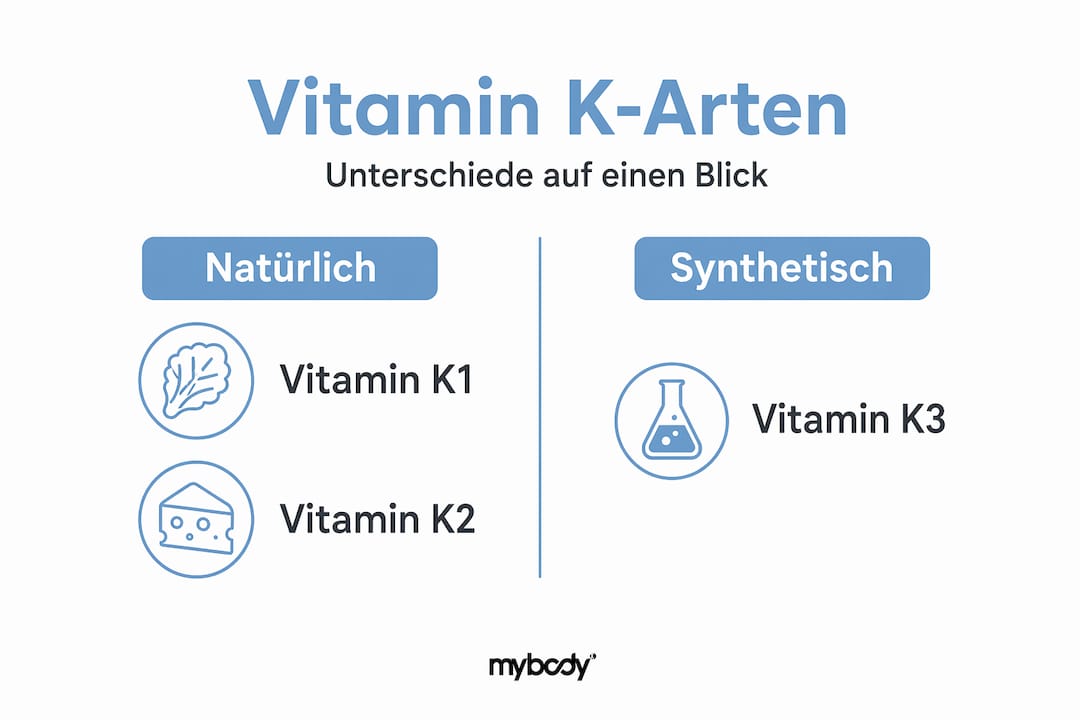
It is important to understand that the numbering K1, K2, K3 suggests a series of related substances. In reality, K3 is biochemically hardly comparable to K1 and K2. It is not a relative, but rather a misguided development from the early history of vitamin research.
Pro tip: When buying supplements, always check the exact designation. “Vitamin K” on a label may mean K1, K2, or a combination of the two. K3 must not be contained in human dietary supplements in the EU.
Health risks of vitamin K3
Researchers once believed that the water-soluble form of a K vitamin might offer advantages because it is absorbed more easily than fat-soluble forms. This assumption turned out to be dangerously wrong.
Menadione disrupts glutathione metabolism, damages cell walls, and causes hepatotoxic effects. Specifically, this means that the substance interferes with a central protective mechanism of cells. Glutathione is one of the body's most important antioxidants. When its function is disrupted, cells are left defenseless against oxidative stress.
The liver is particularly affected. Vitamin K3 was completely withdrawn from human medicine because of its severe hepatotoxicity. This is not a minor reservation, but an active ban based on clinical observations.
The risks at a glance:
- Hepatotoxicity: direct damage to liver cells at higher doses
- Oxidative stress caused by inhibition of glutathione synthesis
- Hemolysis: destruction of red blood cells, documented particularly in newborns
- Cell-wall damage in various tissues
- No proven therapeutic benefit in humans that would justify these risks
“Vitamin K3 is not a therapeutic option for humans. Consumer advocates and nutrition experts emphasize that K3 is primarily used in the animal-feed industry and should remain there.” Source: Verbraucherzentrale
By comparison, vitamins K1 and K2 are considered safe in normal amounts, including with long-term use. K1 has no known dietary toxicity threshold. K2 is well tolerated even at higher supplemental doses. This safety record does not exist for K3.
What many people don't know: Clinical reports of harm caused by K3 use in newborns already existed in the 1980s. This led to the gradual withdrawal of the substance from pediatrics and later from human medicine as a whole. Today, menadione is approved exclusively for animal nutrition, where it is used as a precursor for endogenous K2 synthesis in some animal species.
Pro tip: If you buy a supplement that contains “vitamin K” without specifying the exact form, ask the manufacturer for the specifications. Reputable products always state whether they contain K1, MK-4, or MK-7.
Legal status of vitamin K3 in the EU
EU Directive 2002/46/EC regulates which vitamins and minerals are approved for use in dietary supplements for humans. Vitamin K3 (menadione) is not on this list. EFSA permits health claims only for K1 and K2, not for synthetic K3.
This is not a bureaucratic coincidence. EFSA (the European Food Safety Authority) evaluates substances based on safety and demonstrated benefits. K3 does not pass this assessment because its potential for harm outweighs its possible benefits, and no documented benefit for humans has been established.
| Substance | Status in EU supplements | EFSA approval | Use |
|---|---|---|---|
| Vitamin K1 | Approved | Yes | Human and animal nutrition |
| Vitamin K2 (MK-4, MK-7) | Approved | Yes | Human and animal nutrition |
| Vitamin K3 (menadione) | Not approved | No | Animal nutrition only |
What this means for you as a consumer: Any product sold as a dietary supplement in the EU that contains vitamin K3 is either incorrectly labeled or violates applicable law. Anyone who orders such products online from non-EU countries bears the full health risk themselves.
Nothing has changed in this legal situation in 2026. There is no discussion of loosening the regulations because no new safety data are available that would justify a reassessment. Anyone hoping that K3 supplements might eventually be legalized is waiting for something that cannot be justified scientifically.
Pro tip: When purchasing any supplement, check the ingredients list for “Menadione” or “Menadionum.” These names are chemical synonyms for vitamin K3 and should not appear in human supplements.
Safe alternatives for meeting vitamin K requirements
If K3 is not an option, the legitimate question is: How can I safely meet my vitamin K requirements? The answer is encouraging: A balanced diet can easily provide sufficient amounts.
Natural sources of vitamin K1
Vitamin K1 is found primarily in green foods:
- Kale: approximately 817 µg per 100 g
- Spinach: approximately 483 µg per 100 g
- Broccoli: approximately 102 µg per 100 g
- Parsley and chives: particularly rich in K1
- Lamb's lettuce, Brussels sprouts, peas
According to the German Nutrition Society, the recommended daily intake for adults is 60 to 80 µg per day. Anyone who regularly eats green vegetables almost automatically meets this requirement.
Natural sources of vitamin K2
Vitamin K2 is found in fermented foods and certain animal products:
- Natto (Japanese soy product): by far the richest source
- Hard cheeses such as Gouda or Emmental
- Butter and lard from pasture-raised animals
- Chicken liver
- Sauerkraut in small amounts
The interesting detail about K2: Not everyone eats natto every day. Those who do not reliably get K2 through their diet may benefit from a high-quality supplement. The MK-7 form is considered particularly long-lasting in the bloodstream and is therefore preferred.
The interplay between K2 and vitamin D
K2 and vitamin D are a particularly effective duo. Vitamin D promotes the absorption of calcium from the intestines. K2 then ensures that this calcium is actually incorporated into the bones instead of accumulating in the walls of blood vessels. Anyone who would like to know how vitamin D is obtained through diet can find a detailed guide on this at mybody x.
Anyone who chronically gets little sun and also eats few fermented foods should have their K2 and D3 status measured specifically rather than guessing. Blind supplementation is rarely the best strategy because actual requirements vary greatly from person to person.
Pro tip: Always combine K2 supplements with vitamin D3 and a meal containing fat. Both are fat-soluble and are absorbed significantly better this way.
Anyone who regularly takes blood thinners such as warfarin should consult a doctor about their vitamin K intake. Vitamin K directly affects the coagulation cascade and may influence the effects of such medications. This applies to K1 and K2, not just K3.
The most common nutrient deficiencies in Germany show that a genuine vitamin K deficiency is rare in the general population, but certain at-risk groups, including older people, individuals with intestinal diseases, and people on very low-fat diets, may be affected. Checking early whether a deficiency exists is the wiser decision than waiting for symptoms to appear.
My assessment of vitamin K3
I regularly encounter the question of whether vitamin K3 might have some benefits after all that are being omitted from public discussion. My answer is clear: No.
What concerns me about this topic is not the substance itself, but the pattern behind it. Time and again, health-conscious people look for shortcuts and synthetic options, even though natural alternatives are right in front of them. Green vegetables, fermented cheese, a good MK-7-based K2 supplement. It is not a complicated program.
I have seen people invest a great deal of time and money in questionable supplements that they order online from other countries. The risk they take is completely disproportionate to the supposed benefit. Menadione is clearly categorized scientifically and by regulators. There is no hidden truth that experts are withholding.
My honest advice: Have your vitamin K levels measured before supplementing anything. If you do not know your baseline, you are optimizing blindly. Once you know where you stand, you can take targeted and safe action. Start with natural sources, use targeted supplements when a deficiency has been confirmed, and avoid synthetic substances for which neither approval nor safety evidence exists.
— MYBODY X
Your next step toward optimal nutrient supply
Do you know whether your body is adequately supplied with vitamin K, D, and other important nutrients? Well-intentioned dietary choices are often not enough because individual factors such as genetics, gut health, and lifestyle strongly influence absorption.

At mybody x, you will find scientifically validated tests that show you exactly where your nutrient status stands. Instead of guessing, you get concrete figures and personalized recommendations tailored to your body. Take a look at the nutrient analyses at mybody x and find out what your body really needs. More than 11,300 satisfied customers already trust this method because health should not be a matter of guesswork.
FAQ
What is vitamin K3 and why is it dangerous?
Vitamin K3, chemically known as menadione, is a synthetic substance that does not occur naturally in foods. It disrupts glutathione metabolism, damages liver cells, and was therefore completely withdrawn from human medicine.
Is vitamin K3 legal as a supplement in Germany or the EU?
No. K3 is not approved in the EU as a dietary supplement for humans. The EFSA approves only K1 and K2 for this purpose.
Which foods naturally contain vitamin K?
Vitamin K1 is found in kale, spinach, and broccoli. Vitamin K2 is found in fermented foods such as natto and sauerkraut, as well as in hard cheese and butter from grass-fed cows.
When does a vitamin K supplement make sense?
A supplement makes sense if a genuine deficiency has been confirmed or if your diet is consistently low in green vegetables and fermented foods. The MK-7 form is considered particularly bioavailable for K2 supplements.
How do vitamins K2 and D work together?
Vitamin D promotes calcium absorption from the intestines, while K2 regulates its incorporation into bones and prevents deposits in blood vessels. Taking both together is therefore particularly effective for bone and vascular health.



Share now:
Selenium: Effects, Requirements, and Dosage
Biotin: Effects, Requirements, and Myths Examined