
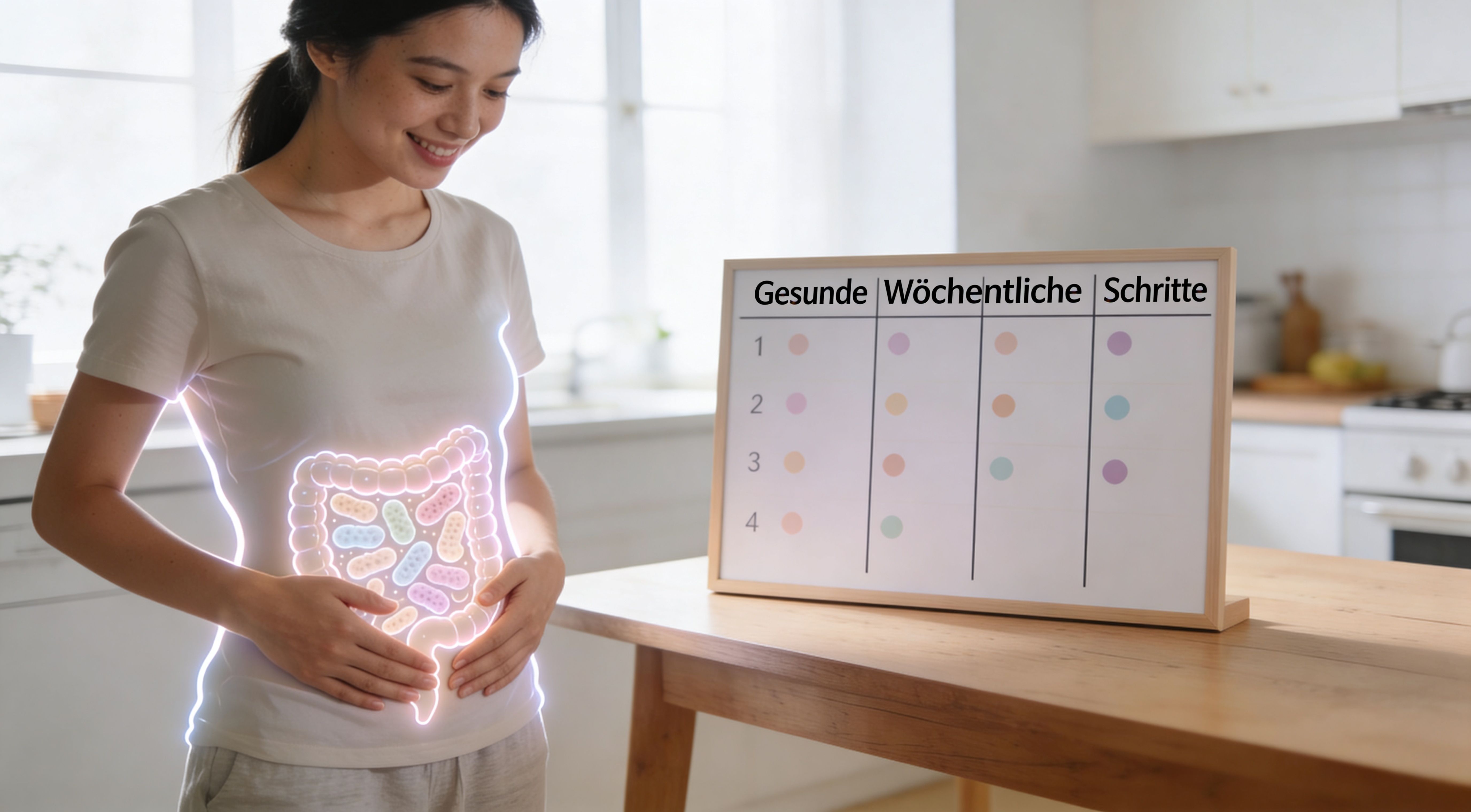
Gut reset: Your 4-week plan for a healthy gut
You eat more mindfully, drink enough, perhaps try probiotics, cut out sugar, and yet that feeling remains: Your gut is working against you. Sometimes there is bloating after seemingly harmless meals, sometimes fatigue for no clear reason, sometimes your skin, mood, or energy simply do not seem stable.
This is exactly where many people start with some gut reset they found online. A powder here, a cleanse there, a trend from social media. The problem is not your interest in health. That is a good thing. The problem is the guesswork.
A gut reset can be useful. But it only becomes truly beneficial when it suits your gut. Not an average gut, not an influencer protocol, but your microbiome, your symptoms, and your everyday life.
Your gut feeling does not lie—Why the gut controls everything
Many people notice for a long time that something is wrong before they can make sense of it. They feel heavy after eating, have inconsistent digestion, react more sensitively to certain foods, or cannot get their energy going in the morning. This is often dismissed as normal. But it is not.

The gut is not just a digestive tract. It is more like a central control center. This is where food is processed, a large part of the immune system is located, and your microbiome—the community of microorganisms in the gut—lives. When this system becomes unbalanced, the effects often show up not only in the bathroom but throughout the body.
Why nonspecific symptoms often begin in the gut
A stressed gut rarely stays quiet. It makes itself known through bloating, a feeling of fullness, constipation, or diarrhea. But fatigue, skin problems, or the feeling that your body has suddenly become more sensitive also fit this picture.
This also explains why general tips are often not enough. More fiber helps some people immediately. Others initially experience even more abdominal pressure. Fermented foods do many people good. For some, however, they initially cause more discomfort. This is not a contradiction. It simply shows that the gut reacts individually.
Practical perspective: If your stomach regularly reacts differently than it used to, that is not a minor detail. It is a signal that your inner balance needs attention.
What a good gut reset should achieve
A sensible gut reset is not about forcibly “cleaning out” the gut. It is intended to relieve the gut, reduce irritants, and then specifically support the development of a more stable gut flora.
That is why it is worth looking at guided programs. In Germany, 85% of participants in guided gut cleanses report a long-term reduction in their symptoms after three months, including a 70% decrease in bloating and a 60% reduction in fatigue, according to NetDoktor’s article on intestinal cleansing.
This is important because it offers a realistic perspective. The gut does not need a miracle solution. It needs a structured approach that is right for you.
Where many people struggle
Not because they lack discipline, but because they start with the wrong lever.
- Too much, too soon: Starting directly with strong probiotics or numerous supplements even though the gut is still irritated.
- Managing symptoms only: Fighting bloating without understanding potential triggers.
- Something new every week: Fasting today, fermented foods tomorrow, and giving up all sorts of things the day after.
The body often responds to this mixture with even more uncertainty. Others have long been optimizing their gut more purposefully—not through more products, but through greater clarity.
Dysbiosis, Leaky Gut & Co – Which type of gut do you have?
Digestive problems often look similar from the outside. Internally, they can be very different. That is precisely why one-size-fits-all cleanses so often fall short. Four patterns are particularly common in practice.

Classic dysbiosis
With dysbiosis, the microbial balance is disrupted. Put simply, there are too few beneficial bacteria, unfavorable microbes gain ground, or the diversity is too low.
The symptoms often fluctuate. Digestion works well for a few days, then not at all. Bloating, an unpleasant feeling in the abdomen after eating, or the sensation that supposedly healthy foods suddenly no longer agree with you may also occur.
A common trigger is antibiotics. In Germany, around 20 million packs of antibiotics are prescribed every year. Studies by the Helmholtz Centre show that this can lead to long-term disruptions of the gut flora in up to 70% of cases, as Zentrum der Gesundheit summarizes in its article on the gut flora after antibiotics.
The irritated and permeable intestine
Many people are familiar with the term Leaky Gut. Put simply, it refers to a weakened intestinal barrier. The intestine is not only meant to absorb nutrients but also to separate cleanly what needs to stay outside. When this protective function is impaired, some people react more sensitively to food, stress, or other strains.
Signs may include:
- Sensitivity after meals: You suddenly tolerate foods less well than you used to.
- Diffuse symptoms: The abdomen is not merely bloated but feels irritated or “inflamed.”
- More than digestion: The skin, energy levels, or general well-being also seem to be affected.
This is not a reliable self-diagnosis. But it is a pattern many people recognize.
The gut after antibiotics or infections
Some symptoms do not begin gradually but clearly follow an event: a course of antibiotics, a gastrointestinal infection, or a stressful period with a poor diet. Afterward, the gut is “never the same again.”
This type usually does not need a radical reset, but rather a sensible rebuilding process. If you simply take probiotics indiscriminately, you will often find that the effect is lacking. Bacteria also need the right diet in order to establish themselves.
After antibiotics, the gut is often not damaged. It is more likely out of balance and needs structure rather than action for action’s sake.
The sluggish, overburdened gut
Not every gut is inflamed or severely imbalanced. Sometimes it is simply chronically overburdened. Too little rest, too many processed foods, too little exercise, and irregular meals. Digestion becomes sluggish, the abdomen feels tight, and energy levels drop.
This overview provides a rough guide:
| Gut type | Common signs | What is often behind it |
|---|---|---|
| Dysbiosis | Bloating, changing digestion, tendencies toward food intolerances | Disrupted bacterial balance |
| Leaky gut pattern | Irritated stomach, reactions to food, nonspecific discomfort | Weakened gut barrier |
| Post-antibiotic gut | Symptoms since a course of treatment or an infection | Lost microbial stability |
| Sluggish gut | Bloating, slow digestion, fatigue after meals | Lifestyle, routine, diet |
This classification is helpful. But it does not replace testing. Two people with similar symptoms can have completely different microbiomes.
Stop the Guesswork – Why Testing Is the Smarter Approach
Self-observation is useful. Keep a food diary, note reactions, and question potential triggers. This often reveals initial patterns. But sooner or later, almost everyone reaches the same point: Should I eat more fiber or less? Are fermented foods good for me, or are they currently too much? Do I even need probiotics?
This is exactly where trial and error becomes costly. Not only financially, but physically too. Constantly trying new capsules, powders, and elimination lists can easily create even more uncertainty.

Self-assessment is useful. But only to a limited extent
You can identify quite a few things yourself:
- When symptoms occur
- Which foods cause problems more often
- Whether stress, sleep, or travel affects your gut
- Whether anything has changed since taking antibiotics
What you cannot determine with certainty this way is the state of your microbiome. You cannot see whether diversity is lacking, whether certain groups are underrepresented, or whether a rebuilding plan is appropriate for the situation at all.
The faster route to a precise gut cleanse
A microbiome test shortens this process. Instead of acting on guesswork, you work with data from your own gut. This saves time, reduces unnecessary experiments, and makes gut cleansing more targeted.
If you would first like to learn more, the article on the at-home gut test provides a good overview of what such analyses can achieve and where their limits lie.
One option in this area is mybody x Gesundheit. The provider offers an at-home microbiome and leaky gut test in which a stool sample is analyzed in a laboratory, with individual guidance on gut flora, nutrition, and possible rebuilding strategies derived from the results.
Important point: By taking responsibility for your own health, you are already on the right track. A test does not make this path more complicated, but more precise.
Especially if you have been searching for answers for some time, this step is worthwhile. Others are already optimizing with clearer data. You do not have to keep guessing when you can measure.
Your 4-week plan for successful gut cleansing
A good gut cleanse is not a crash program. It is an organized process of rebuilding. Proven approaches work in phases. A 3- to 7-day cleansing phase with an alkaline diet is followed by a 2- to 4-week rebuilding phase, during which prebiotics at 10 to 20 g per day and probiotics with at least 10^9 CFU are introduced as multi-strain preparations, as Innovall describes gut cleansing in phases.
This schedule provides useful guidance:

Start Week 1 calmly
The first week is not about maximum change, but about relief. During this phase, many people eat more simply, with fewer irritants and greater regularity.
It makes sense to focus on:
- Simple meals: steamed vegetables, vegetable broths, well-tolerated plant-based foods
- Fewer irritants: pause sugar, white flour, alcohol, and highly processed products
- A calm rhythm: regular meals instead of constant snacking
If you are under a lot of strain, you often respond to this basic approach alone with less abdominal pressure. This week is preparation for everything that follows.
In week 2, do not overburden the gut
Now the relief becomes a little more consistent. The goal is not “detox” as a buzzword, but less strain on a system that currently needs stability.
A practical framework:
- Continue with a simple alkaline diet
- Drink enough
- Allow breaks between meals
- Observe instead of constantly optimizing
Some people use additional measures during this phase. A clear-headed approach is worthwhile here. Not everything marketed as a cleanse is sensible. The more sensitive your gut, the more important a gentle approach is.
If you feel lighter in week 2, that is a good sign. If you feel exhausted, irritable, or increasingly unstable, that is not a heroic signal but an indication to slow down.
Build up strategically in week 3
Now the real core of every gut restoration begins. The rebuilding.
Prebiotics are food for beneficial gut bacteria. Probiotics provide specific bacterial strains. Combining both is often more useful than probiotics alone.
In practice, this means:
| Area | Practical implementation |
|---|---|
| Prebiotics | Gradually add foods such as chicory, garlic, or banana |
| Probiotic foods | Try small amounts of kefir or sauerkraut if you tolerate them |
| Supplements | Multi-strain probiotics can be useful if they suit the situation |
| Intestinal lining | L-Glutamine is often used as a supplement |
The pace is important. If you start everything at once, you will not know in the end what helps and what causes stress. A step-by-step introduction with observation is better.
If you also want to understand more deeply how to support your gut flora sustainably in everyday life, you will find practical approaches in the article on building a healthy gut flora naturally.
Stabilize in week 4 instead of falling back
Many people make a classic mistake. As soon as things improve, they immediately return to old patterns. This is exactly where it is decided whether your gut restoration remains only a short-term effort or actually brings about change.
Week 4 is about transferring this into everyday life:
- Rotate fermented foods: do not eat the same thing every day
- Keep fiber gradual: do not reduce it abruptly again
- Check the trigger consciously: What was problematic before, and what is working better now?
- Maintain a routine: regular meals, enough time, less rushing
What often works best during the four weeks
Not perfection. Consistency.
A realistic four-week plan must work for people with jobs, fit family life, and be easy to maintain day to day. Three simple meals a day, good preparation, and a few carefully chosen supplements. This is usually more effective than a refrigerator full of specialty products.
Precision pays off especially after antibiotics or long periods of symptoms. The better you know your starting point, the more accurately you can decide whether you need relief, rebuilding, or both.
The pillars of gut health beyond nutrition
Nutrition is important. But it is not the whole story. Anyone who focuses only on food while ignoring stress, sleep, and movement leaves three powerful levers unused.
Stress does not calm the gut on its own
The gut responds directly to tension. Many people notice this immediately. Before appointments, the stomach feels nervous; during stressful periods, digestion becomes irregular, and even foods that are usually well tolerated suddenly feel heavy.
What helps is not complicated wellness rituals, but small, repeatable actions:
- Breathing pauses before eating: a few calm breaths slow down your internal pace
- Eat more slowly: thorough chewing eases digestion
- Short periods of relaxation during the day: a walk, stretching, or sitting quietly instead of constant overstimulation
Sleep is regeneration for the gut
An unsettled sleep rhythm often throws the gut off track as well. Eating late, screen light right before falling asleep, or consistently shortened nights can prevent digestion and recovery from working together smoothly.
These simple sleep rules have proven effective:
- Eat lighter in the evening
- Aim for consistent bedtimes
- Give your stomach a rest at night instead of snacking late
A gut that has to constantly defend itself during the day regenerates less effectively. Sleep is not a luxury for this purpose, but working time for your body.
Movement brings dynamism to the system
The gut likes regularity, and movement is part of that. This does not necessarily mean intense exercise. For many people, gentle, consistent activity is even better tolerated.
These are well suited:
- Walking or taking an easy stroll
- Gentle mobility exercises
- Moderate strength training
- Move after eating instead of sitting down again right away
If you want to make your gut restoration sustainable, your microbiome needs an environment where it can stay. Nutrition lays the foundation. Lifestyle often determines whether that becomes stability.
Limits of self-treatment and sustainable success
Taking responsibility for your health is empowering. But it has limits. If you have severe or persistent abdominal pain, notice blood in your stool, lose weight unintentionally, or your symptoms suddenly worsen significantly, you should seek medical evaluation. A gut cleanse does not replace this evaluation.
It is equally important to consider what you are better off avoiding. Not every purported gut cleanse is harmless. Invasive or aggressive methods in particular often seem convincing because they sound radical. That does not make them sensible.
What does not work or is unnecessarily risky
Colonic hydrotherapy is a good example. University Hospital Zurich warns that flushing in up to 60 liters of liquid can severely disrupt the gut flora and create risks such as intestinal injuries and electrolyte imbalances. You can find more information in the USZ fact check on gut myths and facts.
That is the crucial difference between hype and evidence-based practice. A responsible gut cleanse does not work against the gut, but with it.
When looking at the data makes more sense than trying another cleanse
If you have been going around in circles for months, more discipline is usually not the solution. More clarity is. A laboratory-based assessment can be particularly useful if symptoms keep returning, do not go away after antibiotics, or you cannot achieve lasting improvement despite eating a healthy diet.
The article when a gut analysis makes sense offers useful guidance. It clearly explains the situations in which a test can be more valuable than the next standard protocol.
Sustainable success comes from becoming more precise
The best gut cleanse is rarely the strictest one. It is the one you understand, tolerate, and can integrate into your life.
Specifically:
- do not follow every trend
- take symptoms seriously without panicking
- take targeted rather than one-size-fits-all action
- seek medical advice if you notice warning signs
- work with data when you are not making progress
Your body does not send you random signals. When your gut is trying to tell you something, it is worth listening. Not with fear, but with a clear, calm plan.
If you want to stop guessing and put your gut cleanse on a more reliable footing, mybody x Gesundheit offers suitable at-home options. For a reliable assessment of your gut health, the microbiome and leaky gut test and the overview of gut health and microbiome analyses are particularly relevant. This way, you get more than a one-size-fits-all cleanse—you get a more informed basis for your next steps.


Share now:
How to Read Body Metrics Correctly: A Guide to Health & Nutrition
DNA test for weight loss: experiences and what they do not prove