
The yo-yo effect describes this frustrating cycle that so many of us know: First the kilos fall away, then they return—often with reinforcements. But this is not a personal failure or a lack of willpower. It is a natural reaction of your body to what it interprets as a famine: rapid, radical weight loss.
Your metabolism shifts down a gear to save energy. If you return to your old habits after the diet, it stores fat even more efficiently to be prepared for the next “crisis.”
Understanding the vicious cycle of the yo-yo effect
You surely know the feeling: The diet was a complete success, the scale finally shows the number you had been hoping for, and you feel fantastic. But just a few weeks or months later, everything is back to how it was. Sometimes it is even worse. This up-and-down cycle is so common that it is almost considered normal. But what is really behind it?
The truth is that your body is extremely clever and has been programmed for survival for thousands of years. It does not understand a crash diet with a severe calorie deficit as a conscious attempt to work toward your summer body. To your body, it is an alarm signal—a dangerous famine. And to protect you, it immediately ramps up countermeasures.
The body switches to energy-saving mode
Imagine your metabolism as a car engine. When the fuel gauge suddenly hits red (that is, when your calorie intake drops drastically), you take your foot off the accelerator to save fuel. Your body does exactly the same thing. It slows down your basal metabolic rate, the amount of energy it uses while completely at rest. It becomes extremely efficient and tries to get by with a minimum of energy.
At the same time, it often breaks down muscle mass, because compared with fat, muscles are true energy guzzlers. Less muscle means even lower energy expenditure. From an evolutionary perspective, it is a brilliant survival strategy.
This graphic clearly shows the cycle in which many diets end.
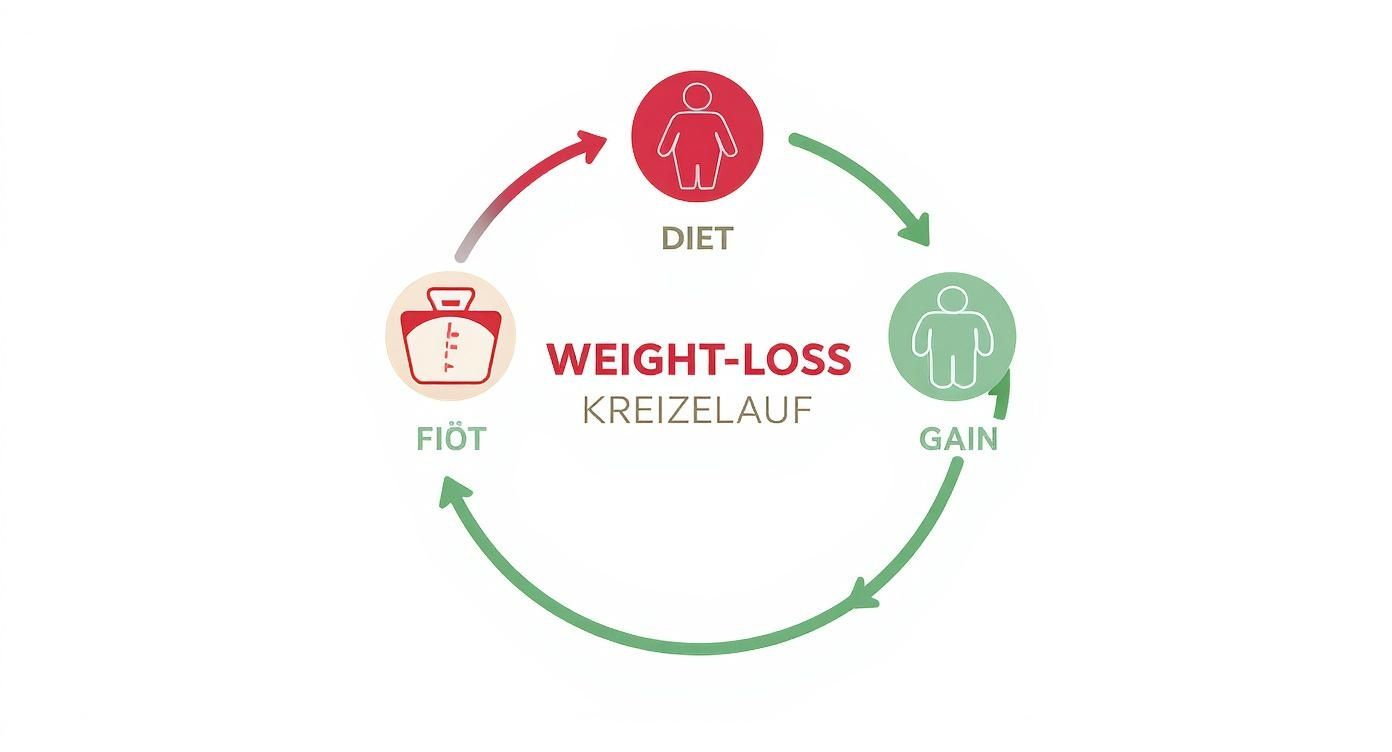
It is clear to see how a short-term diet may lead to weight loss, but the body then overcompensates—the result is rapid weight gain.
To make the process even more tangible, we have summarized the individual steps in a table.
The yo-yo effect at a glance
This table summarizes the key phases of the yo-yo effect to make the cycle easier to understand.
| Phase | What happens in the body | The effect on your weight |
|---|---|---|
| 1. Radical diet | A drastic reduction in calories; your body interprets this as a famine. | Rapid weight loss, mainly due to water and muscle mass. |
| 2. Metabolic adaptation | Your basal metabolic rate drops, and muscle is broken down to conserve energy. | Weight loss slows down or stagnates. |
| 3. Return to normal | After the diet, you start eating normally again. | Your metabolism is still running on low power, so a calorie surplus quickly develops. |
| 4. Overcompensation | Your body stores excess energy as fat reserves for the next “crisis.” | Rapid and often excessive weight gain, frequently more than before. |
The cycle often repeats, which can put further strain on your metabolism with each round.
After the diet, the trap snaps shut
As soon as you return to your normal eating habits, the trap snaps shut. Your metabolism is still running on low power, but suddenly there’s plenty of “fuel” available again. The result?
Every calorie consumed beyond your reduced requirements is stored by your body as a valuable reserve for the next anticipated famine—in the form of body fat.
This mechanism is so effective that many people end up weighing more than they did before their diet. One statistic shows the extent of it: In Germany, around 82 percent of the population have tried a diet within two years, yet around 60 percent of these attempts end in the yo-yo effect. You can find more fascinating insights on pressetext.com.
Simply understanding this biological process is the first and most important step. It frees you from feelings of guilt and makes it clear: You weren’t fighting against your own will, but against a survival instinct deeply rooted in all of us.
Why your body rebels against crash diets
Have you ever wondered why losing weight often feels like an uphill battle, while the pounds you’ve lost come back almost by themselves afterward? The answer isn’t a lack of discipline, but lies deep in our biology. Your body is a survivor, programmed over thousands of years to protect you from famine.
It interprets a crash diet with drastically reduced calories in exactly that way: as an existential threat. It doesn’t know that you simply want to fit into your summer jeans. It only senses that the energy supply has suddenly dried up—and immediately initiates drastic countermeasures. This rebellion is the real reason behind the dreaded yo-yo effect.
Your basal metabolic rate plummets
The centerpiece of your metabolism is your basal metabolic rate. This is the amount of energy your body uses while completely at rest, simply to keep vital functions such as breathing, your heartbeat, and brain activity running. Think of it like your car idling: it constantly uses energy, even while you sleep.
Something crucial happens during a crash diet: Your body recognizes the “emergency” and switches into an extreme energy-saving mode. It slows your basal metabolic rate to waste as little energy as possible. This means you suddenly get by on far fewer calories than before. At first, you may lose weight quickly, but this process slows itself down because your “engine” runs increasingly inefficiently.
Your body tries to survive the drastically reduced energy intake by lowering its own energy expenditure. However, this intelligent adaptation becomes a trap after the diet.
This mechanism is one of the main causes of the yo-yo effect. A key factor is muscle loss during the diet. Since muscles burn a substantial number of calories even at rest, their breakdown leads to lower overall energy expenditure. As soon as you return to your old eating habits after the diet, the reduced basal metabolic rate causes you to gain weight more quickly—often even faster than before the diet. You can find more about the scientific background on Wikipedia.
Valuable muscle mass is sacrificed
To reduce energy expenditure even further, your body takes another radical measure: it breaks down muscle mass. Muscles are your largest metabolic organ, your personal power plants. They burn calories nonstop, even when you are sitting on the couch.
For your body, however, muscles are pure luxury during a famine. They require too much energy to maintain. Fat, on the other hand, is a compact and efficient energy store. From a survival perspective, it therefore makes perfect sense to sacrifice energy-intensive muscles to protect valuable fat reserves.
This muscle loss has two devastating consequences:
- Your basal metabolic rate drops even further: Less muscle means lower energy expenditure at rest.
- Your figure changes for the worse: You lose lean muscle tissue and retain fat. The result is often a less defined figure, even if the scales show a lower number.
If you want to delve deeper into how your energy expenditure works, our guide covers everything you need to know about metabolism explained simply.
Your hormones are going haywire
In addition to your metabolism, your sensitive hormonal balance also gets completely disrupted. Two hormones play the leading roles in the drama of the yo-yo effect: ghrelin and leptin.
Ghrelin is known as the “hunger hormone.” It is produced in the stomach and signals to your brain that it is time to eat. During a radical diet, your ghrelin levels shoot up. Your body practically cries out for food, leading to uncontrollable cravings.
Leptin is its counterpart, the “satiety hormone”. It is produced by fat cells and tells your brain that you are full and your energy stores are replenished. When you lose weight quickly, leptin levels drop drastically. The feeling of satiety fails to appear, and even after a meal, you do not feel truly satisfied.
So your body is hormonally working against you with all its might:
- More hunger: High ghrelin levels cause constant appetite.
- Less satiety: Low leptin levels prevent you from feeling full.
This explosive combination of a slowed metabolism, reduced muscle mass, and hormonal chaos creates the perfect conditions for rapid weight gain as soon as the diet ends. So you are not fighting against your willpower, but against deeply ingrained biological programming.
How Mental Traps Fuel the Yo-Yo Effect
Weight management is about much more than counting calories. A huge part of success—or failure—takes place in your mind. Often, it is deeply ingrained thought patterns and psychological traps that unconsciously sabotage you and steer you straight toward the yo-yo effect.
Your body responds to clear signals such as hunger and satiety. Your mind, however, decides how you interpret these signals. When your mental processes are shaped by stress, strict rules, or negative emotions, even the best plan will fail. It is therefore time to shift your focus from your plate to your thoughts as well.
The Dangerous All-or-Nothing Mindset
Does this sound familiar? You follow your diet disciplined for weeks, but then it happens: a piece of chocolate, a slice of cake at a party, or a pizza with friends. For many people, this one “slip-up” feels like complete failure. And immediately, the mind switches into all-or-nothing mode.
This line of thinking is fatal: “It doesn’t matter now anyway, so I might as well eat the whole bar.” A small moment of enjoyment turns into an uncontrolled binge. The diet is abandoned completely, accompanied by guilt and frustration.
This black-and-white thinking is one of the most common mental traps. It prevents you from learning to reconcile enjoyment with a healthy diet.
A healthy lifestyle is not about perfection, but about balance. A single piece of chocolate has never ruined a diet—the thought that everything is lost because of it has.
When you learn to see such moments for what they are—namely, normal parts of life—you free yourself from this destructive cycle.
How Restrictions Trigger Cravings
Another mental trap is strict prohibition. The more rigidly you forbid yourself certain foods, the more desirable they become. Your brain responds to the thought of deprivation with increased desire—a psychological phenomenon known as reactance.
Think of a child who is told they must not press the red button under any circumstances. What will they want to do? Exactly that. Food works in a similar way:
- Constant focus on forbidden foods: You think nonstop about what you’re not allowed to have.
- Feeling deprived: Constant restriction creates emotional stress and dissatisfaction.
- Uncontrollable cravings: At some point, the dam breaks, and the cravings overwhelm you.
This cycle of restriction followed by loss of control leads not only to weight gain but also permanently damages your relationship with food.
When emotions control hunger
Do you really always eat only because your stomach is growling? Or do you sometimes reach for food because you’re stressed, bored, sad, or lonely? This behavior is called emotional eating. It is a learned strategy for coping with unpleasant feelings and a powerful driver of the yo-yo effect.
Eating can provide short-term comfort and release feel-good hormones, but it doesn’t solve the underlying problem. Instead, a vicious cycle develops: you feel bad, eat to feel better, and then often feel even worse because of the uncontrolled eating.
To break this cycle, it’s important to recognize the triggers. In moments like these, consciously ask yourself: “Am I really hungry, or do I need something else right now?” A clear sense of fullness is often lacking too, which can further encourage emotional eating. You can read more about why you no longer feel a sense of fullness in our detailed guide.
Recognizing these mental patterns is the first, crucial step. Only when you understand why you eat can you learn to find new, healthier ways to cope with stress and emotions—and finally leave the yo-yo effect behind.
Sustainable strategies for lasting success
You now understand what goes wrong in your body and mind during crash diets. The good news is that you’re not helplessly at the mercy of the yo-yo effect. You can deliberately break this cycle—but not with the next fad diet. Instead, make a conscious and lasting change to your lifestyle. The goal is to signal to your body that there is no famine looming and that it can finally leave energy-saving mode.

Forget quick fixes. The path to your comfortable weight is a marathon, not a sprint. With the right strategies, you can build healthy habits that not only get you to your goal but also help you maintain your weight effortlessly. Consider this section your toolkit for a frustration-free and sustainable journey.
Aim for slow and steady progress
The biggest mistake most people make? Wanting too much too quickly. Radical diets are a one-way street straight to the yo-yo effect. Instead, set yourself a realistic goal: slow but steady weight loss of no more than 0.5 to 1 kilogram per week.
This moderate approach has significant benefits:
- Your metabolism stays active: A small calorie deficit prevents your body from going into panic mode and drastically lowering your basal metabolic rate.
- You protect your muscles: Losing weight slowly minimizes the loss of valuable, calorie-burning muscle mass.
- New habits can grow: You give yourself time to truly learn and internalize new eating and behavioral patterns.
Sure, it may feel slow at first. But it is the only truly sustainable way to make your body your ally—not your opponent.
Strength training: your most important partner
If you want to defeat the yo-yo effect once and for all, strength training is indispensable. While endurance exercise such as jogging or cycling is great for your cardiovascular system, strength training has a direct and substantial impact on your basal metabolic rate.
Think of your muscles as small power plants. The more muscle mass you have, the more calories you burn—around the clock, even when you are just lying on the couch. If you diet without strength training, you risk losing a significant amount of these valuable muscles along with fat.
Every kilogram of muscle mass you protect or build works in your favor. It is your best insurance against a sluggish metabolism and regaining weight.
Two to three strength-training sessions per week are ideal for maintaining your muscles and keeping your metabolism operating at a high level.
Harness the power of protein
A high-protein diet is another key to outsmarting the yo-yo effect. Proteins are true all-rounders when it comes to losing weight and keeping it off:
- They keep you full for longer: Compared with carbohydrates and fats, proteins keep you full much longer. This is your secret weapon against cravings and helps reduce your overall calorie intake.
- They protect your muscles: Sufficient protein intake is essential to prevent muscle loss during a calorie deficit.
- They rev up your metabolism: Your body uses more energy to digest protein (this is called the thermic effect of food) than it does to digest fats and carbohydrates.
Include high-quality protein sources such as lean meat, fish, eggs, dairy products, legumes, or tofu in every meal. This supplies your body optimally and supports your goals on several levels at once. For more in-depth guidance, we have put together a comprehensive guide showing you how to lose weight healthily in the long term.
Mental strategies for everyday life
Your mindset is just as important as what ends up on your plate. Work consciously on your attitude and habits to avoid mental pitfalls.
- Set realistic goals: Instead of “lose 10 kilos in 4 weeks,” goals like “exercise twice a week” or “eat vegetables with every meal” are much more helpful and motivating.
- Practice mindful eating: Take your time with your meals, eat slowly, and savor every bite. Learn to listen to your body’s hunger and fullness signals again.
- Throw prohibitions overboard: Allow yourself everything—in moderation. An “all-or-nothing” mindset only leads to frustration and binge eating. A flexible approach is much more successful in the long term.
These strategies may not be a quick fix, but they are the proven way to finally overcome the yo-yo effect. Data from the German Weight Control Registry shows that only a small proportion of people with overweight manage to permanently reduce their weight by at least ten percent. Discover more about the challenges of weight control in Germany to understand why a well-considered approach is so crucial.
Find your personal path—without the yo-yo effect
You now understand why blanket diet tips and standard solutions so often end in failure. The reason is actually quite simple: Your body is unique. To finally leave the dreaded yo-yo effect behind, it is not enough to follow just any advice. You need to know how your own body works—and this is exactly where personalized analyses come in. They give you the decisive advantage.
Imagine if you no longer had to guess which diet works for you. Instead, you would have a scientifically grounded roadmap tailored precisely to your biological needs. This is not a distant dream of the future—it is already possible today.
Know your metabolism type
Each of us processes macronutrients—fats, carbohydrates, and proteins—in our own unique way. This is largely encoded in our DNA. While your friend may achieve great results with a low-carb diet, you may feel sluggish and barely lose weight. This is not due to a lack of discipline, but may simply be a result of your genetic predisposition.
A DNA metabolism analysis from mybody-x can provide you with the decisive answers:
- Your personal macronutrient needs: You will find out whether your body uses fats or carbohydrates more efficiently for energy.
- Your genetic predisposition: You will learn whether you are naturally prone to being overweight and how you can specifically counteract it.
- Optimal sports: The analysis can even tell you whether you respond better to endurance or strength training, helping you reach your goals faster.
With this knowledge, you can perfectly tailor your diet to your genes. This means giving your body exactly what it needs to work efficiently, stay full, and burn fat—instead of constantly working against it. Learn more about how personalized nutrition can truly help you get closer to your goals.
Uncover hidden hurdles
Sometimes the cause of stubborn excess weight or the yo-yo effect lies deeper than just your diet. Your body is a complex system in which hormones and even the bacteria in your gut play a crucial role.
Many people struggle with their weight for years without realizing that a hormonal imbalance or disrupted gut flora is sabotaging their efforts.
Targeted tests can finally provide clarity and make these hidden hurdles visible:
Hormone analyses
Hormones such as cortisol (the stress hormone), thyroid hormones, and sex hormones have a direct influence on your metabolism, appetite, and where your body stores fat. An imbalance can make losing weight extremely difficult, no matter how disciplined you are. A hormone test can reveal whether this is a contributing factor that you can specifically address.
Microbiome analyses
Your gut is home to trillions of bacteria that influence your digestion, immune system, and even your weight. Certain bacterial strains can cause you to extract and store more calories from food. An analysis of your gut flora shows whether there is an imbalance (dysbiosis) and how you can specifically counteract it with the right diet.
Nutrient checks
A deficiency in important vitamins or minerals, such as vitamin D or iron, can slow down your metabolism and lead to fatigue and cravings. A nutrient check ensures that your body is optimally supplied and has all the tools it needs for an active metabolism.
By putting these puzzle pieces together, you gain a complete picture of your body. You replace blind trial and error with well-founded knowledge, creating the best foundation for lasting success. Instead of struggling through countless diets, you address the real causes and find your own personal path to a healthy weight—without the frustrating yo-yo effect.
Your most pressing questions about the yo-yo effect
We've now taken an in-depth look at the yo-yo effect. But you're sure to still have one or two questions weighing on your mind. Here are the answers—briefly, clearly, and without technical jargon, so you're well prepared for your journey.
Can you wake up your metabolism again after the yo-yo effect?
Yes, absolutely! Your metabolism isn't broken; it's just clever. It has adapted to the supposed famine and is now running in energy-saving mode. The good news: You can get it “up and running” again.
The most powerful lever for this is building muscle mass. Nothing burns energy as reliably as your muscles, which is why strength training naturally gets your basal metabolic rate going again.
Combine this with a gradual and fully conscious increase in your calorie intake. Focus on real, nutrient-rich foods. This sends your body the signal: “The crisis is over; you can end the emergency plan.” But give it time—this process can take a few weeks or even months.
Are carbohydrates the real enemy after a diet?
No, demonizing carbohydrates across the board is a myth. They are not the sole reason for the yo-yo effect. The real problem is a sudden return to an overall calorie surplus that meets a slowed metabolism.
What is the yo-yo effect? Recognize the causes and maintain your weight permanently
Quite the opposite: Complex carbohydrates from whole grains, legumes, and vegetables are essential sources of energy. As always, it's all about balance.
An interesting fact: Immediately after a diet, your body first replenishes its carbohydrate stores (glycogen) in your muscles and liver. Since every gram of glycogen binds water, this can lead to a rapid increase of one or two kilograms on the scales. But this isn't new fat—it's a completely normal process! Don't let it demotivate you.
So it’s not about avoiding carbohydrates, but about slowly and carefully readjusting your total calorie intake.
What role does the gut play in preventing the yo-yo effect?
A crucial one that is overlooked far too often! Think of your gut flora as a huge team of employees. These trillions of bacteria help determine how efficiently you process nutrients and how much energy you draw from food—or store as fat.
Radical diets are like mass layoffs for your beneficial gut bacteria. Diversity decreases, creating an imbalance (dysbiosis) that can even promote renewed weight gain. Some bacterial strains can practically incite your body to store more fat.
The best food for your “gut team” is a high-fiber diet rich in vegetables, fruit, and whole grains. A mybody-x microbiome analysis can also show you exactly how your gut is doing and how you can support it specifically to maintain your weight long term.
Does it really matter how quickly I lose weight?
Yes, speed may be the most important factor of all. Slow and steady is the gold standard—a weight loss of around 0.5 kilograms per week is considered ideal. And there’s a good reason for that.
With a crash diet, your body loses not only fat but also water and—most damaging of all—valuable muscle mass. This muscle loss is the main reason your basal metabolic rate plummets, making the yo-yo effect practically inevitable.
Losing weight slowly, on the other hand, has clear advantages:
- Muscle protection: Your body primarily draws on its fat reserves and leaves your muscles alone.
- Metabolic stability: Your basal metabolic rate remains at a much higher level.
- Sustainability: You give yourself the time to establish new, healthy habits that will naturally remain part of your life even after the diet.
Always remember: It’s a marathon, not a sprint. Patience is your strongest ally here.
Are you ready to stop guessing and truly understand your body? At mybody-x, you’ll find scientifically sound analyses—from DNA metabolism tests and microbiome analyses to hormone checks. Find out exactly what your body needs to finally beat the yo-yo effect and maintain your weight long term. Discover your individual path now at https://mybody-x.com.



Share now:
What is a low-carb diet, and how does it work?
Determine your metabolism: Find out what your body really needs