

Calculate Your Basal Metabolic Rate for Weight Loss: Your Smart Starting Point
To lose weight truly successfully—and, above all, permanently—you cannot avoid one topic: your basal metabolic rate. Knowing it is the very first step because it is the foundation for a healthy calorie deficit—one that does not send your body into survival mode.
Why Your Basal Metabolic Rate Is the Secret Ingredient for Sustainable Weight Loss
Have you ever wondered why previous diets failed or why the yo-yo effect kept coming back? The answer usually lies in the fact that we did not properly understand our bodies. It is not just about blindly cutting calories or torturing yourself for hours at the gym. It is about a smart strategy, and that always begins with your basal metabolic rate.
Your Invisible Engine
Imagine your body as a car waiting at a traffic light with the engine idling. It is not moving, but the engine is running and using fuel to keep all the systems operating. That is your basal metabolic rate, also called Basal Metabolic Rate (BMR): the amount of energy your body uses while completely at rest, simply to survive.
These include absolutely fundamental functions:
- Every breath you take.
- Every heartbeat that pumps blood through your veins.
- Your brain activity, which does not stop even while you sleep.
- The constant repair and renewal of your cells.
This “idle consumption” is enormous! It accounts for an impressive 60 to 75% of your total daily energy needs. Even before you get out of bed in the morning, your body has already burned a large share of the day’s calories.
Your basal metabolic rate is not a one-size-fits-all value, but your own personal energetic fingerprint. It is the foundation of any smart weight-loss strategy because it shows you how much energy your body needs at an absolute minimum to stay healthy.
From Guesswork to Knowledge
Many diets throw around blanket figures such as “Just eat 1,500 calories a day.” But without knowing your individual basal metabolic rate, that’s pure guesswork. It may be suitable for one person, while for another it is dangerously low and severely slows down their metabolism.
But when you learn how to calculate your basal metabolic rate to lose weight intentionally, you replace uncertainty with knowledge. You create a data-based foundation for planning a calorie deficit that truly works—safely and sustainably.
The basal metabolic rate (BMR) is therefore the absolute foundation of any weight-loss plan. A real example makes this clear: An office worker weighing 77.5 kg with a fat-free mass of 60.6 kg has a BMR of exactly 1,679 calories per day. To lose weight healthily, his calorie deficit must be based on his total energy requirement—that is, this basal metabolic rate plus the energy required for his daily activities. If you would like to learn more about the exact calculation and its significance, you can find valuable information about the basal metabolic rate on inbody.com.
Determine your basal metabolic rate using tried-and-tested formulas
Now let's get into the details. We'll dive into the world of numbers together, but don't worry—you don't have to be a math genius. The key to understanding your basal metabolic rate lies in well-established scientific formulas. There are several approaches, but one has proven particularly reliable in practice: the Mifflin-St. Jeor formula.
It is considered more accurate today than the older Harris-Benedict formula, simply because it better reflects our modern lifestyle. Think of it as a reliable starting point for determining your body's “idling energy expenditure.”
The Mifflin-St. Jeor formula in detail
At first glance, the formula may look somewhat complicated, but it is really very easy to use. It logically distinguishes between men and women because differences in body composition—men typically have more muscle mass—directly affect energy expenditure.
Here are the two variants:
- For women: Basal metabolic rate (kcal/day) = (10 × weight in kg) + (6.25 × height in cm) – (5 × age in years) – 161
- For men: Basal metabolic rate (kcal/day) = (10 × weight in kg) + (6.25 × height in cm) – (5 × age in years) + 5
You can immediately see which four simple but crucial factors play a role here: weight, height, age, and sex. Each of these variables shapes your personal energy fingerprint. Greater weight and height logically mean more body mass that needs to be supplied with energy. As we age, however, basal metabolic rate decreases slightly due to natural changes in metabolism and often a lower proportion of muscle mass.
Let's work through the whole thing using two real-life examples.
Example 1: A 35-year-old woman with an office job
Imagine Anna. She is 35 years old, 168 cm tall, and weighs 75 kg. Anna has a typical office job and spends most of her day sitting.
We simply enter your values into the formula for women: (10 × 75 kg) + (6.25 × 168 cm) – (5 × 35 years) – 161 = 750 + 1050 – 175 – 161 = 1464 kcal
Anna's basal metabolic rate is therefore 1,464 calories per day. This is the energy her body would burn if she spent the entire day lying in bed.
Example 2: A 50-year-old, lightly active man
Now let's look at Markus. He is 50 years old, 182 cm tall, and weighs 90 kg. Markus also works in an office, but he makes sure to take regular walks and stay active in everyday life.
For him, we use the formula for men: (10 × 90 kg) + (6.25 × 182 cm) – (5 × 50 years) + 5 = 900 + 1137.5 – 250 + 5 = 1792.5 kcal
Markus therefore has a basal metabolic rate of around 1,793 calories. This is his starting point, from which we now take the next crucial step.
From basal metabolic rate to total daily requirement
But your basal metabolic rate is only half the story. To lose weight successfully, you need to know how many calories you burn in total in a day. This is where the so-called PAL factor (Physical Activity Level) comes into play. It is a simple multiplier that combines your basal metabolic rate with your average activity level.
Be absolutely honest with yourself here. A realistic assessment is the be-all and end-all of your success.
The most common mistake many people make is overestimating their own activity level. A 30-minute workout does not turn an otherwise sedentary office day into a highly active day. Always look at the average across your entire 24 hours.
This table gives you a good guide to your PAL factor:
| Activity level | Description | PAL factor |
|---|---|---|
| Mostly sitting/lying down | Very little physical activity, e.g. due to illness. | 1,2 |
| Sedentary work | Office job with little to no additional activity. | 1,4 – 1,5 |
| Sedentary with occasional activity | Office job, but regular walks and light physical activity. | 1,6 – 1,7 |
| Standing/walking job | Jobs such as waiters, salespeople, and tradespeople. | 1,8 – 1,9 |
| Physically demanding work | Construction workers, farmers, professional athletes. | 2,0 – 2,4 |
This flowchart shows you the path to weight-loss success at a glance—everything starts with calculating your basal metabolic rate.
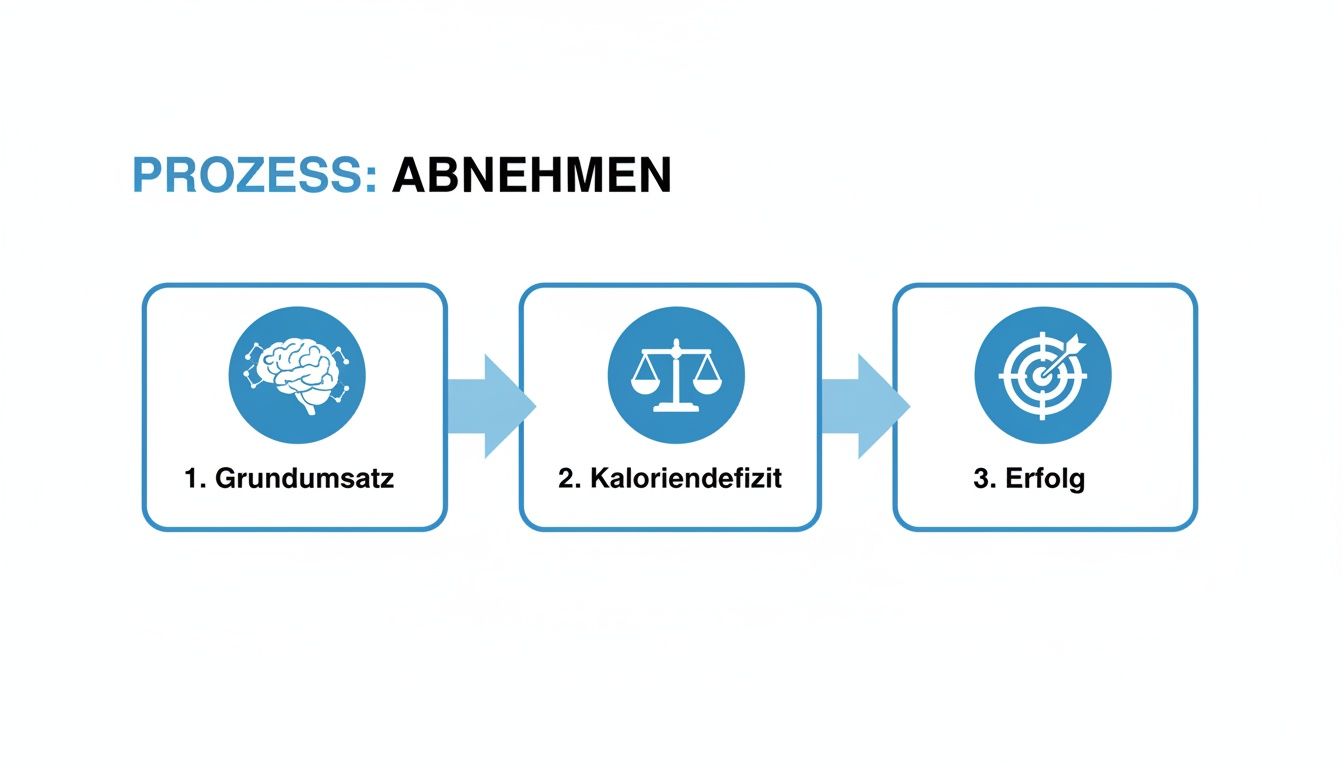
The graphic makes it clear: Knowing your basal metabolic rate is the foundation. You build a strategic calorie deficit on it, which ultimately leads you to your goal.
Completing the calculation
Let's now apply this knowledge to our examples:
-
Anna (office job, little physical activity): Her basal metabolic rate is 1,464 kcal. We choose a realistic PAL factor of 1.4 for her.
- Total daily requirement = 1,464 kcal × 1.4 = 2,050 kcal per day.
-
Markus (office job, but regular walks): His basal metabolic rate is 1,793 kcal. Since he is somewhat more active, we use a PAL factor of 1.6.
- Total daily energy expenditure = 1,793 kcal × 1.6 = 2,869 kcal per day.
These figures—2,050 kcal for Anna and 2,869 kcal for Markus—are the crucial values. This is the amount of calories they would need to eat each day to maintain their weight. To lose weight, they therefore need to stay below this amount.
To make this step easier for you, we have developed a practical calorie-needs calculator that quickly provides you with an accurate estimate without making you reach for a calculator.
With your personal number, you now have the perfect foundation for planning your calorie deficit intelligently and sustainably in the next step.
Finding and maintaining the right calorie deficit
Okay, you have now determined your numbers—your basal metabolic rate and your total daily energy expenditure. That is a huge step! But what do you do with this knowledge now? This is where the strategic part begins: We define a calorie deficit that gets you safely to your goal without sabotaging your body.

A healthy calorie deficit is the absolute key to success. Many people make the crucial mistake here: they think more is better. They drastically reduce their calorie intake in the hope of seeing quick results and fall straight into the crash-diet trap.
Why crash diets are your biggest enemy
A drastic calorie reduction—often far below your basal metabolic rate—puts your body into a state of alarm. It senses a famine and responds with drastic countermeasures to ensure its survival. This is an ancient mechanism that works against you in today's world.
What happens as a result is disastrous for your weight-loss goals:
- \Your metabolism switches to energy-saving mode:\ Your body becomes extremely efficient and reduces its energy expenditure. This means it burns fewer calories, even during everyday activities.
- \You lose valuable muscle mass:\ To obtain energy quickly, the body does not primarily draw on fat; instead, it breaks down muscle. But muscle is your most important ally because it burns calories even at rest.
- \Cravings become unavoidable:\ Your body cries out for quick energy, leading to uncontrollable cravings that you can barely resist.
The result is almost always the dreaded yo-yo effect. As soon as you start eating “normally” again, your sluggish metabolism immediately stores every excess calorie as a fat reserve for the next supposed emergency. If you want to understand the mechanisms behind it in more detail, our guide to the yo-yo effect explains the connections in detail.
The gold standard: a moderate deficit
To avoid this metabolic trap, we rely on a smart and sustainable approach. The gold standard for healthy and effective weight loss is a moderate deficit of 300 to 500 calories per day.
This deficit is small enough not to send your body into panic mode, but large enough to produce visible—and above all, lasting—results. Your metabolism stays active, your muscles are protected, and your energy levels remain stable.
Remember: Successful weight loss is a marathon, not a sprint. A moderate deficit of 300 to 500 calories protects your metabolism, prevents muscle loss, and makes the process sustainable mentally and physically.
What do 500 calories mean in practice?
A calorie deficit of 500 calories per day may sound abstract, but it can be translated into tangible results. To lose one kilogram of body fat, you need to cut about 7,000 calories.
Let’s work it out briefly:
- Daily deficit: 500 kcal
- Weekly deficit: 500 kcal × 7 days = 3,500 kcal
- Result: You lose about half a kilogram of pure fat per week.
Half a kilogram per week may sound slow to some, but that’s exactly the pace your body can handle well. That’s two kilograms per month—a realistic and motivating goal that you can achieve without constant hunger or deprivation.
Smart choices instead of strict deprivation
How can you achieve this deficit without constantly feeling hungry? It’s not about eating less, but about eating differently. The focus is on smart food choices that fill you up, nourish you, and satisfy you.
1. Prioritize protein Protein is your most important building block when losing weight. It keeps you full for longer, protects your muscles from breaking down, and has a higher thermic effect—your body uses more energy to digest it. Include lean meat, fish, eggs, quark, legumes, or tofu in every meal.
2. Fill your plate with vegetables Vegetables are your best friend. They have a high volume with very low calorie density and are packed with important nutrients and fiber. Fill your plate with leafy greens, broccoli, bell peppers, and more—so you can eat until you’re full without blowing your calorie budget.
3. Choose the right carbohydrates Don’t eliminate carbohydrates completely; choose the smarter option instead. Whole-grain products, oats, quinoa, or sweet potatoes provide long-lasting energy and fiber that help keep blood sugar levels stable. On the other hand, reduce simple carbohydrates from white flour and sugar, which provide only a short burst of energy and promote cravings.
4. Don’t be afraid of healthy fats Fats are essential for your hormones and the absorption of vitamins. A small amount of healthy fats from avocados, nuts, seeds, or high-quality oils helps you feel full and is important for your health.
By applying these principles, you shape your calorie deficit so that you perceive it not as deprivation, but as a conscious and nourishing way of eating. This lays the foundation for a path that you not only begin with motivation but also maintain with ease over the long term.
When formulas don’t tell the whole truth
The formulas we’ve looked at are a great starting point. They give you a concrete number to use as you begin your weight-loss journey. But let’s be honest: Your body is infinitely more complex than a simple mathematical equation.
A formula knows your age, weight, and height—but it doesn’t know you. It has no idea about your unique genetic predisposition, your hormonal balance, or how much muscle mass you actually have. And this is exactly where generalized calculations reach their natural limits.
What your formula doesn’t take into account
Your individual metabolism is a finely tuned clockwork mechanism driven by countless small and large gears. A purely numerical basis simply cannot capture these personal nuances. Let’s take a closer look at why your actual needs may differ from the standard calculation.
Some of the most important “invisible” factors include:
- Your unique genetics: Your DNA sets the basic rhythm of your metabolism. Some people naturally burn a little more energy, while others are genetically more likely to run on “low power.”
- Your body composition: This is one of the biggest levers of all. A kilogram of muscle mass burns significantly more calories at rest than a kilogram of fat tissue. So two people with exactly the same weight can have completely different basal metabolic rates—depending on their ratio of muscle to fat.
- Your hormonal balance: Hormones are the conductors of your metabolism. A slight imbalance, for example in thyroid hormones or the stress hormone cortisol, can significantly slow down or accelerate your energy expenditure.
- Your gut microbiome: The trillions of bacteria in your gut also play a role. They influence how efficiently you break down nutrients and how much energy you actually extract from your food.
- Unnoticed nutrient deficiencies: If your body lacks important building blocks such as iron or iodine, essential metabolic processes may not function properly. This slows down your engine without you noticing.
A formula gives you the average. Your personal biology determines whether you fall above or below this value. True optimization begins when you understand your individual circumstances.
The step toward personalized data
So you can see: Calculating your basal metabolic rate is a fundamental starting point, but to get the most out of yourself, it is worth taking a deeper look. And this is precisely where modern, scientifically sound analyses come in, giving you insights that a formula can never provide.
The figures speak for themselves: Around 52% of Germans between the ages of 25 and 55 struggle with excess weight. An inaccurate estimate of calorie needs is responsible for the dreaded yo-yo effect in up to 70% of dieting attempts. Why? Because metabolism often slows down by 20-30% after crash diets. Personalized analyses address this issue directly to minimize the margin of error.
A DNA metabolic test from mybody® Lab GmbH can, for example, reveal whether genetic variants affect your basal metabolic rate by 10-15%—such as variations in the UCP1 gene, which is responsible for your body's heat production.
A comprehensive analysis of what a metabolic analysis is goes even further. It provides a complete picture of your body—from your exact body composition (muscle, fat, and water) to potential nutrient deficiencies that may be unknowingly slowing down your engine.
Standard calculation compared with personalized analysis
A direct comparison quickly shows the limitations of standard formulas and the added value a personalized analysis truly offers.
| Factor | Standard formula (Mifflin-St. Jeor) | Personalized analysis (e.g., mybody® DNA test) | Why the difference matters |
|---|---|---|---|
| Genetics | Not taken into account | Analyzes relevant metabolic genes (e.g., UCP1, FTO) | Your genes can affect your basal metabolic rate by 10-15 % influence. |
| Body composition | Estimates muscle mass only indirectly based on total weight | Measures exact muscle and fat proportions (e.g., BIA analysis) | Muscles burn significantly more calories than fat—a crucial factor. |
| Hormonal status | Not taken into account | Can reveal hormonal imbalances (e.g., thyroid issues) | Hormones play a major role in regulating metabolism. An imbalance makes any formula inaccurate. |
| Nutrient supply | Not taken into account | Identifies specific vitamin or mineral deficiencies | Missing nutrients (e.g., iron, iodine) can slow down the metabolism. |
| Result | A general estimate | A precise, individual value | You work with real data from your body, not an average value. |
This personalized approach transforms estimates into knowledge. You learn not only what you should do, but above all why it is exactly right for your body. Instead of blindly chasing a number, you work with your body—based on data that is as unique as you are.
Make your metabolism your ally
Knowing your basal metabolic rate is the first and most important step on your journey. Great! But now the real work begins: not just understanding your metabolism, but actively getting it to work for you. Successful weight loss means being in harmony with your body, not fighting against it. And your metabolism? It is your most powerful ally—if you learn to give it what it needs.

We focus on three pillars that truly make a difference and naturally boost your energy expenditure: nutrition, exercise, and your lifestyle. These strategies are universal, but personalized data can take them to an entirely new level.
The underestimated power of protein
If there is one nutrient that plays the leading role in weight loss, it is protein. It is so much more than just building material for muscles; it is a strategic tool for revving up your metabolism. One of the main reasons for this is the thermic effect of food (TEF).
Quite simply, this means your body burns calories just to digest the food you eat. And with protein, this effect is enormous: Up to 30 % of the calories from protein are burned solely during digestion. By comparison, fats come in at a meager 0–3% and carbohydrates at 5–10%.
Protein is metabolically expensive. Every protein-rich meal gives your metabolism a temporary boost while keeping you full for longer—the best protection against cravings.
A protein-rich diet also protects your valuable muscle mass while you’re in a calorie deficit. Since muscles burn more energy at rest than fat, preserving them is crucial to prevent your basal metabolic rate from dropping. Include lean meat, fish, eggs, quark, legumes, or tofu in every meal to get the full benefit. You can also read about which foods boost your metabolism in our detailed guide.
Why strength training is superior to cardio
Sure, cardio such as running or cycling is great for your cardiovascular system and burns plenty of calories during the workout. But if you want to raise your basal metabolic rate permanently, targeted strength training clearly comes out on top. Why? Because it builds muscle mass.
Every kilogram of muscle mass you build increases your daily resting energy expenditure by around 13–20 calories. That may not sound like much at first, but it really adds up over time. Even more important is the so-called afterburn effect (EPOC), which kicks in after intense strength training. Your body continues to use additional energy for hours after your workout as it recovers and adapts.
Here are the key benefits at a glance:
- Higher basal metabolic rate: More muscle means higher energy expenditure around the clock.
- Improved body composition: You burn fat while building lean, toned muscle tissue.
- Powerful afterburn effect: Your metabolism remains in high gear long after your workout.
The ideal strategy? Combine both: strength training to build a bigger engine, and cardio for overall fitness and an additional calorie boost.
Sleep and stress: the hidden metabolism killers
You can eat perfectly and train with discipline—but if your lifestyle doesn’t support you, you’re sabotaging yourself. Two of the biggest, often overlooked factors are sleep and stress management. Both have a direct impact on your hormones, which in turn control your metabolism.
Chronic sleep deprivation causes the hunger hormone ghrelin to rise and the satiety hormone leptin to fall. The result: You feel hungry all the time and never feel properly full. At the same time, your body releases more of the stress hormone cortisol, which promotes fat storage—especially around the abdomen.
Chronic stress has a very similar effect. Persistently elevated cortisol levels can disrupt your blood sugar, promote cravings for unhealthy food, and even accelerate muscle loss.
So take these two aspects of your lifestyle damn seriously:
- Make sleep a priority: Aim for 7–9 hours per night. Create a quiet, dark, and cool sleeping environment.
- Actively manage your stress: Find techniques that work for you. Whether it’s meditation, yoga, walks in nature, or taking mindful breaks during the day—do what makes you feel good.
By bringing these three pillars—nutrition, exercise, and lifestyle—into balance, you transform your metabolism from an unpredictable factor into your strongest and most reliable partner on the way to your comfortable weight.
Common questions: Basal metabolic rate and losing weight in everyday life
Finally, I’d like to address a few questions that come up again and again in everyday life. These small uncertainties are often exactly what determines whether someone gives up in frustration or confidently and successfully starts a healthier routine. Here are the answers—short, concise, and straight from practical experience.
Do I really have to monitor my calories exactly every day?
No, absolutely not—and realizing this takes a huge amount of pressure off. When losing weight, it’s not the individual day that matters but the weekly average. Your life doesn’t follow a rigid schedule, so your diet doesn’t have to either.
It’s completely normal to eat more on one day—whether at a social gathering, during a stressful workday, or simply because you feel like it. On other days, you may automatically eat a little less. As long as you end up in your planned calorie deficit over the course of the week, you’re doing everything right. This flexible approach is much more relaxed, prevents cravings, and is the real key to long-term success without constantly feeling deprived.
Help, I’m just not losing weight despite being in a calorie deficit!
This is probably the most frustrating point of all, and it is usually caused by things hidden from view. As a rule, it isn’t one major mistake but a combination of small, unnoticed factors.
The most common practical pitfalls:
- Hidden calories: The splash of oil in the pan, the latte macchiato on the go, the salad dressing, or the supposedly healthy juice—all of these can quickly add up to a few hundred calories that you don’t account for.
- Underestimated portions: We tend to underestimate portion sizes. A “handful of nuts” can quickly contain twice as many calories as we assume. A kitchen scale can work wonders at first.
- Overestimated activity: Many people set their PAL factor too high. Half an hour of exercise does not turn an otherwise sedentary office day into an “active day.” Be honest with yourself here.
- The body fights back: During longer diets, your metabolism can actually adapt somewhat and slightly reduce energy expenditure. This is a protective function of the body known as adaptive thermogenesis.
If you're stuck at this point, a targeted analysis can provide the crucial insight. Sometimes unnoticed nutrient deficiencies or your individual genetic predisposition can slow down your metabolism.
Should I recalculate my basal metabolic rate if I have already lost weight?
Absolutely! This is a crucial point that is often overlooked and can lead to dreaded weight-loss plateaus. Your basal metabolic rate is directly related to your body weight. As you lose weight, your body needs less energy to sustain itself, so your calorie requirement decreases.
A good rule of thumb: Recalculate your basal metabolic rate and your total calorie requirement after every 5 to 10 kg of weight loss. This ensures that your calorie deficit remains effective and that you continue to see progress.
Can I specifically increase my basal metabolic rate through certain foods?
Yes and no. It can give your metabolism a short-term boost, but please don't expect miracles. However, some foods can definitely help.
Protein is the clear frontrunner here. It has the highest so-called “thermic effect.” This means your body uses significantly more energy digesting protein than it does digesting fats or carbohydrates.
Stimulating substances such as caffeine or spicy spices (e.g., chili) can also slightly increase calorie consumption for a short time. However, by far the most effective and sustainable way to permanently increase your basal metabolic rate is to build muscle mass. Muscle is the most metabolically active tissue in your body and continuously burns energy even at rest.
Do you feel that generic formulas have reached their limits for you? At mybody® Lab GmbH, that's exactly where we come in. Instead of guessing, our DNA metabolism tests and nutrient analyses provide you with precise data about your unique body. Replace uncertainty with knowledge and make your metabolism your strongest ally. Discover what a personalized health analysis can do for you.



Share now:
What is a metabolic analysis? How it affects your well-being
Successfully achieve your 2026 New Year’s resolutions with mybody®