

Natural Vitamin D3 K2: What You Really Need to Know
Many people choose natural vitamin D3 K2 supplements because they expect them to be better, safer, or more effective. But what is really behind the “natural” label? The truth is that natural origin primarily describes where a substance comes from, not how well it works. Understanding this helps you make much smarter decisions when buying and taking supplements. This article dispels the most common misconceptions and shows when a D3 K2 combination is actually useful and what really matters.
Table of contents
- Key findings
- What are vitamins D3 and K2, and how do they work together?
- When is supplementation really worthwhile?
- Natural vs. synthetic: What really matters?
- Practical tips for taking vitamin D3 K2
- My assessment of natural vitamin D3 K2
- Your next step with mybody x
- FAQ
Key findings
| Point | Details |
|---|---|
| Natural does not automatically mean better | The source says little about efficacy; the form and dosage matter more. |
| D3 and K2 work as a team | Vitamin D3 promotes calcium absorption, while K2 ensures that calcium reaches the bones rather than the blood vessels. |
| Supplementation is not beneficial for everyone | According to the 2024 Endocrine Society, healthy adults without risk factors do not need routine supplementation. |
| Check laboratory values before taking it | Anyone who wants to supplement strategically should know their vitamin D level before buying. |
| How to properly assess quality characteristics | Vegan, GMO-free, and organic are secondary criteria, not promises of efficacy. |
What are vitamins D3 and K2, and how do they work together?
Vitamin D3, chemically known as cholecalciferol, is the vitamin your body produces itself when exposed to sunlight. It regulates the absorption of calcium from the intestines and plays a central role in bone health, the immune system, and muscle strength. Vitamin K2, especially in the form of MK-7 (menaquinone-7), performs a different but closely related function.
The interaction between the two vitamins can be described as follows: Vitamin D3 ensures that calcium enters the bloodstream in the first place. Vitamin K2 then determines where that calcium goes. It activates calcium-dependent proteins that deposit calcium in the bones while simultaneously preventing it from accumulating in blood vessels. This mechanism is called calcium management.
Specifically, K2 activates two important proteins:
- Osteocalcin binds calcium in bone tissue and strengthens bone mineralization.
- MGP (Matrix Gla Protein) protects arteries from calcification and supports arterial elasticity.
Natural vitamin D3 typically comes from algae or lichen, making it a vegan alternative to animal-derived D3 from wool fat. Vitamin K2 is usually obtained through fermentation, for example from natto (fermented soybeans) or through specific fermentation processes such as those used for vitaMK7®. Natural production refers to the source, not the chemical identity of the vitamins themselves. Both forms, whether naturally or synthetically produced, are chemically identical.
Pro tip: If you are looking for natural vitamin D3, it is worth taking a look at the natural sources of vitamin D in your diet before turning to a supplement.
When is supplementation really worthwhile?
This is where it is important to be honest. In 2024, the Endocrine Society published clear guidelines: no routine supplementation for healthy adults between 19 and 74 years of age without elevated risk. This may sound surprising because vitamin D has been marketed as a cure-all for years.
What does this mean in practice? Healthy people who eat a balanced diet, spend time outdoors regularly, and have no pre-existing conditions derive little benefit from blanket supplementation. Studies show no clear additional benefit for this group.
The situation is different for high-risk groups. For them, targeted supplementation is sensible and well supported by evidence:
- Children and infants, whose bones are still developing
- Pregnant and breastfeeding women, who have increased requirements
- Older people aged 70 and over, whose skin produces less D3 and who are at risk of falling
- People with prediabetes, for whom vitamin D supplementation is recommended according to the guidelines
- People with limited sunlight exposure, for example due to shift work or dark skin
- People with malabsorption problems, for example due to celiac disease or after stomach surgery
“Empirical supplementation in high-risk groups without prior blood testing is often more appropriate than blanket routine supplementation for the general population.” Endocrine Society, 2024
It is also important to note that high-dose vitamin D supplements without target-value monitoring are not only unnecessary for healthy adults without a confirmed deficiency; they can even cause harm if overdosed over a prolonged period. Hypercalcemia, meaning too much calcium in the blood, is a real side effect of uncontrolled high-dose supplementation.
Vitamin K2 has an interesting protective role in this context. Anyone who takes a lot of vitamin D3 increases calcium absorption. K2 then helps distribute this calcium appropriately. This makes the D3 K2 combination particularly relevant for people who are already taking higher doses of D3.

Natural vs. synthetic: What really matters?
The term “natural” on a supplement initially describes its origin, not its quality. Natural vitamin D3 from algae and synthetic vitamin D3 made in a laboratory are chemically the same compound: cholecalciferol. Your body cannot distinguish between them.
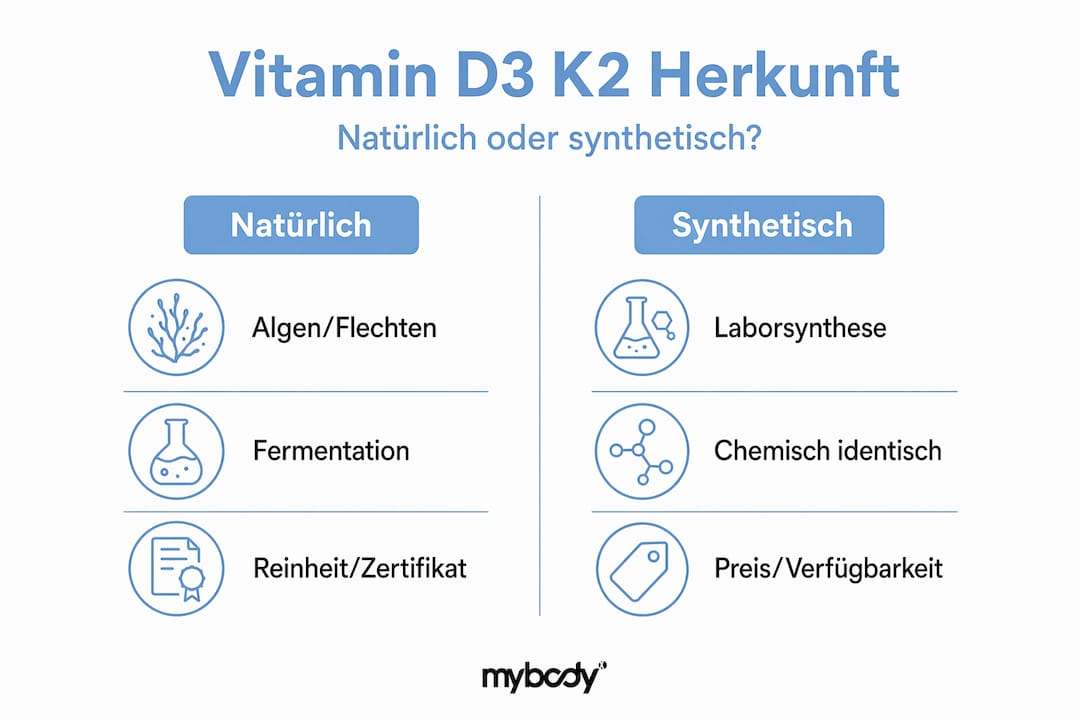
| Characteristic | Natural origin | Synthetic origin |
|---|---|---|
| Chemical identity | Identical (cholecalciferol) | Identical (cholecalciferol) |
| Bioavailability | Comparable | Comparable |
| Suitable for vegans | Often yes (algae) | Not always |
| Certifications | Organic, GMO-free possible | Rare |
| Price | Generally higher | Generally lower |
| Effectiveness | Dose-dependent | Dose-dependent |
Bioavailability depends primarily on the dose and dosage form, not on whether a vitamin was made from algae or in a laboratory. A vegan, organic-certified D3 K2 product is the right choice for some people for ethical or dietary reasons. That is legitimate. But it is not proof of greater effectiveness.
What can actually be relevant for natural products: purity and certification. Vegan, GMO-free products with a traceable supply chain provide greater transparency about what you are actually taking. This is a secondary but nevertheless useful criterion when choosing a product.
Vitamin K2 from fermentation, for example through the process behind MenaQ7® or vitaMK7®, has the advantage that the MK-7 form remains active in the blood for particularly long. MK-7 has a half-life of several days, while MK-4 (another form of K2) is broken down significantly faster. MK-7 is therefore more practical for daily supplementation.
Pro tip: When buying, pay attention to the form of K2: MK-7 from fermentation is better suited for daily use than MK-4 because it remains active in the body longer and lower doses are sufficient.
Practical tips for taking vitamin D3 K2
If, after reading this article, you have decided that supplementation makes sense for you, the next step is putting it into practice. Here are the most important points you should consider.
-
Check your levels first. Before you start taking it, have your 25(OH)D level measured in your blood. This is the only way to know whether you actually have a deficiency and how high your starting dose should be. Identifying vitamin D deficiency is the first step toward targeted supplementation.
-
Dosage based on risk and need. For adults with a confirmed deficiency, 1,000 to 2,000 IU of vitamin D3 daily is a usual starting range. High-risk groups may need higher doses under medical supervision. For K2, 100 to 200 micrograms of MK-7 daily is considered a well-tolerated range.
-
Timing of intake. Vitamin D3 is fat-soluble. Absorption improves when you take it with a meal containing fat. Whether morning or evening is better depends on your routine. You can find more information in the article about the best time to take it.
-
Be aware of interactions. Anyone taking blood thinners such as Marcumar or other anticoagulants should consult their doctor before taking K2. Vitamin K2 affects blood clotting and can alter the effect of anticoagulants.
-
Regular monitoring. Anyone who supplements over the long term should have their vitamin D level checked every three to six months. According to guidelines, routine testing in healthy people provides no additional benefit, but monitoring during active supplementation is useful for avoiding overdosing.
A specific example: A 45-year-old woman who works in an office, gets little sun, and notices mild fatigue has her vitamin D level tested. Result: 18 ng/ml, which is in the deficiency range. Her doctor recommends 2,000 IU of D3 daily combined with 100 micrograms of K2 MK-7, taken with lunch. After three months, her level is 42 ng/ml, and the fatigue has improved significantly. This is a targeted, sensible application.
My assessment of natural vitamin D3 K2
At mybody x, I see every day how many people buy supplements without knowing their actual needs. The word “natural” on the packaging makes people feel good, but it does not replace a needs assessment. What I have learned from working with our customers is this: The question is not “Which product is the most natural?” but “Do I need it at all, and in what amount?”
What really bothers me is indiscriminately taking high doses. I regularly see people taking 5,000 or even 10,000 IU every day without ever having had a lab test. That is neither natural nor safe. The effects depend on individual needs and lab values, not on the dose stated on the package.
My honest advice: Get tested first, then decide. Natural origin can be a sensible additional criterion, especially if you follow a vegan diet or care about purity. But the foundation of any good supplementation plan is knowledge of your own body, not the marketing on the box.
— MYBODY X
Your next step with mybody x
If you now know that targeted supplementation starts with laboratory values, the logical next step is to do exactly that. At mybody x, you can find vitamin D nutrient checks that you can conveniently perform at home. ISO-certified laboratory analysis, scientifically validated evaluation, and specific recommendations for your personal situation.

Instead of blindly buying a product, you will know exactly whether your level is within the healthy range or whether you actually need to supplement—and if so, at what dosage. More than 11,300 customers have already chosen this path. The test is simple, discreet, and provides results that are truly tailored to you. Find out which analyses are suitable for you and make your health decisions based on real data rather than marketing promises.
FAQ
What exactly does “natural vitamin d3 k2” mean?
The term describes vitamin D3 and K2 supplements whose active ingredients come from natural sources, such as D3 from algae and K2 through fermentation. Chemically, these vitamins are identical to synthetically produced variants.
Is natural vitamin D3 better than synthetic vitamin D3?
No. Natural and synthetic vitamin D3 are chemically identical, and their bioavailability is comparable. Natural sources may be preferred for vegan or organic diets, but they do not offer superior efficacy.
What are the benefits of combining vitamin K2 with D3?
Vitamin K2 activates proteins such as osteocalcin and MGP, which deposit calcium in bones and prevent vascular calcification. In combination with D3, K2 ensures that elevated calcium levels are distributed safely.
Who should really consider taking vitamin D3 and K2?
According to the Endocrine Society 2024, high-risk groups benefit most: children, pregnant women, older adults aged 70 and over, people with little sunlight exposure, and people with prediabetes. Healthy adults without risk factors do not need routine supplementation.
How much K2 should you take together with D3?
A well-tolerated range is considered to be 100 to 200 micrograms of MK-7 daily. The MK-7 form from fermentation is preferred because it has a longer half-life. If you take blood thinners, consult a doctor beforehand.



Share now:
Your microbiome test kit: A guide to gut health in 2026
Weight Gain During Menopause: Causes & Solutions 2026