
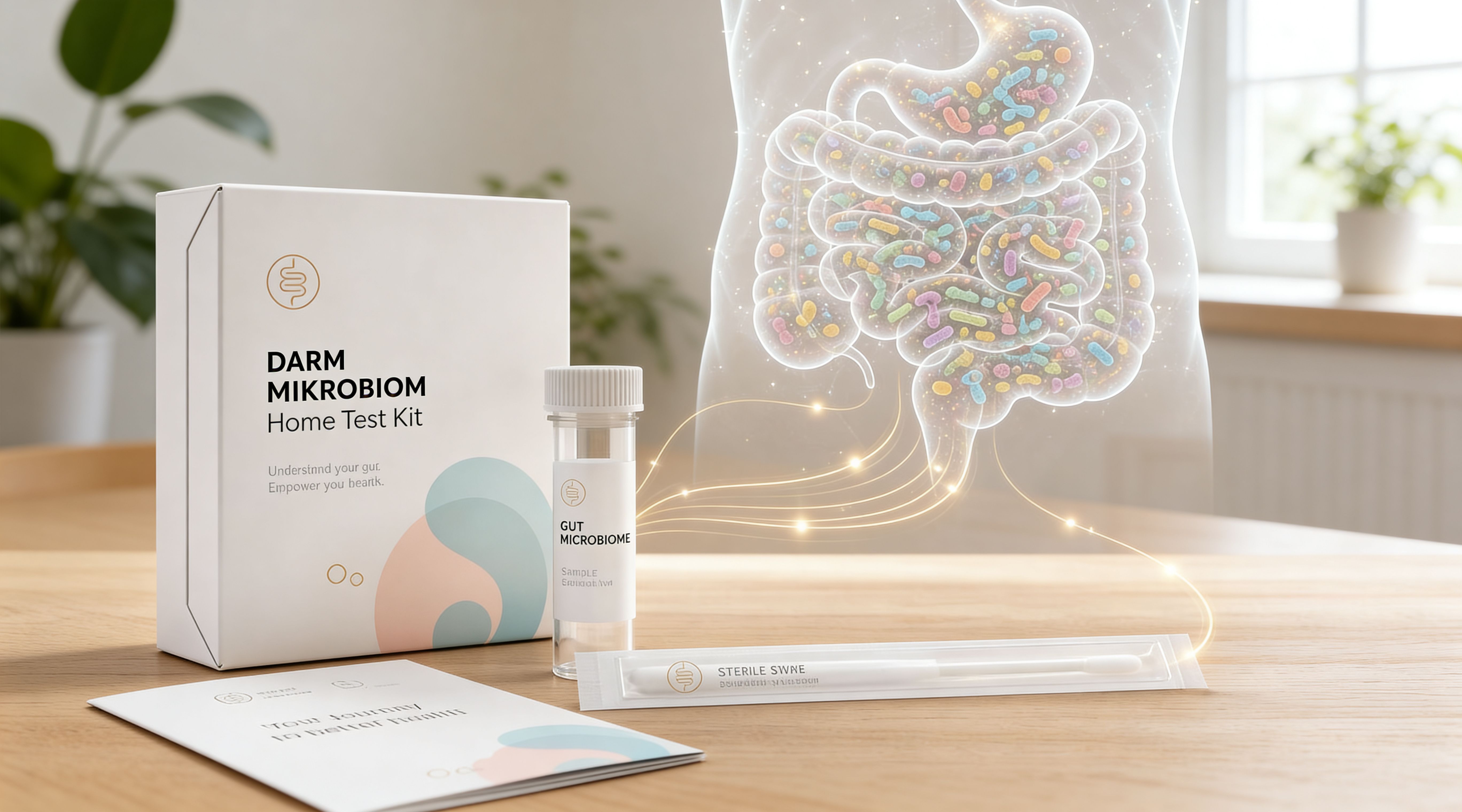
Your microbiome test kit: A guide to gut health in 2026
You pay attention to your diet. You exercise. You sleep reasonably well. And yet your body does not feel the way it should. Maybe your stomach is often bloated. Maybe you lack energy even though you are doing everything “right.” Or you notice during training that you are not making the progress you expect.
This is frustrating, but not unusual. Many people first notice in everyday life that something has become unbalanced. Not as a clear diagnosis, but as a vague feeling: Your gut seems to be working against you, your digestion is inconsistent, your concentration fluctuates, and general health tips only help to a limited extent.
This is exactly where a microbiome test kit becomes interesting. It is not magic and does not replace medical evaluation. But it can give you a much more precise view of what is currently happening in your gut. Instead of continuing to try different foods, routines, or supplements on a trial-and-error basis, you get a more informed foundation for your decisions.
Often feel less than fit? Your gut feeling might be right
It’s Monday morning. You had a proper breakfast, the day is planned, and yet you already feel sluggish before noon. After eating, your stomach feels pressured. In the afternoon, your energy drops again. You make an effort, but your body does not respond the way you would expect.
Many people experience exactly this kind of daily life. It often has less to do with willpower than with a lack of direction. General health tips are a good starting point. But they are not always enough to create noticeable changes, because your gut does not function according to the average person’s pattern, but according to your own.

Why the gut is so often underestimated
Your gut works like a team in the background. When everything is well coordinated, you barely notice it. When things go wrong, it often shows up not only in your digestion but also in your resilience in everyday life, when eating, or during training.
This includes your microbiome, meaning the community of microorganisms in your gut. If you want to better understand the basics, this introduction to the gut microbiome and its role in health can help.
A microbiome test kit can be useful at this point. It does not replace a medical diagnosis. But it can give you a structured starting point, so you no longer have to guess which foods, routines, or supplements might suit you.
Between a suspicion and a next step you can plan
A picture like this is typical:
- Your stomach reacts unpredictably. Sometimes everything is calm; other times, even normal meals are enough to cause pressure or bloating.
- Your energy fluctuates. You function, but you do not really feel stable or resilient.
- Despite your efforts, there is no progress. You take care of yourself, yet no clear improvement appears in your digestion, well-being, or performance.
A test is not a label saying “healthy” or “unhealthy.” It is more like a map before a journey. It does not take every step for you, but it shows where you are now and which direction might make sense.
That is the real value of this kind of data. You do not get a generic to-do list, but insights related to your situation that can later be translated into concrete decisions. That is what makes the difference between trying things at random and following a personal path toward more energy, calmer digestion, and better performance.
Other conditions affecting areas close to the body also show how little blanket advice can help. You can find an example here: Intimate area smells despite hygiene. The common point is simple. Understanding the cause better allows you to take more targeted action.
Understanding your microbiome and recognizing common gut problems
You can think of your microbiome as your own personal garden. In a well-maintained garden, everything does not grow wildly out of control. There is balance, diversity, and a stable environment. The same applies to the gut. Many different microorganisms live there, together forming a sensitive ecosystem.
When this balance is disrupted, many people refer to it as dysbiosis. This does not automatically mean illness. At first, it simply means that the composition of your gut environment may have become unbalanced.

What the microbiome means in everyday life
Your gut microbiome is closely connected to how food is processed. It influences how well certain components of your diet can be used. It is also part of a larger interplay with your immune system and your daily resilience.
If you want a simple introduction to the topic, the article What is the microbiome provides a good foundation.
One honest point is important here: Expert overviews point out that there is still no generally accepted “normal state” of the gut microbiome. Home tests are therefore considered primarily “informational only” and hypothesis generators for dietary and lifestyle adjustments, not standalone diagnostic tools (clinical limitations of microbiome tests).
Four typical patterns that many people recognize themselves in
Not every complaint originates in the gut. But many people are right to look there for answers.
-
The Bloating Type
You eat “healthily,” but vegetables, legumes, or whole grains in particular tend to make things worse. Your stomach looks noticeably fuller in the evening than in the morning, even though you have not eaten excessively. -
The Fatigue Type
You wake up feeling okay but regularly hit a slump during the day. Coffee helps only briefly. Variable digestion or a heavy feeling after eating often come along with it. -
The Performance Plateau Type
You have your training, routines, and diet in place. Even so, recovery remains difficult, or you never feel truly light and resilient. The gut is often considered as a factor only later. -
The Sensitive Type
You react to many foods without being clear about exactly what you are reacting to. Sometimes something goes well, sometimes it does not. This back and forth makes self-observation exhausting.
Gut-related complaints often do not occur in isolation. Many people first notice them through their energy, skin, resilience, or mood.
A related topic is that the body microbiome is not relevant only in the gut. If you want to understand why odor or microbial balance can also play a role in other parts of the body, the article Intimate Area Smells Despite Hygiene may be helpful.
Why self-observation only goes so far
A food diary can be valuable. Recording symptoms can also reveal initial patterns. But it remains an approximation. You see from the outside what you eat and feel. You do not directly see which microbes are present or what your gut profile currently looks like.
That is why a microbiome test kit is the next sensible step for many people. Not because it answers every question, but because it supplements your gut feeling with real data.
How a microbiome test kit for home use works so simply
Most people imagine laboratory analysis as something complicated. In practice, a microbiome test kit for home use is much easier to fit into everyday life. The process is usually discreet, quick, and well guided.

This is how the test works
At its core, it involves a small stool sample that you collect at home and send to the laboratory. There, the sample is analyzed using DNA-based methods.
A typical process looks like this:
-
Receive kit at home
You receive a test kit with instructions and sampling materials. -
Collect sample
Collection usually takes only a few minutes. -
Send sample
You then send it back to the laboratory. -
Laboratory analysis
The sample is analyzed there using sequencing. -
Receive report
You receive a report designed to make your microbiome easier to understand.
16S or shotgun: What is the difference?
This is often where things get technical, so here is a simple explanation.
| Method | What it broadly provides | What it is better suited for |
|---|---|---|
| 16S rRNA sequencing | Provides an overview of bacterial composition | If you want a general profile |
| Shotgun metagenomics | Analyzes more broadly and in greater detail | If you are looking for greater depth and a more comprehensive picture |
International consensus guidelines explicitly recommend amplicon sequencing such as 16S rRNA or whole-genome or metagenomic sequencing for microbiome profiling. Traditional cultures or PCR alone are not considered suitable substitutes for this purpose. At the same time, a market analysis forecasts growth in the “Gut Microbiome Testing Kit” segment from US$1.20 billion in 2025 to US$2.66 billion by 2035, more than doubling within ten years (Market development and technology in gut microbiome testing kits).
Why the Sample Chain Is So Important
Many people overlook what may be the most important point. It is not just the sequencing that matters, but the entire journey of the sample.
The preanalytical phase is crucial. Different collection systems, storage conditions, and even the analysis pipelines used can lead to significantly different results for identical samples. That is why clear standards for the entire process chain are essential (Importance of preanalytics in microbiome analyses).
Practical rule: A home test is always just a snapshot. The cleaner the collection process and the more standardized the procedure, the more reliable the result.
That is also why you should not focus solely on the price when choosing a provider. An inexpensive test is of little use if the sample chain is not properly organized.
From Data to Action – Interpreting Your Results Correctly
The report arrives. You open it. Then charts, bacterial names, and technical terms appear. This is exactly where many people give up. Yet this is where the useful part really begins.
A good report should not only show you which microbes are present, but also what you can take from this for your everyday life.

What you should really take away from a report
Many people first look at striking names or rankings. A more useful question is: What are the next steps for your diet and lifestyle?
Some reports discuss microbiome diversity, dominant groups, or markers that may be linked to your dietary habits. This is helpful when it leads to clear recommendations.
Many tests only detect which microbes are present, not what they do. More informative analyses that also consider functional metabolic pathways or clinical markers provide more direct guidance for actionable recommendations, especially for symptoms such as bloating or fatigue (comparison of gut microbiome test kits and their significance).
Making data practical for everyday life
Let’s consider three simple situations:
-
When your report suggests low diversity
Then the practical question may be whether your diet is too one-sided. Often, the answer is not radical restrictions but more variety in plant-based foods. -
When your digestion seems sensitive
Then it is worth taking a closer look at tolerability, portion sizes, eating patterns, and which fibers do you tolerate well and which may currently be too much. -
When you have symptoms rather than mere curiosity
In that case, tests that show not only biodiversity but also focus more on functional insights or clinical markers are more interesting.
A good test report does not just answer “What was found?” but above all “What will you do differently tomorrow?”
Examples of actionable changes
Microbiome data often lead to small, precise changes rather than spectacular ones. For example:
- More fermented foods such as yogurt or kefir, if they are well tolerated
- More targeted prebiotic fiber from foods such as oats, leeks, or asparagus
- More variety in plants instead of eating the same meals over and over
- Calmer testing instead of frantic changes to supplements or diets
This is where a microbiome test kit offers its real benefit. You can avoid some of the typical trial-and-error approach. Instead of blindly following trends, you work more systematically with what your body likely needs right now.
Choosing the right provider for your gut test
The market looks modern and simple at first glance. In reality, this is exactly where a little caution is advisable. Not every microbiome test kit offers the same quality, transparency, or interpretation.
How to recognize credibility
Numerous microbiome self-tests are available on the market in the EU without clear regulatory oversight, and their regulatory classification is often unclear. It is therefore important for consumers to look for transparent quality standards such as laboratory certifications (EU overview of microbiome self-tests and regulation).
In practice, this means: Don’t focus first on colorful graphics, but on the underlying conditions.
A simple selection checklist
-
Check laboratory standards
Does it clearly state which laboratory performs the analysis and which standards it follows? -
Understand the method
Does it explain whether a broad overview or more in-depth sequencing is used? -
Take data protection seriously
Health data is sensitive. Transparent information about data protection and data handling is essential. -
A report instead of raw-data chaos
The report should be easy to understand and enable concrete next steps. -
Interpreting symptoms
A reputable provider makes it clear that a home test does not replace a medical diagnosis.
Anyone who wants to compare different offerings objectively can find useful guidance in the article Microbiome Test Comparison.
When a provider is a better fit for you
If you’re simply curious about your gut profile, a clearly structured basic test is often enough. If, on the other hand, you want to better understand recurring symptoms, digestive stress, or unexplained fatigue, the quality of the interpretation matters more than a particularly attractive dashboard.
As an objective example among the available options, mybody x Gesundheit offers home tests in the field of gut health, with a stool sample collected at home and analyzed in a laboratory. What matters less is the packaging than whether you can derive concrete, understandable steps from the results.
Your path to optimized gut health starts now
You’re sitting at breakfast, eating sensibly, and yet your stomach still feels unsettled. Maybe you lack energy in the afternoon; perhaps you alternate between bloating, sluggishness, and the feeling that your body isn’t responding to good habits the way it should. At exactly this point, concrete data can help more than yet another general health tip.
A microbiome test kit gives you a starting point tailored to you. You not only see that something may be out of balance. You also get guidance on where to start in everyday life, for example with fiber, routines, recovery, or managing digestive stress. This turns an abstract laboratory analysis into a personal plan, step by step.
The real value lies not in the report alone. It lies in what you do differently afterward.
If you also want to strengthen your foundation, the article Building a healthy gut flora offers practical approaches that can easily be incorporated into everyday life. It is like following a training plan. Progress you can feel—in areas such as energy, digestion, and resilience—comes from combining an assessment of your current state with suitable habits.
You do not have to start perfectly. One clear first step is enough. When you can better interpret your own gut data, you often make calmer, more targeted decisions instead of repeatedly trying new recommendations that may not suit your body at all.
CTA: Get your personal analysis now with the mybody-x Microbiome & Leaky Gut Test. Discover the right solution for your gut health here: mybody-x Microbiome & Leaky Gut Test and Gut Health and Microbiome at mybody-x
Frequently asked questions about the microbiome test
How often should you take a microbiome test?
For many people, an initial test is enough as a starting point. If you then make targeted changes to your diet or routines, a later comparison may be useful. The exact timing depends on your goal and on whether you are testing out of curiosity or because of specific symptoms.
Is collecting the sample uncomfortable?
The sample is collected at home and is generally quick, discreet, and painless. That is one of the major benefits of an at-home test.
Can a test replace a diagnosis?
No. At-home tests are primarily information tools. They can provide insights and help you take a more informed approach to your diet and lifestyle. For medical diagnoses, you still need a doctor’s assessment if you have symptoms.
What should I do if I have symptoms despite living a healthy lifestyle?
Then you have not failed. Often, all that is missing is a more precise look at your own body. That is exactly where a microbiome test kit can be useful. It makes the good progress you have already made more concrete.
If you want to take a data-driven, practical approach to your health, mybody x Gesundheit offers at-home tests for the gut, blood, nutrients, and other areas that can help you better understand your body and take more targeted action.



Share now:
Understanding Antioxidants: Your Guide to Healthy Eating
Natural Vitamin D3 K2: What you really need to know