
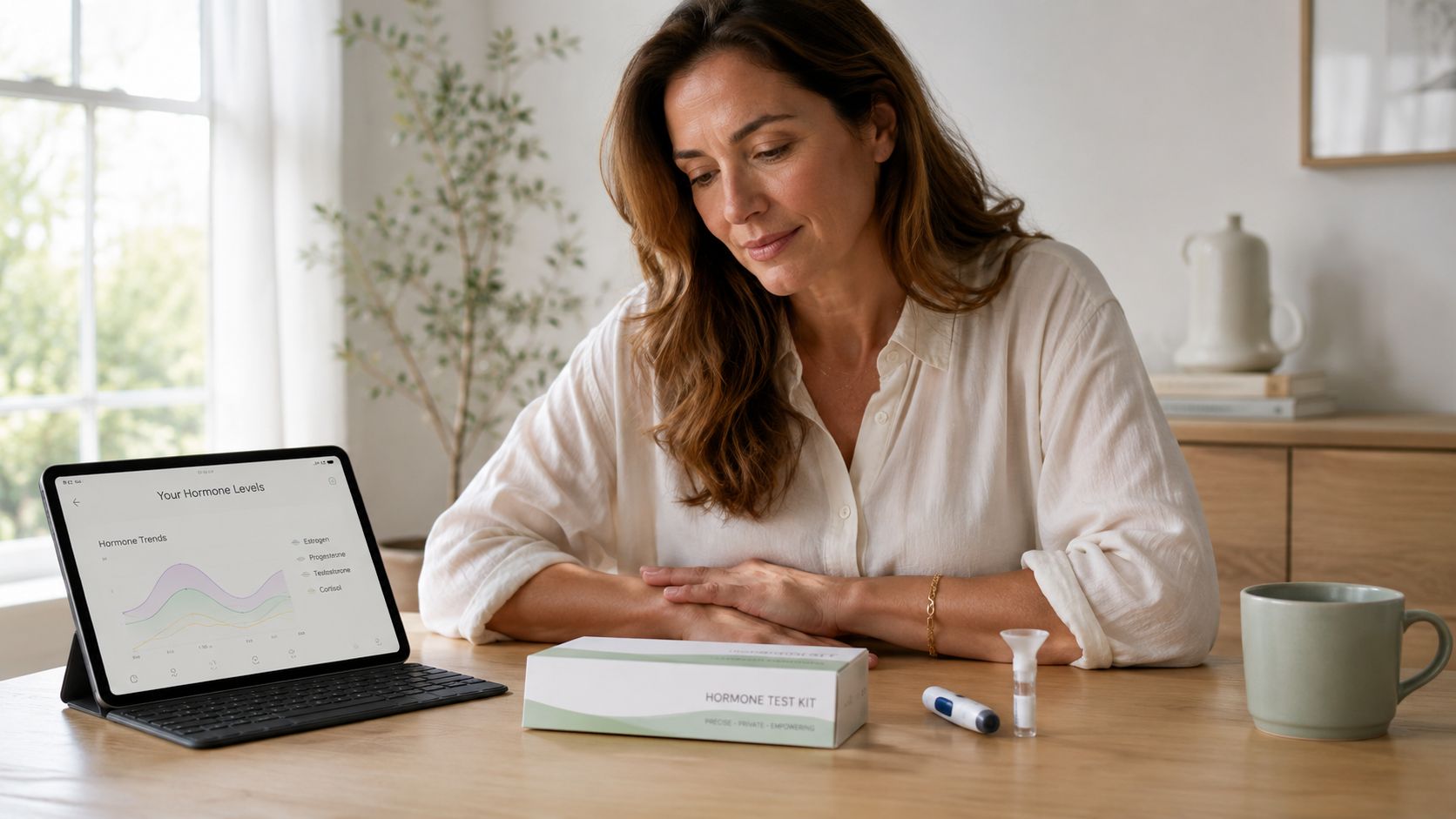
Menopause Hormone Test: Understanding Symptoms, Interpreting Values
You notice something is different. Not dramatic. More gradual. You suddenly sleep lighter, wake up more often, react more sensitively to stress, and wonder why your cycle isn't as reliable as it used to be. Perhaps you first think of too much work, too little rest, or simply getting older.
This is exactly when many women look for a menopause hormone test. Not because they suspect an illness. But because they want to understand what is happening in their body. That's an important distinction. Clarity reduces pressure. And it helps you decide on the next steps, not based on gut feeling, but more informed.
Is that still really you? When your body suddenly feels unfamiliar

You sit with your coffee in the morning and realize: nothing dramatic has actually happened. And yet you feel different than you did a year or two ago. You sleep more lightly, are more irritable, your cycle behaves unusually, and stress suddenly hits you much harder.
Many women experience exactly this already in their early 40s. The irritating part is that it often doesn't look like menopause as one typically imagines it. No clear hot flashes, no clear line. More like a body that feels familiar and foreign at the same time.
A common, often overlooked beginning is not primarily a sharp drop in estrogen, but an early decline in progesterone. We see this repeatedly in customer data. Women come with sleep problems, inner restlessness, stronger PMS, shorter cycles, or the feeling of being less emotionally stable. Many then suspect chronic stress, thyroid issues, or simply overwork. However, perimenopause could already be behind it.
When many small changes together form a picture
Progesterone acts in the body somewhat like the calming counterpart in the cycle. If this component declines earlier, not every lab value necessarily has to be significantly outside the normal range. Nevertheless, the balance can already shift. This is precisely why symptoms in this phase often feel so elusive.
Perhaps you know this. You are exhausted in the evening and still wake up at night. Before your period, you suddenly feel significantly more tense than before. Your cycle becomes shorter, fluctuates more, or announces itself with more breast tenderness, headaches, or irritability.
Each individual sign can still be explained away.
Together, they often form a pattern that should be taken seriously. Not out of alarm. But because early changes are easier to interpret if you don't play them off against your daily life, your age, or your stress levels for months.
You don't have to wait until symptoms are strong or clear to trust your perception.
A hormone test can help here because it provides more context to your feelings. It doesn't answer every question. But it can make visible whether diffuse discomfort is already due to a hormonal imbalance. Especially in perimenopause, this is important because not just a single hormone changes, but often several regulatory circuits begin to fluctuate simultaneously.
Why so many women don't believe themselves at first
Many women have been conditioned for years to associate menopause only with their late 40s or 50s. If changes start earlier, this often doesn't fit together internally. Then it's quickly said: I'm just more sensitive. I need to sleep better. I just need to pull myself together more.
However, perimenopause begins gradually for many women. And it starts individually. One woman first notices worse sleep. Another notices stronger mood swings. Another wonders about shorter cycles, more migraines before bleeding, or the feeling of no longer being as resilient as before. A good first orientation to such early signs of menopause can help to better classify one's own symptoms.
The most important thought in this phase is often very simple: you're not imagining it. Your body isn't sending confusing signals to annoy you. It's reporting that its internal adjustments are changing. That's where clarity begins.
The Hormone Orchestra in Menopause

If you only look at hormones as individual lab values, everything quickly becomes confusing. It becomes clearer if you see them as an orchestra. As long as the instruments play together, the whole thing sounds harmonious. In menopause, it's not just one note that goes out of tune. The entire interplay changes.
The main players in the interplay
The most well-known are estrogen and progesterone. Both influence the cycle, sleep, mood, and body sensation. Many women first think of declining estrogen when they think of menopause. That's true. But that's often not the whole story.
It is often overlooked that progesterone can become unbalanced early on. This is exactly what many women experience as the first silent shift. Then the absolute hormone levels are not necessarily "extreme," but the ratio no longer fits. This can feel like inner restlessness, poor sleep, or stronger mood swings.
In addition, there are FSH and LH. These hormones belong to the body's own control of the ovaries. When the ovaries work more irregularly, these signals also change. This explains why a menopause hormone test often considers several values and not just a single one.
Why a single value is rarely enough
Many women wish for a simple statement like: "Yes, you are in menopause" or "No, you are not." Unfortunately, the body rarely works that way. Especially in perimenopause, values can fluctuate. What seems consistent one day may look different in the next cycle.
This way of thinking is often more helpful:
- Not only the level counts. A value can be within the reference range and still be noticeable in relation to other hormones.
- Symptoms count too. Lab values without symptoms only tell part of the story.
- Trends are important. If your well-being changes, the development is often more telling than an isolated moment.
Rule of thumb: With hormonal complaints, it's rarely just about "too much" or "too little," but often about a shifted balance.
The often underestimated co-players
The hormonal picture includes more than just classic cycle hormones. Cortisol, DHEA, and testosterone can also shape the experience of this phase. If stress is high, many women feel symptoms more strongly. This doesn't mean that "everything is psychological." It just means that the hormone system works in a networked way.
An example from counseling practice: A woman feels exhausted, sleeps poorly, and becomes irritable more quickly. She initially thinks of lack of sleep or professional overload. In the background, however, there can be a complex pattern in which not only estrogen and progesterone, but also stress hormones are involved.
Therefore, it is worth not seeing a menopause hormone test as a search for the one culprit. Rather, it's like tuning an orchestra. You want to hear which instrument is too loud, too soft, or out of tune.
Blood test or saliva test – which is right for you?

You're 42, suddenly sleeping lighter, feeling restless just before your period, and wondering if this could be perimenopause. Your cycle might still be there, but somehow it's no longer reliable. This is exactly where the next question often arises: Which test will really help me now?
The honest answer is: blood and saliva don't measure the same thing in the same way. Therefore, the better question is not "Which test is better?", but "What information do I need right now?"
For the initial medical classification, a blood test is usually the clearer start. It shows what is currently measurable in the bloodstream and is well suited if you want to classify symptoms that are easily confused in early menopause. These include, for example, sleep problems, breast tenderness, shorter cycles, stronger PMS symptoms, or the feeling that you no longer feel hormonally "as you used to." This is especially important in early perimenopause, because not only estrogen and progesterone play a role. Depending on the situation, FSH, LH, testosterone, DHEA, prolactin or thyroid values can also be useful.
One point that always surprises in consultations: The first significant tipping point is often not a dramatic estrogen deficiency, but an early decline in progesterone. This fits many symptoms in the early 40s, even though bleeding may still seem regular. A blood test can help classify this pattern together with other values and symptoms.
The saliva test has a different strength. It often becomes interesting when it comes to free, biologically available hormone levels or daily fluctuations, especially for cortisol and partly also for DHEA. If stress, inner restlessness, early waking, or a significant drop in performance are at the forefront, this can be a useful addition. For women who are interested in this, this overview of the saliva test for hormones is helpful.
It is important to manage expectations for the test. A saliva test usually does not replace medical clarification if the question is: Am I in perimenopause, is the thyroid behind it, or is there another cause? A professional classification of the areas of application and limitations of saliva and blood measurements is also described in the specialist overview of saliva and blood tests in menopause.
As a simple guide, this distinction helps:
| Test type | More suitable for |
|---|---|
| Blood test | Initial classification of symptoms, broad view of several hormones, clarification of similar causes such as thyroid or prolactin |
| Saliva test | Additional questions about free hormone levels, daily profiles of certain hormones, especially for the stress axis or progress monitoring |
So if you're just starting out and want to understand why your body is changing in your early 40s, blood is often the more sensible first basis. If the basic question is already clearer and you want to specifically look at stress hormones or trends, saliva can be a good supplement.
Your path to hormone status with a home test
A home test often sounds technical at first to many. In practice, it's usually much simpler than you think. The key isn't doing everything perfectly. The key is preparing the sample well and collecting it at the right time.
The right timing makes all the difference
For women in perimenopause, the cycle day is crucial for the validity of a blood test. Blood collection is ideally done on days 2 to 5 of the cycle. In postmenopause, the measurement can be performed at any time. Such tests in Germany are usually a self-pay service and can cost over 150 Euros, as the laboratory notes on test timing and costs describe.
Why is this timing so important? Because hormones naturally fluctuate during the cycle. If you measure on a completely different day, you're easily comparing apples to oranges. Then the result becomes harder to interpret.
Here's how to proceed practically
If you're doing a home test, a small checklist helps:
-
Note your cycle
Write down the first day of your bleeding. This helps you determine the appropriate test day. -
Record symptoms
Note sleep, mood, hot flashes, cycle changes, or inner restlessness. This information will later help with the interpretation. -
Collect the sample calmly
Depending on the test, this is a small blood sample from the fingertip or a saliva sample. Read the instructions completely beforehand. -
Fill out all documents completely
Age, cycle status, and current symptoms are often just as important as the sample itself.
What to do with an irregular cycle
This is often where the problem lies. Many women ask themselves: "How am I supposed to hit day 2 to 5 if my cycle is already messed up?" In that case, a pragmatic solution helps. Take the test as close as possible to the beginning of actual bleeding. If bleeding occurs very rarely or not at all, the overall context of symptoms, life stage, and laboratory results becomes more important.
A concrete example from the market is the mybody®x hormone test for menopause. It is designed as a home test for an initial orientation on hormone status. Such offers can be useful if you are looking for clarity and want to keep the effort low. Nevertheless, it remains important: the test is a starting point, not a complete diagnosis.
Understanding and correctly interpreting your findings
You open your findings and see numbers, abbreviations, and reference ranges. On paper, it seems clear. In real life, it's often much less clear, especially in perimenopause from the early 40s, when hormones don't drop steadily but rather jump, stumble, and influence each other.
That's why the simple question "Is the value normal?" is usually only of limited help. More important is: Does the picture fit your cycle, your age, and your symptoms?
Read the findings like a pattern, not a school grade
Hormones work like an orchestra. If just one instrument gets louder or softer, the whole piece often sounds different. For many women, an early sign is not a clear estrogen deficiency, but a shift in balance. In actual customer data, one point that is easily overlooked always stands out: Progesterone often drops surprisingly early. This often happens before periods become completely irregular or classic hot flashes are prominent.
This explains why symptoms can look so different. You sleep worse, are more internally tense, wake up at night, react more sensitively to stress, or notice stronger PMS-like days than before. In such cases, a "still normal" individual value can be of little help if the balance of hormones is already out of sync.
Three questions are therefore helpful:
- Do the values match my symptoms?
- How do progesterone, estrogen, and other involved hormones relate to each other?
- Do my findings suggest fluctuations rather than a clear deficiency?
Why progesterone in particular is often the early indicator
Many women first look for an explanation via estrogen. This is understandable, but often falls short. In early perimenopause, it's not just estrogen and progesterone. FSH, LH, and depending on the symptoms, cortisol or thyroid values can also contribute to the overall picture. Nevertheless, in practice, a relative drop in progesterone often appears first.
It's a bit like a mobile. If one part becomes lighter, the whole balance changes, even if the other parts are still there. Estrogen may not even be particularly high. It just acts stronger in proportion because progesterone declines earlier. This is precisely what often leads to symptoms that are dismissed as non-specific for a long time.
An example that makes classification easier
A client in her mid-40s came in with sleep problems, inner restlessness, and the feeling of no longer recognizing herself. Her values were not in a range that seemed "dramatic" at first glance. However, the interplay of hormones was striking. Progesterone had already significantly decreased, while estrogen appeared stronger in proportion.
Such findings are not a label. They are more of an explanatory sketch. Suddenly, it becomes understandable why someone can be exhausted and tense at the same time, why the cycle is still there but still feels somewhat shifted.
A good finding doesn't just answer whether a value is within range. It explains why your body feels different now than it did two or three years ago.
What you can derive from the result for yourself
A hormone status is most helpful when you interpret it in conjunction with your life stage. There is no straight line between your early 40s and late menopause. Especially during perimenopause, fluctuations are typical. Therefore, a self-test is not a self-diagnosis. It can help you to better categorize your experience and to go into a conversation with a doctor, naturopath, or consultant well-prepared.
If you are unsure, read the findings in this order:
-
Symptoms first
Which two or three symptoms truly bother you in everyday life? -
Cycle context added
Are there still regular periods, shorter cycles, stronger PMS phases, or surprising skipped periods? -
Check ratios
Don't just look to see if a value is marked, but if the balance seems plausible. -
Consider early perimenopause
In the early 40s, symptoms are often not yet recognized as hormonal, even though the shift has already begun.
If you generally want to read lab results more confidently, the article on understanding blood values correctly and nutrition will also help you.
Medical guidelines emphasize individual assessment for symptoms during the transition to menopause. This is precisely the point. Your findings are not a judgment, but a piece of the puzzle. Only together with symptoms, cycle history, and your personal course does it form a picture that you can truly work with.
From knowledge to action: your next steps

A menopause hormone test only truly helps when you derive decisions from it. Not huge, perfect decisions. Rather small, smart steps that fit into your daily life.
What you can do with the result
If your results indicate hormonal shifts, you don't have to immediately turn everything upside down. Often, it's more sensible to target the areas that typically react most strongly to this phase:
-
Nutrition with a focus on balance
Many women benefit from consciously incorporating phytoestrogens like flaxseed or soy and reducing patterns high in sugar. -
Consider the nervous system
Magnesium and Vitamin B6 are often mentioned as building blocks when sleep, inner tension, or irritability are prominent. -
Do not treat stress as a secondary issue
If cortisol is involved, it's not very helpful to only look at cycle hormones. Stress reduction and good sleep hygiene should then be central, not peripheral. -
Individually check herbal support
Some women are additionally interested in adaptogens or other accompanying approaches. It is important not to do this blindly, but in a way that suits symptoms and the overall situation.
The doctor's appointment will be much better with good notes
Many people go to the doctor with a test result and then realize they've forgotten their actual questions. That's why a little preparation is worthwhile.
| What you should bring | Why it helps |
|---|---|
| Symptom list | Makes it clear how often and when symptoms occur |
| Cycle tracking | Shows whether changes seem systematic or random |
| Test results | Facilitates professional classification |
| List of questions | Prevents you from losing your train of thought during the conversation |
Practical step: Before the conversation, write down three things you want to understand. You don't need more than that to start.
Why your test is not an endpoint
A finding doesn't answer every question. But it can very clearly show where you should start. Some women primarily need relief in everyday life and better sleep. Others want to have a doctor check whether a therapy option is sensible. Still others want to observe first and measure again after some time.
It's important that you don't stay alone with your results. A sober laboratory value doesn't change anything yet. Understanding, classification, and actionable next steps do. That's where a menopause hormone test truly creates benefits for everyday life.
If you want to check your hormone status comfortably from home and better interpret the results, you can find self-tests for various health questions and accompanying information on the health portal at mybody x Gesundheit. This can be a sensible start if you want to understand your body better and take the next steps more informed.



Share:
Natural Vitamin D3 K2: What you really need to know
Menopause Weight Gain: Causes & Solutions 2026