

Food intolerance self-test: How to finally gain clarity
Do you suffer from constant bloating, unexplained fatigue, or skin problems and wonder what could possibly be causing them? A food intolerance self-test can conveniently provide you with valuable initial clues from home. Instead of continuing to grope in the dark, such a test offers a targeted way to finally get to the bottom of the potential triggers of your symptoms.
Finally find the cause of your symptoms
Does this sound familiar? You pay attention to your diet, exercise, and try to live healthily—but you still often feel simply not quite fit. Vague symptoms such as bloating, skin blemishes, or constant lack of energy can make everyday life difficult and seriously diminish your enjoyment of life.
Many people know this feeling. They try countless diets or avoid certain foods on a whim without anything really improving. This is not only frustrating, but often the wrong approach. The real cause could be a hidden food intolerance, in which your body reacts to certain food components only after a delay.

The first step toward greater clarity
This is where the crucial advantage of a modern self-test comes into play. Instead of waiting months for an appointment with a specialist or keeping a complicated food diary, you can take the first step yourself. A food intolerance self-test such as the one from mybody®x allows you to easily and discreetly collect a small blood sample at home.
This sample is then analyzed in a specialized, ISO-certified laboratory in Germany. The result provides you with a clear overview of which foods your immune system responds to by producing IgG4 antibodies.
Think of the test as a personal guide. It does not tell you what you can never eat again; instead, it gives you a sound basis for making targeted adjustments to your diet and actively improving your well-being.
How a test gives you back control
Knowing which foods could be responsible for your symptoms is the key to making a change. It frees you from constantly guessing and gives you back control over your health. You no longer have to give up entire food groups such as gluten or lactose across the board; instead, you receive a completely personalized evaluation.
A test can help you take targeted measures that truly make a difference. Instead of general advice, you receive specific guidance based on your own body’s reaction.
A food intolerance self-test is therefore more than just an analysis—it is your starting point for a more conscious life and a better sense of well-being. It empowers you to make informed decisions about your health and finally identify the cause of your symptoms instead of merely treating them.
The subtle but crucial difference: allergy or intolerance?
“I have some kind of allergy”—everyone has probably heard or said that at some point. Yet very often, the symptoms are not caused by a true allergy at all, but by an intolerance. The two terms are frequently mixed up in everyday life, but they describe two fundamentally different reactions in your body. Knowing this exact difference is the key to finally getting to the root of your problems.
A true food allergy is a direct and often quite severe attack by your immune system. Your body mistakes a harmless substance—say, a peanut protein—for a dangerous attacker and immediately triggers a full-scale alarm.
A food intolerance, also called an intolerance, is usually a metabolic problem. Your body simply cannot properly break down or process a particular component of food. The symptoms often develop gradually and are much subtler, but they can be all the more persistent and may become chronic.
Allergy: Your body’s loud fire alarm
The best way to think of an allergy is like an over-sensitive fire alarm. As soon as the supposed “enemy”—the allergen—enters the room, the siren goes off. Your immune system suddenly releases messenger substances such as histamine to fight the intruder with full force.
The reaction occurs promptly, usually within minutes and no more than two hours, and can be very severe:
- Skin: Sudden rash, itchy welts (hives).
- Airways: A runny nose, sneezing attacks, coughing, or even wheezing, progressing to shortness of breath.
- Mouth and throat: Tingling or itching, or swelling of the lips, tongue, and throat.
- Circulation: In the worst case, anaphylactic shock may occur—a life-threatening situation.
Intolerance: The silent saboteur in the background
An intolerance is a silent saboteur by comparison. The reaction is not a loud explosion but rather a quiet yet persistent barrage in the background. Symptoms often appear only many hours or even up to 72 hours after you have eaten the triggering food.
An intolerance primarily affects your digestive tract and overall well-being. Its symptoms are often so vague and chronic that it is almost impossible to catch the culprit in the act without a targeted test.
Typical signs of an intolerance tend to be subtle but debilitating:
- Digestion: Constant bloating, a feeling of fullness, abdominal cramps, diarrhea, or constipation.
- General well-being: Unexplained fatigue, headaches, migraines, or joint pain.
- Skin: Chronic skin blemishes, acne, or eczema that do not respond to any ointment or cream.
This knowledge is so crucial because a food intolerance self-test like the one from mybody®x specifically targets these silent saboteurs. It analyzes your body's reaction at the IgG level, which is associated with precisely these delayed immune responses.
Many people suffer from vague symptoms for years because they mistakenly assume they have an allergy, when an intolerance is actually the cause. The figures speak for themselves: Almost 30% of Germans believe they are sensitive to certain foods. Experts estimate, however, that only 3–7% have genuine allergies, while up to 20% are affected by intolerances. This gap shows how important education is, as you can also read in this article about the differences between allergies and intolerances.
A test can finally give you the clarity you need to identify the foods that are quietly affecting your well-being. You can also learn more about these fascinating figures in the patient information from the Association of Statutory Health Insurance Physicians in North Rhine.
Choose the right self-test for you
Do you feel that certain foods simply don’t agree with you, and do you finally want some clarity? That’s a great first step, because it means taking charge of your own health. But the market for a food intolerance self-test can quickly become overwhelming—there are so many methods and providers. So how do you find the test that’s right for you?
Don’t worry—we’ll shed some light on the subject. The goal is to make a decision tailored to your symptoms and everyday life. Not every test is the same, and the differences in scientific validity and effort involved are considerable.
The most common methods at a glance
To make it easier for you to decide, let’s take a closer look at the best-known methods. Each has its own strengths and weaknesses, and you should know what they are before you get started.
- IgG blood tests (such as the mybody®x test): These tests measure the concentration of IgG antibodies against a wide range of foods in your blood. An elevated level is a clear signal that your immune system is reacting to a particular food—often the cause of delayed symptoms such as bloating, headaches, or skin problems.
- Breath tests (for lactose/fructose): Here, you drink a special sugar solution, after which the hydrogen content in your breath is measured at regular intervals. If it rises, this is a strong indication that the sugar has reached the large intestine undigested—a classic sign of malabsorption.
- Elimination diet with challenge test: This is, so to speak, the “gold standard” of traditional nutritional counseling. You consistently remove all suspected foods from your diet for several weeks. If you feel better, you reintroduce them one at a time and carefully observe whether the old symptoms return.
Precisely because the symptoms can be so diffuse, it is important to know the difference between a true allergy (immediate reaction) and an intolerance (delayed reaction). This infographic helps you better classify your symptoms.
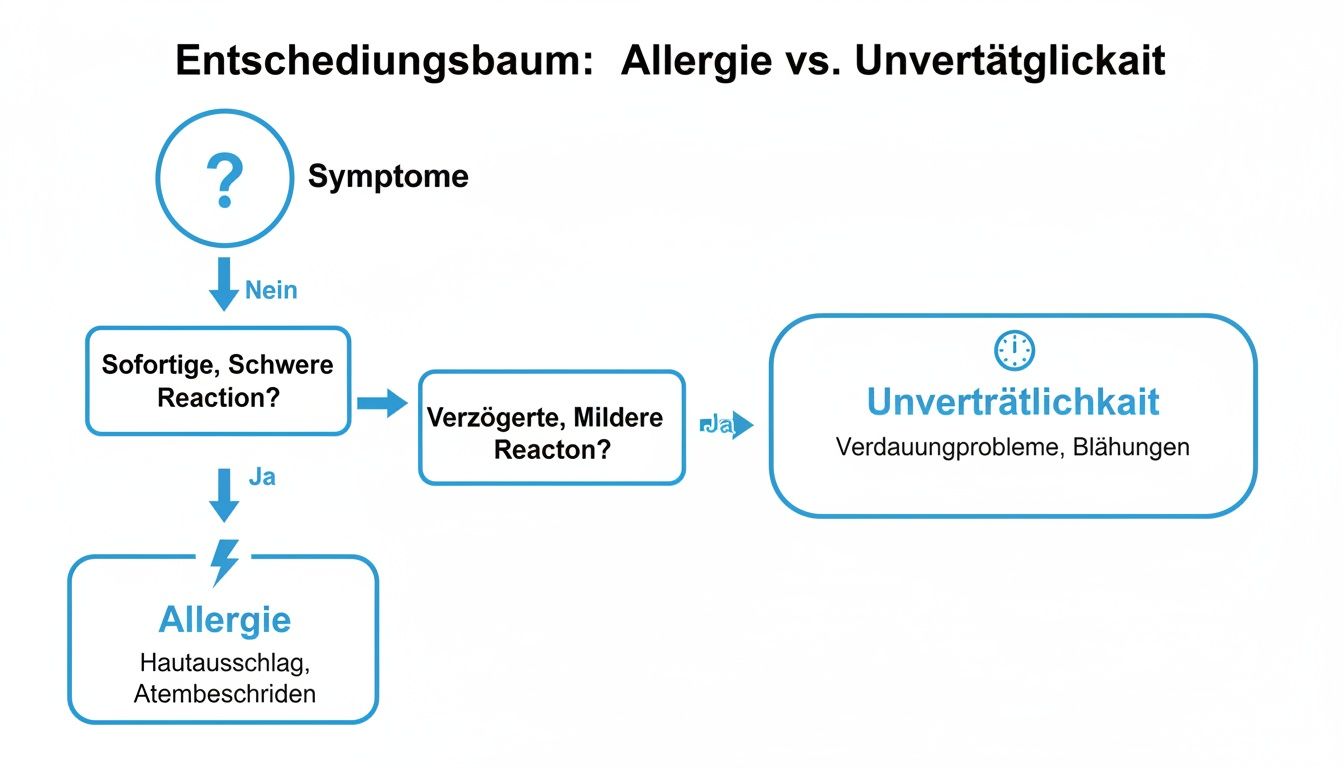
The graphic illustrates it quite well: while an allergy often strikes like lightning out of the blue, an intolerance is more like a gradual process that first needs to be uncovered.
Comparison of self-test methods for food intolerances
To make the decision even easier for you, we have compared the most important methods in a table. This overview compares the common self-tests and helps you find the best choice for your individual needs.
| Testing method | What is measured? | Procedure | Advantages | Disadvantages |
|---|---|---|---|---|
| IgG blood test | IgG antibodies against foods (immune response) | Small blood sample from the finger, conveniently collected at home | Comprehensive screening of many foods, clear, data-driven roadmap, time-saving | Scientific validity is disputed by some experts |
| Breath test | Hydrogen (H2) in the breath after consuming a sugar solution | Drinking a test solution, then blowing into a device several times | Established standard for lactose and fructose intolerance | Tests only specific types of sugar, not comprehensive, and may take several hours to complete |
| Elimination diet | Direct physical reaction to foods | Eliminating suspected foods for weeks, then reintroducing them individually | Considered highly reliable when carried out consistently | Extremely time-consuming, prone to errors, requires iron discipline, severely restricts social activities |
As you can see, each method has its place. For a broad, straightforward overview, the IgG test is often the most pragmatic starting point, while an elimination diet may be precise but is also a real challenge in everyday life.
Why a lab-based blood test is often the better choice
Although an elimination diet sounds logical in theory, it is extremely demanding in practice. It requires iron discipline, a meticulously maintained food diary, and can significantly disrupt your social life. And if you react to several foods at the same time, it becomes almost impossible to identify the real culprit.
This is exactly where a lab-based food intolerance self-test offers a decisive advantage. The mybody®x test uses precise blood analysis evaluated in an ISO 9001-certified laboratory in Germany. You take a tiny blood sample from your finger at home, send it in, and receive a detailed, scientifically grounded analysis.
This approach gives you a clear, data-driven roadmap. Instead of spending weeks groping in the dark, you receive a specific list of foods your body reacts to. This allows you to adjust your diet in a targeted and efficient way.
Quality and reliability as key criteria
The reliability of a test depends on the quality of the laboratory. With mybody®x, you can be sure that your sample is analyzed according to the highest standards. This guarantees results you can rely on—a solid foundation for all your next steps.
By the way, you are far from alone in your suspicions. Estimates suggest that around 20% of adults in Germany suffer from food intolerances. Lactose intolerance is particularly common, affecting approximately 15%, while fructose malabsorption affects 30% of people, although only a fraction develop symptoms. A survey showed that only 21% of those affected have a medical diagnosis—a huge proportion are searching for answers on their own.
A good test can help you break free from this uncertainty. If you are not yet completely sure which option is right for you, our guide "Which test is right for me?" offers further valuable guidance to help you decide. Ultimately, it is about choosing the path that gives you the clarity you need for greater well-being as quickly and reliably as possible.
How easy your self-test is
Have you chosen a food intolerance self-test from mybody®x? Great—this means you are already one big step closer to solving the mystery behind your symptoms! You may be wondering exactly how it all works. Don't worry, the entire process is designed to be so straightforward and clear that you can easily carry it out at home.
We will guide you and show you how easy the path to greater clarity about your body can be. You will see: it is simpler than you think.
Your path to results in 4 easy steps
The mybody®x testing process has been carefully designed from start to finish. From ordering to receiving your personal results, we have optimized every step to make it as safe and easy as possible for you.
1. Order and receive your test kit
Everything begins easily online. You order your mybody®x food intolerance test directly to your home. Within just a few days, you will have your personal test kit in your hands—discreetly packaged and equipped with everything you need to collect your sample.
2. Activate your test online
Before you get started, there is one very important step: activating your test. In your kit, you will find a unique test ID. Use this ID to quickly and easily register your test in the secure mybody®x customer portal. This is essential, because it is the only way your sample can later be anonymized while still being uniquely assigned to you. Data protection and security are our top priorities.
3. Collecting the sample—a small prick is all it takes
Now for the practical part—but don’t worry, it’s really quick and easy. Your test kit contains everything you need to collect a tiny blood sample from your fingertip.
Here’s a brief overview of what to expect:
- Preparation: Wash your hands thoroughly with warm water. This stimulates blood flow and makes everything even easier.
- Disinfection: Use the enclosed alcohol swab to clean the fingertip you have chosen for the prick.
- The prick: Use the sterile safety lancet provided to make a quick prick on the side of your fingertip. It’s a tiny prick that is barely noticeable.
- Collecting the blood: Now fill the sample tube with a few drops of blood. The kit is designed so that you can easily collect the required amount.
The entire process takes just a few minutes. No medical knowledge is required, and you can complete everything easily and stress-free in your familiar surroundings.
4. Send in your sample and wait for the results
As soon as you have collected the sample, pack it securely in the enclosed, prepaid return envelope. Simply drop it in the nearest mailbox—that’s it. Your sample will then head straight to our ISO-certified partner laboratory in Germany.
There, experts analyze your blood for IgG4 antibodies against a wide range of foods. The analysis is completed after just a few business days.
Your report in your personal portal
As soon as your results are available, we’ll notify you by email. You can then conveniently log in to your personal online portal and view your report.
Your result is far more than just a dry list. You receive a detailed, easy-to-understand report that shows you exactly which foods your body reacts to more strongly or weakly. At last, you have a clear, scientifically sound basis for making targeted adjustments to your diet and gradually regaining your well-being.
Use your results to improve your well-being
Congratulations, you’ve completed the most important step: you’re holding your personal report in your hands! This moment may feel a little overwhelming at first—a list of foods your body apparently reacts to. But look at it positively: this isn’t a verdict; it’s your personal roadmap to greater well-being.
Your result from the food intolerance self-test is the starting point for an exciting journey of self-discovery. This is not about radically overhauling your diet or giving up everything you love from one day to the next. Instead, it is about targeted, gradual adjustments that can make a huge difference.

Understand your results—the rotation strategy
Your mybody®x report generally shows different reaction levels. Instead of a strict “yes/no” classification, you get a much more detailed overview. This helps you set priorities. The most effective way to give your body a break and find out what is truly good for you is the so-called rotation diet.
The principle is surprisingly simple and sustainable:
- Elimination phase (the first few weeks): First, focus on the foods that showed the strongest reaction in the test. Avoid these completely for a certain period—often around four to eight weeks.
- Observation phase: During this time, you give your body a chance to recover. It is best to keep a small food diary to record how your well-being changes. Do you feel more energetic? Is your digestion calmer?
- Reintroduction phase (provocation): After the break, reintroduce the avoided foods one at a time and in small quantities. Observe very closely how your body reacts. This will help you find your personal tolerance threshold.
The goal is not lifelong restriction, but discovering your individual balance. You’ll often find that you can enjoy certain foods in moderation again without experiencing any discomfort.
Find delicious and creative alternatives
Changing your diet is the perfect opportunity to discover something new! You’ll be surprised by how varied and enjoyable your meals can be, even if you temporarily avoid certain foods.
A few simple examples:
- Instead of wheat flour: Why not try flours made from buckwheat, chickpeas, almonds, or coconut? They are ideal for baking bread, pancakes, or cakes.
- Instead of cow’s milk: The selection of plant-based alternatives is enormous. Oat, almond, soy, and coconut drinks taste great not only in coffee but also in muesli or smoothies.
- Instead of chicken eggs: When baking, flaxseed or chia “eggs” (ground seeds mixed with water) or simply applesauce can often serve as a binding agent.
This phase is your chance to get creative and broaden your culinary horizons. It is not about loss, but about genuinely enriching your meal plan.
Turning knowledge into habits
The key to long-term success is turning your new knowledge into established habits. It is alarming how many people suffer without realizing it. In industrialized countries, the prevalence of food intolerances is around 20 %. At the same time, nutrition reports show that 57 % of Germans consume dairy products every day, and 26 % consuming sweets every day—both common triggers for symptoms. This clearly shows how important it is to make conscious choices.
Start with small, manageable steps instead of trying to do everything at once. Plan your meals a few days in advance and make a shopping list. This takes the stress out of everyday life and helps you stay on track.
Your test is so much more than just a sheet of paper. It is a tool that empowers you to take responsibility for your health and build a deeper connection with your body. If you would like to explore the topic further, you will find many more practical tips in our guide to optimizing your diet after receiving your test results. Take this opportunity to enjoy a new, carefree outlook on life.
What you may still be wondering
You have now explored the topic in depth and are considering finally gaining clarity for yourself. Great! Nevertheless, a few last questions often come up just before taking the decisive step. That is completely normal.
That is exactly what this section is for: your honest starting point for clearing up the most common uncertainties. We have collected the questions we are asked again and again and answer them here for you—without any technical jargon. This way, you can make an informed decision and get started with confidence.
How reliable is an IgG self-test, really?
This is the most important question of all, and it is absolutely justified. An IgG test, such as the one offered by mybody®x, is an incredibly valuable tool. It provides you with initial, crucial clues about which foods could be behind your vague symptoms. The test measures very specific IgG antibodies in your blood, and an elevated concentration indicates that your immune system has reacted to a particular food.
It is important to understand: This is not a classic allergy (type IgE), which often triggers immediate and severe reactions. While the scientific debate about the exact clinical significance of IgG levels is still ongoing, practical experience speaks clearly: Thousands of people report a significant improvement in their symptoms after changing their diet based on the results.
Think of the test as an extremely precise compass. It shows you a clear direction to follow. You then find the actual confirmation yourself by deliberately avoiding the indicated foods and observing how your well-being improves.
The tests from mybody®x are evaluated exclusively in ISO-certified German laboratories. This guarantees extremely high analytical quality and precision. So you do not receive a vague estimate, but a solid, data-based foundation—the ideal guide for your personal dietary changes.
Do I have to avoid certain foods forever after the test?
This is one of the biggest concerns, but we can reassure you here: No, in the vast majority of cases, this is not necessary! A positive result in your food intolerance self-test is not a lifelong ban. Think of it instead as a snapshot of your body and an opportunity to give your digestive system a well-deserved break.
The recommendations you receive follow a clever rotation principle:
- The resting phase: First, you avoid the foods that caused a strong reaction for a limited time—usually just a few weeks. During this phase, your gut can calm down and regenerate.
- The testing phase: You then deliberately and gradually reintroduce these exact foods. You start with small amounts and carefully observe how your body reacts to them.
- The insight phase: It often turns out that your tolerance has improved significantly in the meantime. The goal is to find your very own personal tolerance threshold.
You may be able to tolerate a food again without any problems in small amounts or if you only eat it every few days. The goal is to find a varied and enjoyable long-term diet that is exactly right for you.
When should I see a doctor despite taking a self-test?
A self-test is a fantastic tool for taking charge of your well-being, but it does not replace a medical diagnosis for serious conditions. It is absolutely crucial to know when seeing a doctor is unavoidable.
Please be sure to see a doctor if you notice any of these symptoms:
- Severe, acute reactions: Sudden shortness of breath, swelling of the face or throat, severe skin rash (hives), or circulatory problems immediately after eating.
- Signs of celiac disease: Severe digestive problems combined with significant weight loss or iron deficiency.
- Blood in the stool: This is always a warning sign that requires immediate medical evaluation.
- Persistent, severe abdominal pain: When cramps and pain severely interfere with your daily life.
A food intolerance self-test is ideal for chronic, diffuse, and non-life-threatening symptoms such as constant bloating, unexplained fatigue, headaches, or skin problems. It can help improve your quality of life, but it is not a substitute for investigating serious illnesses.
How quickly will I notice an improvement?
This is, of course, a fascinating question, but the answer is as individual as you are. Your body is not a clockwork mechanism. Recovery time depends on many factors—how long you have had the symptoms and how consistently you change your diet play a major role.
However, many of our now more than 11,314 satisfied customers report their first positive changes within the first two to four weeks.
What you might notice:
- Better digestion: Constant bloating disappears, and the feeling of fullness after eating subsides.
- More energy: The leaden fatigue in the afternoon gives way to a feeling of strength and vitality.
- Clearer skin: Stubborn blemishes or redness may visibly improve.
- Fewer headaches: If certain foods were your triggers, migraines or tension headaches may become less frequent.
For some people, it can take up to eight weeks for the improvements to become clearly noticeable. The most important advice is: Be patient with yourself and your body. A food diary is a brilliant tool for tracking your progress objectively and seeing the connection between what you eat and how you feel in black and white.
Are you finally ready to gain clarity and take control of your well-being? At mybody®x, you’ll find the right laboratory-supported test to point you in the right direction.



Share now:
Constantly tired despite getting enough sleep: what’s really behind it
The most important vitamins for women: A comprehensive guide to your health